US Immigration Myths 2026: 9 Claims About Visas and Green Cards Checked Against Official Rules
By Visaora Editorial Team · Updated November 2026 · 11 min read
Quick Answer: No. Most popular US immigration claims fail at the same point: only US authorities decide. A visa never guarantees entry, marriage never grants an automatic green card, tourist visas never allow work, and no agent can promise approval. Nine widespread myths are checked below against official USCIS and State Department rules.
Disclaimer: Visaora provides software tools and general information, not legal advice. Rules change; always confirm with the official authority.
Key facts
- A visa lets you travel to a port of entry and request entry; CBP officers decide admission.
- Visitor (B-1/B-2) status never allows employment in the United States.
- Marriage starts a petition process; it does not grant status by itself — an approved Form I-130 alone gives no immigration benefit.
- A refusal under section 214(b) applies to that application only; you may reapply with a new application and fee.
- Overstaying voids your visa under section 222(g); 180+ days of unlawful presence can trigger a 3-year bar.
Fees are where myths turn into real money lost, because forum-based budgets regularly miss entire forms. Before planning around any claim, price your case with Visaora’s free USCIS fee calculator and keep each stage’s paperwork straight with the document checklist generator.
Table of contents
- Myth 1: Visa = guaranteed entry?
- Myth 2: Work on a tourist visa?
- Myth 3: Marriage = automatic Green Card?
- Myth 4: A refusal is forever?
- Myth 5: Paying extra = approval?
- Myth 6: DV lottery open to all?
- Myth 7: An agent can guarantee it?
- Myth 8: Short overstay harmless?
- Myth 9: Invitation letter secures it?
- Myth vs fact at a glance
- Check a claim before believing it
- Common mistakes
- Example scenario
- Frequently asked questions
Immigration advice travels faster than immigration law. A claim heard in a family group chat, repeated by an agent, or posted in a forum can sound settled — until it meets the one test that matters: what the US government itself publishes. This article takes nine of the most widespread claims about US visas and green cards and answers each one with the position published by the US Department of State or US Citizenship and Immigration Services (USCIS), fetched in November 2026.
Does a US visa guarantee entry?
Immigration advice travels faster than immigration law. A claim from a group chat, an agent or a forum can sound settled — until it meets the test that matters: what the US government itself publishes. Nine claims are answered below with the official position of the State Department or USCIS, fetched in November 2026.
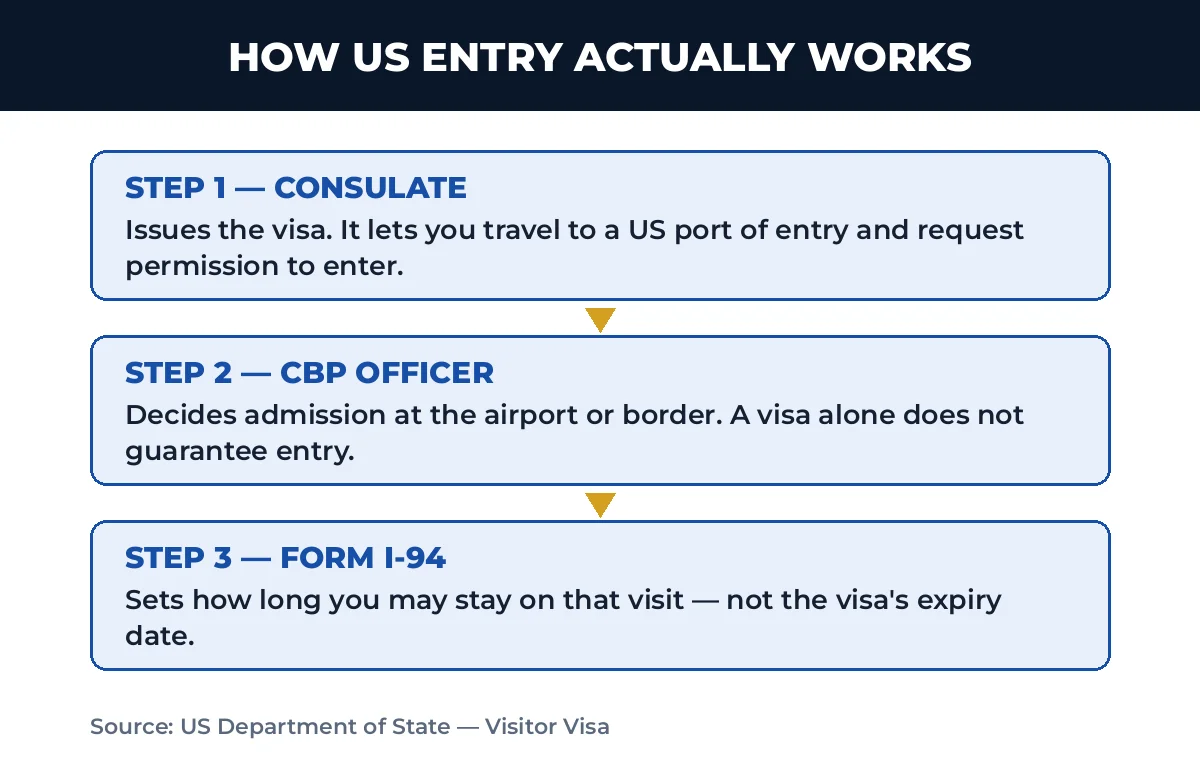
No. A visa gets you to the door; it does not open it. The Department of State explains that a visa lets you travel to a US port of entry and request entry — it does not guarantee it. The admission decision belongs to the Department of Homeland Security: CBP officials have the authority to permit or deny admission. If admitted, the officer’s stamp or Form I-94 sets the date you must leave. A visa can be valid for ten years while one visit is admitted for months: the visa controls when you may seek entry; the I-94 controls each stay.
Official source: US Department of State, Visitor Visa.
Can you work in the United States on a tourist visa?
No. Employment is expressly off-limits on a visitor visa. The State Department’s page lists what B-1/B-2 covers — meetings, conferences, negotiations, tourism, family visits, medical treatment — and what needs a different category. Employment tops that second list, and the page states it plainly: “An individual on a visitor visa (B1/B2) is not permitted to accept employment or work in the United States.” No exception exists for short jobs, trial shifts, or helping in a relative’s business. If the plan involves working, it needs a work-authorised category before travel. Our USA tourist visa documents checklist shows what the visitor route is actually for.
Official source: US Department of State, Visitor Visa.
Immigration agency? Qualify UAE leads free with Visaora Agency Leads → https://visaora.io/visaora-agency-leads/
Does marrying a US citizen automatically give you a Green Card?
No. Marriage opens a process; it does not deliver a status. A US citizen can petition for a spouse as an immediate relative, with no annual numerical limit — but the petition is step one. USCIS states on its Form I-130 page that filing is the first step, and that “the filing or approval of this petition does not give your relative any immigration status or benefit.” The spouse must still apply for the Green Card — Form I-485 adjustment if eligible inside the US, or consular processing abroad — and prove the marriage genuine with evidence of its bona fides: joint property, a shared lease, combined finances. Fiancé(e)s start differently: see our K-1 fiancé visa process guide.
Official sources: US Department of State, Family Immigration; USCIS, Form I-130, Petition for Alien Relative.
Does a visa refusal mean you can never apply again?
Usually not. A refusal under section 214(b) is for that specific application: the officer was not persuaded that you qualified, or that your ties abroad would compel you to leave after a temporary stay. There is no appeal and the closed case cannot be reopened — but the Department of State confirms you may reapply with a new form, fee and interview, ideally showing evidence of significant changes. Reapplying with an identical file invites an identical result. One caution: not every ground is forgiving. Fraud or willful misrepresentation under section 212(a)(6)(C)(i) is a permanent ineligibility unless a waiver is authorised. Our 214(b) refusal guide covers the reapplication logic.
Official source: US Department of State, Visa Denials.
Can paying extra fees speed up or guarantee approval?
Only through one narrow official channel — and it speeds a decision, never the outcome. USCIS premium processing, requested with Form I-907, is limited by USCIS’s own form page to Form I-129, Form I-140, certain categories of Form I-765 and certain classifications of Form I-539. Everything else has no premium option: no I-907 reaches a consular officer, and family petitions sit outside the list. Paying also changes nothing about eligibility — USCIS can still request evidence or refuse. Anyone selling a “paid fast-track” tourist visa or a guaranteed approval is selling something the system does not contain. Our USCIS fees guide separates real charges from invented ones.
Official source: USCIS, Form I-907, Request for Premium Processing Service.
Is the Diversity Visa lottery open to every country?
No. The lottery is deliberately closed to high-admission countries. The DV program serves natives of countries with historically low immigration to the US. Under the official DV-2026 instructions, natives of countries from which more than 50,000 people immigrated in the family- and employment-based categories during the previous five years cannot enter at all. The Department of Homeland Security recalculates annually, so the list changes: for DV-2026 it included Bangladesh, Brazil, Canada, China, India, Mexico, Nigeria, Pakistan, the Philippines, South Korea and others. Two narrow exceptions let some applicants claim a spouse’s or a parent’s country of birth instead. Entry is free — the State Department confirms there is no cost to register.
Official source: US Department of State, Instructions for the 2026 Diversity Immigrant Visa Program.
Can an agent or consultant guarantee your US visa?
No, because no agent holds any part of the decision. The Department of State states that “the sole authority to approve or deny visa applications is given to consular officers at U.S. Embassies and Consulates”; USCIS decisions likewise rest with USCIS officers. An agent can complete forms and organise documents, but holds no quota, channel or promised outcome. State’s DV guidance makes the same point: it strongly encourages entrants to enter themselves, without a “Visa Consultant” or “Visa Agent”, and keep their own confirmation number. A guarantee is a warning sign, not a premium service — and if an agent submits false documents in your name, the resulting misrepresentation ineligibility attaches to you, permanently.
Official sources: US Department of State, Visa Denials; US Department of State, Diversity Visa Program – Submit an Entry.
Is overstaying by a few days harmless?
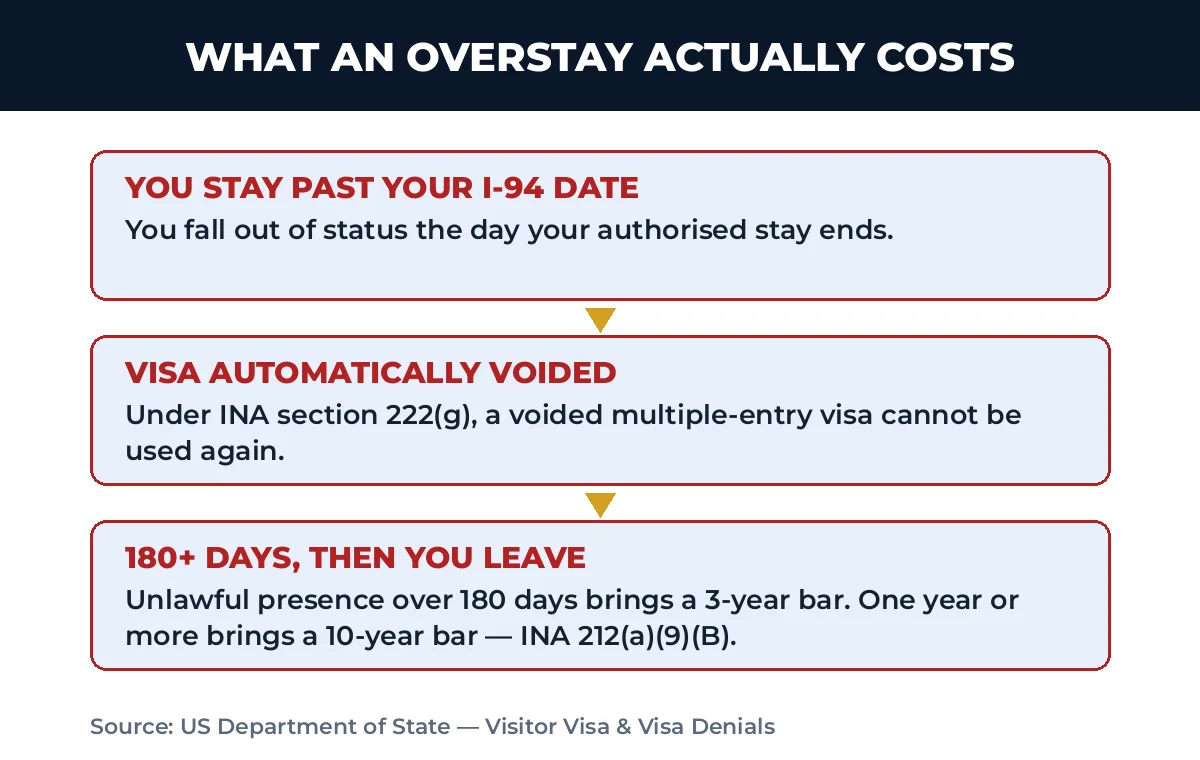
No. Even a short overstay kills the visa you travelled on. The visitor visa page warns that failing to depart on time leaves you out of status, and under section 222(g) the visas of people who are out of status are automatically voided; a voided multiple-entry visa is not valid for future entries, and overstaying may also affect future eligibility. Longer overstays escalate: time beyond your authorised stay is unlawful presence, and under section 212(a)(9)(B), more than 180 days followed by departure brings a 3-year bar, while a year or more brings a 10-year bar. A few days triggers no bar — but still voids a visa you may have used for years.
Official sources: US Department of State, Visitor Visa; US Department of State, Visa Denials.
Will an invitation letter from a US host secure your visitor visa?
No. The Department of State says the letter is not a deciding factor at all. Visitor applicants must qualify on their own ties, not on assurances from US family and friends. A letter of invitation or Affidavit of Support is not needed to apply — and if you bring one, the Department states it “is not one of the factors used in determining whether to issue or deny the visa.” A polished letter cannot substitute for your own employment, home and family ties. It does no harm in the file; it carries none of the weight letter-writing services claim.
Official source: US Department of State, Visitor Visa.
Myth vs fact: the nine claims at a glance
| The myth | What official sources say |
|---|---|
| A visa guarantees entry to the US | CBP decides admission; the I-94 sets your stay |
| You can work on a tourist visa | Employment is prohibited on B-1/B-2; a work category is required |
| Marriage means an automatic Green Card | The I-130 is only step one; alone it gives no status |
| A refusal ends your chances forever | A 214(b) refusal covers that application only; reapplying is allowed |
| Paying extra speeds up or guarantees approval | Premium processing (I-907) covers only I-129, I-140, some I-765/I-539 |
| The DV lottery is open to every country | Countries over the 50,000 threshold are excluded; list changes yearly |
| An agent can guarantee your visa | Only consular and USCIS officers decide; nobody else has authority |
| A few days of overstay is harmless | Overstaying voids the visa (222(g)); longer stays bring 3-/10-year bars |
| An invitation letter secures a visitor visa | State says it is not one of the factors used in the decision |
How do you check an immigration claim before you believe it?
- Ask who owns the decision. Consulates decide visas, USCIS decides petitions, CBP decides admission. A claim bypassing all three is a rumour.
- Find it on a .gov page. Official positions live at travel.state.gov and uscis.gov. A rule found on neither is unverified.
- Demand the form number. Real fees attach to named forms — I-130, I-485, I-907. A charge with no form behind it is invented.
- Check the date. Fee schedules, DV lists and rules change. Confirm you are reading the current version.
- Watch for guarantee language. No official page promises approval or a lottery win; “guaranteed” identifies the seller, not the rule.
- Price it yourself first. Run the official fee schedule before paying anyone, so every quote can be compared with the government’s.
Common mistakes
- Reading the visa’s expiry date as your allowed stay. Your stay ends on the date in your stamp or Form I-94 — often far earlier.
- Booking non-refundable travel before the visa is issued. The State Department warns there is no guarantee of issuance — make no final plans or purchases until you hold the visa.
- Reapplying after a refusal with an identical file. A 214(b) reapplication should show significant changes; the same evidence usually earns the same refusal.
- Letting an agent keep your DV confirmation number. Without it you cannot check selection results. Enter yourself, as State urges, and keep the number.
- Assuming a pending family petition lets you live or work in the US. An approved I-130 alone gives no status; the Green Card application is separate.
Example scenario: how the myths collide in one case
Hypothetical example: Ahmed, a fictional applicant in Dubai, builds his plan on three beliefs. His brother married a US citizen and now holds a Green Card, so marriage seems automatic. An agent offers a “guaranteed” visitor visa for a large fee. Ahmed plans to arrive as a tourist, find work after landing, and overstay a few weeks if needed.
Each belief fails at a checkpoint. The agent cannot guarantee anything — only a consular officer adjudicates. Even with a visa, CBP decides entry and his I-94 fixes his stay. Working on it is prohibited, and overstaying would void the visa under section 222(g), damaging future applications. The workable version is slower but real: the correct petition or work-visa route, fees budgeted upfront.
Frequently asked questions
Does a US visa guarantee entry?
No. The Department of State states that a visa only allows you to travel to a US port of entry and request permission to enter. Customs and Border Protection officials there decide admission. If admitted, your stamp or Form I-94 — not the visa — sets how long you may stay.
Can I work in the US on a B-1/B-2 visitor visa?
No. Employment is on the State Department’s list of activities that cannot be done on a visitor visa, and the Department states plainly that a visitor may not accept employment or work in the United States. Meetings and conferences are allowed on B-1; a job requires a work-authorised category.
I was refused a US visa once. Can I apply again?
Usually yes. A refusal under section 214(b) applies to that specific application and is not permanent. There is no appeal, but you may reapply with a new form, fee and interview, ideally showing significant changes in your circumstances. Other ineligibilities, such as fraud, are permanent unless waived.
Does premium processing guarantee petition approval?
No. Premium processing (Form I-907) only speeds up processing, and only for the forms USCIS lists: I-129, I-140, certain I-765 categories and certain I-539 classifications. It changes no eligibility standards, cannot be used for consular visas, and USCIS can still refuse. It buys a faster decision, not a favourable one.
Is the Diversity Visa lottery open to every country?
No. The program is for natives of countries with historically low US immigration. Under the DV-2026 instructions, natives of countries that sent more than 50,000 family- and employment-based immigrants in the previous five years — including India, Pakistan, China and Mexico — were not eligible. DHS recalculates annually.
What happens if I overstay my US stay by a few days?
Even a short overstay has consequences. Failing to depart on time leaves you out of status, and under section 222(g) your visa is automatically voided for future trips. Longer overstays add unlawful-presence bars: over 180 days can mean a 3-year bar after departure; a year or more, a 10-year bar.
Sources
- US Department of State — Visitor Visa
- US Department of State — Visa Denials
- USCIS — Form I-130, Petition for Alien Relative
- USCIS — Form I-907, Request for Premium Processing Service
- US Department of State — DV-2026 Program Instructions
Visaora provides software tools and general information, not legal advice. Rules change; always confirm with the official authority.
✈️ Planning Your Trip?
We may earn a commission — at no extra cost to you. Learn more