K-1 Fiancé Visa Process 2026: Steps, Fees, Timeline and Requirements
The k1 visa exists for one situation: a US citizen wants to marry a partner who lives abroad, and the wedding will happen in the United States. It brings your fiancé(e) to the US, gives you 90 days to marry, and then turns into a Green Card application without your new spouse leaving the country.
This guide covers the route in order — who qualifies, the petition, the embassy stage, fees, timing, and the mistakes that stall cases. Every figure comes from USCIS or the Department of State, checked in November 2026.
Quick Answer: The K-1 visa lets a foreign-citizen fiancé(e) of a US citizen enter the United States to marry within 90 days. The citizen files Form I-129F with USCIS, the case moves through the National Visa Center to an embassy interview, and after the wedding the spouse applies for a Green Card with Form I-485.
Visaora provides general information, not legal advice. Rules change; always confirm with the official embassy, consulate or government website before you apply.
By Visaora Editorial Team · Updated November 2026 · 12 min read
Key facts (checked November 2026)
- The petitioner must be a US citizen — green card holders cannot petition for a fiancé(e).
- You must have met in person within the 2 years before filing; a waiver exists only for extreme hardship or strict, long-established customs.
- Form I-129F petition fee: $675 (USCIS fee schedule).
- K visa application fee: $265 per applicant, including each K-2 child (Department of State).
- The marriage deadline is 90 days from entry — K-1 status cannot be extended.
- After the wedding, Form I-485 costs $1,440 (paper filing, age 14+).
Contents
- What is the K-1 visa?
- Eligibility requirements
- Step-by-step process
- Fees in 2026
- How long it takes
- Documents checklist
- K-2 visas for children
- Working on a K-1 visa
- K-1 vs CR-1 spouse visa
- Refusal and delay reasons
- Mistakes to avoid
- Frequently asked questions
What is the K-1 visa and who is it for?
The K-1 is a nonimmigrant visa for the foreign-citizen fiancé(e) of a US citizen. The label misleads: the holder fully intends to immigrate, which is why K-1 applicants must also meet some immigrant visa requirements. The visa does one job — it lets your fiancé(e) travel to the US for a single entry so you can marry there.
It suits couples who are not yet married and plan to wed in the United States. If you have already married, or plan to marry abroad, the spouse (immigrant visa) process applies instead. It is also unavailable if your fiancé(e) already resides legally in the US. Our guide to the difference between a visa and a Green Card explains why the K-1 is a travel document, not residence.
Start with the paperwork. Build your list with the free document checklist generator before either of you pays a fee.
K-1 eligibility requirements
USCIS lists four core requirements, and all four must hold at once:
- The petitioner is a US citizen. Only citizens can file Form I-129F for a fiancé(e); permanent residents cannot use this category.
- You both intend to marry within 90 days of admission, genuinely — a real life together, not a marriage only for an immigration benefit.
- You are both legally free to marry, at filing and ever since; any previous marriage must have ended by divorce, annulment or death.
- You met in person at least once within the 2 years before filing. A waiver exists only if meeting would violate strict, long-established customs of your fiancé(e)’s culture, or cause you extreme hardship.
The marriage must also be legally possible in the state where you will marry. Met through an international marriage broker? Extra I-129F disclosure rules apply — read them first.
Immigration agency? Qualify UAE leads free with Visaora Agency Leads → https://visaora.io/visaora-agency-leads/
Step-by-step: the K-1 process from petition to entry
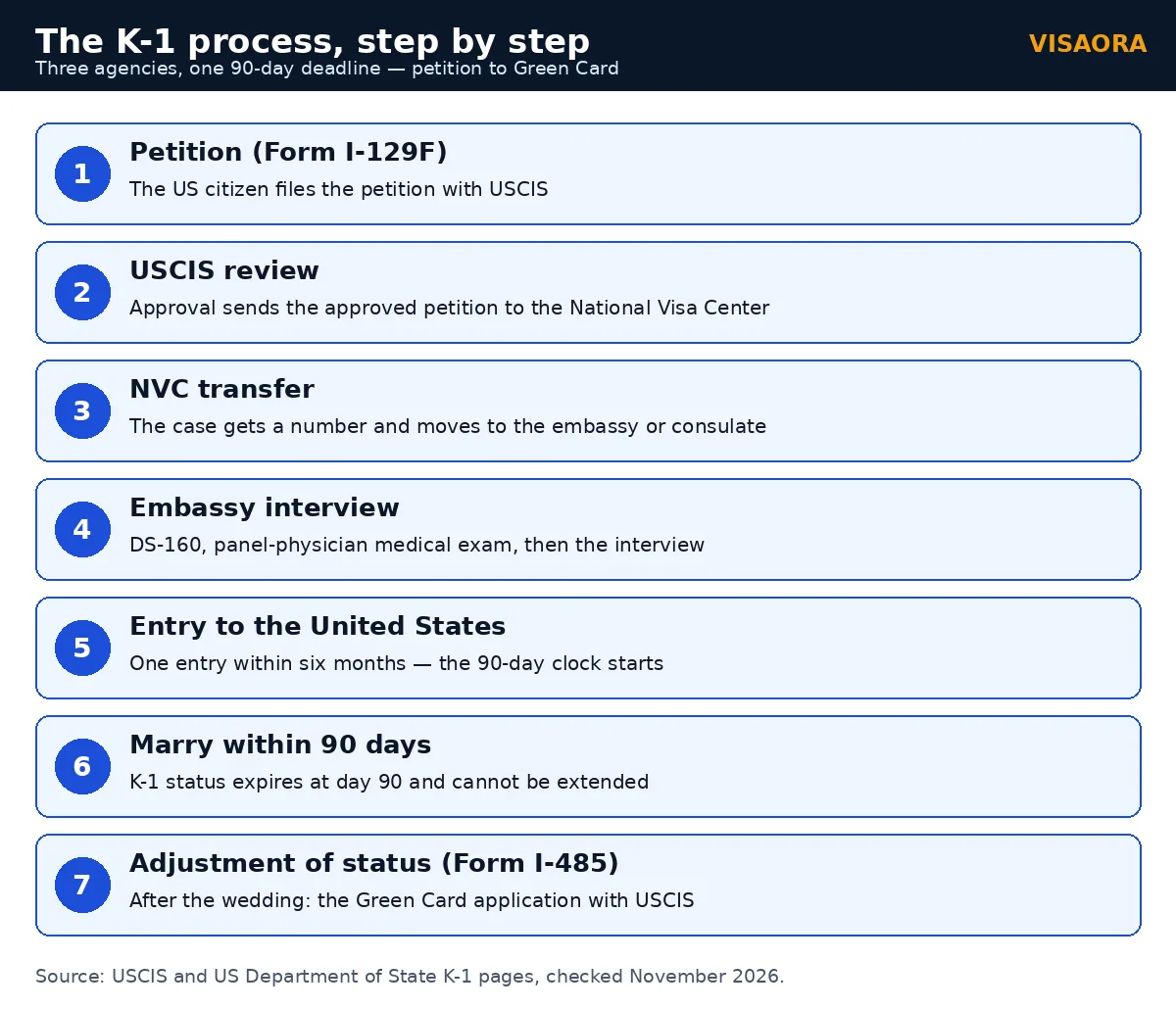
Three agencies handle the case in sequence — USCIS, the Department of State, and Customs and Border Protection.
- File Form I-129F with USCIS. The citizen files the Petition for Alien Fiancé(e) at the Dallas lockbox, with proof of citizenship, evidence of your meeting and your intention to marry within 90 days, and one recent passport-style photo of each of you. Sign the form — USCIS rejects unsigned forms.
- USCIS decides the petition. It may mail a request for evidence if something is missing. On approval, it sends the petition to the National Visa Center; an approved petition is valid for four months.
- The National Visa Center (NVC) transfers the case, giving it a number and forwarding it to the embassy or consulate where your fiancé(e) lives.
- Your fiancé(e) applies for the visa: Form DS-160 online, the embassy’s own K-case instructions, and the checklist documents below.
- Medical examination and interview. Every applicant needs a medical examination with an authorised panel physician. At the interview, the officer tests whether the relationship is genuine and may ask for financial support evidence, such as Form I-134 from the citizen.
- Entry to the United States. The visa allows one entry within six months. Your fiancé(e) receives a sealed packet — only the official at the port of entry may open it. A visa never guarantees admission; the CBP officer decides.
- Marry within 90 days of admission. There is no extension.
- Apply for the Green Card. Your spouse files Form I-485 with Form I-864, Affidavit of Support, from you; USCIS usually interviews you both. If married under two years at approval, the card is conditional for two years; Form I-751 removes the conditions later. Our free I-485 cover letter generator helps organise it.
How much does a K-1 visa cost in 2026?
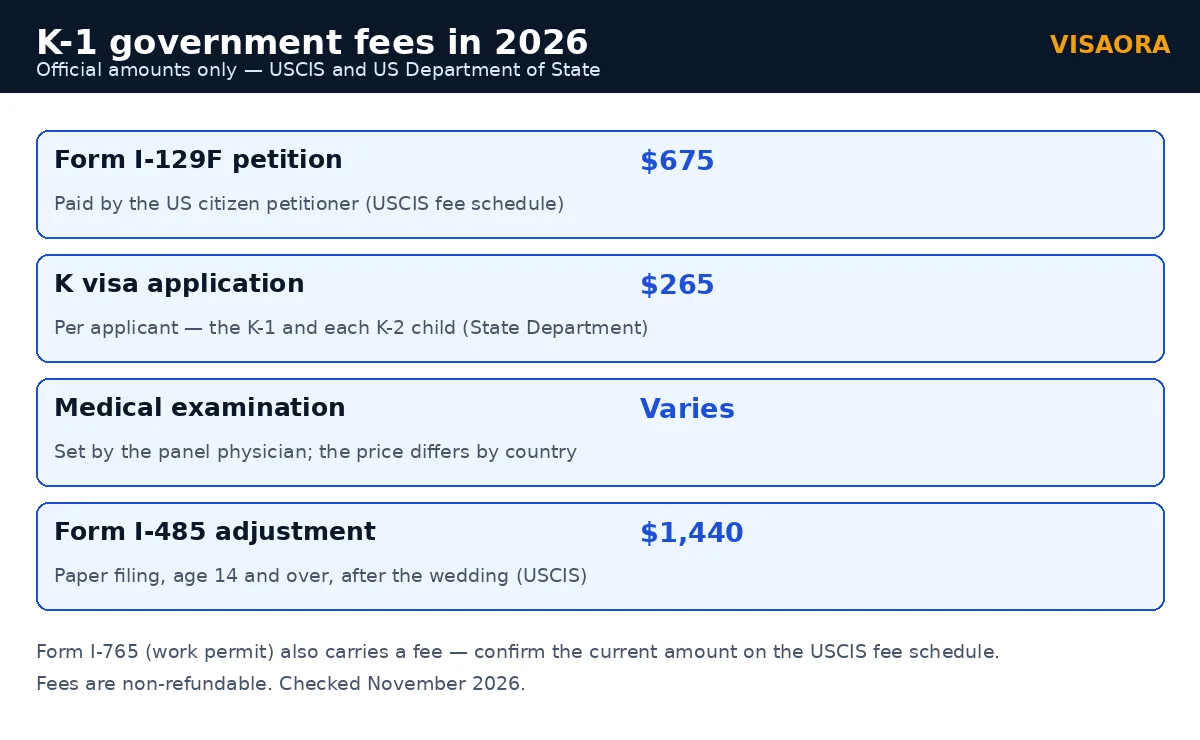
The fees are split between USCIS and the Department of State and charged at different stages. Amounts from the official fee pages, checked November 2026:
| Stage | Fee | Notes |
|---|---|---|
| Form I-129F petition (USCIS) | $675 | Paid by the US citizen petitioner when filing; non-refundable |
| K visa application (Department of State) | $265 | Per applicant — the K-1 applicant and each K-2 child |
| Medical examination | Varies | Panel physician sets it; varies by post — confirm on the embassy page |
| Form I-485 adjustment of status (USCIS) | $1,440 | Paper filing, applicant aged 14 or over; filed after the wedding |
| Form I-765 work authorisation (optional) | Fee applies | Confirm the current amount on the USCIS fee schedule |
The State Department also lists smaller real costs: translations, photocopies, document fees, travel to the embassy. USCIS fees are non-refundable even if refused, and the wrong fee means rejection — check your category with the free USCIS fee calculator on filing day.
How long does the K-1 visa take?
There is no honest single number. USCIS processes petitions in the order received and publishes current Form I-129F processing times by service center on its processing times page.
The consular stage runs on the embassy’s timetable, which varies by post. Cases slow down when applicants follow instructions loosely or send incomplete information, and some need further administrative processing after the interview. Two windows matter for planning: the approved petition is valid for four months (a consular officer can extend it), and the issued visa gives up to six months to travel. The only fixed deadline is the last one — marry within 90 days of entry.
Documents checklist
The file splits in two: the petitioner’s USCIS bundle, and the applicant’s embassy bundle. Foreign-language documents need a full English translation with the translator’s certification.
| Stage | Documents |
|---|---|
| Petition (I-129F) | Proof of US citizenship (birth certificate, naturalization certificate, CRBA or unexpired passport); divorce, annulment or death certificates for previous marriages; one passport-style photo of each partner (within 30 days); evidence of meeting in person within 2 years; evidence of intent to marry within 90 days; name-change evidence if applicable |
| Embassy interview | DS-160 confirmation; passport valid 6+ months beyond the intended stay; birth certificate; divorce or death certificates for both partners’ previous spouses; police certificates from every country lived in 6+ months since age 16; medical examination; relationship evidence; financial support evidence (Form I-134 may be requested); two 2×2 photos |
Visiting first instead? Tourist trips use a different file — see the US tourist visa documents checklist.
K-2 visas for children
Eligible children of a K-1 applicant receive K-2 visas. A child qualifies if under 21 and unmarried, and the US citizen must list them on the Form I-129F — no separate petition needed. Each child files their own application and pays the $265 fee; children aged 16 or over also need police certificates.
Children may travel with the K-1 parent or follow later, but never before them. Follow-to-join travel must happen within a year of the K-1 visa’s issuance; later needs separate immigrant petitions. After the wedding, each child files their own Form I-485 (never on the parent’s application) and must remain unmarried. One timing trap: for a child to adjust as a stepchild, the marriage must take place before the child’s 18th birthday.
Can you work on a K-1 visa?
Not on the K-1 alone. A K-1 holder has no automatic right to work and needs an Employment Authorization Document (EAD) first. USCIS allows two ways to get one. Immediately after entry, your fiancé(e) may file Form I-765 on the basis of the K-1 admission — but it is valid for only 90 days.
Most couples use the second route: after the wedding, file Form I-765 together with the Form I-485. That EAD is valid for one year and can be extended in one-year increments while the Green Card application is pending. Work starts only with the EAD in hand.
K-1 vs CR-1 spouse visa: which is faster to live together?
The trade-off: the K-1 moves the wedding and reunion earlier but leaves the immigration paperwork for afterwards; the spouse route finishes that step before travel, at the price of longer apart.
| Question | K-1 fiancé(e) visa | CR-1 spouse visa |
|---|---|---|
| Starting petition | Form I-129F, filed by a US citizen | Form I-130, filed after the marriage |
| Where you marry | In the US, within 90 days of entry | Before the process starts, usually abroad |
| Status on arrival | K-1 nonimmigrant — must still adjust status | Lawful permanent resident on entry |
| Work on arrival | No — an EAD is needed first | Yes, as a permanent resident |
| Steps after arrival | Wedding, then Form I-485 and an interview | No adjustment step needed |
For living together sooner, couples usually choose the K-1 — only the petition and consular stage stand before the flight. Choose the spouse route to marry first and have your partner land as a resident who can work immediately. Compare current I-129F and I-130 processing times before deciding; the gap moves.
Common K-1 refusal and delay reasons
A 221(g) refusal. The commonest outcome that feels like a refusal is not final. Under section 221(g), the officer lacked everything needed to decide: the application is incomplete and specific documents are required, or the case needs further administrative processing. You have one year to submit the missing information; after that you must reapply and pay the application fee again.
The relationship does not convince the officer. If the officer does not find the relationship genuine, the Department of State will not issue the visa and returns the petition to USCIS. Thin evidence — few meetings, little shared history, inconsistent answers — is the usual cause.
The two-year meeting rule was missed. A petition filed without an in-person meeting in the previous two years, and without evidence meeting the narrow waiver grounds, fails a core requirement.
Paperwork failures at USCIS. Requests for evidence, or outright rejection, follow from missing initial evidence, an unsigned form, or the wrong fee. Genuine ineligibilities — fraud or misrepresentation, certain criminal history, previous overstays — can bar a visa entirely, sometimes permanently; the officer will say if a waiver exists. A previous 214(b) visitor-visa refusal is a different decision and does not by itself decide a K-1 case — our guide to 214(b) refusal meaning explains it.
Mistakes to avoid
- Filing as a green card holder. The K-1 category is citizens-only; a resident’s I-129F for a fiancé(e) cannot succeed.
- Marrying before entering on the K-1. A wedding abroad before travel ends K-1 eligibility — you are now a spouse case.
- Treating the meeting rule loosely. One meeting, inside the two-year window, documented — photos with dates and travel records matter.
- Missing the 90-day deadline. K-1 status expires at 90 days, with no extension. If you do not marry, your fiancé(e) must leave — staying can lead to removal.
- Opening the sealed packet. Only the immigration official at entry may open it.
- Working before the EAD arrives. K-1 status alone is not work authorisation, however soon the job starts.
- Paying last year’s fees. USCIS fees change — check the fee schedule on the day you file.
Frequently asked questions
How long does the K-1 visa process take?
There is no fixed total. USCIS publishes current I-129F processing times by service center, and petitions are processed in order received. The embassy stage then runs on the post’s own timetable, and some cases need extra administrative processing after the interview. Check the official processing times page first.
How much does a K-1 visa cost in total?
The petition and visa stages cost $940 in government fees — $675 for Form I-129F plus $265 for the K visa application. The medical fee varies by country and panel physician. After the wedding, Form I-485 adds $1,440 (age 14+). Each K-2 child adds $265, plus their own later adjustment fee.
Can I work in the US on a K-1 visa?
Not on K-1 status alone — you need an Employment Authorization Document first. Form I-765 filed right after entry gives authorisation for only 90 days. The practical route is to marry, then file Form I-765 with your Form I-485; that authorisation is valid for one year and renewable in one-year steps while the Green Card case is pending.
What happens if we do not marry within 90 days?
K-1 and K-2 status automatically expires after 90 days and cannot be extended. If you do not marry, your fiancé(e) and any children must leave the United States; staying risks removal and damages future immigration options. Marrying later switches you to the spouse route: Form I-130.
Can my children come with me on K-2 visas?
Yes — if they are under 21, unmarried, and listed on the Form I-129F. No separate petition is needed, but each child files their own application and pays the fee. They travel with you or follow within a year, never before you. After the marriage, each child files their own Form I-485.
Is K-1 faster than marrying first and applying for a spouse visa?
For living together, usually yes: the K-1 needs only the petition and consular stage before travel, so couples are typically reunited sooner. But your partner still needs a wedding, adjustment and a work permit after arrival. A spouse visa takes longer apart, yet your partner enters as a permanent resident who can work straight away.
Sources
- USCIS — Form I-129F: https://www.uscis.gov/i-129f
- USCIS — Fiancé(e) Visas: https://www.uscis.gov/family/family-of-us-citizens/visas-for-fiancees-of-us-citizens
- USCIS — Fee Schedule (Form G-1055): https://www.uscis.gov/g-1055
- US Department of State — K-1 Visa: https://travel.state.gov/content/travel/en/us-visas/immigrate/family-immigration/nonimmigrant-visa-for-a-fiance-k-1.html
- US Department of State — Fees for Visa Services: https://travel.state.gov/content/travel/en/us-visas/visa-information-resources/fees/fees-visa-services.html
- US Department of State — Visa Denials (section 221(g)): https://travel.state.gov/content/travel/en/us-visas/visa-information-resources/visa-denials.html
- USCIS — Check Case Processing Times: https://egov.uscis.gov/processing-times/
Last checked: November 2026
Visaora provides software tools and general information, not legal advice. Rules change; always confirm with the official authority.
✈️ Planning Your Trip?
We may earn a commission — at no extra cost to you. Learn more
Pingback: US Immigration Myths 2026: 9 Claims Checked | Visaora