B-1/B-2 Visitor Visa Interview Preparation 2026: What Officers Assess and the Myths to Ignore
By Visaora Editorial Team · Updated November 2026 · 13 min read
Quick Answer: Prepare for a B-1/B-2 interview around one legal test: under INA 214(b), you are presumed to intend immigration until you show a genuine temporary purpose and strong ties at home. Carry your passport, DS-160 confirmation, fee receipt and supporting evidence. The application fee is $185 and non-refundable, and no invitation letter, bank balance figure or paid ticket decides the outcome.
Disclaimer: Visaora provides software tools and general information, not legal advice. Rules change; always confirm with the official authority.
Key facts
- B-1 covers temporary business (meetings, conferences, contract negotiation); B-2 covers tourism, holidays, family visits and medical treatment.
- Almost every applicant is interviewed; exceptions are limited, and any applicant can be called.
- The application fee for the B category is $185 per applicant, and it is non-refundable — even if the visa is refused.
- Under INA 214(b) you are presumed an intending immigrant until you show a temporary purpose and strong ties compelling you to leave on time.
- Carry: a passport valid at least six months beyond your stay, your DS-160 confirmation page, your fee receipt, and a printed photo if the DS-160 photo upload failed.
- An invitation letter or Affidavit of Support is not required — and is not one of the factors used to decide, per the State Department.
- A 214(b) refusal is not permanent and cannot be appealed; you may reapply with a new form, a new fee and evidence of significant changes.
Most applicants prepare by collecting papers. Officers, however, decide cases — so prepare for the conversation, not just the folder. Start by listing the documents your answers may need behind them with the free Document Checklist Generator, then work through what the officer tests, how to get ready, and which myths to ignore.
Contents
- What does a consular officer actually assess in a B-1/B-2 interview?
- What is INA 214(b), and why does it sit behind almost every question?
- Which documents should you carry on interview day?
- How should you prepare, step by step?
- Which B-1/B-2 interview myths should you ignore?
- Example: one hypothetical applicant, prepared two ways
- What happens after the interview?
- What are the most common B-1/B-2 interview mistakes?
- Frequently asked questions
- Sources
What does a consular officer actually assess in a B-1/B-2 interview?
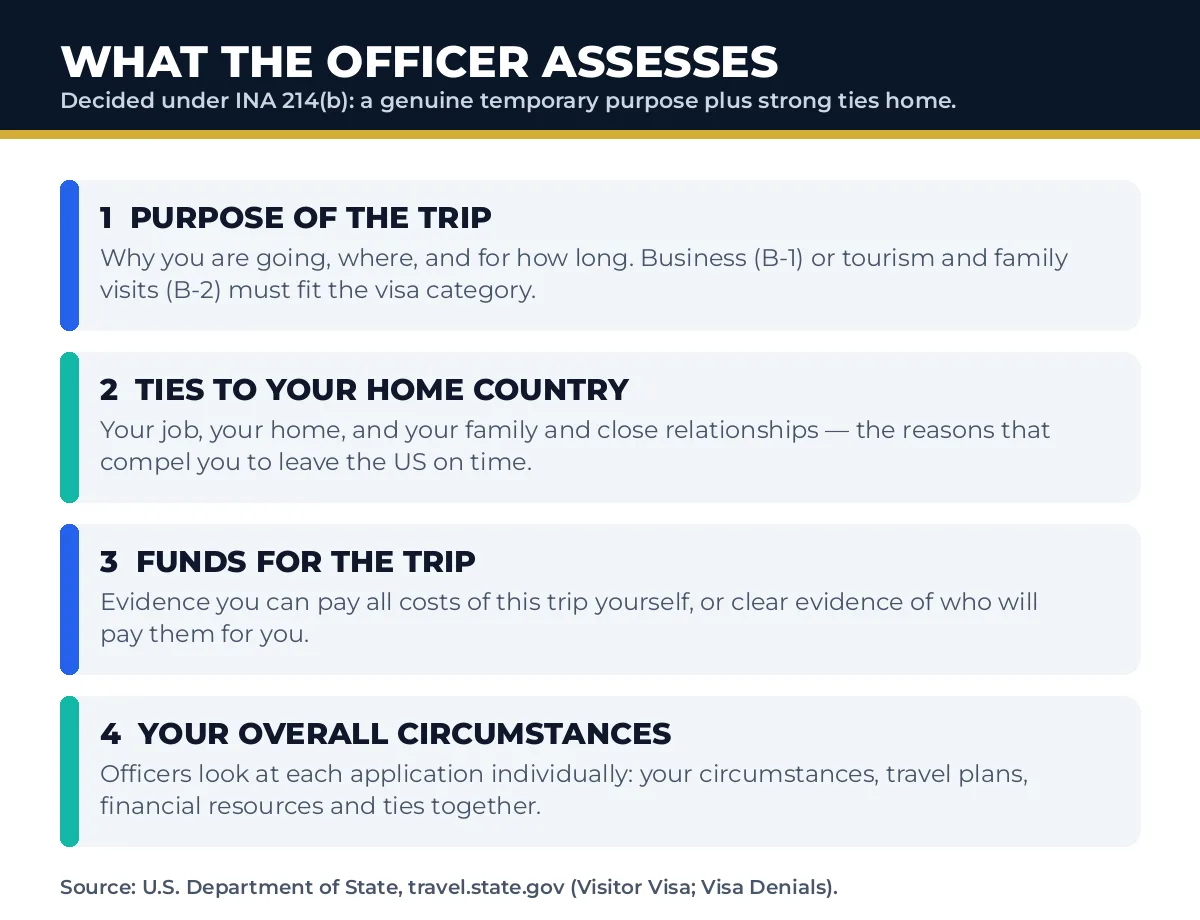
The officer is deciding whether you qualify for the visa category you applied for, as a genuine temporary visitor. That judgement rests on four things: your trip’s purpose, your ties at home, your ability to pay, and your overall circumstances.
Purpose. Your trip must fit the category. Consulting with business associates, attending a conference or negotiating a contract is B-1 business. A holiday, visiting friends or relatives, or medical treatment is B-2 tourism. Study, employment, paid performances and permanent residence are not allowed on a visitor visa, so an answer that drifts into those areas creates a problem no document can fix.
Ties. The State Department describes ties as the aspects of your life that bind you to your home country — its examples: your job, your home, your relationships with family and friends. Officers weigh whether they will compel you to leave on time.
Funds. You must show you can pay all the costs of the trip, or clear evidence of who will cover them. No published figure exists; the money must make sense for the trip you describe.
The whole picture. Officers look at each application individually, considering your circumstances, travel plans, financial resources and ties together. That is why similar applicants can receive different decisions: the test is how the pieces fit, not any single number.
What is INA 214(b), and why does it sit behind almost every question?
Section 214(b) of the Immigration and Nationality Act presumes that every nonimmigrant visa applicant is an intending immigrant until they establish, to the officer’s satisfaction, that they qualify for the visa sought. A refusal under 214(b) means the officer found you did not sufficiently demonstrate that you qualify, or did not overcome that presumption by showing strong ties at home.
This presumption explains the shape of the interview. Questions that sound casual — what do you do, how long are you staying, who is paying — are how the officer tests whether your stated purpose is real and whether your life pulls you back home. Your form, documents and spoken answers are compared with each other — inconsistency is the fastest way to look like a risk.
Two points calm most applicants down: a 214(b) refusal is specific to that one application — not a ban, not a finding of fraud — and there is no appeal process. The remedy the State Department describes is reapplying with evidence of significant changes. If you have already been refused and want the full recovery picture, read our guide to what a 214(b) refusal means and how to overcome it after this one.
Immigration agency? Qualify UAE leads free with Visaora Agency Leads → https://visaora.io/visaora-agency-leads/
Which documents should you carry on interview day?
Carry two layers: the few items the State Department requires of everyone, and a slim supporting file on purpose, ties and funds in case the officer asks. Everything you carry should agree with your DS-160.
| Document | Required or supporting | Why it matters at the window |
|---|---|---|
| Passport (valid at least six months beyond your stay, unless country-specific agreements exempt you) | Required | The visa is placed in your passport; an expiring one can stall issuance. |
| DS-160 confirmation page (printed) | Required | Links your interview to the application on the officer’s screen. |
| Application fee payment receipt | Required where you pay before the interview | Proves the $185 fee is paid so the interview can proceed. |
| One printed photo meeting US specifications | Required if the DS-160 photo upload failed | Your application cannot be completed without a compliant photo. |
| Employment letter, business registration or conference invitation | Supporting | Evidence of your purpose — and of the job waiting at home. |
| Bank statements and income evidence | Supporting | Shows you can pay all costs of the trip you describe. |
| Property, tenancy or family evidence | Supporting | Concrete proof of the ties weighed under 214(b). |
| Day-by-day trip plan | Supporting | Makes a short trip easy to believe; build one free with the Travel Itinerary Generator. |
Our USA tourist visa documents checklist covers the full file. One warning outranks the rest: never carry or submit anything false. A willful, material misrepresentation can make you permanently ineligible under INA 212(a)(6)(C)(i) — far worse than a refusal.
How should you prepare, step by step?
Follow these steps in order and you will arrive knowing what the officer needs to hear.
- Complete the DS-160 carefully. Fill in the online form at ceac.state.gov, upload a compliant photo, and print the confirmation page. Every interview answer will be compared with this form.
- Pay the $185 fee and keep the receipt. The fee is non-refundable, so treat this as one serious attempt, not a rehearsal. Families can total the real cost with our B1/B2 visa fee calculator.
- Book the interview where you live, and book early. The State Department advises scheduling in the country where you live — applying elsewhere can make qualifying harder — and wait times vary, so do not work backwards from a flight date.
- Write your purpose in one sentence. “Two weeks in Texas visiting my sister, back at work on the 20th” is an answer; “seeing America someday” is not. Prepare the sentence, the dates and the plan behind it.
- Assemble evidence behind each answer. Purpose, ties, funds — one or two strong documents per point, within easy reach. The free B1/B2 interview prep checklist turns this into a tick-box exercise.
- Rehearse out loud, honestly. Practise saying your purpose, job, ties and funding in short, direct answers. Rehearsal is for clarity, not scripts — memorised speeches collapse under one follow-up question.
- Plan the day itself. Know what to bring (passport, confirmation page, receipt, photo if needed), expect ink-free digital fingerprint scans, and leave travel purchases until after the decision.
Which B-1/B-2 interview myths should you ignore?
Myths survive because they sound like shortcuts. Each one below is how applicants repeat it — followed by the official position.
| Myth | Fact (official position) |
|---|---|
| An invitation letter from a US host decides the outcome. | It is not needed, and the State Department states it is not one of the factors used to decide. Applicants qualify on their own ties abroad. |
| You must show one fixed minimum bank balance. | No official minimum is published. The official test is evidence of your ability to pay all costs of the trip — for your trip, not a universal threshold. |
| Buying flights and hotels first improves your chances. | There is no guarantee you will be issued a visa, and the State Department advises: do not make final travel plans or buy tickets until you have a visa. |
| A 214(b) refusal is permanent — but you can appeal it. | Both halves are wrong: it applies to that application only, it is not permanent, and there is no appeal process. You may reapply with significant changes. |
| A smooth talker (or a quiet applicant) is judged on performance. | Officers look at each application individually: circumstances, travel plans, financial resources and ties. |
| A small exaggeration in your answers is harmless. | Willfully misrepresenting a material fact can make you permanently ineligible under INA 212(a)(6)(C)(i). A refusal is temporary; that penalty is not. |
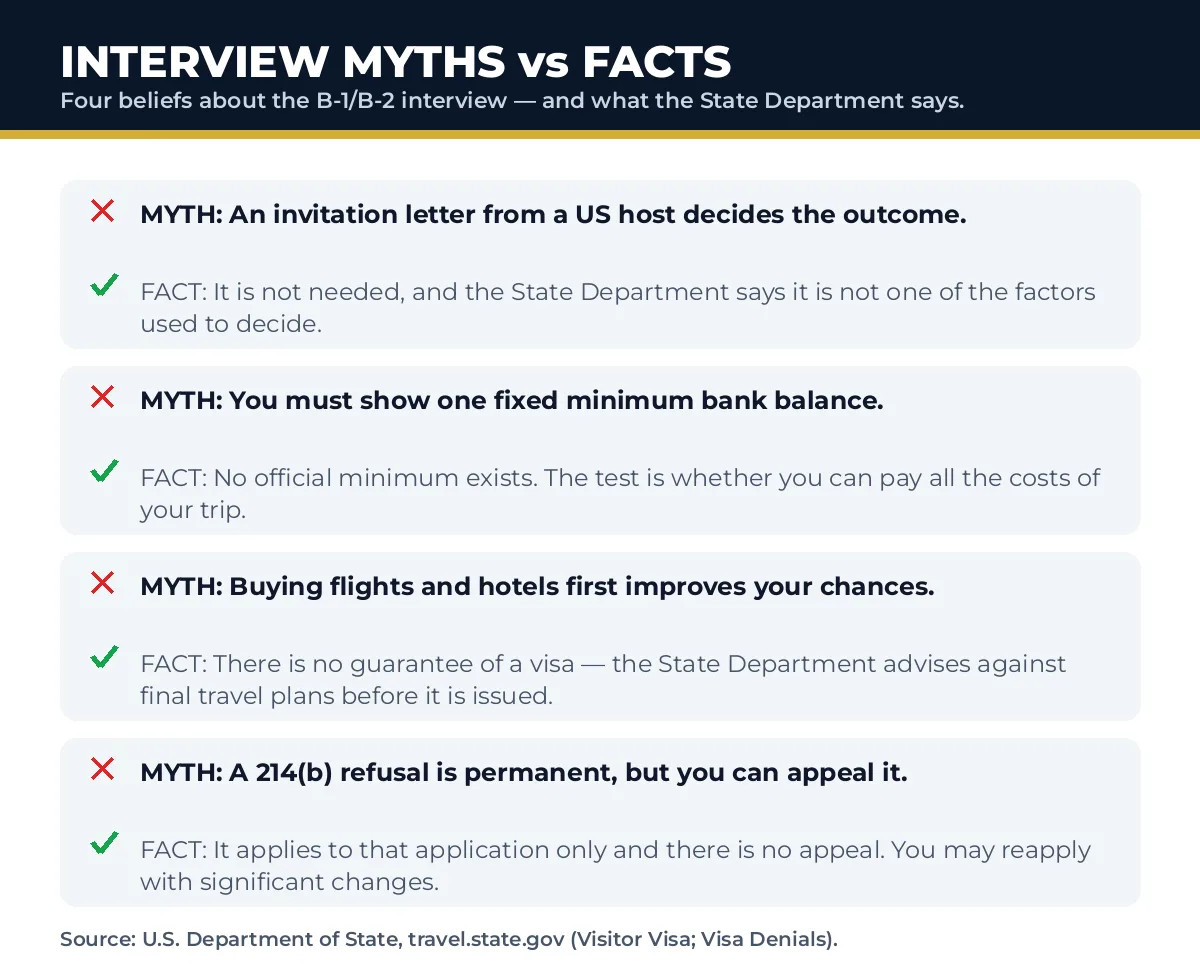
Notice the pattern: every myth replaces your ties and purpose with an object — a letter, a balance, a ticket. Your circumstances are the case; documents simply prove them.
Example: one hypothetical applicant, prepared two ways
Hypothetical example (illustrative only — not a real case): Imran, a hypothetical logistics supervisor from Abu Dhabi, applies for a B-1 visa to attend a three-day trade conference in Chicago. Unprepared, he says he will “stay a few weeks, maybe visit friends after,” carries no employer letter, and says his brother in the US will “sort everything out” — leaving his purpose fuzzy, his return date open and his funding resting on someone else.
Prepared, the same applicant says: “Three days at the conference, flying home on Sunday; my employer is sending me and here is their letter, and I am back on shift the following Wednesday.” He carries the conference registration, the employer letter with his role and leave dates, and bank statements covering the trip. Nothing about his life changed — only how clearly the officer can see his purpose, his ties and his funds.
What happens after the interview?
The officer normally tells you the decision at the window. If approved, your passport is kept for visa printing and returned by the post’s delivery method; some nationalities also pay a visa issuance fee at this stage — the reciprocity schedule sets out whether one applies to you.
If the officer needs more information, your case can enter administrative processing, and the post will tell you what is required. If you are refused, you will be informed of the section of law that applies — most commonly 214(b) — and the fee is not refunded.
One last caution: a visa does not guarantee entry into the United States. It allows you to travel to a port of entry and request permission to enter, where Department of Homeland Security officials decide. And a valid visa in an expired passport stays valid — travel with both passports.
What are the most common B-1/B-2 interview mistakes?
Most refusals are caused not by missing paperwork but by answers that undermine the case:
- Answers that contradict the DS-160. Different dates, job title or host — the officer compares your words with your form in real time.
- A purpose that does not fit the category. Hinting at work, study or an open-ended stay invites exactly the 214(b) concern the interview tests.
- Treating an invitation letter as the case. It is not a deciding factor; your own ties and circumstances are.
- Buying non-refundable flights before the decision. Official advice says no final travel plans until you have the visa — a booking proves nothing and can cost you money.
- Applying far from home without a reason. The Department warns qualifying may be harder outside the country where you live.
- Exaggerating anything. Salary, job title, savings — a material misrepresentation risks permanent ineligibility, which is far worse than an honest refusal.
- Overstaying a previous trip or ignoring its conditions. Misuse can get a visa revoked, and your travel history is part of what the officer weighs.
Frequently asked questions
How much does a B-1/B-2 visa interview cost in 2026?
The application fee for a B-1 or B-2 visitor visa is $185 per applicant, according to the U.S. Department of State fees page. The fee is non-refundable: you do not get it back if your visa is refused. Some nationalities also pay a separate visa issuance fee after approval, based on reciprocity between the two countries.
What is the 214(b) presumption in a B-1/B-2 interview?
Section 214(b) of the Immigration and Nationality Act presumes that every nonimmigrant visa applicant intends to immigrate to the United States. At your interview, the burden is on you to overcome that presumption by showing a genuine temporary purpose and strong ties to your home country — such as your job, home and close family — that will compel you to leave on time.
Which documents must I bring to the interview?
The State Department lists four items to prepare before your interview: a passport valid for at least six months beyond your stay, the printed DS-160 confirmation page, your application fee payment receipt if you had to pay before the interview, and one printed photo if your DS-160 photo upload failed. Bring supporting evidence of purpose, ties and funds as well.
Does an invitation letter from a U.S. host improve my chances?
No letter is required, and it carries little weight. The State Department states that a letter of invitation or an Affidavit of Support is not needed to apply for a visitor visa, and that it is not one of the factors used in determining whether to issue or deny the visa. You qualify on your own ties abroad, not on assurances from U.S. family or friends.
Should I buy flights and hotels before my interview?
The State Department’s advice is direct: there is no guarantee you will be issued a visa, so do not make final travel plans or buy tickets until you have one. A clear written plan of your trip is enough for the interview. If you do reserve anything in advance, choose options you can cancel without losing money.
Can I appeal or reapply after a 214(b) refusal?
There is no appeal process for a 214(b) refusal, but the refusal is not permanent — it applies to that application only. You may reapply with a new application form, the $185 fee paid again and a new interview. Reapplying makes sense when you can present evidence of significant changes in your circumstances, rather than the same file a second time.
Sources
- U.S. Department of State — Visitor Visa (B-1/B-2)
- U.S. Department of State — Visa Reciprocity and Civil Documents by Country
- U.S. Department of State — Fees for Visa Services
- U.S. Department of State — Visa Denials (INA 214(b))
Visaora provides software tools and general information, not legal advice. Rules change; always confirm with the official authority.
✈️ Planning Your Trip?
We may earn a commission — at no extra cost to you. Learn more