Canada Visitor Visa Refused? How to Reapply Stronger in 2026
By Visaora Editorial Team · Updated November 2026 · 10 min read
Quick Answer: A Canada visitor visa refusal is not a ban and there is no waiting period, but reapplying with the same file usually brings the same answer. Read the refusal letter and the officer decision notes, fix each reason named with new evidence, and only then apply again. The fee is CAD 100 per person, plus CAD 85 for biometrics, and fees are not refunded.
Key takeaways
- There is no formal appeal against a visitor visa refusal. Your real options are a stronger new application or, in narrow cases, judicial review in the Federal Court.
- IRCC’s own guidance is blunt: applying again with the same information usually will not change the decision.
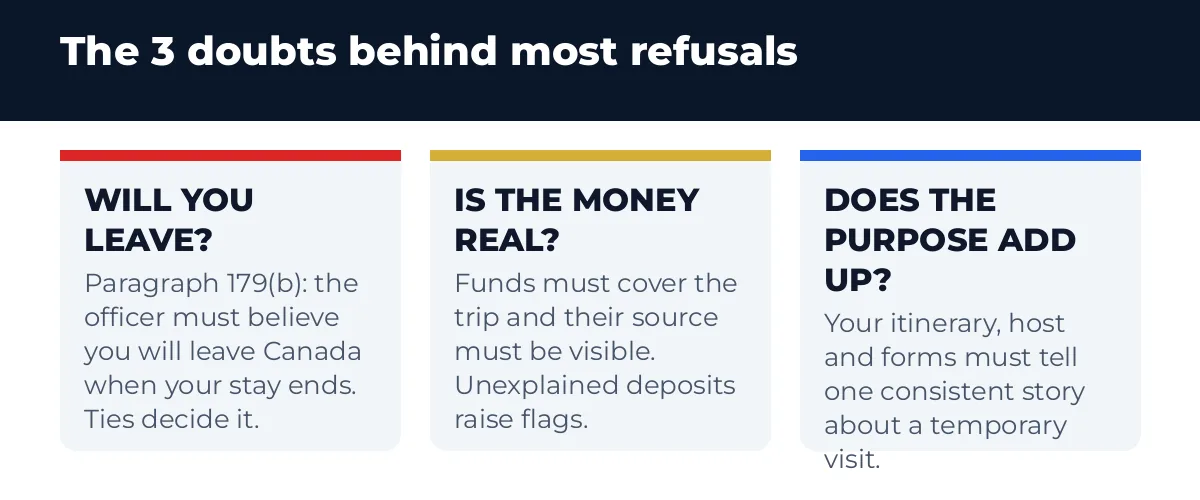
- Most refusals come down to three doubts: you will not leave Canada on time, your money is not enough or not explained, or your stated purpose does not add up.
- A refusal for misrepresentation is different from the rest: it can make you inadmissible to Canada for at least five years.
- Every new application must declare the earlier refusal. Hiding it is misrepresentation, even if an agent filled the form for you.
A refusal letter feels personal, but it is really a short list of doubts written in legal language. Your job is to work through that list one item at a time. Before you start, lay out everything you submitted the first time with the free Document Checklist Generator, so you can see exactly what the officer saw — and what was missing.
Contents
- What is your refusal letter actually telling you?
- Why are Canada visitor visas really refused?
- Can you appeal, or should you reapply?
- How do you reapply stronger, step by step?
- Example scenario: two refusals, two different problems
- What does reapplying cost?
- Common mistakes after a Canada visitor visa refusal
- Frequently asked questions
- Sources
What is your refusal letter actually telling you?
It names the legal ground for the refusal, and that ground is your repair list. The letter refers to a section of the Immigration and Refugee Protection Act or its Regulations. The most common one for visitors is paragraph 179(b) of the Regulations: the officer was not satisfied that you would leave Canada at the end of your stay. Alongside the letter you may receive officer decision notes, which show the reasoning in plainer words. Read both documents slowly and write down every distinct concern. A letter that lists three concerns needs three answers, not a thicker file.
One sentence in the letter matters more than all the others. If the last sentence says you are “inadmissible for misrepresentation”, stop. That is not an ordinary refusal: IRCC treats false or missing information as a five-year problem, and applying again inside that period will simply be refused. Everything below assumes an ordinary refusal about ties, funds or purpose.
Immigration agency? Qualify UAE leads free with Visaora Agency Leads → https://visaora.io/visaora-agency-leads/
Why are Canada visitor visas really refused?
Almost every visitor refusal fits one of three doubts. The officer was not convinced you would leave, not convinced your money covers the trip, or not convinced the trip itself makes sense. Here is how each doubt usually appears, and the evidence that answers it:
| What the officer doubted | How it shows up on paper | Evidence that answers it |
|---|---|---|
| You will not leave Canada at the end of your stay | Weak or unproven ties: no stable job, few family members at home, little travel history, a long or open-ended stay | Employer letter confirming your job and approved leave dates, family responsibilities at home, property or a lease, a return date that matches a real plan |
| Your money is not enough, or its source is unclear | Balance too low for the trip cost, a large recent deposit with no explanation, statements that do not match your stated income | Several months of statements, salary credits that match your employer letter, a written explanation for any large deposit, a trip budget that fits the balance |
| Your purpose is inconsistent with a temporary stay | A vague itinerary, a visit that keeps changing length, documents that contradict the stated reason for travel | A dated itinerary, confirmed bookings where sensible, an invitation letter from your host that matches your forms, one clear purpose stated the same way everywhere |
Last checked: November 2026 – Sources: IRCC refusal guidance and fee list, linked under Sources below.
Notice what is not on this list: a single magic document. Officers weigh the whole picture, and IRCC says the documents you submit must connect clearly to what your forms claim. For the standard document set, work through our Canada visitor visa checklist before you rebuild anything.
Can you appeal, or should you reapply?
There is no appeal for a visitor visa refusal, so for almost everyone the answer is a better second application. IRCC does not offer a review process that reopens a temporary resident decision. Judicial review in the Federal Court does exist, but it is a court process about whether the decision was made fairly and reasonably — the court does not look at new documents, and it is not a second chance to present your case. It has strict filing deadlines and normally needs a Canadian lawyer, so it suits the rare case where the officer ignored evidence or made a clear error, not the ordinary weak-file refusal.
That leaves the practical route: a fresh application that treats the refusal letter as the specification for what to fix. This is the approach IRCC itself describes — deal with the reasons, show that your situation has changed or that you have significant new information, and document the change clearly.
How do you reapply stronger, step by step?
Do not rush. A careful second application filed in two months beats a copy of the first one filed tomorrow.
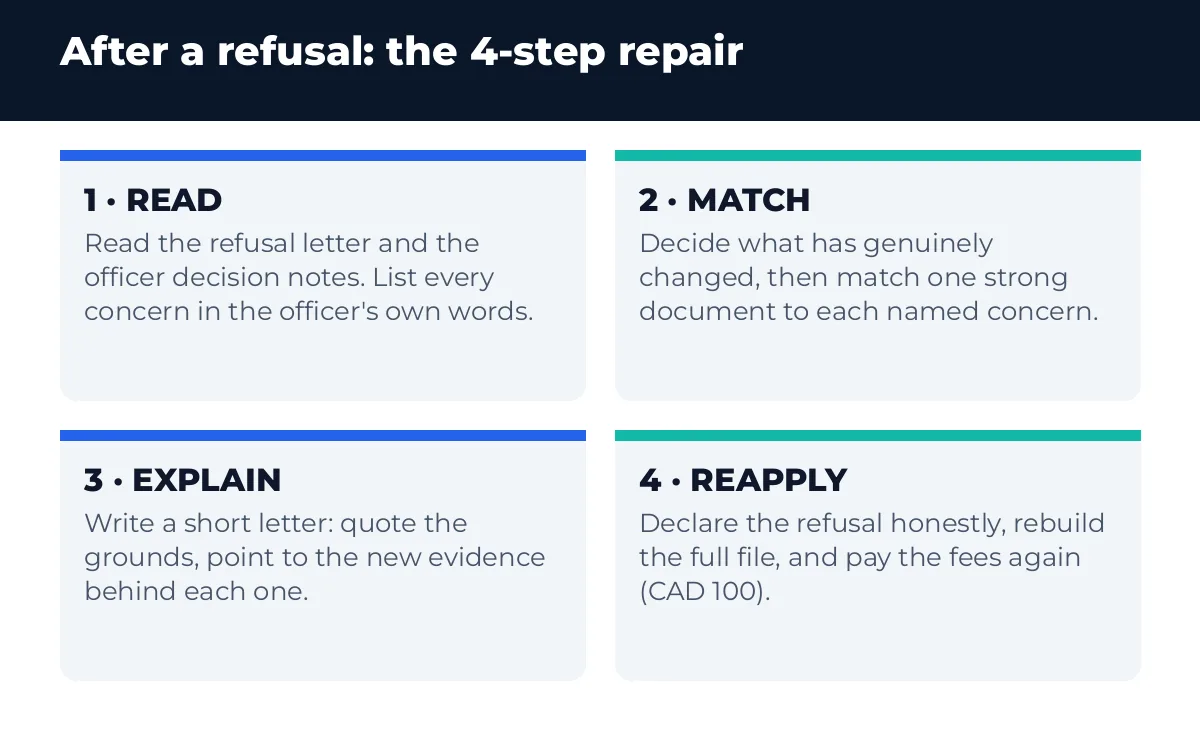
- List every refusal reason. Take the letter and the officer notes and turn them into a checklist: one line per concern, in the officer’s own words.
- Decide what has genuinely changed. A new job, a raise, an approved leave letter, a deposit you can now document, a shorter and clearer trip. If nothing has changed and you have no new evidence, waiting is the stronger move.
- Collect one strong document per concern. Match each checklist line to a specific piece of evidence. One document that answers a named doubt is worth ten generic ones.
- Write a short explanation letter. State that you were refused, quote the grounds briefly, and walk the officer through what is different now, pointing to the document behind each point.
- Declare the refusal honestly. The forms ask about refusals by Canada and other countries. Answer yes and give the details. Leaving it out converts a simple refusal into a misrepresentation problem.
- Rebuild the file with the checklist tool. Run the full document set through the Document Checklist Generator again so nothing from the standard set is missed this time.
- Pay the fees and submit. A new application means new fees, and biometrics are reused if you gave them for Canada within the last ten years.
Residents of the Gulf applying again can also compare their file against the requirements in our guide to the Canada visitor visa from the UAE, and families visiting parents or children should check whether the Super Visa fits their situation better than a regular visitor visa.
Example scenario: two refusals, two different problems
Example scenario (illustrative only, not a real case): Ahmed, an engineer in Dubai, was refused with the 179(b) ground. His first file showed a good salary but a three-month open-ended trip and no employer letter. He waited four months, then reapplied for a three-week visit with an employer letter approving exact leave dates, a dated itinerary, and a short letter answering the refusal point by point. Sara, refused over funds, had the opposite problem: her balance was high, but a large deposit from her brother appeared two weeks before she applied, unexplained. Her fix was not more money — it was bank statements showing the deposit’s source and a letter explaining it. Same refusal letter format, completely different repairs.
What does reapplying cost?
A second application costs the same as the first, and the first application’s fees are gone. IRCC does not refund application fees once processing has begun, and it says so plainly on its refusal guidance page. Budget for CAD 100 for the visitor visa itself. If your biometrics from a previous Canadian application are still valid — temporary resident biometrics are generally valid for ten years — you do not pay the CAD 85 biometrics fee again; if you never gave them, or they have expired, add it. The full fee table is on IRCC’s official fee list. You can also browse the wider set of Canada visa tools on Visaora to plan the wider move, if a visit turns into a longer plan.
Common mistakes after a Canada visitor visa refusal
- Reapplying within days with the same file. IRCC warns that the same information usually produces the same decision — and another non-refundable fee.
- Answering a doubt the officer never raised. Extra documents aimed at the wrong concern make the real concern harder to find.
- Hiding the refusal. The form asks directly. A false “no” is misrepresentation and can bar you from Canada for five years.
- Letting an agent submit documents you have not seen. IRCC holds you responsible for everything in your application, whoever completed it.
- Padding the file with irrelevant paper. Officers look for the connection between your forms and your documents; volume is not a connection.
- Treating a misrepresentation refusal like an ordinary one. If the letter says inadmissible for misrepresentation, the five-year clock is the story, not your itinerary.
Frequently asked questions
Can I appeal a Canada visitor visa refusal?
No. There is no formal appeal for a visitor visa (temporary resident) refusal. Your options are a new application with new information that answers the refusal reasons, or judicial review in the Federal Court if you believe the decision itself was unfair or unreasonable — a legal process that does not consider new documents.
How soon can I reapply after a Canada visitor visa refusal?
There is no waiting period in law. You can apply again as soon as your situation has changed or you have significant new information. Reapplying immediately with the same information usually leads to the same decision, and your fees will not be refunded.
What does paragraph 179(b) mean on a Canada refusal letter?
It means the officer was not satisfied that you would leave Canada by the end of your authorized stay. It is the most common ground for visitor refusals and is usually about ties: your job, your family and responsibilities at home, your assets, and whether your trip plan looks like a genuine temporary visit.
Will a Canada visitor visa refusal affect future applications?
Yes, it becomes part of your record and must be declared on future applications to Canada and often to other countries that ask. A refusal declared honestly and answered with stronger evidence is manageable. A refusal you hide can be treated as misrepresentation, which is far more serious.
How much does it cost to reapply for a Canada visitor visa?
The visitor visa fee is CAD 100 per person. Biometrics cost CAD 85 per person, but if you already gave biometrics for a Canadian temporary resident application within the last ten years, they are normally still valid and you do not pay again. Fees from the refused application are not refunded.
Should I use a consultant for my second Canada application?
It is optional. IRCC says using a representative gives no special attention and does not improve your chances by itself; the decision rests on your information and documents. If you do use one, use an authorized representative, and read everything before it is submitted — you are responsible for its contents.
Sources
- IRCC — If your application for a visitor visa was refused
- IRCC — Citizenship and immigration application fees: temporary residence fee list
- Government of Canada — Visit Canada: visitor visa overview
Rebuilding after a refusal? Start with the free Document Checklist Generator to assemble the document set your second application needs, then work through the refusal reasons one by one.
Visaora provides software tools and general information, not legal advice. Rules change; always confirm with the official authority.
✈️ Planning Your Trip?
We may earn a commission — at no extra cost to you. Learn more