E-2 Investor Visa 2026: Requirements, Investment Amount and Treaty Countries
Starting a business in the United States is easy; living there to run it yourself is the hard part. For investors from the right countries, the e2 visa — officially the E-2 treaty investor classification — is the route built for that: it lets a treaty-country national enter the US to develop and direct a business they have funded with substantial capital. There is no fixed minimum investment, no lottery and no employer sponsor. The case stands on the investment: real money, genuinely at risk, in a real business. This guide covers the requirements, steps, fees and refusal traps.
Quick Answer: The E-2 investor visa lets nationals of treaty countries live in the US to develop and direct a business they have funded with a substantial, at-risk investment. There is no fixed minimum amount. Stays are granted for up to two years at a time, and Pakistan is an E-2 treaty country.
Visaora provides general information, not legal advice. Rules change; always confirm with the official embassy, consulate or government website before you apply.
By Visaora Editorial Team · Updated November 2026 · 11 min read
Key facts (checked November 2026)
- Only nationals of a treaty country on the State Department’s official list can apply. Pakistan is listed for E-2, in force since 12 February 1961.
- No fixed minimum investment exists; the legal test is a “substantial” amount, judged against the business’s total cost (USCIS).
- You must own at least 50% of the enterprise, or hold operational control, and enter to develop and direct it.
- The business must be real and active, and must not be marginal — it must do more than provide a minimal living for your family.
- Stays run up to two years, extendable in two-year increments with no limit on extensions (USCIS).
Contents
- What is the E-2 investor visa?
- Who qualifies for an E-2 visa?
- E-2 treaty countries
- How much do you need to invest for an E-2 visa?
- What counts as a qualifying business?
- Step-by-step: how to apply for an E-2 visa
- E-2 fees and validity
- Can your spouse work on E-2 status?
- E-2 vs EB-5: key differences
- How long can you stay and how do renewals work?
- Common E-2 refusal reasons
- Mistakes to avoid
- Frequently asked questions
What is the E-2 investor visa?
The E-2 is a nonimmigrant classification: temporary permission to live and work in the US for one purpose — running your investment enterprise — not a route to permanent residence. USCIS describes it as admission for a treaty-country national investing a substantial amount of capital in a US business. Only those nationals can apply; nationality counts, not residence.
Certain employees can also qualify; a spouse and unmarried children under 21 can accompany the investor, who may work only in the approved activity. Already in the US in a lawful status? USCIS provides for a Form I-129 change of status to E-2; outside the US, you apply at a US embassy or consulate. The free document checklist generator turns the requirements below into a working list for your file.
Who qualifies for an E-2 visa?
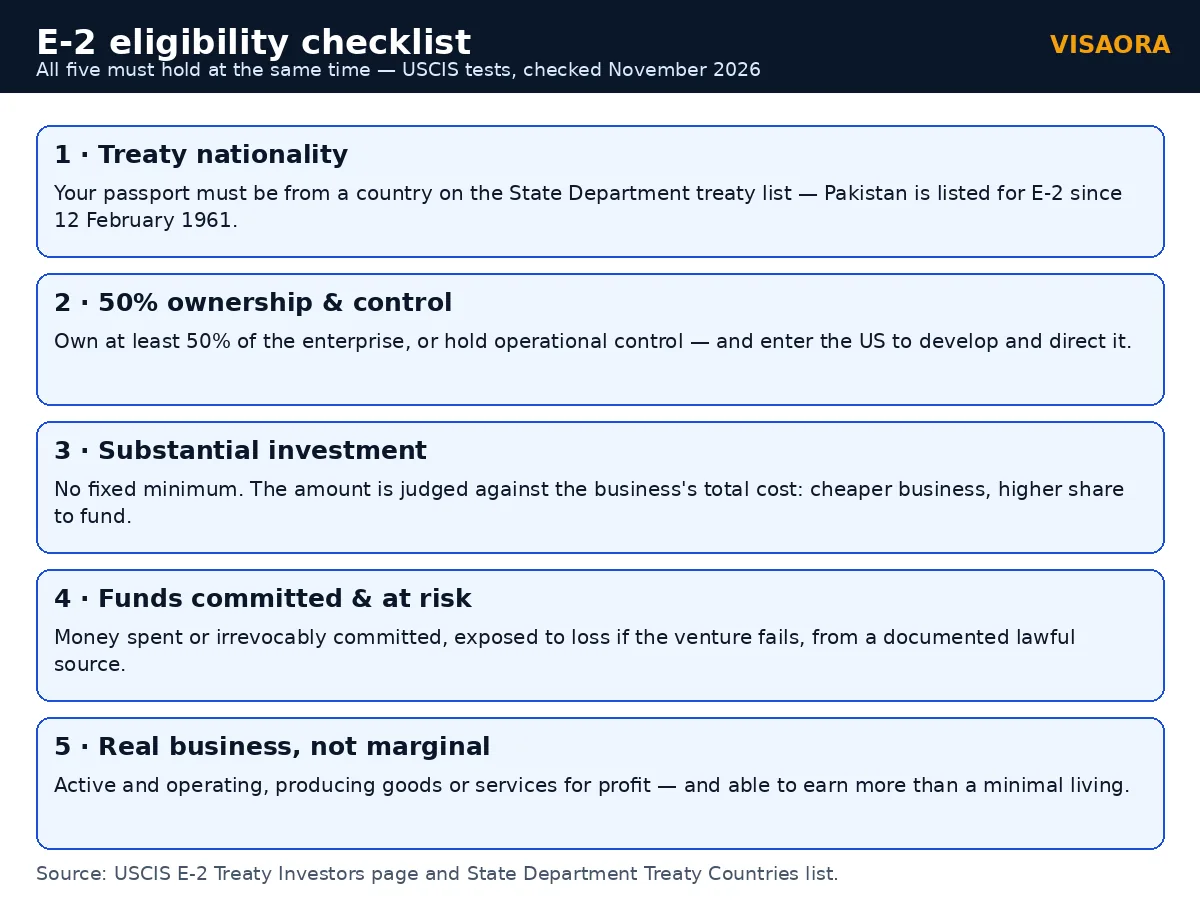
Four things must hold at once: treaty-country nationality, ownership and control, capital committed and at risk, and a real, non-marginal enterprise. USCIS sets the test in three parts:
- Nationality. Be a national of a country with which the US maintains a treaty of commerce and navigation or a qualifying agreement, or which legislation has deemed qualifying.
- Investment. Have invested, or be actively investing, a substantial amount of capital in a bona fide US enterprise.
- Develop and direct. Be entering solely to develop and direct the enterprise — shown by at least 50% ownership, or operational control through a managerial position or other corporate device.
The money must be placed at risk in the commercial sense — aiming for profit, exposed to partial or total loss — and must not come from criminal activity. A company employer must itself be at least 50% treaty-national owned. Employees can qualify too, with the principal employer’s treaty nationality and executive or supervisory duties, or special qualifications making them essential.
Immigration agency? Qualify UAE leads free with Visaora Agency Leads → https://visaora.io/visaora-agency-leads/
E-2 treaty countries
The State Department’s treaty countries list names each country, its classification — E-1 for treaty traders, E-2 for treaty investors, E-3 for Australian specialty occupation workers — and the date the treaty entered into force. Check your nationality’s E-2 line: a country can appear under one classification and not the other. Around eighty countries appear for E-2; India, mainland China, Brazil, Russia, the United Arab Emirates and Saudi Arabia are absent.
| Country | Classification | E-2 treaty entered into force |
|---|---|---|
| United Kingdom | E-2 | 3 July 1815 |
| Japan | E-2 | 30 October 1953 |
| Pakistan | E-2 | 12 February 1961 |
| Canada | E-2 | 1 January 1994 |
Pakistan’s position, which outdated pages get wrong: Pakistan is an E-2 treaty country, listed under classification E-2, in force since 12 February 1961 — the same date as its E-1 entry, with no footnote attached. This table shows examples only; check the full list before committing money.
How much do you need to invest for an E-2 visa?
There is no official minimum investment for an E-2 visa. No figure appears in the regulation, USCIS publishes none, and any agent quoting a legal minimum for the e2 visa investment amount is inventing it.
The test is substantiality, which USCIS explains in three parts: the amount must be substantial relative to the total cost of buying an established enterprise or establishing a new one; sufficient to ensure your financial commitment to its successful operation; and of a magnitude supporting the likelihood you will successfully develop and direct it. Proportionality decides real cases — in USCIS’s words: the lower the cost of the enterprise, the higher, proportionately, the investment must be.
The widely quoted $100,000 is a practical benchmark many applicants work to — proportionality is usually satisfied at that level for a typical small business — but it is not an official rule. The money must also be committed and at risk: spent on the purchase, lease, equipment and stock, or irrevocably committed to them. Cash sitting untouched in a personal account is not yet an investment.
What counts as a qualifying business?
A qualifying business is what USCIS calls a bona fide enterprise: a real, active and operating commercial or entrepreneurial undertaking producing services or goods for profit, meeting local legal requirements for doing business. Shell companies, passive share portfolios and speculative land purchases do not meet it.
The second test refuses more borderline cases than any other: the enterprise may not be marginal — USCIS defines that as lacking the capacity to generate more than enough income to provide a minimal living for the investor and their family. A business that exists only to pay its owner a wage is not enough; it should have a significant economic impact beyond the household, and employing US workers is the clearest evidence. A start-up lacking that capacity today is not automatically marginal, but it should have the capacity to generate such income within five years of the E-2 classification beginning. Shops, restaurants, franchises and service companies commonly qualify.
Step-by-step: how to apply for an E-2 visa
Most investors apply at a US embassy or consulate:
- Check your nationality. Confirm your country is on the State Department’s treaty list under E-2.
- Form or buy the US enterprise. Register it, obtain licences, secure premises, open its bank account.
- Commit the money. Pay the purchase price or spend on lease, equipment and stock, keeping the funds’ paper trail.
- Build the package. Ownership records, proof of funds at risk, and a business plan showing a real, non-marginal enterprise.
- Complete the forms. DS-160 online for each applicant; employee applicants also file Form DS-156E, in the consulate’s own package format.
- Pay the fee and book. $315 per applicant, then schedule the interview through the consulate’s system.
- Attend the interview. Explain the business, the money and your directing role.
- Travel. A CBP officer decides admission at the port of entry and grants a stay of up to two years.
Already in the US in a lawful status? A Form I-129 request to USCIS can change your status to E-2, though you would still need a visa to re-enter after travel. Locations are in the free global VAC locator; our USA tourist visa documents checklist shows how a standard file is organised.
E-2 fees and validity
The application fee comes first: the State Department’s fees page sets the nonimmigrant visa application processing fee for the E category at $315.00, non-refundable whether the visa is issued or refused, and every applicant pays it, including derivative spouses and children. A visa issuance fee applies only after approval, and only where your nationality’s reciprocity schedule sets one — sometimes none at all.
Validity works the same way: how long the visa remains valid, and how many entries it allows, is set per nationality in the reciprocity schedule — neither figure is your permitted stay, capped at a maximum initial stay of two years. Pakistani applicants should read Pakistan’s reciprocity schedule before travelling. Our guide to where the visa number sits on a US visa helps you record its details, and the free USCIS fee calculator cross-checks any government fee figure quoted to you.
Can your spouse work on E-2 status?
In most cases, yes — with no separate permit. USCIS states that spouses of E-2 workers in valid E-2 or E-2S status are considered employment authorized incident to status. The employer’s evidence is the Form I-94: since 30 January 2022 it has carried an E-2S admission code for these spouses, accepted as evidence of work authorisation for Form I-9. An optional Form I-765 can still produce a physical work card. One exception: spouses of long-term E-2 CNMI investors in the Northern Mariana Islands must apply for authorization instead.
E-2 vs EB-5: key differences
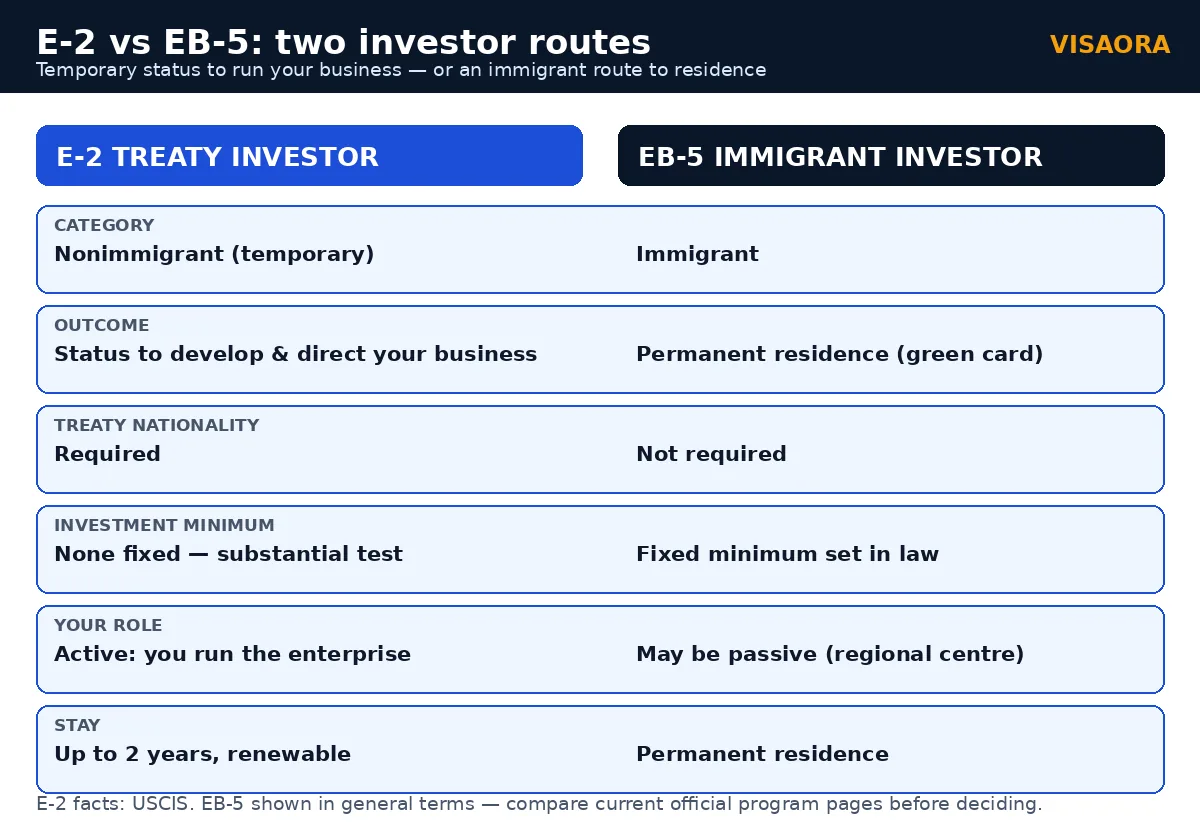
E-2 and EB-5 solve different problems. E-2 is a temporary, renewable status built around running your own business; EB-5 is an immigrant category whose outcome is permanent residence, with its investment minimum fixed in law. E-2 sets no amount, judging the same money through the substantiality test above.
| Point | E-2 | EB-5 |
|---|---|---|
| Outcome | Status to develop and direct your business | Permanent residence (a green card) |
| Treaty nationality | Required | Not required |
| Investment minimum | None fixed — the amount must be substantial | A fixed minimum set in law |
| Your role | Active — you develop and direct the enterprise | May be passive, including through regional centre projects |
| Job creation | No fixed count — the business must not be marginal | Must create full-time jobs for US workers |
Nothing about holding E-2 status converts into a green card; a separate immigrant category, if you qualify, is a second, independent application. Our explainer on the difference between a visa and a green card covers the two systems.
How long can you stay and how do renewals work?
USCIS allows qualified investors and employees a maximum initial stay of two years. Extensions, or changes of status into E-2, come in increments of up to two years each, with no limit on the number granted. Travel abroad generally earns an automatic two-year readmission on return, if admissible.
You may work only in the approved activity, and a substantive change to the enterprise — mergers, acquisitions, or sale of the division where you work — must be notified with a new Form I-129. And every holder must maintain an intention to depart the US when their status expires or is terminated.
Common E-2 refusal reasons
Refusals rarely come from one missing document; they happen when the evidence fails a built-in test:
- Nationality fails. The applicant’s country has no E-2 treaty, or the enterprise is not at least 50% treaty-national owned.
- The money is not at risk. Funds sit untouched in a personal account; spending is promised rather than completed.
- The amount fails proportionality. The investment is small next to the business’s true cost, or a thin slice of it.
- The business is not real yet. No premises, licences or trading — a plan and a bank balance are not an enterprise.
- The enterprise looks marginal. The figures show a minimal living for the investor, with no credible five-year capacity beyond it.
- The source of funds is unclear. Gaps in the paper trail, or money whose lawful origin cannot be documented.
Most were repairable before the interview.
Mistakes to avoid
- Treating $100,000 as a legal minimum. A planning benchmark, not a rule; cases turn on substantiality and proportionality.
- Keeping the money safe. Unspent funds are not at risk; the spending, or an irrevocable commitment to it, is the evidence.
- Buying a business you will not run. You must develop and direct the enterprise; a passive stake fails the central test.
- Writing a plan with no staff in it. Numbers supporting only the owner read as marginal; credible hiring is the counter-evidence.
- Relying on residence instead of nationality. Living in a treaty country does not qualify you; the passport decides.
- Ignoring the family record details. Your spouse’s right to work rests on the E-2S notation on the Form I-94 — check it on arrival.
- Assuming E-2 becomes a green card. It does not; years in E-2 status build no residence rights.
Frequently asked questions
What is the minimum investment for an E-2 visa?
There is no official minimum investment for an E-2 visa. The legal test is that the amount must be substantial, measured against the business’s total cost, with lower-cost businesses needing a higher proportion funded. The $100,000 figure quoted widely is a practical benchmark, not a rule.
Is Pakistan an E-2 treaty country?
Yes. Pakistan appears on the US Department of State’s official treaty countries list under the E-2 classification, entered into force on 12 February 1961. It also holds E-1 status from the same date, and no country-specific footnote restricts its entry, so Pakistani nationals apply under the standard E-2 rules.
How long is an E-2 visa valid?
Two different periods apply. The visa’s validity and entries are set in your nationality’s reciprocity schedule and vary by country. Your stay is separate: USCIS allows a maximum initial stay of two years, extendable in increments of up to two years, with no limit on extensions.
Can my spouse work in the US on E-2 status?
Generally yes. USCIS treats spouses of E-2 workers in valid E-2 or E-2S status as employment authorized incident to status, evidenced by the Form I-94 showing the E-2S admission code. One exception: spouses of long-term E-2 CNMI investors must apply for authorization.
Can an E-2 visa lead to a green card?
Not directly. E-2 is a nonimmigrant classification granting temporary status to develop and direct your business, and USCIS requires every holder to maintain an intention to depart the United States when that status expires or is terminated. Time in E-2 never converts into permanent residence by itself.
What businesses qualify for an E-2 visa?
A qualifying business is a real, active and operating enterprise that produces goods or services for profit and meets local legal requirements — and it must not be marginal. Shops, restaurants, franchises, consultancies and service companies commonly qualify. Shell companies and passive holdings do not.
Sources
- USCIS — E-2 Treaty Investors: https://www.uscis.gov/working-in-the-united-states/temporary-workers/e-2-treaty-investors
- US Department of State — Treaty Countries: https://travel.state.gov/content/travel/en/us-visas/visa-information-resources/fees/treaty.html
- US Department of State — Fees for Visa Services: https://travel.state.gov/content/travel/en/us-visas/visa-information-resources/fees/fees-visa-services.html
- US Department of State — U.S. Visa: Reciprocity and Civil Documents by Country: https://travel.state.gov/content/travel/en/us-visas/Visa-Reciprocity-and-Civil-Documents-by-Country.html
Last checked: November 2026
✈️ Planning Your Trip?
We may earn a commission — at no extra cost to you. Learn more