Schengen Multiple-Entry Visa: How the Cascade Works (2026)
By Visaora Editorial Team · Updated November 2026 · 9 min read
Quick Answer: Schengen multiple-entry visas follow a legal ladder in Article 24 of the EU Visa Code, called the cascade. Lawfully use three visas within two years and you qualify for a one-year multiple-entry visa; use that correctly and a two-year visa follows; then a five-year visa. The fee is the same €90 as any short-stay visa, and the 90-days-in-180 limit never changes.
Key takeaways
- The cascade is in the law, not at the whim of the officer: Article 24 of the Visa Code sets three steps — one year, two years, five years.
- “Lawfully used” means you actually travelled on the visa and respected its dates and the 90/180 rule. A visa you never used does not count.
- Airport transit visas and limited territorial validity (LTV) visas do not count toward the steps.
- Your passport caps everything: a visa cannot be valid beyond the expiry of your travel document.
- Consulates can still issue a shorter visa in an individual case where they reasonably doubt the entry conditions will be met for the whole period.
Frequent travellers to Europe often assume a long multiple-entry visa is a favour handed out by generous consulates. Since the Visa Code was amended in 2020, it is closer to a progression system: use short visas properly, and longer ones are provided for in the rules themselves. You can estimate where you stand on the ladder with Visaora’s free Schengen Multi-Entry Calculator, and this guide explains the law behind the estimate.
Contents
- What is a multiple-entry Schengen visa?
- How does the cascade work, step by step?
- What does “lawfully used” actually mean?
- How do you apply so the cascade works for you?
- Example scenario: one traveller climbing the ladder
- When can a consulate give you less than the cascade says?
- Common mistakes with multiple-entry visas
- Frequently asked questions
- Sources
What is a multiple-entry Schengen visa?
It is a short-stay (type C) visa marked “MULT” that lets you enter and leave the Schengen Area as many times as you like while it is valid. Validity can run for up to five years. What it never changes is how long you may stay: a maximum of 90 days in any 180-day period, counted on a rolling basis. A five-year visa is five years of permission to visit, not five years of residence. If you are new to the day-count rule, the free Schengen 90/180 Counter shows how the rolling window is calculated.
How does the cascade work, step by step?
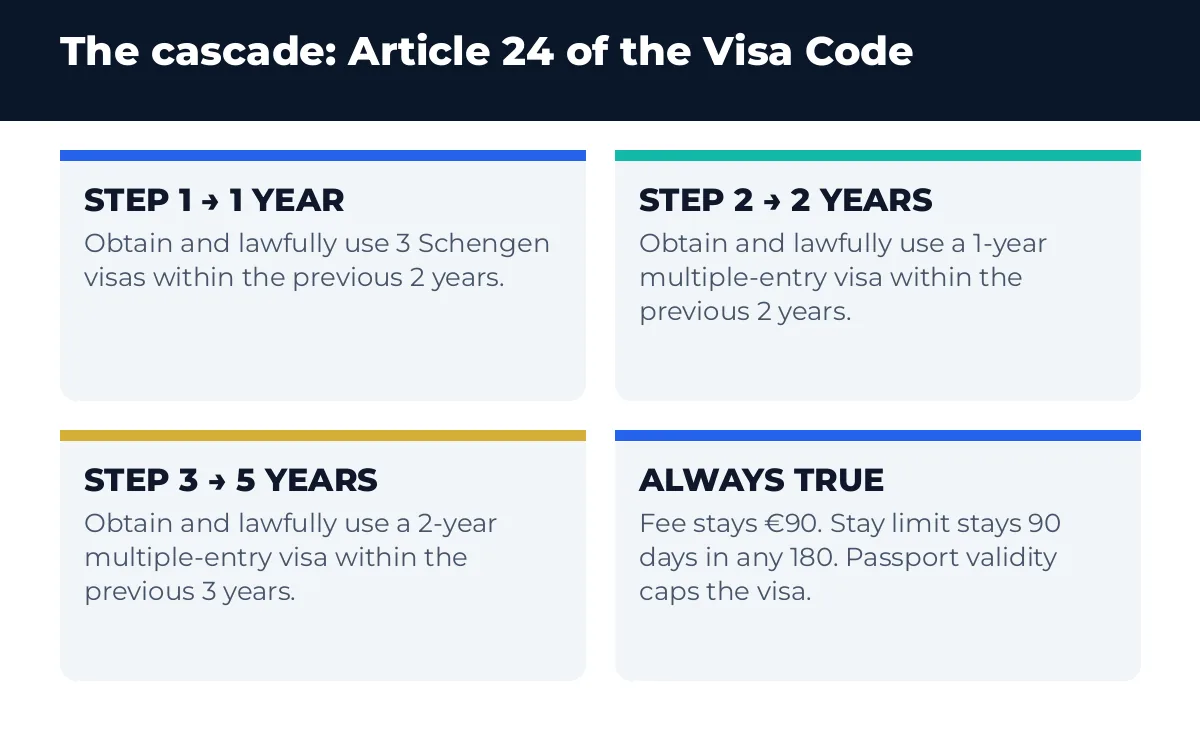
Article 24(2) of the Visa Code, in the text set by Regulation (EU) 2019/1155, says that long-validity multiple-entry visas “shall be issued” for set periods once the traveller meets the conditions and continues to fulfil the entry conditions. The three steps are:
| Step | What you must have done | Visa the cascade provides |
|---|---|---|
| Step 1 | Obtained and lawfully used three Schengen visas within the previous two years | Multiple-entry visa valid for 1 year |
| Step 2 | Obtained and lawfully used a one-year multiple-entry visa within the previous two years | Multiple-entry visa valid for 2 years |
| Step 3 | Obtained and lawfully used a two-year multiple-entry visa within the previous three years | Multiple-entry visa valid for 5 years |
Last checked: November 2026 – Source: Visa Code Article 24, as amended by Regulation (EU) 2019/1155; full link under Sources.
Two details in the legal text matter. First, airport transit visas and LTV visas are explicitly excluded — they do not build your history. Second, the visa’s validity cannot exceed your passport’s validity, so a five-year step needs a passport with at least five years left. The Visa Code also allows the EU to set specific cascades for particular countries, which is why travellers from a few countries follow adapted ladders; the three steps above are the general rule. Visaora’s Schengen Travel History Analyzer can help you review which of your past visas count.
Immigration agency? Qualify UAE leads free with Visaora Agency Leads → https://visaora.io/visaora-agency-leads/
What does “lawfully used” actually mean?
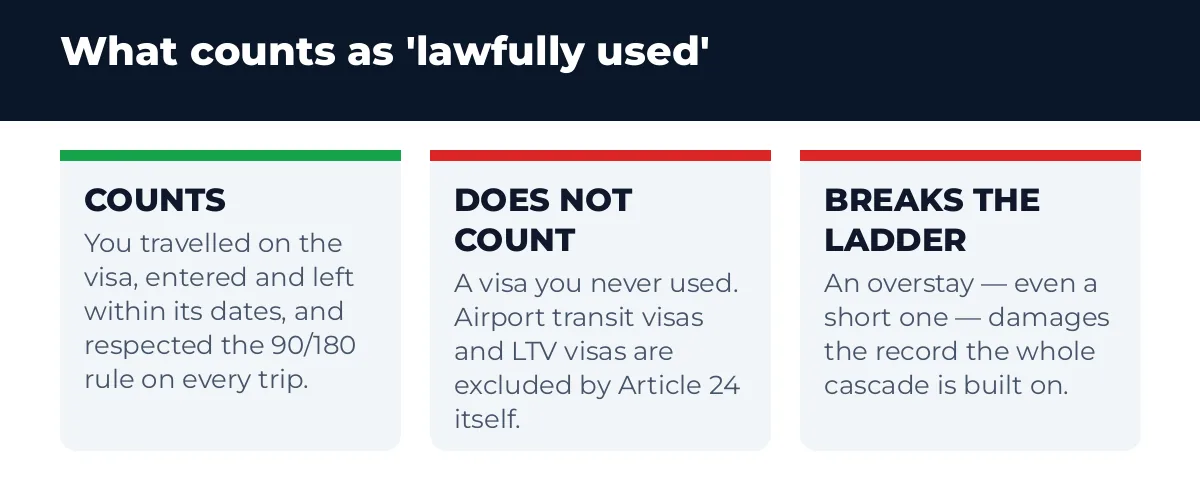
It means the visa did its job and you respected it. You travelled on it during its validity, you entered and left through the rules, and you never overstayed — not the visa’s dates and not the 90-days-in-180 limit. A visa that sat unused in your passport does not advance you, because it proves nothing about how you travel. An overstay does the opposite: it is the fastest way to fall off the ladder, and with border crossings now recorded digitally across the Schengen Area, your history is easy for a consulate to see. Think of every trip as evidence for your next application, because in this system it literally is.
How do you apply so the cascade works for you?
- Count your qualifying visas. List every Schengen visa from the last three years and mark which ones you actually used within their rules. Airport transit and LTV visas do not count.
- Check your passport’s remaining validity. If it expires in three years, a five-year visa cannot be issued to you, whatever your history.
- Tick “multiple entries” on the application form and say, in your cover letter, which cascade step you meet and which previous visas support it.
- Include copies of your previous visas and entry/exit stamps. Make the officer’s job easy: put the evidence of lawful use where it cannot be missed.
- Apply at the right consulate — the country that is your main destination, or your first entry if destinations are equal. Applying elsewhere to shop for a longer visa does not work.
- Meet the standard requirements in full: travel medical insurance of at least €30,000 covering the first trip, proof of funds for the journey, and the €90 visa fee — the same fee as a single-entry application.
The money side of a Schengen application is where many otherwise strong files wobble; our guide to Schengen visa bank balance requirements walks through what consulates look for, and the complete Schengen visa guide covers the full application from forms to biometrics.
Example scenario: one traveller climbing the ladder
Example scenario (illustrative only, not a real case): Mariam, a sales manager based in Doha, travelled to Europe for trade fairs. In 2024 and 2025 she obtained and used three short single-entry visas, each time leaving well inside her permitted days. On her next application she ticked “multiple entries”, cited her three used visas and attached copies of each one. She received a one-year multiple-entry visa. She used it for four short trips across the following two years, always within the 90/180 limit. Her next application met step two, and she was issued a two-year visa. No agent, no shortcut — just a clean, documented record doing the work.
When can a consulate give you less than the cascade says?
The cascade is a strong rule, not an absolute one. Article 24(2a) lets a consulate shorten the validity in an individual case where there is reasonable doubt that the entry conditions will be met for the entire period — for example if your circumstances look unstable or your purpose of travel is unclear. You must also keep fulfilling the basic entry conditions each time: a valid travel document, justification of purpose and means, and no alerts against you. And if your file is weak in the ordinary ways — thin funds evidence, an unconvincing itinerary — the application can still be refused outright; the cascade governs the validity of visas that are issued, it does not compel approval. Our comparison of the easiest Schengen visa countries explains why approval practice still differs between consulates even under one shared code.
Common mistakes with multiple-entry visas
- Believing a five-year visa allows a five-year stay. It never does. The ceiling is 90 days in any 180-day period, for every type C visa.
- Counting visas you never used. Only obtained and lawfully used visas advance you. An unused visa in an old passport adds nothing.
- Overstaying “just a few days”. One overstay damages the record the whole cascade is built on.
- Letting your passport run down. The visa cannot outlive the travel document; renew the passport first if it is short.
- Applying at the wrong consulate. Your main destination decides where you apply, not the consulate you think is friendliest.
- Hiding previous visas. Your history is your asset in this system — present it, with copies, instead of starting each application from zero.
Frequently asked questions
How do I qualify for a five-year multiple-entry Schengen visa?
By climbing the cascade in Article 24 of the Visa Code: lawfully use three visas within two years to reach a one-year multiple-entry visa, lawfully use that to reach a two-year visa, then lawfully use the two-year visa within three years to qualify for five years. Your passport must also have enough validity left to cover the period.
Does a multiple-entry visa let me stay in Schengen for its whole validity?
No. However long the visa is valid — one, two or five years — you may stay a maximum of 90 days in any 180-day period. The validity controls when you may enter; the 90/180 rule controls how long you may remain on each stretch of travel.
Do unused Schengen visas count toward the cascade?
No. The Visa Code requires visas to have been obtained and lawfully used. A visa you never travelled on does not count, and airport transit visas and limited territorial validity visas are excluded by the text of Article 24 as well.
How much does a multiple-entry Schengen visa cost?
The standard short-stay visa fee is €90 for adults, the same as for a single-entry visa — there is no extra charge for multiple entries or longer validity. Children aged 6 to 11 pay €45, and children under 6 are free. The fee is not refunded if the application is refused.
Can a consulate refuse to follow the cascade?
The cascade is the rule, but Article 24 also allows a shorter validity in an individual case where there is reasonable doubt that the entry conditions will be met for the whole period. A weak or unclear application can also still be refused; the cascade sets the validity of visas that are granted, it does not force an approval.
Which consulate should I apply to for a multiple-entry visa?
The consulate of your main destination — the country where you will spend the most time. If several destinations are equal, apply where you first enter. Your previous visas from any Schengen consulate count toward the cascade; you do not need to return to the same consulate each time.
Sources
- EUR-Lex — Regulation (EU) 2019/1155 amending the Visa Code (Article 24 cascade text)
- European Commission — Applying for a Schengen visa
- European External Action Service — Example of a country-specific cascade decision (Türkiye)
Travelling to Europe often? Check your own position on the ladder with the free Schengen Multi-Entry Calculator, and keep your stays legal with the Schengen 90/180 Counter.
Visaora provides software tools and general information, not legal advice. Rules change; always confirm with the official authority.
✈️ Planning Your Trip?
We may earn a commission — at no extra cost to you. Learn more