Schengen Visa 2026: The Complete Guide — Requirements, Fees, New EES Rules & the 90/180 Rule Explained
Quick Answer: A Schengen visa lets you travel freely across 29 European countries for up to 90 days. In 2026 the fee is €90 for adults, you need travel insurance of at least €30,000, and the new EES system now records your fingerprints and face at the border while automatically tracking your 90/180-day limit.
📑 In This Guide
Planning a European trip in 2026? One document decides whether it happens: the Schengen visa — and 2026 brought the biggest border change in decades, a digital system tracking every entry and exit.
This is the complete, no-fluff guide: requirements, documents, fees, fingerprint rules, and the 90/180-day rule in plain language. Bookmark it.
⭐ Key Takeaways
- One visa = 29 countries, no internal border checks.
- Fee in 2026: €90 for adults, €45 for children aged 6–11, free for under-6s.
- EES is live — fingerprints + face scan at first entry; stamps are gone.
- Maximum 90 days in any 180-day period — counted automatically now.
- Normal processing: 15 calendar days; apply up to 6 months before travel.
What Is a Schengen Visa?
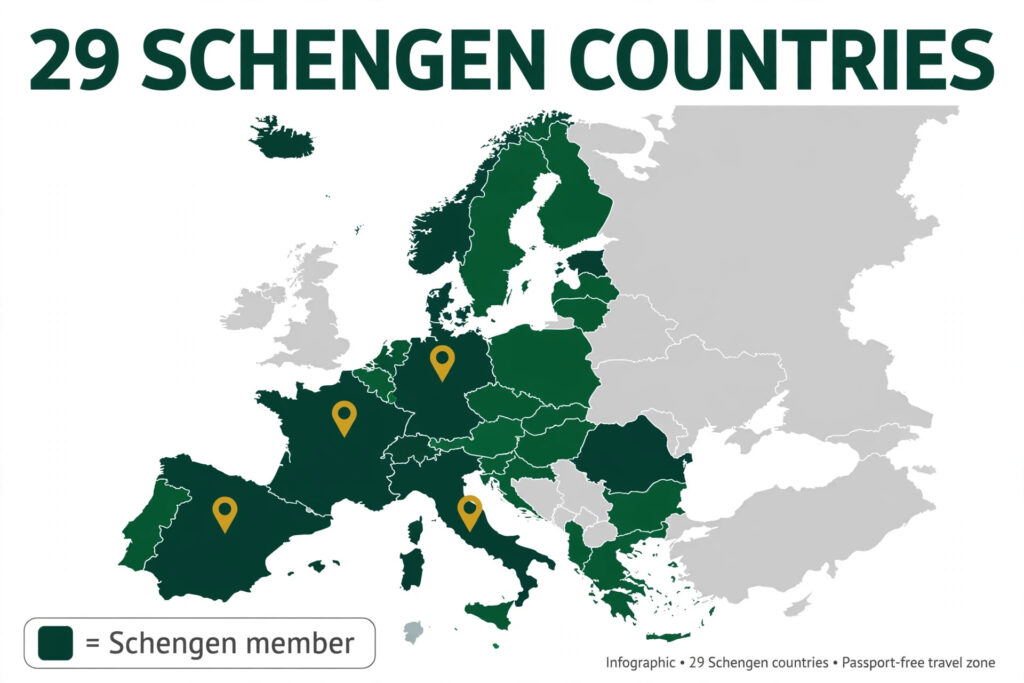
A Schengen visa (Type C) is a single permit letting non-EU travelers move freely across the Schengen Area — 29 European countries, no internal border checks. One visa, 29 destinations.
The zone keeps growing: Croatia joined in 2023, and Bulgaria and Romania became full members in 2025. The 29 members: Austria, Belgium, Bulgaria, Croatia, Czech Republic, Denmark, Estonia, Finland, France, Germany, Greece, Hungary, Iceland, Italy, Latvia, Liechtenstein, Lithuania, Luxembourg, Malta, Netherlands, Norway, Poland, Portugal, Romania, Slovakia, Slovenia, Spain, Sweden, and Switzerland.
🌎 One Visa, 29 Countries
The Schengen Area in 2026: Austria, Belgium, Bulgaria, Croatia, Czech Republic, Denmark, Estonia, Finland, France, Germany, Greece, Hungary, Iceland, Italy, Latvia, Liechtenstein, Lithuania, Luxembourg, Malta, Netherlands, Norway, Poland, Portugal, Romania, Slovakia, Slovenia, Spain, Sweden, Switzerland. Schengen is not the same as the EU — Norway, Iceland, Switzerland and Liechtenstein are in Schengen but not the EU.
Member countries
No internal border checks between them.
Days max
In any rolling 180-day period.
Visa fee
Adults in 2026; €45 for children 6–11.
Days processing
Standard decision time at the consulate.
Schengen ≠ EU: Norway, Iceland, Switzerland, and Liechtenstein are in Schengen but not the EU. Always verify the current list.
Schengen Visa Requirements 2026
Every consulate applies the same core requirements under the EU Visa Code:
- A genuine travel purpose — tourism, business, or visiting family/friends.
- Enough money to cover your stay and return — proven with bank statements.
- Reason to return home — job, business, family, or property ties.
- Travel medical insurance — at least €30,000, valid in all Schengen states.
- Passport valid 3+ months beyond your Schengen departure, with 2 blank pages.
Cross-check the European Commission’s Schengen visa page and your consulate’s local checklist — some ask for extras.
Schengen Visa Documents Checklist
Gather these before booking your appointment:
- ✅ Signed Schengen visa application form
- ✅ Passport + copies of previous visas (if any)
- ✅ Two recent passport photos (white background)
- ✅ Travel insurance policy (minimum €30,000 coverage)
- ✅ Flight reservation (don’t buy non-refundable tickets yet)
- ✅ Hotel bookings or invitation letter for the full stay
- ✅ Bank statements (last 3–6 months) showing stable funds
- ✅ Employment letter / business registration / student enrollment
- ✅ Day-by-day travel itinerary
- ✅ Visa fee payment receipt (€90)
✅ Documents Checklist
Gather every item before booking your appointment.
Application form
Signed Schengen visa application form.
Passport
Valid 3+ months beyond departure, 2 blank pages.
Photos
Two recent biometric photos, white background.
Insurance
Travel medical insurance, minimum €30,000.
Flights
Reservation only — do not buy non-refundable tickets yet.
Accommodation
Hotel bookings or invitation letter for the full stay.
Bank statements
Last 3–6 months showing stable funds.
Employment proof
Employer letter, business registration or enrollment.
Itinerary
Day-by-day travel plan.
Fee receipt
€90 visa fee payment.
Find free tools for each item in the Schengen visa tools collection.
⚡ Get Your Approval Readiness Score
RiskScan™ checks your refusal risk and flags missing documents in 60 seconds — before the consulate does. From $12.
Schengen Visa Fee 2026
The standard Schengen visa fee in 2026 is:
- €90 — adults and children 12 and over
- €45 — children aged 6 to 11
- Free — children under 6, plus certain categories (spouses of EU citizens, students on study trips, researchers)
Beyond the consulate fee: visa centers (VFS/BLS) add a service fee (~€20–40), plus insurance. Non-refundable — even if refused. One more reason to get it right first time.
How to Apply for a Schengen Visa: Step-by-Step
- Pick the right consulate — the country of your longest stay (“main destination”); if equal, the country of first entry.
- Gather documents from the checklist above; translate anything not in English or the consulate’s language.
- Book your appointment at the consulate or visa center (VFS/BLS) — slots fill fast in summer.
- Attend in person. Submit documents, pay the fee, and give biometrics (fingerprints + photo).
- Track and wait — normally 15 calendar days. When notified, collect your passport and check the visa sticker’s dates and entries.
Apply up to 6 months before travel (9 for seafarers), no later than 15 days before. Sweet spot: 6–8 weeks ahead.
New EES Rules at the Border (2026)
The biggest change in decades: the EU’s Entry/Exit System (EES) is fully live at all Schengen external borders since April 2026. Passport stamps are gone — at first entry:
👁 What Happens at the Border (EES)
Passport stamps are gone. At your first entry in 2026:
Passport scan
At an automated gate or border desk.
Four fingerprints
Captured electronically.
Facial image
Matched to your biometrics.
Entry logged
Date, border point and stay recorded centrally for 3 years.
- Passport scan at an automated gate or border desk.
- Four fingerprints captured electronically.
- Facial image matched to your biometrics.
- Entry logged — date, border point, and stay recorded centrally.
Data is stored 3 years and shared across all Schengen states — overstays are detected automatically now. See the official EU EES page and our overstay 2026 guide for what violations cost.
ETIAS — a separate pre-travel authorization planned for visa-exempt travelers, not a visa. Its timeline has shifted before; check the current official status.
The 90/180 Rule Explained (Simply)
The 90/180 rule: you may stay at most 90 days within any rolling 180-day period. “Rolling” means the window slides — each day, the system looks back 180 days and counts your Schengen days. That count must never exceed 90.
⏱️ The 90/180 Rule, Visualized
Every day, the system looks back 180 days and counts your Schengen days. Example:
31 days in France (January) + 31 in Spain (March) = 62 days used on April 1st.
28 days remain. Country-hopping resets nothing — all Schengen days count together.
Example: 31 days in France (January) + 31 in Spain (March) = 62 used on April 1st — 28 remain. All Schengen countries count together; country-hopping resets nothing.
Never calculate this by hand — one miscounted day can mean an overstay record. Use the free 90/180 day counter and Schengen calculators instead.
Schengen Visa Processing Time
Under the EU Visa Code, consulates must decide within 15 calendar days of receiving a complete application — up to 45 days for complex cases needing detailed examination.
Reality check: the clock starts when the consulate gets your file, and appointment availability is the real bottleneck in peak season. Apply 6–8 weeks ahead; never book non-refundable flights before approval.
DIY Application vs Visaora Intelligence Suite
An honest comparison of both paths:
| DIY Application | Intelligence Suite | |
|---|---|---|
| Extra cost | €0 (your time) | From $12 |
| Document check | Manual, from checklists | DocScan™ flags gaps automatically |
| Refusal risk score | Guesswork | RiskScan™ scored report |
| Cover letter | Write it yourself | CoverScan™ drafts it |
| Time needed | Hours of research | ~60 seconds for the scan |
The Suite can’t replace the consulate’s decision — but it catches the fixable mistakes behind most refusals. Learn more.
How to Avoid Rejection
Most refusals come down to avoidable errors: thin bank statements, vague itinerary, weak home ties, missing insurance, inconsistent documents. Fix each — stable 3–6 month bank history, day-by-day itinerary with bookings, employment letter, compliant €30,000+ insurance, one consistent story.
With EES live, any past overstay is visible to every Schengen state when you reapply — protect your record with the 90/180 counter.
⚡ Get Your Approval Readiness Score
RiskScan™ checks your refusal risk and flags missing documents in 60 seconds — before the consulate does. From $12.
Schengen Visa 2026 — FAQs
How much does a Schengen visa cost in 2026?
In 2026 the Schengen visa fee is €90 for adults, €45 for children aged 6–11, and free for children under 6. Most applicants also pay a visa-center service fee of roughly €20–40. The fee is non-refundable — you do not get it back if your visa is refused.
How long does Schengen visa processing take?
Consulates must decide within 15 calendar days of receiving a complete application, but complex cases can take up to 45 days. In practice, appointment availability is the real delay. Apply 6–8 weeks before travel and never book non-refundable flights before approval.
What is the 90/180-day rule?
You may spend a maximum of 90 days inside the Schengen Area within any rolling 180-day period. Every day, the system looks back 180 days and counts your Schengen days — the total must stay at or under 90. Time in all Schengen countries counts together.
What is the EES and how does it affect travelers?
The Entry/Exit System (EES) is the EU’s digital border system, fully live since April 2026. At your first entry it records four fingerprints and a facial image, replacing passport stamps. It automatically tracks your 90/180-day limit and flags overstays instantly across all Schengen states.
Do I need travel insurance for a Schengen visa?
Yes — travel medical insurance is mandatory. It must cover at least €30,000 for emergency medical care, hospitalization, and repatriation, and be valid in all Schengen countries for your entire stay. Applications without compliant insurance are routinely refused at the document check.
Can I work in Europe on a Schengen visa?
No. A Schengen short-stay visa covers tourism, business trips, and family visits only — it does not permit employment. Working requires a national long-stay visa or work permit from the specific country. Attempting to work on a tourist visa can lead to deportation and bans.
Which country’s consulate should I apply to?
Apply at the consulate of your main destination — the country where you will spend the most days. If you will spend equal time in several countries, apply to the country where you first enter the Schengen Area. Applying at the wrong consulate is a common refusal reason.
What happens if my Schengen visa is refused?
You receive a written refusal stating the reason. You can either fix the issues and submit a fresh application (paying the fee again) or appeal the decision. Before reapplying, identify exactly what went wrong — a RiskScan™ report from Visaora’s Intelligence Suite can pinpoint your weak points.
Ready to apply? Start with the free Schengen visa tools and 90/180 counter, then get your readiness score from the Intelligence Suite — from $12. Safe travels! ✈️
✈️ Planning Your Trip?
We may earn a commission — at no extra cost to you. Learn more
Pingback: Schengen Business Visa Requirements 2026: Full Guide
Pingback: Schengen Visa for Pakistani Freelancers 2026 Guide