UK Visa Processing Time After Biometrics 2026: Every Route
By Visaora Editorial Team · Updated November 2026 · 12 min read
Quick Answer: UK visa processing time is counted from your biometrics appointment, not from the day you apply online. From outside the UK, the published time is 3 weeks for visitor, student and work visas, and 12 weeks for family visas. Inside the UK, most applications take 8 weeks. A £500 priority service cuts most waits to 5 working days.
Key takeaways
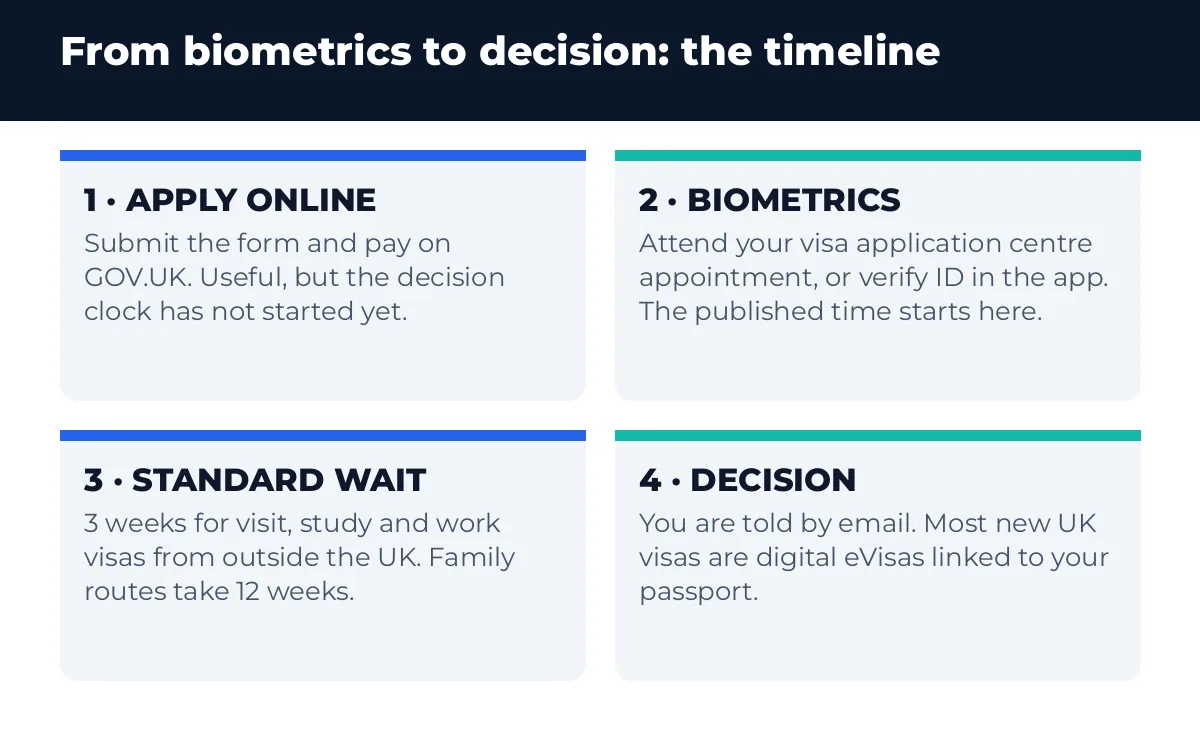
- The decision clock starts on the day you give fingerprints and a photo at a visa application centre, or verify your identity in the UK Immigration: ID Check app.
- Outside the UK: 3 weeks for visit, study and work routes; 12 weeks for partner, parent, child and adult dependent applications.
- Inside the UK: 8 weeks for most routes, 3 weeks for Health and Care Worker and Start-up, and 12 months for some family cases.
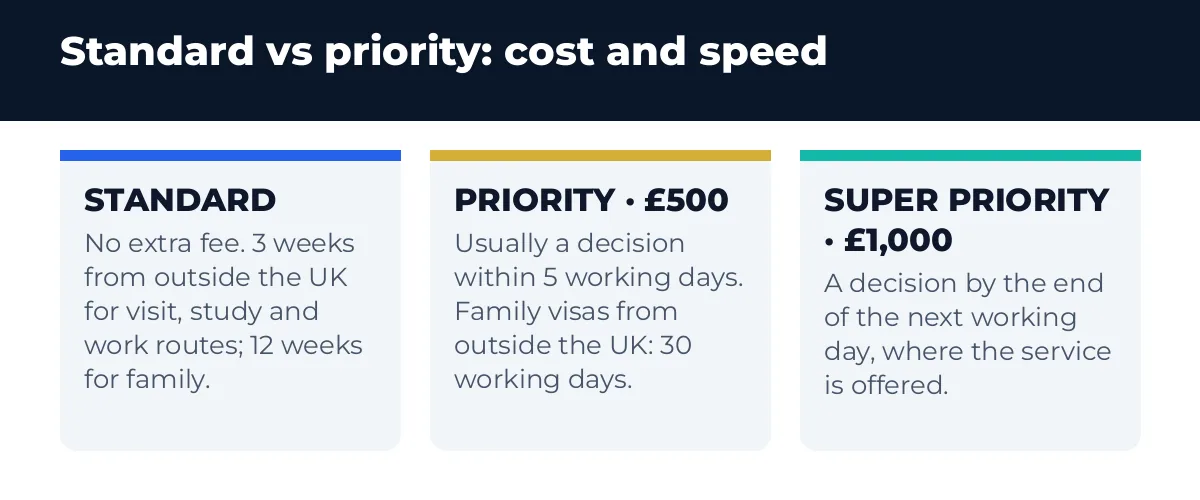
- Priority costs £500 per person for a decision in about 5 working days. Super priority costs £1,000 for a decision by the end of the next working day.
- Published times are service standards for straightforward applications, counted in UK working days. They are targets, not promises.
Almost every “my visa is late” panic starts with one misunderstanding: counting from the wrong day. People submit the online form, wait three weeks, and conclude something has gone wrong, when the official count had not even started for the first of those weeks. This guide walks through exactly when the clock starts, what GOV.UK currently publishes for each route, what the paid fast lanes really buy, and what to do when your wait runs past the standard. If you are still at the planning stage, start with our UK Visitor Visa Guide for fees and eligibility, then come back here for the timeline.
Contents
- When does the UK visa clock actually start?
- How long does a UK visa take from outside the UK?
- How long does a UK visa take from inside the UK?
- Can you pay for a faster UK visa decision?
- Why is your UK visa taking longer than the standard?
- What should you do while you wait?
- Example scenario: two applicants, two very different waits
- Common mistakes that make the wait feel longer
- Frequently asked questions
- Sources
When does the UK visa clock actually start?
UK Visas and Immigration (UKVI) starts processing your application on the day your identity is confirmed. That means one of two moments: you attend your appointment at a visa application centre and provide your fingerprints and photograph, or you verify your identity and submit your documents through the UK Immigration: ID Check app, if UKVI has told you that you can use it. The day you fill in the online form and pay the fee does not start the count.
This one detail explains most of the gap between the published time and what applicants experience. If appointments in your city are booked out ten days ahead, your real wait is ten days plus the published time. GOV.UK also counts in the UK working week: Monday to Friday, including UK public holidays, but not public holidays in the country where you apply. A three-week standard is fifteen working days, and a UK bank holiday inside your window does not pause it.
Immigration agency? Qualify UAE leads free with Visaora Agency Leads → https://visaora.io/visaora-agency-leads/
How long does a UK visa take from outside the UK?
For most people, three weeks. GOV.UK’s current waiting times for applications made outside the UK put visitor, student and work visas at 3 weeks, and family visas at 12 weeks. The table below is the full picture for the routes readers ask about most.
| Route (applying outside the UK) | Published processing time |
|---|---|
| Standard Visitor, Marriage Visitor, Transit | 3 weeks |
| Student, Child Student, Short-term Student | 3 weeks |
| Skilled Worker, Health and Care Worker | 3 weeks |
| Temporary work routes (Charity, Creative, Seasonal, Religious and others) | 3 weeks |
| Global Talent, Youth Mobility, UK Ancestry, High Potential Individual | 3 weeks |
| Partner or spouse | 12 weeks |
| Parent, Child, Adult coming to be cared for by a relative | 12 weeks |
| British National (Overseas) | 12 weeks |
Last checked: November 2026 – Sources: GOV.UK, visa decision waiting times for applications outside the UK.
Two things hide inside that “3 weeks”. First, it applies to straightforward applications; a file that needs extra checks leaves the standard behind, which is why two friends who applied on the same day can get decisions a month apart. Second, the earliest you can apply matters as much as the wait itself. Visitor visas can be lodged up to 3 months before you travel, and students can apply up to 6 months before their course starts. Using that full window is the cheapest speed upgrade there is. Our UK visitor visa requirements guide covers the earliest application dates route by route, and the UK Skilled Worker Points Calculator helps work-route applicants check eligibility before they start a clock they cannot pause.
How long does a UK visa take from inside the UK?
Longer, in most cases: 8 weeks is the standard for the majority of in-country applications. Extensions and switches for students, skilled workers and most other routes sit at 8 weeks. Two routes are faster: Health and Care Worker and Start-up applications are published at 3 weeks. Family cases split sharply. A partner or spouse application that meets the minimum income and English language requirements is listed at 8 weeks, but partner applications on the private life route and parent applications are published at 12 months. British National (Overseas) applications made inside the UK take 12 weeks.
The in-country wait carries a hard rule that catches people out every year: while an application made inside the UK is undecided, travelling outside the Common Travel Area (the UK, Ireland, the Channel Islands and the Isle of Man) usually counts as withdrawing it. A holiday can quietly cancel the application you are waiting on. If your current leave expires while you wait, section 3C of the Immigration Act normally extends your existing conditions until the decision, provided you applied in time — so a long wait alone does not make you an overstayer.
Can you pay for a faster UK visa decision?
Yes, in many countries and on many routes, and it is bought at the application centre stage rather than from any agent. GOV.UK lists two paid services. The priority service costs £500 per applicant and usually brings a decision within 5 working days for most visa applications. Two exceptions matter: settlement and citizenship applications usually take 30 working days on priority, and family visa applications made from outside the UK also usually take 30 working days. The super priority service costs £1,000 per applicant and usually brings a decision by the end of the next working day after your appointment or document upload.
Three warnings before you pay. First, neither service is offered on every route or in every country; you find out what is available for your application when you apply. Second, the fee buys speed, not a better outcome — a weak file is simply refused faster. Third, the fee is per person, so a family of four pays four times. If UKVI cannot provide the service you paid for, the fee can be refunded; if your application is refused after the service was provided, it is not. Students on a fixed course start date and workers with a start date in their contract are the applicants who usually get real value from priority. If your dates are flexible, the standard queue plus an early application is often the smarter spend. Applicants budgeting for a partner application can model the income side with our UK spouse visa financial requirement guide before deciding whether speed is worth £500 a head.
Why is your UK visa taking longer than the standard?
Because something in the file needs more work than a straightforward case. UKVI’s own published reasons for longer decisions are practical ones: information in the application that is inaccurate or needs further consideration, a need for further evidence such as proof of funds, documents that have to be verified with the issuer, an interview, personal circumstances such as a criminal conviction, a surge in demand, or a technical problem on their side. Verification is the slow one most applicants never see — a bank statement or employment letter that UKVI chooses to confirm with the bank or employer adds days that no one can hurry.
Peak seasons stretch things too. Applications made just before the summer travel peak and the September student intake compete with the year’s highest volumes. And remember what the standard is measured on: it is a customer service target for straightforward cases, not a deadline the Home Office legally owes you. If your wait passes the standard, that alone is not evidence that anything has gone wrong with your file. What you can control sits before submission: consistent documents, funds that match the route’s rules, and forms that agree with each other. Our guide to UK visa refusal reasons and reapplying shows the document problems that most often trigger both delays and refusals.
What should you do while you wait?
Wait actively, not anxiously. These steps keep you inside the rules and ready for either answer:
- Count correctly. Mark your biometrics date, then count the published working days for your route. Do not start counting from the online submission date.
- Use the official checker. GOV.UK’s visa processing time service gives the current standard for your visa type and country; check it before drawing conclusions from forums.
- Keep travel flexible. Do not book non-refundable flights or hotels against an undecided application. GOV.UK advises against booking travel until you have the decision.
- Watch your email, including spam. Requests for further evidence and interview invitations arrive by email, and a missed request is a common cause of both delay and refusal.
- Only chase once you are clearly past the standard. If the published time plus a reasonable buffer has passed, contact UKVI through its official contact service and keep your application reference to hand.
Example scenario: two applicants, two very different waits
Example — the people below are invented to show how the counting works; the times are the real published standards. Sara applies for a Standard Visitor visa from Dubai on 1 June. Her visa application centre appointment is not available until 10 June, so her three-week standard runs from 10 June: fifteen working days, landing around 1 July. Her brother applies for a partner visa the same week. His standard is 12 weeks, so his decision window lands in early September — from an application made on the same day, in the same family. A third friend, applying to extend a Student visa inside the UK, works to the 8-week standard and does not book a summer trip home, because leaving the Common Travel Area would withdraw her application. Same system, three clocks.
Common mistakes that make the wait feel longer
- Counting from the wrong day. The form submission date starts nothing. Biometrics or the ID Check app starts the clock.
- Booking non-refundable travel first. Flights do not speed up decisions, and a refusal or a slow decision leaves you holding the cost.
- Paying for priority on a weak file. Priority changes when you hear, not what you hear. Fix the file first.
- Assuming priority exists everywhere. Availability varies by route and country. Some application centres never offer it on some routes.
- Leaving the UK mid-application. For in-country applications, travel outside the Common Travel Area usually withdraws the application.
- Missing the evidence request. Interview invitations and document requests go to the email you applied with. Check it daily, spam folder included.
Frequently asked questions
How long does a UK visitor visa take after biometrics?
The published standard is 3 weeks — fifteen UK working days — from your biometrics appointment for applications made outside the UK. Straightforward cases often finish inside it; cases needing verification or an interview take longer. The priority service, where offered, usually decides within 5 working days for £500 per applicant.
Does UK visa processing time start when I submit the online form?
No. Submitting and paying online does not start the clock. UKVI starts processing when you attend your visa application centre appointment and give fingerprints and a photo, or when you verify your identity and submit documents through the UK Immigration: ID Check app, if you were told you can use it.
How long does a UK spouse or partner visa take in 2026?
From outside the UK, the standard is 12 weeks. Priority for family applications made abroad usually means a decision within 30 working days, not 5, and costs £500 per applicant. From inside the UK, a partner application that meets the income and English requirements is published at 8 weeks; private life partner cases take 12 months.
How much does the UK priority visa service cost?
The priority service costs £500 per applicant on top of the visa fee, and usually delivers a decision within 5 working days for most routes. The super priority service costs £1,000 per applicant for a decision by the end of the next working day. Neither is available on every route or in every country.
Why has my UK visa taken longer than 3 weeks?
The 3-week figure is a service standard for straightforward applications, not a deadline. UKVI says decisions take longer when information needs further consideration, extra evidence is required, documents must be verified, an interview is needed, or volumes surge. If you are well past the standard, contact UKVI through its official contact service with your reference ready.
Can I travel while my UK visa application is being decided?
If you applied from outside the UK, your passport is normally held or returned under the centre’s keep-my-passport option, so plan as if you cannot travel on it. If you applied inside the UK, travelling outside the Common Travel Area usually counts as withdrawing your application, so most applicants stay put until the decision arrives.
Sources
- GOV.UK — Visa decision waiting times: applications outside the UK
- GOV.UK — Visa decision waiting times: applications inside the UK
- GOV.UK — Get a faster decision on your visa or settlement application
Planning a UK application? Run your dates and documents through the free UK Student Visa Funds Calculator and the rest of our 100+ free tools before you submit — a clean file is the one legal way to stay at the fast end of every timeline in this guide.
Visaora provides software tools and general information, not legal advice. Rules change; always confirm with the official authority.
✈️ Planning Your Trip?
We may earn a commission — at no extra cost to you. Learn more