If you run a US visa processing UAE agency, your B-1/B-2 pipeline now runs on dated official lines, not on interview dates. As of 19 October 2026, the US missions in the United Arab Emirates and Saudi Arabia state that routine visa processing is not available, and the State Department instructs nonimmigrant applicants to apply in their country of nationality or residence. This playbook gives your team a triage workflow — hold, nationality-country, or renewal-waiver — plus EN/AR client message templates and a documentation SOP that records every advice decision without promising an outcome.
Last reviewed: 19 October 2026
Quick Answer: Routine US visa processing is not available in the UAE or Saudi Arabia (as of 19 October 2026, per the US embassy notices). Triage every US client into one of three lanes — hold, apply in the country of nationality, or check renewal interview-waiver eligibility. Advise in writing, date every fact you quote, and never promise an outcome.
Key Takeaways
- US missions in the UAE and Saudi Arabia state that routine visa processing is not available (lines quoted and dated below).
- State Department rule (last updated 15 July 2026): nonimmigrant applicants should schedule interviews in their country of nationality or residence; fees are non-refundable and non-transferable.
- Triage every US client into one lane — hold, nationality-country, or renewal-waiver — and log the lane in the client file.
- The UAE embassy page also lists Friday appointment releases: a documented conflict. Re-check weekly; do not resolve it for the client.
- Every client message carries five elements plus a no-promise line. Keep a copy in the case file — that is your audit trail.
In This Guide
- US visa processing UAE agency briefing: what the embassies say now
- Triage your US pipeline: hold, nationality-country, renewal-waiver
- Country-of-residence rule explained for agency staff
- Client message templates (EN/AR) without promises
- Rebuilding the case file while clients wait
- How a 5-scan case file documents your advice
US visa processing UAE agency briefing: what the embassies say now (quoted, dated)
Start every team briefing with the exact lines, not with social-media summaries. Here is what the official pages say as of 19 October 2026.
United Arab Emirates. The US Embassy & Consulate visa page (Abu Dhabi and Dubai) carries this notice:
“While the U.S. Embassy in Abu Dhabi and Consulate in Dubai are open, routine visa processing is not available in the United Arab Emirates at this time. Further updates regarding visa processing will be posted here when available.”
The same page adds that applicants for US nonimmigrant visas should schedule their interview appointments “at the U.S. Embassy or Consulate in their country of residence or nationality,” and that visa application fees are non-refundable and non-transferable. (ae.usembassy.gov/visas — verified 19 October 2026.)
Saudi Arabia. As of 16 October 2026 research, the US Embassy in Saudi Arabia’s visa page carried a notice that routine visa processing is not available in Saudi Arabia. (sa.usembassy.gov/visas.) A direct re-check on 19 October 2026 was not possible from the research location (page access restricted), so treat the 16 October reading as the latest confirmed line and re-verify it yourself before quoting it to clients.
The documented conflict — present it honestly, do not resolve it. The UAE embassy page that says “routine visa processing is not available” also says, further down the same page, that the Embassy in Abu Dhabi and the Consulate General in Dubai “release appointments for nonimmigrant visa interviews every Friday morning between 7:30 a.m. and 11:30 a.m.” And the State Department’s official wait-time tables continue to show entries for Abu Dhabi and Dubai. We present both facts with their dates; we do not decide which one “wins.” Your clients deserve the contradiction, stated plainly, not a guess about it.
Agency SOP: the weekly check. Assign one staff member to re-check both embassy pages every Monday morning and log the date, the exact notice text, and any change. The UAE page promises “further updates regarding visa processing will be posted here when available” — your log is how you catch them first. Never advise from last month’s screenshot.
Triage your US pipeline: hold, nationality-country, renewal-waiver
Open every US client file and assign it to exactly one lane. No file stays “undecided” — an undecided file is how clients start calling embassies themselves and getting inconsistent answers.
| Lane | Who belongs here | Your action |
|---|---|---|
| Hold | Client applies on the basis of UAE/Saudi residence (iqama) with no workable alternative post | Pause local interview planning; switch to readiness work; schedule the next status check |
| Nationality-country | Client holds a passport from a country where US missions are processing normally | Research that post’s wait times and residence-evidence rules before advising travel |
| Renewal-waiver | Client is renewing a previous US visa and may qualify for an interview waiver | Verify current waiver criteria on travel.state.gov; do not assume eligibility |
A worked example. Take a hypothetical client, Mariam: Egyptian passport, UAE residence visa, first-time B-1/B-2 applicant, wants to travel in March. She does not belong in the hold lane forever — her nationality-country lane is Egypt, where she can check the US mission’s current processing status and wait times. Contrast with a hypothetical client, Daniyal: Pakistani passport, Saudi iqama, previous US visa expired 18 months ago. His file goes to the renewal-waiver lane first: verify whether the current interview-waiver criteria cover him before planning any travel for an interview. Same pause, different lane — the lane decision is the advice, and the lane decision is what you document.
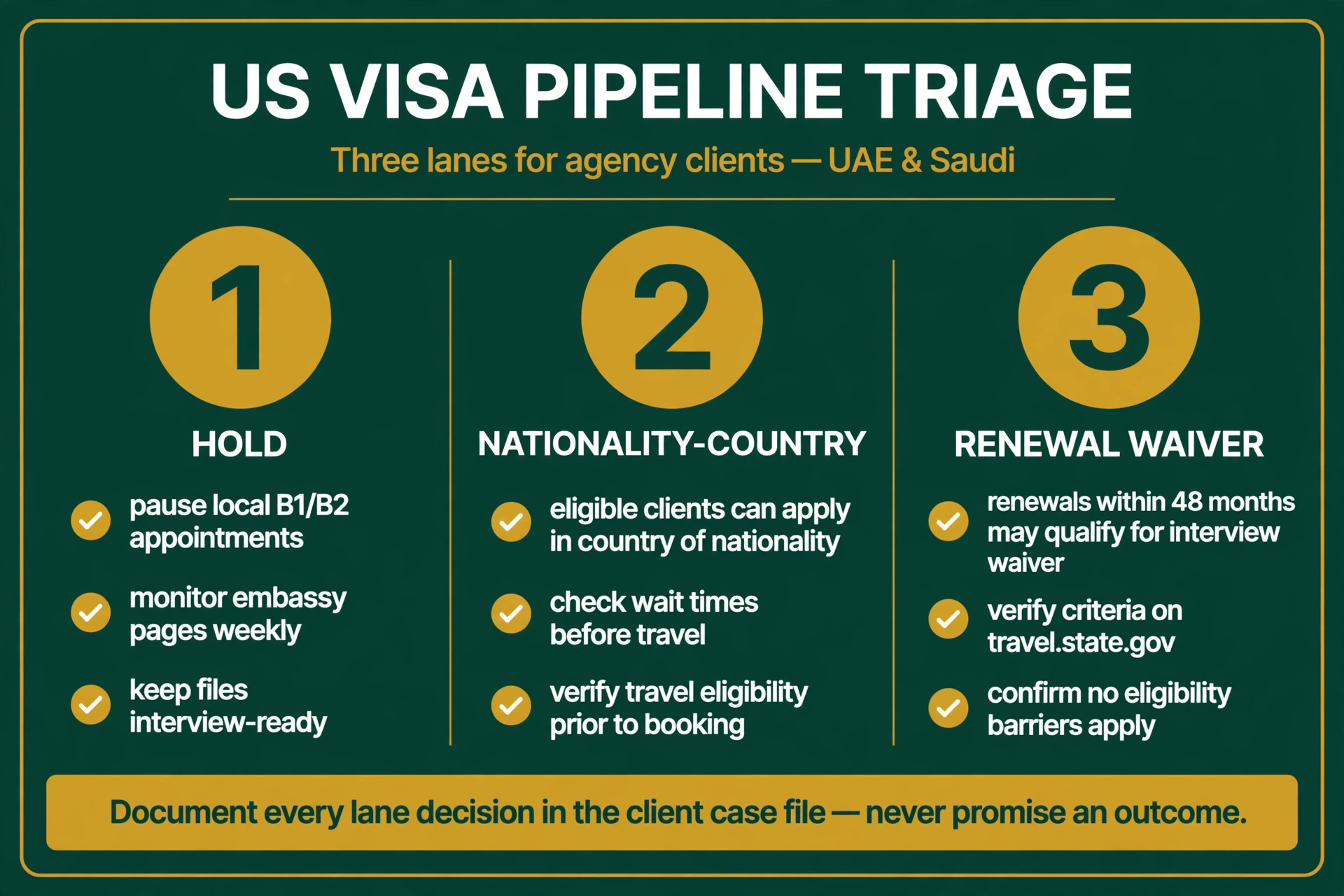
Three rules for the triage meeting:
- One lane per file, decided this week. Write the lane and the date in the file. A lane is a decision; “waiting to see” is not.
- Never promise that a lane leads to a visa. The lane is a plan for how to proceed, not a prediction of the outcome.
- Re-triage on every status change. If the embassy pages change, if the client’s travel happens, if waiver criteria update — the lane is reviewed again.
Country-of-residence rule explained for agency staff
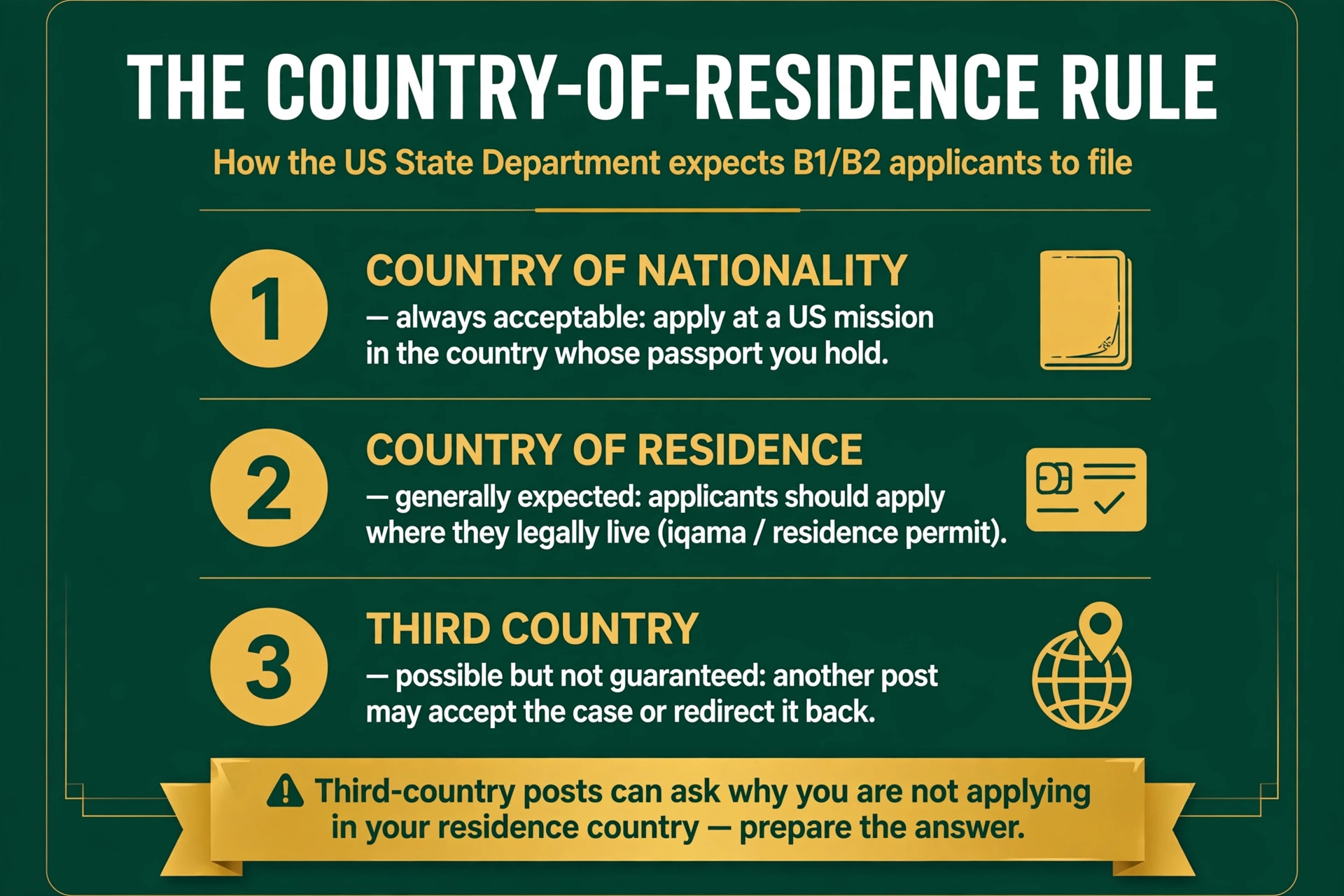
The State Department’s notice, “Adjudicating Nonimmigrant Visa (NIV) Applicants in Their Country of Residence” (last updated 15 July 2026, verified 19 October 2026), sets the rule your staff must be able to explain without reading from a screen:
- Where to apply: nonimmigrant applicants should schedule interviews at the US Embassy or Consulate in their country of nationality or residence.
- Prove residence: if the application is based on residency, the applicant must be able to demonstrate residence in that country — in the Gulf, that means a valid residence permit (iqama) and ties such as employment or tenancy.
- Nationals of countries without routine processing must apply at a designated post, unless their residence is elsewhere.
- Third-country applications are discouraged, not banned: fees for interviews scheduled outside the country of nationality or residence will not be refunded and cannot be transferred, and applicants “should expect to wait significantly longer for an appointment.”
- Existing appointments will generally not be cancelled (with narrow exceptions at specific posts).
- Diplomatic and official categories (A, G, C-2, C-3, NATO) are excepted — irrelevant for B-1/B-2 client files, but know they exist.
(travel.state.gov — NIV country-of-residence notice)
What this means in plain language for your clients: a resident of Dubai cannot simply fly to a third country and expect the same treatment as applying in their country of nationality or residence. The post may accept the case or redirect it back, the fee stays non-refundable either way, and the wait is longer. That is not a refusal to help — it is the honest basis for the nationality-country lane in your triage.
Use the US visa appointment wait-times guide to compare posts before you advise any client to travel for an interview — but treat wait-time tables as indicative, not as a promise of a slot.
Client message templates (EN/AR) without promises
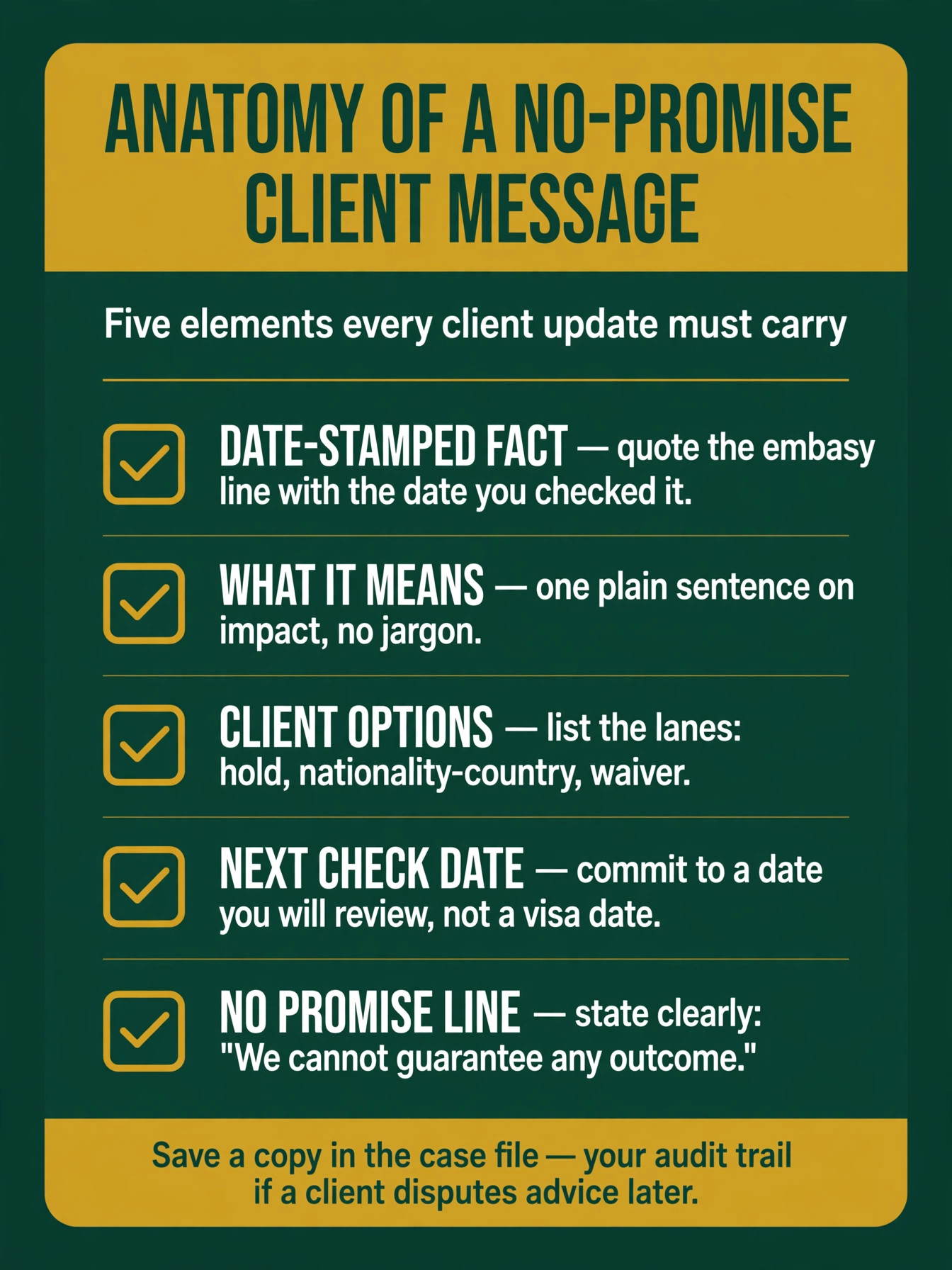
Every client update must carry five elements — no exceptions, no “quick call will do”:
- 1. Date-stamped fact — quote the embassy line with the date you checked it.
- 2. What it means — one plain sentence on the impact, no jargon.
- 3. The client’s options — the lanes: hold, nationality-country, waiver.
- 4. Next check date — commit to a date you will review the file, never to a visa date.
- 5. No-promise line — state clearly that no outcome can be guaranteed.
English template:
Dear [Name],
As of [date], the US Embassy & Consulate in the UAE states that “routine visa processing is not available in the United Arab Emirates at this time” (checked [date]; we re-check every Monday). This means we are pausing interview scheduling for your file.
Your options are: (1) hold — we keep your file interview-ready and review on [next check date]; (2) nationality-country — apply in [country] if its US mission is processing; (3) renewal-waiver — we verify whether you qualify for an interview waiver.
We cannot guarantee any visa outcome or timeline. We will update you again on [next check date].
[Agency name]
Arabic template:
السادة الكرام،
حسب آخر مراجعة بتاريخ [التاريخ]، تعلن السفارة والقنصلية الأمريكية في الإمارات أن “المعالجة الاعتيادية للتأشيرات غير متوفرة حالياً”. لذلك نوقف حالياً جدولة مواعيد المقابلات لملفكم.
خياراتكم هي: (1) الانتظار — نُبقي ملفكم جاهزاً ونراجعه بتاريخ [تاريخ المراجعة]؛ (2) التقديم من بلد الجنسية — إذا كانت البعثة الأمريكية هناك تعمل بشكل طبيعي؛ (3) الإعفاء من المقابلة — نتحقق من أهليتكم للتجديد دون مقابلة.
لا نستطيع ضمان أي نتيجة أو موعد. سنوافيكم بالتحديث القادم بتاريخ [تاريخ المراجعة].
[اسم الوكالة]Send every update in writing (email or WhatsApp Business — keep the thread), and save a copy in the client file. If a client later disputes what they were told, the dated message is your evidence. For clients facing a previous refusal, the 214(b) refusal guide is a useful read to attach — education now prevents a weak reapplication later.
Rebuilding the case file while clients wait
A pause is not dead time. Files that are interview-ready on day one of resumed processing will move first. Put every hold-lane file through this rebuild checklist:
- DS-160 readiness. Draft the DS-160 answers now (travel history, employment, ties) so the form is accurate and consistent when it is time to submit. Inconsistencies between the form and the interview are a classic refusal trigger.
- Document pack. Passport validity, iqama/residence permit, employment letter, bank statements, travel history evidence, invitation or conference details for B-1. Scan everything; name files clearly.
- Fee timing. The B-1/B-2 nonimmigrant application (MRV) fee is commonly reported at US$185 per applicant as of October 2026. The US embassy notice states fees are non-refundable and non-transferable — do not let clients pay a fresh fee for a post that cannot process their case. “Fees change. Check the official website before you pay” — the embassy page points applicants to travel.state.gov for fee information. Run the numbers for families with the US B-1/B-2 visa fee calculator before anyone pays anything.
- Interview prep. Work through the B-1/B-2 interview prep checklist now, while there is no date pressure. Clients who rehearse early answer calmly later.
- Renewal-waiver verification. For the waiver lane, verify the current interview-waiver criteria on travel.state.gov. Criteria change; last year’s rule is not this year’s rule.
A worked example. A hypothetical family of four (two adults, two children) in the nationality-country lane: each applicant pays their own MRV fee, so four fees before any interview exists — and every one of them non-refundable if the application does not proceed. That is the conversation to have with clients before money moves: map the full fee exposure first, then decide the lane.
How a 5-scan case file documents your advice
When a client asks “why did you tell me to wait?” six months from now, your answer cannot be a memory. It has to be a file. A structured 5-scan case file records the professional work your agency did during the pause:
- 1. Profile & eligibility scan — nationality, residence status (iqama), travel history, previous US visas.
- 2. Status-evidence scan — the dated embassy lines and official source links you relied on.
- 3. Triage-decision scan — the lane chosen (hold / nationality-country / renewal-waiver), the date, and the reason.
- 4. Communication scan — the client messages sent (EN and AR), with the no-promise wording intact.
- 5. Readiness scan — the documents prepped for the day interviews resume.
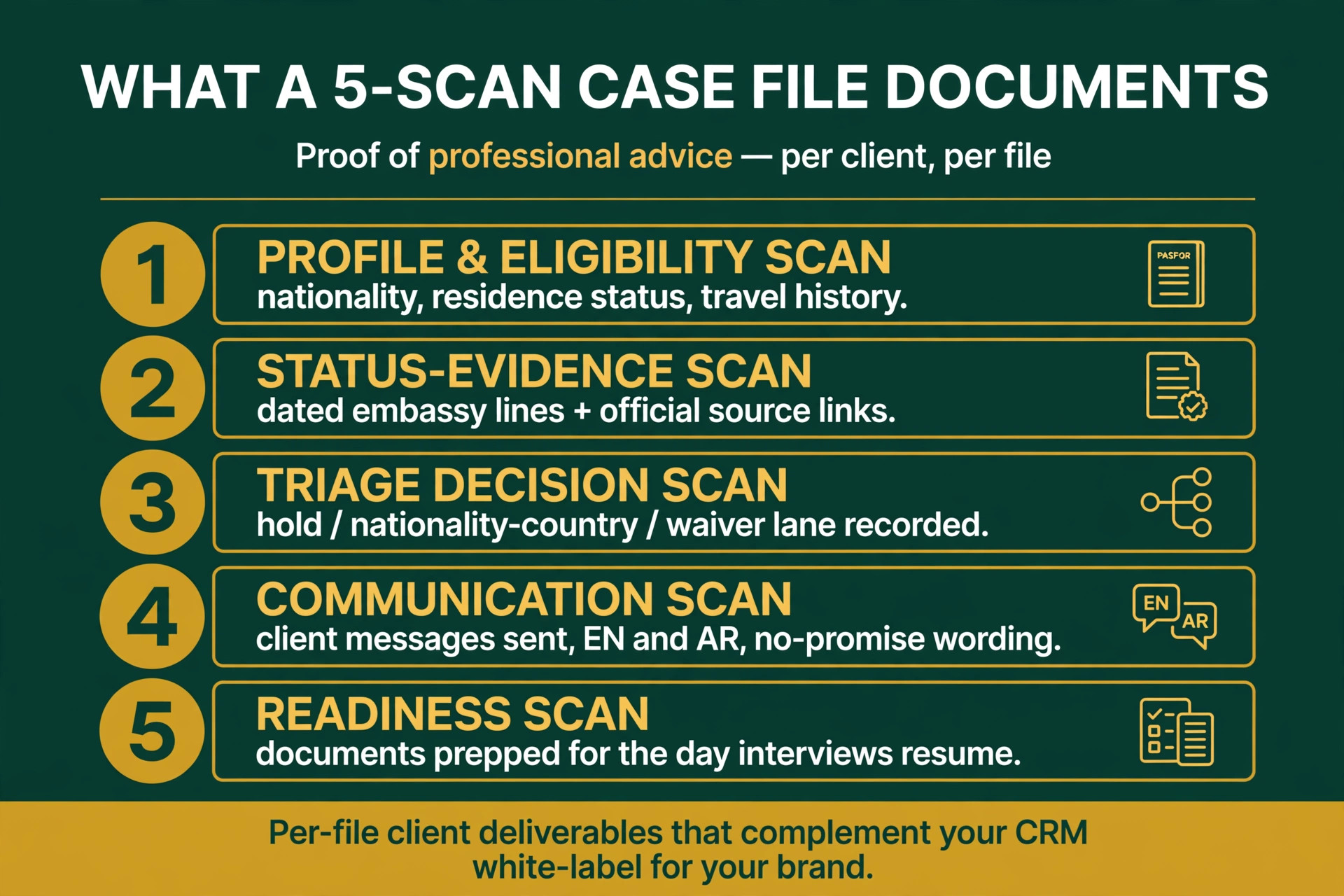
This is what per-file client deliverables look like: a professional document your client can hold, separate from your CRM. Your CRM tracks the relationship; the case file proves the advice. Request a free sample case file from Visaora Agency Suite and see how the five scans read in your own branding.
Frequently Asked Questions
Is US visa processing really paused in the UAE?
As of 19 October 2026, the US Embassy & Consulate visa page states: “routine visa processing is not available in the United Arab Emirates at this time.” The same page also lists Friday appointment releases and wait-time tables show Abu Dhabi/Dubai entries — a documented conflict. Re-check the official page weekly rather than relying on summaries.
Can my client apply for a US visa from their home country instead?
Generally yes — the State Department instructs nonimmigrant applicants to apply in their country of nationality or residence. Before advising travel, verify that the mission in the nationality country is processing normally, check its wait times, and confirm the client can demonstrate the required ties. Travel costs and non-refundable fees apply either way.
Do the Friday appointment releases mean interviews are available in Dubai?
The UAE embassy page says appointments are released Friday mornings 7:30–11:30 a.m., while its notice says routine processing is not available. Both lines are on the same official page as of 19 October 2026. Do not resolve this contradiction for the client — present both lines with their dates and keep the file in the hold lane until the notice changes.
What is the US country-of-residence rule for nonimmigrant visas?
Per the State Department notice (last updated 15 July 2026), NIV applicants should schedule interviews in their country of nationality or residence, and must be able to demonstrate residence where they apply. Third-country applications face significantly longer waits, and fees are non-refundable and non-transferable. Existing appointments are generally not cancelled.
Should clients pay the US visa fee while processing is paused?
Not until the lane is decided. The MRV fee is non-refundable and non-transferable, so paying for a post that cannot process the case wastes the client’s money — commonly reported at US$185 per B-1/B-2 applicant as of October 2026. Map the full fee exposure first, then pay only when the lane requires it. Fees change — check the official website before you pay.
How can agencies document US visa advice to clients?
Use a structured case file: profile and eligibility, dated status evidence with source links, the triage-lane decision, copies of every client message (EN/AR), and the readiness checklist. Each scan is dated and kept in the client’s file, so any advice can be evidenced later. This is the professional standard during a processing pause.
Disclaimer: Visaora is software and does not provide legal advice. Requirements depend on your nationality and situation. Confirm with the official authority or a licensed adviser.
Sources
- US Embassy & Consulate in the UAE — Visas page, notice that “routine visa processing is not available in the United Arab Emirates at this time” (verified 19 October 2026): https://ae.usembassy.gov/visas/
- US Embassy in Saudi Arabia — Visas page (routine processing notice, researched 16 October 2026; direct re-check 19 October 2026 not possible from research location): https://sa.usembassy.gov/visas/
- US Department of State — “Adjudicating Nonimmigrant Visa (NIV) Applicants in Their Country of Residence” (last updated 15 July 2026; verified 19 October 2026): https://travel.state.gov/content/travel/en/News/visas-news/adjudicating-niv-applicants-in-their-country-of-residence.html
- travel.state.gov — official source for US visa fee information (as referenced by the US Embassy UAE visa page): https://travel.state.gov
Related reading: Visaora Agency Suite · US Visa Appointment Wait Times · US B-1/B-2 Visa Fee Calculator · B-1/B-2 Interview Prep Checklist · 214(b) Visa Refusal: Meaning & How to Overcome It
CTA: Request a free sample case file from Visaora Agency Suite and see how a 5-scan file documents your advice during the pause. Agencies: turn this into a client-ready case file with Visaora Agency Suite.
✈️ Planning Your Trip?
We may earn a commission — at no extra cost to you. Learn more