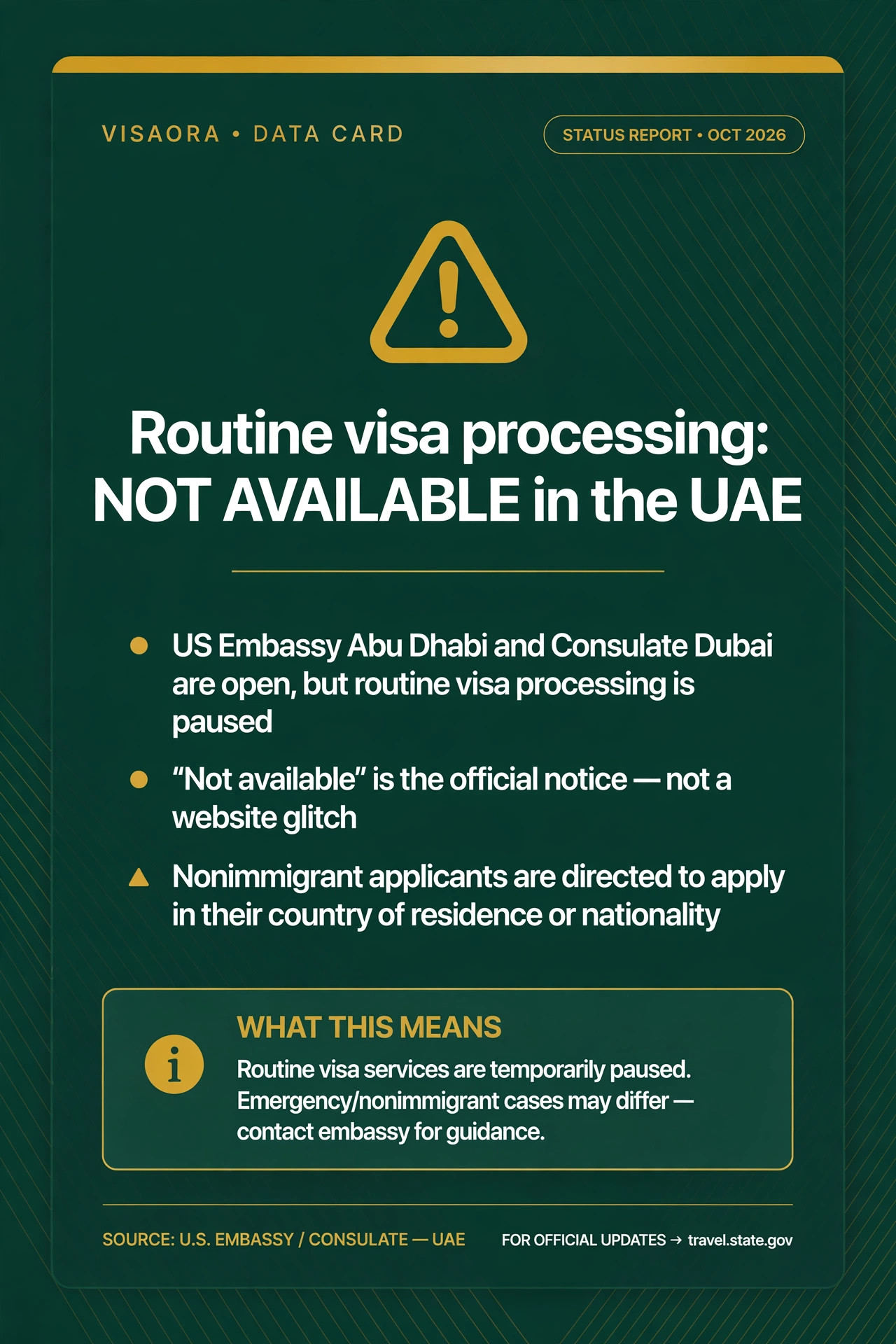
Routine US visa processing in the UAE is currently not available. The US Embassy states that while its posts in Abu Dhabi and Dubai are open, routine processing is paused, and it directs nonimmigrant applicants to schedule interviews in their country of residence or nationality — so a “US visa appointment UAE not available” result is the official position, not a website problem. Your 2026 options are to apply in your country of residence or nationality, pay the non-refundable visa fee only where you will interview, and prepare for an in-person interview, because interview-waiver rules were narrowed in September 2025.
Last reviewed: 19 October 2026
Before anything else, run the numbers: the free US wait-time checker compares official wait times across posts, so you can see which country gives you the earliest realistic interview date.
Quick Answer: The US Embassy in the UAE says routine visa processing is not available in Abu Dhabi or Dubai (as of 19 October 2026) and directs nonimmigrant applicants to their country of residence or nationality. The State Department’s global wait-time table (last updated 17 September 2026) still lists Abu Dhabi B1/B2 next-available at 12.5 months and Dubai at 11.5 months — an automated snapshot that conflicts with the embassy notice, so confirm the live position before paying any fee. Visa fees are non-refundable and non-transferable.
Key Takeaways
- “Routine processing not available” is the official embassy notice for the UAE — not a booking-system glitch.
- The embassy’s rule: nonimmigrant applicants should interview in their country of residence or nationality.
- The MRV fee is non-refundable and non-transferable — pay it only in the country where you will interview.
- Interview waivers were narrowed in September 2025, so most renewals now need an in-person interview.
- Check your nationality against the current restriction list on travel.state.gov before paying anything.
In This Guide
- What “US visa appointment UAE not available” means
- Can UAE residents apply in another country? (residence vs nationality)
- Fees: non-refundable, non-transferable — what to do with a paid MRV
- Renewals and interview waivers after the September 2025 limits
- Nationality restrictions: check your nationality first
- Checklist before you book anywhere
What “US visa appointment UAE not available” means
The notice on the US Embassy in the UAE’s visas page reads: “While the U.S. Embassy in Abu Dhabi and Consulate in Dubai are open, routine visa processing is not available in the United Arab Emirates at this time” (as of 19 October 2026, source). The posts are open; the routine appointment pipeline is not. That distinction matters — emergency and limited services are a separate question, and the embassy says updates will be posted on that same page when available.
Here is the honest conflict you need to understand. The State Department’s global visa wait-time table still shows rows for both UAE posts: as of its last update on 17 September 2026, Abu Dhabi lists a B1/B2 next-available appointment of 12.5 months and Dubai lists 11.5 months (source). That table is an automated monthly snapshot, updated on its own cycle. The embassy notice is the controlling statement for the UAE, and the two pages can disagree while the situation evolves.
Adding to the confusion, the embassy page itself still describes weekly appointment releases — nonimmigrant interview slots released every Friday morning between 7:30 and 11:30 a.m. — in its scheduling section. So the same official page carries both a “not available” notice and routine scheduling instructions. The practical reading: treat the notice as current, treat the wait-time table and scheduling text as lagging indicators, and confirm the live position in the scheduling system and on the notice page before you pay anything.
Can UAE residents apply in another country? (residence vs nationality)
Yes — and that is exactly what the embassy tells you to do. Its guidance: “Applicants for U.S. nonimmigrant visas should schedule their visa interview appointments at the U.S. Embassy or Consulate in their country of residence or nationality” (as of 19 October 2026, source).
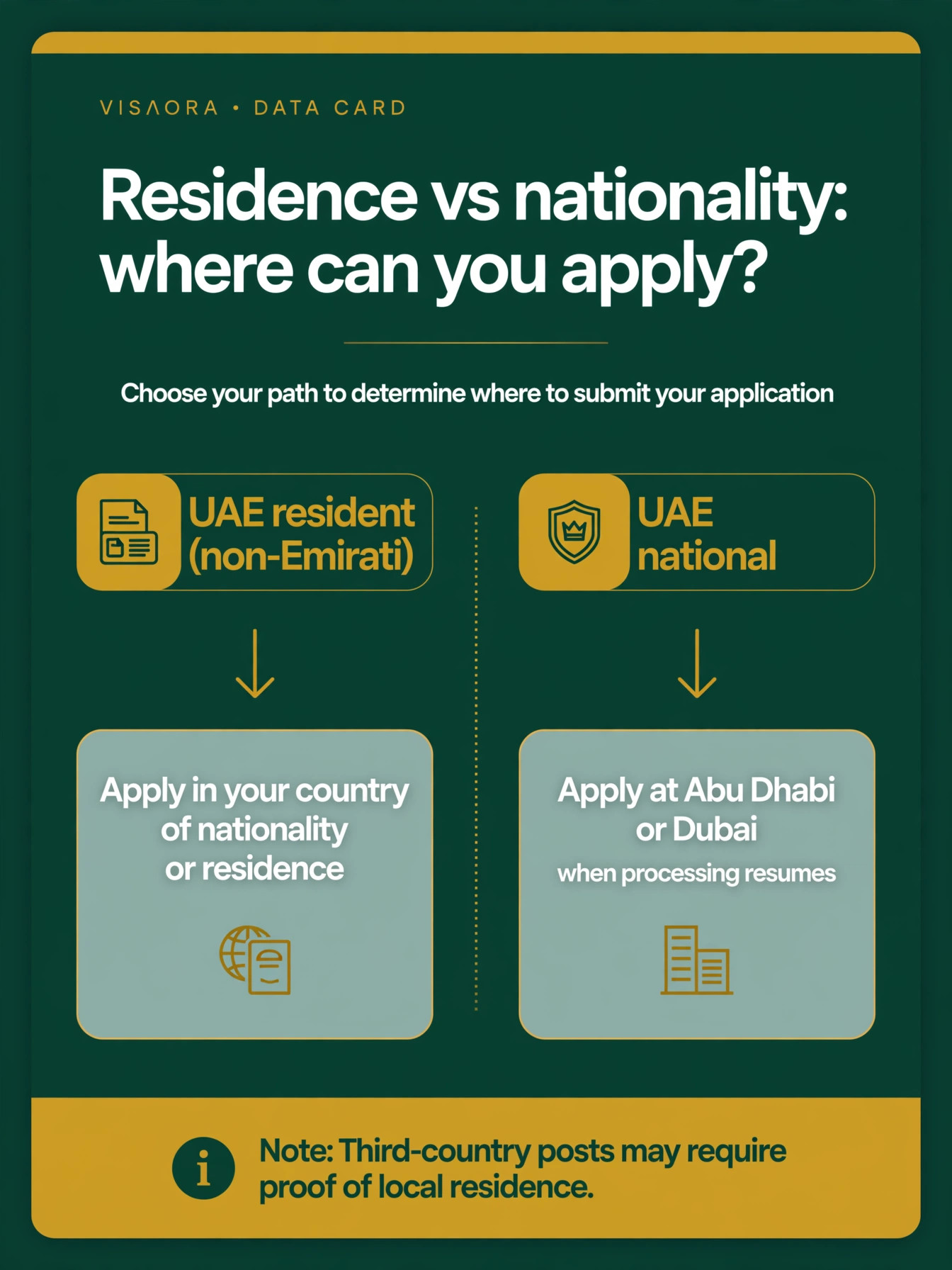
Residence vs nationality, in plain terms. Most UAE expats have two possible doors. Your country of nationality is the country on your passport — for example, an Indian passport holder living in Dubai would apply in India, a Filipino resident in Abu Dhabi would apply in the Philippines. Your country of residence is where you legally live — the UAE — but routine processing there is paused, which is why the nationality door matters most right now. If you hold another residence permit elsewhere, that country is also an option. UAE nationals are in a different spot: the UAE is their country of nationality, so they wait for local processing to resume.
What about a third country — applying for a US visa outside the UAE entirely, somewhere you are neither a national nor a resident? Some posts will see you, but it is the weakest option: officers may question your ties to that country, and some consulates require proof of legal residence before they will schedule you. Do not book flights and hotels until you have checked that specific embassy’s page and confirmed you can be scheduled there.
Either way, start your document preparation early. The US tourist visa documents checklist covers what B1/B2 applicants typically need to assemble — having it ready before an appointment opens is how you avoid losing a slot to paperwork.
Fees: non-refundable, non-transferable — what to do with a paid MRV
The B1/B2 visa application (MRV) fee is $185 as of 19 October 2026 (official fee page). “Fees change. Check the official website before you pay.”
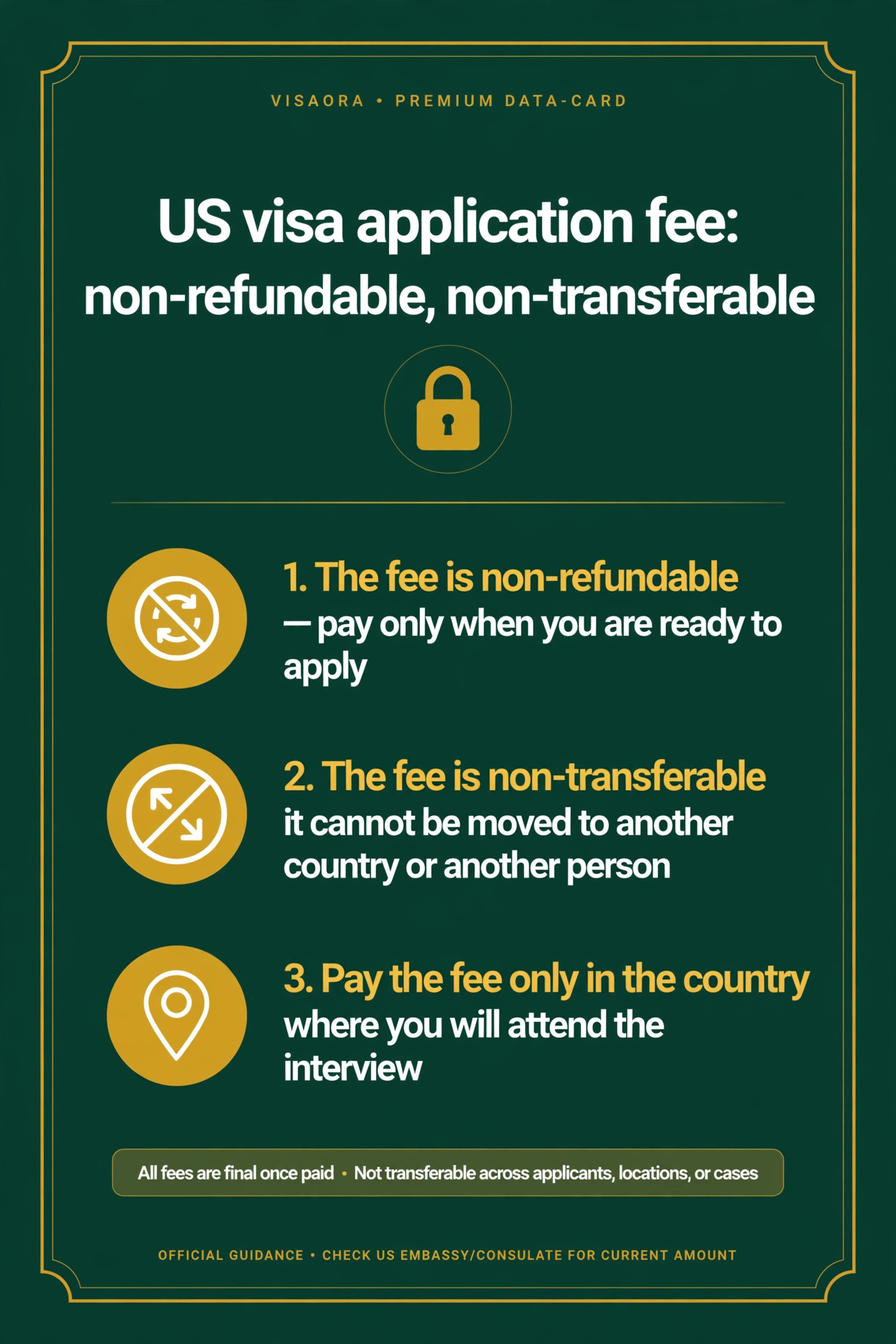
The embassy notice states the two facts that decide every fee decision: “Visa application fees are non-refundable and non-transferable” (source). This means:
- A fee paid for the UAE cannot be moved. If you paid expecting to interview in Abu Dhabi or Dubai, that payment cannot be transferred to India, the Philippines, or any other post. It is tied to where it was paid.
- It cannot be passed to someone else. Fees are per applicant and per application — not transferable between people or cases.
- It cannot be refunded because processing paused. The pause does not create a refund route under the official policy.
So the rule is simple: pay the fee only in the country where you will actually attend the interview, and only when you are ready to book. Do not pay speculatively in the hope that UAE slots reopen — a paid fee will not help you and will not come back. Note also that fee receipts are time-limited, so check the validity terms on your payment confirmation and the official fee page rather than assuming a receipt lasts indefinitely.
If you already paid for a UAE application, there is no official refund or transfer path — treat it as a sunk cost, and pay fresh in the country where you will interview.
Work out the full cost picture first with the free US B1/B2 visa fee calculator so the fee, travel and timing land in one plan.
Renewals and interview waivers after the September 2025 limits
Many UAE residents were counting on renewing a B1/B2 without an interview — the classic dropbox-style renewal. That path got narrower: the State Department narrowed interview-waiver eligibility effective September 2025 (travel.state.gov). Renewals that previously qualified for a waiver, including many recent expiries, now require an in-person interview.
For anyone searching “b1 b2 renewal interview waiver UAE” in 2026, the combined picture is blunt: there is no routine processing locally, and the waiver you may have used last time probably no longer applies. Assume you need an interview, and plan travel and an appointment around that assumption. Do not book non-refundable flights on the hope of a waiver — confirm the current waiver rules on travel.state.gov against your specific case (visa class, expiry date, prior visa history) before you commit to anything. If you were waiting on a US visa renewal in Dubai in 2026 hoping the process would reopen, the realistic move is to schedule a renewal interview in your country of nationality instead of waiting.
Nationality restrictions: check your nationality first
Before you pay a fee or book any travel, check this. The embassy’s UAE notice flags a presidential proclamation in effect from 1 January 2026 that suspends or limits entry and visa issuance for nationals of certain countries — the notice cites 39 affected countries — and a separate pause on diversity visa issuance (as of 19 October 2026, source).
This guide does not list countries, because the lists change. Check your nationality against the current restriction list on travel.state.gov before you do anything else. This is the single most expensive thing to get wrong: if your nationality is restricted, you can be ineligible for issuance no matter where you interview or how early you book. Applicants who are subject to restrictions may still submit applications and attend interviews, but may be ineligible for visa issuance or admission — so verify first, pay later.
Checklist before you book anywhere
Run through this list in order before you pay a fee or book travel:
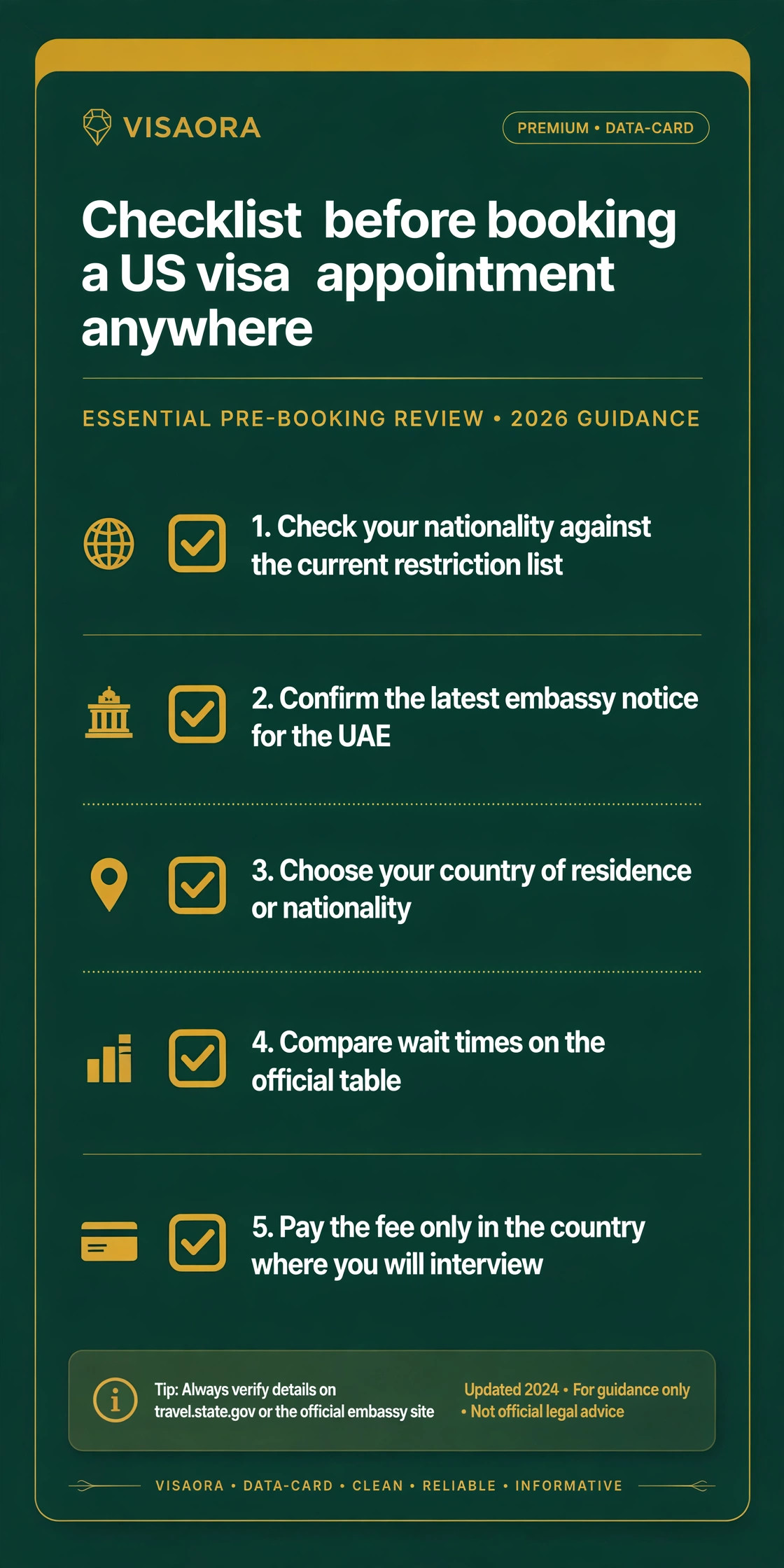
- Check your nationality against the current restriction list on travel.state.gov.
- Re-read the embassy’s UAE notice (ae.usembassy.gov/visas) for the latest position — it changes.
- Choose your post: your country of residence or your country of nationality, per the embassy’s rule.
- Compare B1/B2 wait times for that post on the official wait-time table — and note the table’s last-updated date.
- Complete the DS-160 and gather documents before slots open, so paperwork never costs you an appointment. The USA visa tools hub collects the free tools for this stage.
- Pay the MRV fee only in the interview country — never in advance, never elsewhere.
- Book only through the official scheduling system. Never pay agents or third parties for appointment slots.
Frequently Asked Questions
Can I book a US visa appointment in Dubai or Abu Dhabi right now?
As of 19 October 2026, the US Embassy states that routine visa processing is not available in the UAE, even though both posts are open. The embassy directs nonimmigrant applicants to their country of residence or nationality instead. Check the notice page for updates before making any plans.
Can a UAE resident apply for a US visa in their home country?
Yes. The embassy’s stated rule is to schedule the interview at the embassy or consulate in your country of residence or nationality. For most expats, that means the country on their passport — for example, India or the Philippines. Confirm scheduling rules on that post’s page first.
Is the US visa application fee refundable if I cannot get an appointment?
No. The embassy states visa application fees are non-refundable and non-transferable. A fee paid for a UAE application cannot be moved to another country, given to another person, or refunded because processing paused. Pay only in the country where you will interview.
What is the current US visa wait time in Abu Dhabi and Dubai?
The State Department’s wait-time table (last updated 17 September 2026) lists B1/B2 next-available appointments of 12.5 months for Abu Dhabi and 11.5 months for Dubai. But this automated snapshot conflicts with the embassy’s “not available” notice, so confirm the live position before paying any fee.
Can I renew my B1/B2 visa without an interview in 2026?
Probably not. Interview-waiver eligibility was narrowed effective September 2025, so most renewals — including recent expiries that previously qualified — now require an in-person interview. Confirm the current waiver rules on travel.state.gov against your specific case before you book any travel.
Which nationalities face US visa restrictions in 2026?
A presidential proclamation in effect from 1 January 2026 limits entry and visa issuance for nationals of certain countries, and diversity visa issuance is separately paused. The lists change, so check your nationality against the current list on travel.state.gov before paying any fee.
Disclaimer: Visaora is software and does not provide legal advice. Requirements depend on your nationality and situation. Confirm with the official authority (US Embassy / travel.state.gov) or a licensed adviser.
Sources
- U.S. Embassy & Consulate in the UAE, Visas page — routine processing not available; apply in country of residence or nationality; fees non-refundable and non-transferable (as of 19 October 2026): https://ae.usembassy.gov/visas/
- U.S. Department of State, Global Visa Wait Times (last updated 17 September 2026) — Abu Dhabi B1/B2 next available 12.5 months; Dubai 11.5 months: https://travel.state.gov/content/travel/en/us-visas/visa-information-resources/global-visa-wait-times.html
- U.S. Department of State, visa fees page — MRV fee amounts (as of 19 October 2026): https://travel.state.gov/content/travel/en/us-visas.html
Related reading: US Wait-Time Checker · US B1/B2 Visa Fee Calculator · USA Visa Tools · US Tourist Visa Documents Checklist 2026 · Visaora Intelligence Suite
CTA: Run a free US wait-time check to compare interview posts before you commit. And before you pay the non-refundable $185 MRV fee, a $12 Intelligence Suite scan reviews your case details so you pay in the right country, once. Agencies: turn this into a client-ready case file with Visaora Agency Suite.
✈️ Planning Your Trip?
We may earn a commission — at no extra cost to you. Learn more