USA Tourist Visa Documents Checklist 2026: Everything You Need for B1/B2
Updated: October 2026 · Reading time: 9 minutes
Getting your USA tourist visa documents checklist for 2026 right is the difference between walking into your interview confident and walking out with a refusal slip. The B1/B2 visa process hasn’t fundamentally changed — but 2026 brings new fees, tighter interview rules, and less room for sloppy paperwork. This guide covers every document you need, which ones are mandatory versus recommended, the exact photo specifications, current fees, and the five document mistakes that sink more applications than anything else.
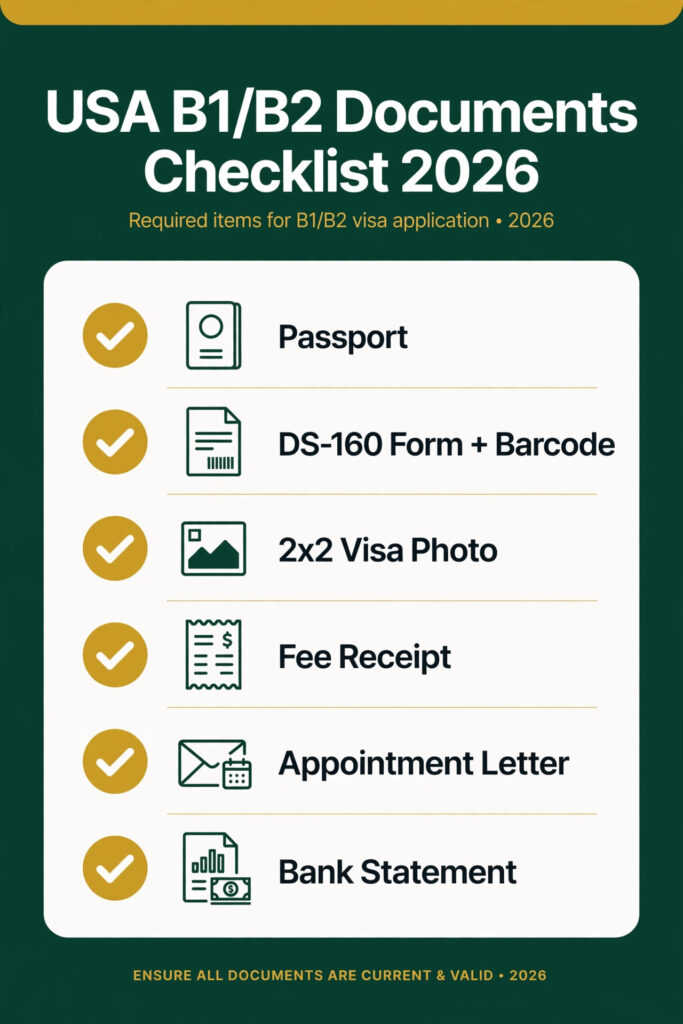
- Five documents are non-negotiable: passport, DS-160 confirmation, photo, $185 fee receipt, appointment letter.
- There is no official minimum bank balance — officers judge whether your funds fit your trip.
- You do not need a confirmed flight ticket; an itinerary is enough.
- A new $250 visa integrity fee is rolling out — budget for it on top of the $185 MRV fee.
- Since September 2025, almost all applicants must attend an in-person interview — waivers are rare.
Your entry ticket — missing any one ends the appointment before it begins.
USA Tourist Visa Documents Checklist 2026: The 5 Mandatory Items
Think of these as your entry ticket. Embassy security checks them before you even reach the waiting room, and missing any single one ends your appointment before it begins. These requirements are the same at every U.S. embassy and consulate worldwide, as published on the State Department’s official visitor visa page (travel.state.gov).
1. Valid Passport
Your passport must be valid for at least six months beyond your intended stay in the United States. Planning a two-week trip in December 2026? Your passport should be valid until at least mid-2027. Also bring any old passports containing prior U.S. visas — they demonstrate travel history and past compliance, which officers view favorably.
2. DS-160 Confirmation Page
The DS-160 is the Online Nonimmigrant Visa Application form every B1/B2 applicant must complete. After submitting it, you receive a confirmation page with a barcode and application ID. Print it or save a clear screenshot to your phone — the consular officer pulls up your entire file using that barcode. Without it, your record is effectively invisible and you will be turned away. Fill it out carefully: inconsistencies between your DS-160 answers and your interview responses are one of the most common refusal triggers.
3. Visa Photograph (2×2 inch)
One recent color photograph, 2×2 inches (51×51 mm), taken within the last six months against a plain white background. No glasses, and head coverings only for religious reasons. You’ll upload a digital copy during the DS-160 process, but bring a printed copy too — most consulates still want one in hand. (Full specifications in the photo section below.)
4. MRV Fee Receipt ($185)
The Machine Readable Visa application fee for B1/B2 is $185, and it is non-refundable — you don’t get it back if you’re refused. Keep your bank confirmation or receipt code from the payment portal your country uses. You’ll need to show proof of payment before your interview is scheduled.
5. Interview Appointment Confirmation
The confirmation email or page from the visa appointment service showing your date, time, and location with a barcode. Security staff scan this at the embassy entrance. Arrive early — late arrivals routinely lose their slots.
Supporting Documents That Win Approvals
Here’s what most guides get wrong: the five mandatory items get you into the interview. The supporting documents decide whether you walk out approved. The consular officer is really answering one question: “Will this person return home after the visit?” Every supporting document you bring should help answer “yes.”
Organize them into three folders — finances, ties to home, and travel purpose — and only present them if the officer asks. Volunteering a stack of papers unprompted can look desperate; having them ready when requested looks prepared.
Proof You Can Afford the Trip
- Bank statements for the last 3–6 months (showing stable income, not a sudden large deposit)
- Recent pay slips (3 months)
- Income tax returns
- Fixed deposit or savings certificates, if applicable
- Sponsor letter plus the sponsor’s financial documents, if someone else is funding your trip
Proof You’ll Come Back (Ties to Home Country)
- Employment letter on company letterhead stating your role, salary, approved leave dates, and expected return date
- Business registration documents, if self-employed
- Property ownership deeds or long-term lease agreements
- Family ties: marriage certificate, children’s school enrollment, evidence of dependents
- Enrollment proof, if you’re a student returning to studies
Proof of Your Travel Purpose
- Day-by-day travel itinerary (cities, dates, activities)
- Hotel reservations (bookings, not necessarily paid in full)
- Flight itinerary or reservation — not a paid non-refundable ticket
- Invitation letter from U.S. hosts, if visiting family or friends
- Conference registration or business meeting agenda, for B-1 travel
- Medical treatment letters and cost estimates, for medical travel
Required vs. Recommended: The Full Table
| Document | Status | Notes |
|---|---|---|
| Passport (6+ months validity) | Required | Bring old passports with prior U.S. visas too |
| DS-160 confirmation page | Required | Barcode must be scannable |
| 2×2 inch visa photo | Required | White background, under 6 months old |
| $185 MRV fee receipt | Required | Non-refundable |
| Appointment confirmation | Required | Scanned at embassy entrance |
| Bank statements (3–6 months) | Recommended | Stable income matters more than balance |
| Employment letter | Recommended | Strongest proof of ties for employees |
| Property / family documents | Recommended | Deeds, marriage certificate, dependents |
| Travel itinerary + hotel bookings | Recommended | Reservations fine; paid tickets unnecessary |
| Invitation letter (if visiting hosts) | If applicable | From U.S.-based family or friends |
USA Tourist Visa Fees in 2026
Budget carefully — U.S. visa fees are non-refundable, and 2026 adds a new charge on top of the familiar one:
- MRV application fee: $185. This is the standard B1/B2 fee and has been stable for years. You pay it before you can schedule the interview, and you don’t get it back if refused.
- Visa integrity fee: $250 (new, rolling out). A new $250 integrity fee is being introduced for applicants in select categories to support program oversight. It is separate from the MRV fee and cannot be waived, though refunds may be possible under very specific conditions after visa expiry. Because this is a developing rule, confirm whether it applies to your case before you pay — check the State Department’s official guidance at travel.state.gov.
- Visa issuance (reciprocity) fee: varies. Some nationalities pay an additional issuance fee if approved, based on reciprocity arrangements. Check the State Department’s fee tables for your country.
Practical tip: never pay any visa fee to a third party who promises guaranteed approval. Fees are paid through official channels only, and no agent can influence the consular officer’s decision.
Not sure your documents are strong enough?
Run a free readiness check before you pay the $185 fee — spot the weak points officers will question.
Check My Approval Chances →Photo Specifications for 2026
The U.S. has some of the strictest visa photo rules in the world, and photo rejections cause pointless delays. Get this right the first time:
- Size: 2×2 inches (51×51 mm), square format
- Recency: taken within the last 6 months, showing your current appearance
- Background: plain white, no shadows, no patterns
- Expression: neutral or natural smile, both eyes open, facing the camera directly
- Glasses: not allowed — remove them even if you wear them daily
- Head coverings: only for religious reasons, and the full face must remain visible
- Digital upload: you’ll upload a digital copy during the DS-160; bring a printed copy to the interview as backup
Most dedicated visa photo studios know these specs by heart. A generic passport photo from a mall kiosk sometimes doesn’t — it’s worth the small extra cost to use a studio that does U.S. visa photos regularly.
There is no official minimum bank balance — officers judge whether your funds fit your trip.
Financial Proof: What Officers Actually Check
There is no official minimum bank balance for a B1/B2 visa. Anyone quoting you a magic number is guessing. What the officer actually evaluates is whether your finances make sense for your trip: a two-week New York vacation costs very different money than a two-month family visit in Texas.
What builds confidence:
- Consistency over size. Six months of steady salary deposits beats a single mysterious lump sum deposited last week. A sudden large deposit right before the interview is a classic red flag — officers read it as borrowed money.
- Income that covers the trip. Your regular earnings should plausibly cover flights, hotels, food, and shopping for the stated duration, with a comfortable margin left over.
- Paper trail. Tax returns corroborate your stated income. Pay slips corroborate your employment letter. Each document should tell the same story.
If a sponsor is funding your trip — a parent, spouse, or U.S.-based relative — bring their bank statements and a signed sponsor letter explaining the relationship and exactly what costs they cover. Your own finances still matter; a fully sponsored trip with zero personal funds raises questions.
Ayesha, a schoolteacher in Karachi, plans a two-week trip to visit her sister in Houston. She brings six months of salary-credited bank statements, three months of pay slips, a school letter confirming her post and approved leave dates, and her sister’s invitation letter — but no paid flight ticket, just an itinerary. The officer’s real question is simple: will she come back? The school letter, her steady income and her family at home answer yes far more convincingly than any single bank balance could.
5 Document Mistakes That Lead to Refusal
- Expired or short-validity passport. The six-month rule catches more people than you’d think. Check your expiry date the day you start the DS-160, not the day before the interview — renewals take weeks.
- Blurry or outdated photo. A photo that doesn’t meet specs gets your application bounced before the officer even sees your file. Don’t reuse a five-year-old photo.
- Missing fee receipt. Without proof of the $185 MRV payment, you can’t even book the interview in most countries. Save the receipt the moment you pay.
- DS-160 inconsistencies. Saying “single” on the form but wearing a wedding ring, or listing different employment dates than your letter states — officers notice, and dishonesty (even accidental) is fatal to credibility.
- Fake or altered bank statements. This is the worst mistake on the list. Submitting forged financial documents isn’t just a refusal — it can trigger misrepresentation findings that complicate every future U.S. visa application. Never do it.
What’s New for B1/B2 in 2026
Three policy shifts affect how you should prepare:
- Interview waivers narrowed (since September 2025). The pandemic-era waiver program has been rolled back — most applicants, including many renewing the same visa class, must now attend in-person interviews. Expect longer appointment wait times and plan months ahead.
- Visa bond pilot program. Since August 2025, certain B1/B2 applicants from countries with high overstay rates may be required to post a refundable bond of $5,000, $10,000, or $15,000, set case-by-case by the consular officer. The bond is returned if you depart on time or if the visa is denied — it’s forfeited only on overstay or violation. Check whether your country is designated before your interview.
- $250 visa integrity fee. As covered above, this new fee is rolling out for select categories. Budget $435 total ($185 + $250) until you confirm otherwise.
Policies are moving quickly — always verify current rules on the State Department’s official tourism and visit page before you apply. For a broader look at planning tools, see our USA visa tools hub.
Avoid a $185 mistake.
Our Intelligence Suite scans your profile the way a consular officer would — before you file.
Check My Approval Chances →Pro Tips for Interview Day
- Organise, don’t volunteer. Keep finances, ties-to-home and travel-purpose documents in three separate folders. Present them only when the officer asks — prepared beats desperate.
- Match your DS-160 exactly. Re-read your submitted form the night before so dates, job titles and travel plans are identical in person.
- Budget $435 until confirmed otherwise. The $185 MRV fee plus the rolling-out $250 integrity fee — check the State Department’s current guidance for your case.
- Check the bond pilot. Since August 2025, applicants from certain high-overstay countries may face a refundable $5,000–$15,000 visa bond. Verify whether your country is designated before your interview.
- Apply months ahead. Interview wait times have stretched since the September 2025 waiver rollback — plan the timeline before you book flights or hotels.
USA Tourist Visa Documents: FAQs
What documents do I need for a US B1/B2 visa interview in 2026?
You need five mandatory items: a passport valid six months beyond your stay, the DS-160 confirmation page with barcode, a 2×2 inch photo taken within six months, the $185 MRV fee receipt, and your interview appointment confirmation. Bring supporting documents too — bank statements, employment proof, and evidence of ties to your home country strengthen your case significantly.
Do I need a confirmed flight ticket for a US tourist visa interview?
No. The U.S. embassy does not require a paid, confirmed airline ticket, and buying a non-refundable fare before approval is financially unwise. A flight itinerary or reservation showing your intended dates is sufficient. The same applies to hotels — reservations are fine. Officers care about your intent and means, not about prepaid bookings.
How much bank balance do I need for a US tourist visa?
There is no official minimum. Officers assess whether your funds reasonably cover your specific trip — its length, destinations, and purpose — with a comfortable margin. Six months of stable income matters far more than one large balance. Avoid sudden lump-sum deposits before the interview; they look like borrowed money and raise red flags.
What is the DS-160 form and is it mandatory?
The DS-160 is the Online Nonimmigrant Visa Application, mandatory for every B1/B2 applicant. You complete it online, then bring the printed confirmation page with its barcode to the interview — without it, the embassy cannot retrieve your file and will turn you away. Answer every question truthfully; inconsistencies between the form and your interview are a leading refusal cause.
What documents prove strong ties to my home country?
An employment letter stating your role, salary, approved leave, and return date is the strongest single proof. Add property deeds or leases, marriage certificates, children’s school enrollment, or business registration if self-employed. Together they show the officer you have compelling reasons — job, assets, family — to return home after your visit.
Do I need an invitation letter for a US tourist visa?
Only if you’re visiting specific people. An invitation letter from U.S.-based family or friends supports applications centered on visiting them, but tourists with a hotel-based itinerary don’t need one. Never buy a fake invitation letter — officers verify, and fraud findings can bar future applications. A genuine letter should state the host’s status, your relationship, and visit dates.
What are the US visa photo requirements in 2026?
Photos must be 2×2 inches (51×51 mm), color, taken within the last six months on a plain white background. Face the camera directly with a neutral expression and both eyes open. Glasses are not allowed, and head coverings are permitted only for religious reasons with the full face visible. Upload a digital copy with the DS-160 and bring a print.
Can a previous visa refusal affect my new B1/B2 application?
Yes. A prior refusal — especially under INA 214(b) for weak ties — means the officer will scrutinize what’s changed since. Bring evidence addressing the earlier weakness: stronger finances, new employment, or property acquired since. Be honest if asked about the refusal; hiding it is far worse, as officers can see your history.
Disclaimer: This guide is for general information only and is not legal or immigration advice. Visa rules and fees change — always confirm current requirements on the official U.S. State Department website or with your local U.S. embassy before applying.
✈️ Planning Your Trip?
We may earn a commission — at no extra cost to you. Learn more