Schengen Student Visa Requirements 2026: Documents, Funds Proof & Complete Guide
Dreaming of a lecture hall in Berlin, Paris, or Barcelona? Getting there starts with paperwork — and the Schengen student visa requirements for 2026 are more country-specific than most first-time applicants realize. Germany locks your money into a blocked account, France lifted its monthly funds bar in August 2026, and Spain runs its own income formula. This guide lays out every document you will need, the exact funds proof each major destination expects, the application process from start to finish, honest timelines, and the mistakes that sink applications — written for applicants across Asia and the Gulf.
- Degree-length study needs a Type D national visa, not the short-stay Type C visa — file at the embassy of your main study country.
- Germany 2026: €11,904 deposited in a blocked account (Sperrkonto), released to you at €992/month.
- France 2026: €877.50/month (€10,530/year) required from 1 August 2026 — shown with ordinary bank statements, no blocked account.
- Spain 2026: roughly €600/month based on the IPREM indicator — about €7,200 for an academic year.
- Health insurance covering €30,000 minimum is compulsory everywhere.
- Start 3–4 months before your course — late files and weak funds proof are the top two refusal triggers.
What Is a Schengen Student Visa? Type C vs Type D
Here is the confusion that catches out most first-timers: there is no single document called a “Schengen student visa.” Short courses of up to 90 days — language programs, summer schools, entrance exams — run on the Schengen Type C short-stay visa. Anything longer than 90 days — a full degree, a foundation year, an exchange semester — needs a Type D long-stay national visa issued by the country where you will actually study.
Type D carries a handy bonus: it is valid for your study country and doubles as a travel document across the other 29 Schengen states for up to 90 days in any 180-day period. You lodge the application at the embassy or consulate of your main destination — the country where you will spend most of your study time — not at some generic “Schengen” desk. Each country keeps its own checklist, its own funds rules, and sometimes its own pre-visa pipeline (France’s Campus France system is the classic example), which is why country-specific guidance beats generic advice every time.
A 2026 practical note: the EU’s biometric Entry/Exit System (EES) is now fully operational at Schengen borders, so your entries and exits are recorded digitally. ETIAS travel authorization is rolling out in late 2026, but it covers visa-exempt short-stay visitors — not long-stay student visa holders.
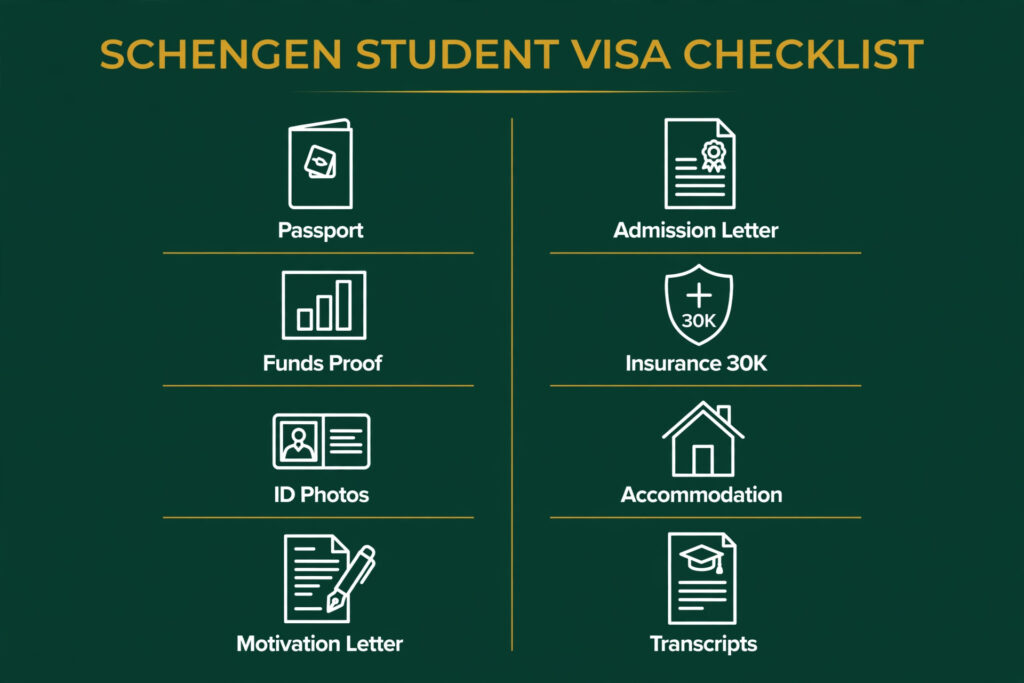
Schengen Student Visa Requirements 2026: Document Checklist
Every Schengen country’s student checklist covers the same core categories, with national twists. Pull these together before you book your appointment — an incomplete file is the quickest way to waste a trip to the visa center.
- Valid passport — issued within the last 10 years, valid at least 3 months beyond your planned stay, with 2+ blank pages.
- National long-stay application form — your destination country’s own form, completed and signed (France uses the France-Visas online form).
- Passport photos — two recent 35×45mm photos, white background, ICAO standard.
- Admission letter — official acceptance or enrolment confirmation from a recognized university or institution.
- Proof of funds — blocked account, bank statements, scholarship letter, or sponsor documents; exact amounts below.
- Health insurance — certificate covering medical, hospitalisation and repatriation costs of at least €30,000.
- Accommodation proof — lease, university housing confirmation, or host letter (France typically wants the first 3 months covered).
- Academic records — transcripts and diplomas; certified translations if not in an accepted language.
- Motivation letter — why this program, why this country, and your plans after graduation.
- Language proof — if your program requires it (IELTS/TOEFL for English-taught programs, DELF for French ones, and so on).
France adds its own layer: applicants from many countries must complete the Campus France / Études en France procedure and carry the Campus France attestation to the visa appointment. Germany may require APS certificates for certain nationalities. Always cross-check the exact checklist on your consulate’s page — the German consulates, in particular, are famously strict about document order and completeness.
Funds Proof by Country: Germany, France, Spain
Funds proof is where student applications are won or lost. Each country defines “enough money” differently, and the formats do not transfer — a German blocked account means nothing to a French consulate, and French bank statements will not satisfy a German officer.
Germany: €11,904 in a Blocked Account (Sperrkonto)
Germany runs the most rigid system — and the most predictable one. For 2026, deposit €11,904 into a blocked account before your visa appointment. Once you arrive and register your address, the bank releases €992 per month into your regular account. The figure tracks the BAföG student support rate. Well-known providers include Expatrio, Fintiba and Coracle (setup fees roughly €49–€159); Deutsche Bank also offers blocked accounts but tends to be slower. Send a small buffer above €11,904 — intermediary bank fees can shave the deposit down and invalidate your confirmation. Alternatives such as a formal sponsorship declaration (Verpflichtungserklärung) or a recognized scholarship exist but face tougher scrutiny.
France: €877.50/Month From August 2026
France raised its requirement sharply: from 1 August 2026, student visa applicants must show €877.50 per month (€10,530 over 12 months), up from the previous €615 — a roughly 43% increase linked to the French minimum wage. The upside: France does not demand a blocked account. Standard bank statements (usually 3–6 months), a sponsor affidavit backed by income proof, a scholarship letter, or an education loan sanction letter all work. For a 10-month academic year, plan on roughly €8,775 in demonstrable funds. If you applied before the August 2026 cutoff under the old threshold, confirm with your consulate which figure governs your file.
Spain: ~€600/Month (IPREM-Based)
Spain anchors its requirement to the IPREM (the public income indicator), which lands at roughly €600 per month — about €7,200 for a full academic year. Expect to show 6 months of bank statements plus proof of tuition payment. Real-world living costs in Madrid or Barcelona run €900–€1,100/month, so treat the visa minimum as a floor, not a budget.
For a deeper look at how consulates read bank statements — seasoning periods, large deposits, sponsor paperwork — see our Schengen visa bank balance guide for 2026.
Application Process: Step by Step
Visa Fees & Processing Times
Budget for three separate costs: the visa fee itself (France charges around €50–€99 for long-stay student visas depending on nationality; fees vary by destination and are non-refundable), the service fee charged by VFS/TLS appointment centers, and your document costs (translations, attestations, insurance, photos). None of these count toward your proof-of-funds amount.
Processing usually takes 15–45 days for student files, though peak season (July–September) can run longer. Apply at least 6–8 weeks before your course starts — ideally earlier. A late application with classes starting in two weeks signals poor planning, and that alone can count against you.
Real-Life Scenario: A Blocked Account Done Right
Fatima, 21, was accepted into a bachelor’s program in Munich starting October 2026. She opened a blocked account with an online provider in early June and transferred €12,050 — a buffer above the €11,904 minimum to absorb transfer fees. Her confirmation letter arrived within two weeks.
Her mother, who funded the account, also signed a short sponsor note with her own bank statements and salary slips, so the source of the money was documented. Fatima paired this with university housing confirmation, a motivation letter tying her chosen program to her A-level subjects, and insurance covering €30,000. She attended her VFS appointment in late July — ten weeks before classes — and her visa arrived in four weeks. The difference between her file and the refused ones she later heard about: every euro was traceable, and nothing was rushed.
Common Rejection Reasons (and How to Avoid Them)
Refusal patterns for student visas are remarkably consistent across Schengen countries. Here are the five that matter:
For the full breakdown of refusal patterns across all Schengen visa types, read our Schengen visa rejection reasons guide.
Common Mistakes to Avoid
Beyond the refusal reasons above, these are the smaller errors that quietly weaken strong files:
- Copy-pasting a motivation letter from the internet. Officers read hundreds of these; generic templates are obvious and damage credibility. Write your own story.
- Transferring the exact blocked-account amount to the cent. Bank fees can push you below €11,904 and invalidate the confirmation — always add a buffer.
- Ignoring the Campus France step. France applicants who skip the Études en France procedure arrive at the visa appointment missing the attestation and get turned away.
- Submitting home-printed bank statements. Many consulates want stamped or officially generated statements; screenshots can trigger doubts.
- Booking non-refundable flights before approval. Never spend money you cannot afford to lose before the visa is in hand.
- Forgetting translations. Documents not in an accepted language need certified translations — arrange these early; they take weeks.
Pro Tips for a Stronger File
Frequently Asked Questions
How much bank balance is required for a Schengen student visa in 2026?
It depends on the country. Germany needs €11,904 in a blocked account (€992/month). France needs €877.50/month (€10,530/year) from August 2026, shown through bank statements. Spain needs roughly €600/month based on the IPREM indicator. Always confirm the current figure with your consulate, since thresholds are reviewed annually.
What is a blocked account (Sperrkonto) for Germany?
A Sperrkonto is a special German bank account where you deposit €11,904 upfront for 2026. The money stays “blocked” — after you arrive and register your address, the bank releases €992 per month to your regular account. It proves to the embassy you can support yourself for a year. Providers include Expatrio, Fintiba, Coracle and Deutsche Bank.
Do I need IELTS for a Schengen student visa?
The visa itself does not mandate IELTS — language requirements come from your university and program. But you need the admission letter to apply for the visa, and most English-taught programs require IELTS, TOEFL or equivalent. Programs taught in French, German or Spanish will expect the corresponding language certificate instead.
How long does a Schengen student visa take to process?
Typically 15–45 days, depending on the country, season and your nationality. Applications spike in July–September, which can stretch waits. Apply at least 6–8 weeks before your course begins — ideally 3 months ahead — so a delay cannot derail your semester start.
Can I work while studying on a Schengen student visa?
In most cases, yes, with limits. Germany allows 140 full days or 280 half-days of work per year. France, Spain and the Netherlands generally permit part-time work (often around 20 hours/week during term). Rules differ by country and permit type, so verify your host country’s exact work rights before counting on job income.
What is the difference between Type C and Type D student visas?
Type C is the short-stay Schengen visa for courses up to 90 days (language schools, summer programs). Type D is the long-stay national visa for degree programs and anything over 90 days. Type D is issued by your study country and also allows travel across the Schengen Area for up to 90 days per 180-day period.
Do I need travel insurance for a student visa?
Yes. Health insurance covering at least €30,000 for medical, hospitalisation and repatriation costs is mandatory for the visa application in every Schengen country. Some countries also require you to join their national health system after arrival — budget for both the initial certificate and ongoing coverage.
Can my student visa be rejected? What are the common reasons?
Yes. The most common reasons are insufficient or poorly documented funds, an unclear study purpose in the motivation letter, missing documents, weak ties to the home country, and applying too late. A thorough, well-organized file with seasoned funds and a convincing study plan avoids the great majority of refusals.
Conclusion: Start Early, Document Everything
A Schengen student visa is not won with luck — it is won with a complete, honest, well-timed file. Pick your destination country, learn its exact funds rule, season your money, gather every document on the consulate’s checklist, and apply 6–8 weeks before your course starts. Do that, and the odds are firmly in your favor.
Still unsure whether your file is strong enough? Run it through the Visaora Intelligence Suite — it scores your documents, funds and timeline against real refusal patterns and shows you exactly what to fix before you file. And for the bigger picture across all visa types, start with our complete Schengen visa guide for 2026.
✈️ Planning Your Trip?
We may earn a commission — at no extra cost to you. Learn more