Easiest Schengen Visa Country 2026: France vs Spain vs Italy vs Greece Compared
Updated October 2026 · Based on the latest published EU visa statistics · 8 min read
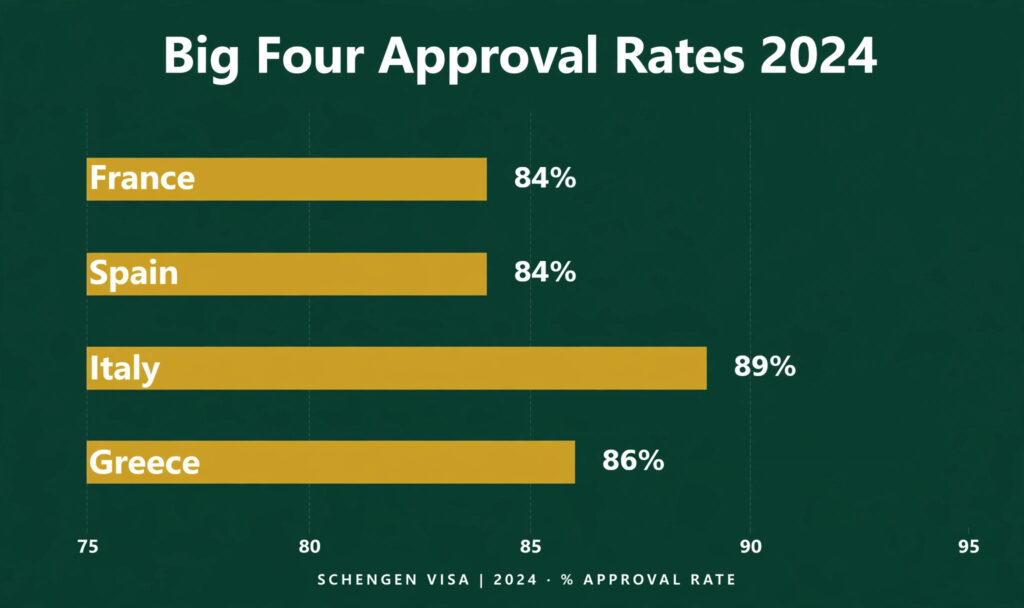
- Italy (~89%) leads the big four on 2024 approval rates, ahead of Greece (~86%), Spain (~84%) and France (~84%).
- The gap is small — about five percentage points top to bottom — and your nationality matters more than the consulate.
- EU law requires you to apply to your main destination (where you spend the most nights); “visa shopping” risks refusal.
- France (3M+ applications) and Spain (1.6M) carry the heaviest volumes — book appointments early, especially in summer.
- A complete file, credible funds, strong home ties and an early application beat any “easy country” tactic.
- What “Easiest” Really Means
- France vs Spain vs Italy vs Greece: Head-to-Head
- France: The Volume Giant
- Spain: The Summer Favorite
- Italy: The Approval Leader
- Greece: The Rising Star
- The Rule Nobody Should Break
- 5 Ways to Maximize Your Approval
- Real-Life Scenario: Two Trips, Two Outcomes
- Common Mistakes to Avoid
- Pro Tips for a Stronger File
- FAQs
Hunting for the easiest Schengen visa country in 2026? You are far from alone — it is one of the most searched visa questions every year. France, Spain, Italy and Greece receive more Schengen applications than any other countries on the planet, so comparing them is the right instinct. But here is what most “easiest country” lists leave out: the gap between these four is surprisingly narrow, the headline numbers are averages that mask huge differences by nationality, and — most important of all — European law decides which consulate you must apply to, not convenience. This guide compares all four on the latest published European Commission statistics, explains what the numbers genuinely mean for your case, and shows how to push your approval odds as high as they can go wherever you apply.
What “Easiest” Really Means (Read This First)
When people call a country “easy” for Schengen visas, they almost always mean it has a high approval rate — the share of decided applications that get granted. The most recent official figures come from the European Commission’s 2024 Schengen visa statistics: 11.7 million applications were lodged worldwide (up from 10.3 million in 2023, though still below the pre-pandemic 17 million of 2019), with an overall approval rate of roughly 85.3% and a rejection rate of 14.8% — the lowest refusal level since before the pandemic.
Three caveats matter more than the rankings themselves. First, nationality dominates everything. Aggregate rates blend nationalities with near-100% approval and others facing far higher refusal rates; your passport, travel history and finances shape your outcome far more than the consulate’s flag. Second, tiny countries top the charts. Lithuania (~97%) and Iceland (~91%) lead all Schengen states, but they process a tiny fraction of the volume — and you can only legitimately apply there if it is genuinely your main destination. Third, among high-volume destinations, the spread is narrow. The gap between the “easiest” and “hardest” of the big four is about five percentage points — meaningful, but not decisive.
France vs Spain vs Italy vs Greece: Head-to-Head
Here is how the four most popular Schengen destinations compare on the latest published (2024) EU data. Figures are approximate and rounded — treat them as background context, not a prediction about your individual case.
Approximate 2024 approval rates, European Commission Schengen visa statistics. Individual outcomes vary significantly by nationality and application quality.
| Country | 2024 Applications | Approval | Rejection | Key Notes |
|---|---|---|---|---|
| France | 3M+ (world #1) | ~84% | 15.8% | Highest volume; book appointments early |
| Spain | 1.6M (world #2) | ~84% | 15.7% | Summer demand peaks; plan ahead |
| Italy | 1M+ (world #4) | ~89% | ~11% | Highest approval of the big four |
| Greece | ~0.5M (world #5) | ~86% | ~14% | Rising popularity; tourism-friendly files |
France: The Volume Giant
France is the undisputed heavyweight of Schengen visas: its consulates received more than 3 million applications in 2024 — over a quarter of every Schengen application on Earth — and approved about 2.55 million of them. The 15.8% rejection rate sits slightly above the Schengen average, which partly reflects sheer scale: at that volume, consulates run rigorous, standardized document checks and show little patience for incomplete files.
What this means for you: France has the world’s most experienced Schengen processing network and extensive appointment infrastructure — but slots at busy VFS/TLS centers fill weeks ahead in summer and December. French officers scrutinize itinerary logic closely: your stated plans, bookings and finances must tell one coherent story. If France is genuinely your main destination, apply with confidence and a flawless file; if it is not, do not use France as a back door (more on that rule below).
Spain: The Summer Favorite
Spain overtook Germany in 2024 to become the second-largest Schengen visa issuer, handling 1.6 million applications with a 15.7% rejection rate — roughly 250,000 refusals in absolute terms. Spain’s popularity is heavily seasonal: Barcelona, Madrid and the Balearics drive enormous summer demand, which means appointment bottlenecks from May through August.
Spanish consulates are known for straightforward, checklist-driven processing — complete files move smoothly, while weak financial evidence is a frequent refusal trigger. Because Spain is such a popular first-Schengen-trip destination, officers see a high share of first-time travelers; a clean, simple itinerary with solid proof of funds goes a long way here.
Italy: The Approval Leader of the Big Four?
Among the big four, Italy has the strongest approval record: roughly 89% of 2024 applications were granted, from a base of more than one million filings. Italy’s consulates are deeply accustomed to tourism-driven applications — Rome, Venice, Florence and the Amalfi Coast generate enormous leisure demand — and straightforward holiday itineraries with coherent finances tend to move through smoothly.
Italy is also relatively welcoming to applicants whose profiles are slightly non-standard, such as self-employed travelers, provided the documentation is transparent. That said, “highest of the four” is not “easy”: the standard Schengen requirements — valid passport, travel insurance, proof of accommodation, financial means and ties to home — apply in full. For an in-depth look at what sinks applications, see our guide to Schengen visa rejection reasons.
Greece: The Rising Star
Greece climbed to become the fifth-largest Schengen visa issuer in 2024, overtaking the Netherlands, with an approval rate around 86%. Island-hopping itineraries — Athens plus Santorini, Mykonos or Crete — are completely normal to Greek officers, so multi-stop holiday plans that might raise eyebrows elsewhere are routine here.
The trade-off is seasonality: Greece’s consular workload is intensely concentrated in the summer months, and appointment availability tightens from June to September. If Greece is your main destination, apply in spring for summer travel. A well-documented island itinerary with pre-booked ferries or domestic flights actually strengthens the file, because it shows genuine planning.
The Rule Nobody Should Break: Main Destination
This is the single most important section in this guide. Under the EU Visa Code, you must apply to the consulate of the country that is your main destination — in practice, the country where you will spend the most nights. If the main destination cannot be determined (for example, equal stays), you apply to the country of first entry. This is not guidance; it is law, and officers enforce it.
Count your nights. The country where you spend the most nights is your main destination — that is where you apply.
Nights tied? Apply to the country of first entry into the Schengen Area.
Applying to an “easier” country while spending your trip elsewhere is visa shopping — a classic refusal ground.
Applying to an “easier” country while actually spending most of your trip elsewhere has a name — visa shopping — and it is one of the classic refusal grounds. Officers compare your stated itinerary against your bookings; a mismatch can lead to refusal, and in serious cases a visa issued on false premises can be annulled at the border. Refusals are also recorded in the Visa Information System (VIS), visible to every Schengen state, so a tactical refusal follows you.
The honest strategy is therefore simple: choose the right consulate, then make the application bulletproof. A well-prepared application to your true main destination beats a suspicious application to a statistically “easier” one every single time. Our complete Schengen visa guide for 2026 walks through the full document checklist.
5 Ways to Maximize Your Approval (Any Country)
Since your profile matters more than the consulate, this is where to invest your effort:
- Submit a complete file. Missing documents are the #1 avoidable refusal cause. Use the consulate’s official checklist and tick every item.
- Prove your funds clearly. Show stable, credible financial means — sudden large deposits just before applying raise red flags. See our bank balance guide for country-specific expectations.
- Demonstrate strong home ties. Employment letters, family ties, property or ongoing studies all signal you will return.
- Write a clear cover letter. A concise letter connecting your itinerary, finances and return intent helps the officer understand your case in minutes.
- Apply early. You can lodge your application up to 6 months before travel (9 for seafarers) and no later than 15 days before departure. Aim for 4–8 weeks ahead to survive backlogs and fix issues.
Want to check your own readiness before you apply? Run your profile through our free Schengen visa tools — including the 90/180 day calculator and document checklists.
Real-Life Scenario: Two Trips, Two Outcomes
Ahmed, a marketing executive in Dubai, planned 12 days in Europe: 8 nights in Paris, 4 in Rome. A friend told him Italy was “easier,” so he applied at the Italian consulate with a thin Italian hotel booking. The officer noticed the imbalance, questioned the itinerary, and refused the application for an unjustified purpose of stay. The refusal went into VIS — visible to every Schengen state.
Ahmed’s second trip — the right way. A year later, Ahmed applied properly: 7 nights in Rome as his main destination, honest itinerary, six months of steady bank statements, an employer letter with approved leave, and travel insurance. He applied at the Italian consulate — this time legitimately — and was approved in 12 days. Same applicant, same Italy. The difference was never the country. It was the honesty of the file.
Common Mistakes to Avoid
Pro Tips for a Stronger File
Frequently Asked Questions
Which Schengen country has the highest visa approval rate overall?
On the latest published EU statistics (2024), Lithuania leads all Schengen states at around 97% approval, followed by Iceland at roughly 91–93%. But these are low-volume consulates. Among the high-volume destinations most travelers actually visit, Italy tops the ranking at about 89%, ahead of Greece, Spain and France.
Is France or Italy easier for a Schengen visa?
By the numbers, Italy: its 2024 approval rate of roughly 89% beats France’s 84%. France also processes over three million applications a year, so appointment slots fill faster and scrutiny is intense. That said, if France is your main destination, apply there — a well-prepared French application beats a suspicious Italian one every time.
Can I apply through an “easier” country and then travel elsewhere?
No — this is called visa shopping and it is one of the fastest routes to a refusal. EU rules require you to apply at the consulate of your main destination, meaning where you spend the most nights. Officers check whether your itinerary matches your application, and a mismatch can lead to refusal or even annulment of an issued visa.
Which Schengen country processes visas the fastest?
EU law sets the same standard everywhere: a decision within 15 calendar days of lodging, extendable in complex cases. In practice, speed depends on consulate workload and season, not the flag on the door. High-volume consulates in France and Spain slow down in summer; applying four to eight weeks before travel is the safest buffer.
Does a rejection from one Schengen country affect future applications?
Yes. Refusals are recorded in the Visa Information System (VIS), which all Schengen states can access, and application forms ask about previous refusals — always answer honestly. A past refusal is not an automatic ban, but your next application must directly address the stated refusal reasons with stronger, clearer evidence.
Which Schengen country is best for first-time travelers?
Italy and Greece are strong picks: both combine solid approval rates with consulates accustomed to tourist-heavy applications, and straightforward holiday itineraries are easy to document. France and Spain work equally well if that is where you are actually going. For first-timers, a simple single-country trip is easier to evidence than a complex multi-stop tour.
How early should I apply for a Schengen visa in 2026?
You can apply up to six months before your trip — nine months for seafarers — and no later than 15 days before departure, but do not cut it that fine. Aim for four to eight weeks ahead: it leaves room to fix document issues, rebook appointments, and survive summer backlogs at busy consulates in Paris, Madrid or Rome.
Do Schengen approval rates differ by applicant nationality?
Enormously. Published country rates are averages across all nationalities, blending near-100% approval nationalities with others facing far higher refusal rates. Your passport, travel history, finances and home ties matter far more than which of the big four you apply through. Treat the rankings as background context, never as a prediction about your case.
Conclusion: The Easiest Country Is the One You Prepare For
Italy may lead the big four on paper, but the data is clear on what actually decides your outcome: the right consulate (your main destination, by law), a complete file, credible funds, convincing home ties, and an application submitted with time to spare. No country’s statistics can rescue a weak file — and no country’s average can sink a strong one.
Before you file, check your readiness with the Visaora Intelligence Suite — it scores your profile against real refusal patterns so you fix weaknesses before the officer sees them. For the full document picture, continue with our complete Schengen visa guide for 2026.
Sources: European Commission Schengen visa statistics 2024; EU Visa Code (Regulation (EC) No 810/2009); European External Action Service Schengen factsheet. Figures are approximate and rounded. This article is general information, not legal or immigration advice.
Official resources: EU: Travel documents for non-EU nationals · European Commission: Schengen visa policy · France-Visas (official French portal)
✈️ Planning Your Trip?
We may earn a commission — at no extra cost to you. Learn more