UK Standard Visitor Visa Requirements 2026: The Complete Guide
Planning a trip to London, Edinburgh, or the Lake District? The UK Standard Visitor visa requirements for 2026 are refreshingly straightforward once you understand what UK Visas and Immigration (UKVI) is actually looking for. This plain-English guide covers eligibility, the exact documents to prepare, the £135 fee, the 6-month bank statement expectation, and the mistakes that get applications refused — all checked against the official gov.uk pages so you can apply with confidence.
- One visa covers tourism, family visits, business and short courses — the UK Standard Visitor visa requirements for 2026 are the same for all of them.
- Fee: £135 for up to 6 months. Apply online at gov.uk, earliest 3 months before travel; decision usually within 3 weeks of biometrics.
- No official minimum bank balance exists. Six months of consistent statements beat a last-minute big deposit.
- You cannot work on this visa, and it does not cover marrying in the UK — that needs a separate Marriage Visitor visa.
- Visitor visas are exempt from the Immigration Health Surcharge — no £1,035-per-year charge. Arrange travel insurance instead, since free NHS care does not cover visitors beyond emergencies.
- Who Needs a UK Standard Visitor Visa
- What You Can and Cannot Do
- Eligibility Rules
- Document Checklist
- Bank Statements: How Much to Show
- Fees, Biometrics & Processing Time
- How to Apply, Step by Step
- Standard Visitor vs Other UK Visit Routes
- Why Applications Get Refused
- Real-Life Scenario: From Refusal to Approval
- Common Mistakes to Avoid
- Pro Tips for a Stronger File
- FAQs
Who Needs a UK Standard Visitor Visa in 2026
Whether you need a visa depends on your passport, not where you fly from. Nationals of countries such as India, Pakistan, Nigeria, China, and Ghana — so-called “visa nationals” — must apply for a Standard Visitor visa before travelling. Travellers from visa-exempt countries (the USA, Canada, EU countries, Australia, and others, including UAE nationals) do not need a visa but now need a UK ETA (Electronic Travel Authorisation, £20) before boarding. Even visa-free travellers must still meet the Standard Visitor eligibility rules, and Border Force officers can question you on arrival. If you have ever been refused entry or have a criminal record, gov.uk advises applying for a visa even when you might not need one.
If you travel between countries regularly, browse our UK visa tools alongside our Schengen visa tools to plan multi-destination trips.
What You Can and Cannot Do
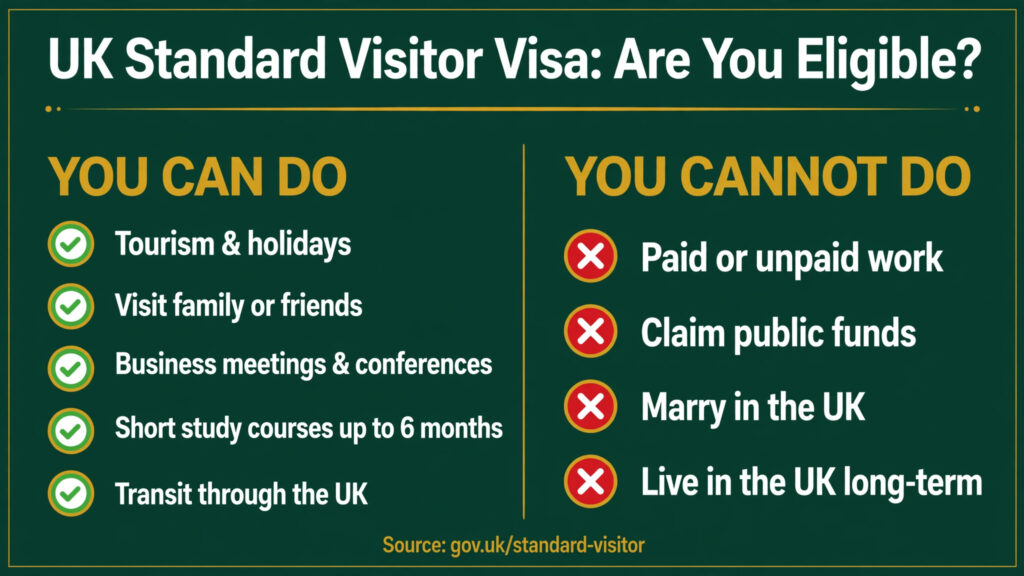
The Standard Visitor visa is deliberately flexible — one visa covers tourism, family visits, business trips, and short study. But the boundaries are strict, and crossing them is one of the fastest ways to be refused entry or have a visa cancelled.
✅ Allowed activities
- Tourism and holidays — sightseeing anywhere in the UK.
- Visiting family or friends staying with relatives in the UK.
- Business activities — meetings, interviews, conferences, trade fairs (promoting, not selling), work-related training.
- Study — courses up to 6 months at an accredited institution, exams and short research.
- Volunteering — up to 30 days with a registered charity.
- Transit and medical treatment — passing through, or receiving private medical care.
🚫 Prohibited activities
- No paid or unpaid work — not for a UK company, not self-employed (narrow exceptions for permitted paid engagements only).
- No public funds — you cannot claim UK benefits.
- No living in the UK — frequent or successive visits that make the UK your main home can get your visa cancelled.
- No marriage — you cannot marry or give notice of marriage; a separate Marriage Visitor visa is required.
UK Standard Visitor Visa Requirements 2026: Eligibility Rules
gov.uk sets a short, non-negotiable checklist. You need a passport or travel document valid for your whole stay, and you must be able to show that:
- you will leave the UK at the end of your visit;
- you can support yourself and any dependants during the trip (or someone else is funding you);
- you can pay for your return or onward journey;
- you will not live in the UK for extended periods through frequent or successive visits, or make the UK your main home.
Extra rules apply if you are visiting to study, as an academic, for a permitted paid engagement, or for medical reasons — gov.uk lists the additional documents each category needs.
Document Checklist for the UK Standard Visitor Visa
There is no single official document list that fits everyone — UKVI expects evidence matched to your circumstances. In practice, a strong application tells three stories: who you are, why you are going, and why you will come home.
- Identity: passport valid for the whole stay; previous passports showing travel history; online application confirmation with your GWF reference.
- Finances: bank statements for the last 6 months; payslips; employment letter with role, salary and approved leave; tax returns or business accounts if self-employed.
- Purpose of visit: flight itinerary (a reservation is fine — no need to pay before approval); hotel bookings or host details; invitation letter for family visits; business invitations or conference registrations.
- Ties to home: employment contract, property documents, family responsibilities, children’s school enrolment — proof you have reasons to return.
- Other: certified English translations of non-English documents; TB test certificate if required for your country; sponsor’s evidence and relationship proof if someone else funds the trip.
Documents are submitted digitally — you upload them online before your biometric appointment rather than posting paper bundles. Every fact on the form must match your documents exactly; inconsistencies are a classic refusal trigger.
The Money Question: Bank Statements and How Much to Show
This is the question applicants ask most, and the answer surprises people: UK immigration rules set no minimum bank balance for the Standard Visitor visa. Officers decide whether your money realistically covers your trip — flights, accommodation, daily spending, and the return ticket — while leaving your normal life funded at home.
What actually matters is the story your statements tell over six months:
- Consistency: regular income matching your stated salary or business, with a natural balance that rises and falls in a believable pattern.
- Source of funds: every significant deposit should have an obvious origin — salary credits, business income, family support. Unexplained lump sums are red flags.
- Affordability: the total trip cost should look proportionate to what you normally earn and spend. A trip costing more than your annual income raises eyebrows.
Never deposit a large sum just before applying to “boost” your balance. Caseworkers specifically watch for this — sudden, unexplained deposits are among the most common refusal triggers. If you do receive a legitimate lump sum (a bonus, a property sale), explain it in your cover letter and provide proof.
Fees, Biometrics, and Processing Time
The Standard Visitor visa costs £135 for up to 6 months (confirmed on the official gov.uk Standard Visitor page). Frequent travellers can get long-term Standard Visitor visas of 2, 5, or 10 years for higher fees — but each individual visit is still capped at 6 months. Always confirm the current fee table on gov.uk before paying, since fees change periodically. Fees are non-refundable, even if the visa is refused.
The good news on costs: you pay no Immigration Health Surcharge on a visitor visa. gov.uk’s own healthcare-payment guidance states plainly: “You do not need to pay if you’re applying for a visitor visa.” That surcharge (£1,035 per year on work and study routes) does not touch visitors at all. The trade-off: you are not entitled to free NHS treatment — only emergency care — so budget for travel insurance.
How long it takes
Once you have applied online, paid, and given your fingerprints and photo at a visa application centre, you will usually get a decision within 3 weeks. Apply at least 8–10 weeks before travel in peak season, since queues stretch in summer and December. The earliest you can apply is 3 months before your trip. If you are in a hurry, priority service (decision in about 5 working days, roughly £500 extra) and super priority (next working day, roughly £1,000 extra) may be available at your centre — but paying for speed buys queue position only; your documents still face the same checks.
How to Apply, Step by Step
- Check what you are allowed to do as a Standard Visitor on gov.uk/standard-visitor, and check whether you need a visa at all.
- Complete the online application at gov.uk/standard-visitor/apply-standard-visitor-visa — travel dates, accommodation, trip cost, address history, income, travel history, family details.
- Pay the £135 fee online by debit or credit card.
- Book and attend a biometrics appointment at a visa application centre (VFS Global in most countries). Bring your passport; fingerprints and a digital photo are taken.
- Upload your supporting documents through the online portal before the appointment.
- Wait for the decision — usually within 3 weeks. Track progress with your GWF reference number, and do not book non-refundable travel until the visa is in hand.
Standard Visitor vs Other UK Visit Routes
The Standard Visitor visa covers most short trips — but a few similar-sounding routes serve different purposes. Applying for the wrong one wastes the fee:
| Route | For | Max stay | 2026 fee |
|---|---|---|---|
| Standard Visitor | Tourism, family visits, business, short study, medical | 6 months per visit | £135 |
| Marriage Visitor | Marrying or registering a civil partnership in the UK | 6 months | £135 |
| Visitor in Transit | Passing through the UK only, on the way somewhere else | 48 hours | £74.50 |
| UK ETA | Visa-exempt nationals (US, Canada, EU, UAE, etc.) | 6 months per visit | £20 |
Comparing destinations too? Our country hubs cover Canada visa tools, USA visa tools, and Gulf visa tools if your plans stretch beyond the UK.
Why Applications Get Refused (and How to Avoid It)
UKVI decides each case on its own facts, but refusal letters follow familiar patterns:
Important: most visitor visa refusals carry no right of appeal. The remedy is a fresh application that directly answers every point in the refusal letter. Reapplying with the same weak evidence almost always produces the same result — fix the substance first.
Real-Life Scenario: From Refusal to Approval
Bilal, a 34-year-old sales manager, first applied in February with three months of statements, a large deposit from his brother added two weeks before the appointment, and a one-line purpose: “tourism.” The refusal letter cited insufficient evidence of funds and weak ties — he had submitted no employer letter and no leave approval.
Four months later he reapplied properly: six months of untouched statements showing regular salary credits, an employment letter confirming his role and approved leave, a day-by-day London itinerary with refundable hotel bookings, and a cover letter explaining the family wedding he would return for. Approved in 18 days. The fee was the same both times. The file was the difference.
Common Mistakes to Avoid
- Depositing a “top-up” before applying. The classic self-inflicted wound — caseworkers specifically look for sudden deposits.
- Writing “tourism” with no plan. A vague purpose plus no bookings is the fastest route to a genuine-visitor refusal.
- Submitting documents in Urdu, Arabic or other languages without certified translations. Non-English documents without translations are effectively invisible to the caseworker.
- Letting the form contradict the documents. If your salary on the form does not match your payslips, credibility is gone.
- Using frequent visits to live in the UK. Spending more time in Britain than at home across successive visits can get a long-term visa cancelled.
- Skipping travel insurance to save money. Visitors get only emergency NHS care free — one hospital visit without insurance can cost more than the entire trip.
Pro Tips for a Stronger File
Frequently Asked Questions
How much bank balance is required for a UK visitor visa?
There is no fixed minimum bank balance in the immigration rules. You must show enough to cover your accommodation, living expenses, and return journey for your specific trip — while keeping your normal life at home funded. Six months of consistent statements with a clear income source matter far more than a single large balance.
How many months of bank statements do I need?
The immigration rules do not prescribe an exact number, but six months of statements is the standard expectation in practice. They should be recent, show regular income and spending, and explain any large transactions. Statements older than six months, or accounts with unexplained deposits, weaken rather than strengthen your application.
How long does a UK Standard Visitor visa take to process?
You usually get a decision within 3 weeks of your biometric appointment. Apply as early as possible — the earliest you can apply is 3 months before travel, and peak seasons (summer, December) can stretch standard times. Priority service (about 5 working days) and super priority (next working day) may be available for an extra fee.
How much does a UK visitor visa cost in 2026?
The Standard Visitor visa costs £135 for up to 6 months. Long-term 2, 5, and 10-year visitor visas cost more, though each visit stays capped at 6 months. Visitor visas pay no Immigration Health Surcharge. Check the current fee table on gov.uk before paying, as fees are revised periodically.
Can I work on a UK visitor visa?
No. The Standard Visitor visa does not permit paid or unpaid work for a UK company or as a self-employed person. Narrow exceptions exist for permitted paid engagements — such as experts giving lectures or artists performing with a written UK invitation — but any regular work requires a proper work visa instead.
Do I need an invitation letter for a UK visitor visa?
It is not mandatory in every case, but it strongly supports your application when visiting family or friends. The letter should state who is hosting you, your relationship, the dates, and where you will stay — ideally with the host’s proof of UK status and address. If a sponsor funds your trip, their letter and bank evidence are essential.
Do I need to pay the Immigration Health Surcharge?
No. Visitor visas are exempt: gov.uk’s healthcare guidance states “You do not need to pay if you’re applying for a visitor visa.” The £1,035-per-year surcharge applies to longer routes such as work and study visas. Note the trade-off: visitors get only emergency NHS care free, so private travel insurance is strongly recommended.
What should I do if my UK visitor visa is refused?
You can reapply immediately, but do not resubmit until you have addressed every point in the refusal letter — reapplying with unchanged evidence usually ends in another refusal. Most visitor refusals carry no right of appeal, so a fresh, strengthened application is the remedy. Professional review of the refusal notice is worthwhile for complex or repeated refusals.
Conclusion: The UK Rewards the Well-Prepared
The UK Standard Visitor visa is not a lottery. Officers apply a clear, published test: genuine visitor, affordable trip, reasons to return. Meet it with six months of honest statements, a real itinerary, documented ties to home, and an application filed with weeks to spare — and the £135 buys you one of the world’s most useful travel documents.
Not sure your file clears the bar? Let the Visaora Intelligence Suite score it first — it flags the exact weaknesses a caseworker would notice, before you pay the fee. Planning a wider trip? Our UK visa tools and Schengen visa tools hubs help you plan every leg.
✈️ Planning Your Trip?
We may earn a commission — at no extra cost to you. Learn more