By Visaora Editorial Team · Updated November 2026 · 11 min read
UK Spouse Visa Financial Requirement 2026: £29,000 Rule Explained
Quick Answer: For a first application made on or after 11 April 2024, you and your partner must usually show combined gross income of at least £29,000 a year, with no extra amount for children. Cash savings above £16,000 can fill a shortfall using the formula (savings − £16,000) ÷ 2.5, so £88,500 meets the requirement alone.
Visaora provides general information, not legal advice. Rules change; always confirm with the official embassy, consulate or government website before you apply.
Key facts (checked November 2026)
- The standard minimum income requirement is £29,000 gross per year for first applications made on or after 11 April 2024.
- Pre-11 April 2024 applicants extending with the same partner stay on £18,600, plus child amounts capped at £29,000.
- Only cash savings above £16,000 count, divided by 2.5: savings alone need £88,500, held for at least six months.
- If your partner receives a listed disability or carer’s benefit, there is no fixed threshold — adequate maintenance applies instead.
- Test figures in the free UK spouse visa income checker.
The rule itself is one number, but the evidence code behind it — Appendix FM-SE — is strict about whose income counts, which months count, and which documents prove it. This guide explains the £29,000 rule in November 2026, the £18,600 transitional rule, categories A to G, the savings formula with worked figures, Gulf-based sponsors, and the exemptions.
Which threshold applies to you: £29,000 or £18,600?
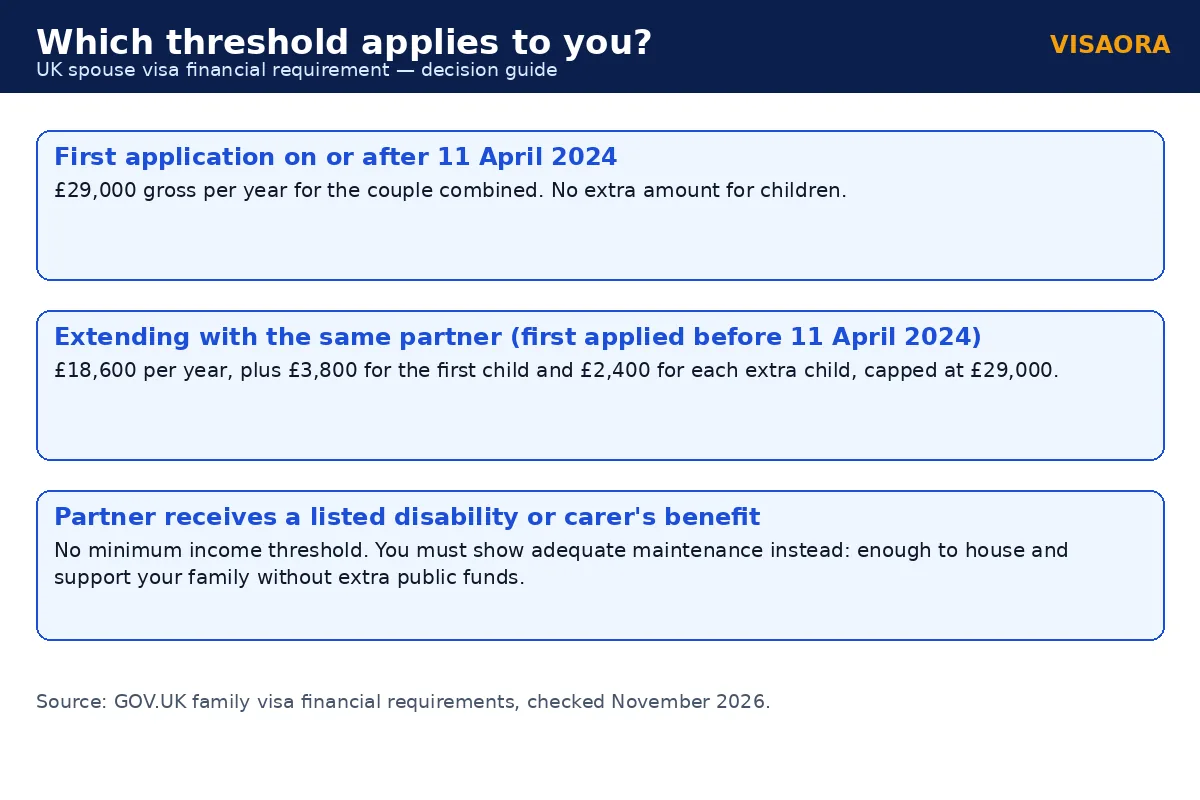
The threshold is £29,000 for a first partner application made on or after 11 April 2024, and £18,600 if you first applied before that date and are extending with the same partner. Settle this before you look at a single payslip — it changes every other calculation.
For new applicants, the £29,000 figure is a single flat amount. There is no extra amount for children, however many are applying with you — a real change from the old system, where each child pushed the threshold higher. GOV.UK states the position plainly: you and your partner usually need to prove a combined income of at least £29,000 a year, and this is called the minimum income requirement.
The transitional group is protected. If you first applied as a partner — including as a fiancé, fiancée or proposed civil partner — before 11 April 2024, and you are extending with the same partner, the old numbers follow you: £18,600 a year, plus £3,800 for the first child counted and £2,400 for each additional child. Children who are British or Irish citizens, permanently settled, or hold pre-settled status do not add to the amount, and the total is capped at £29,000. The protection is tied to staying on the partner route with the same partner.
| Your situation | Threshold | Children | Savings-only figure |
|---|---|---|---|
| First application on or after 11 April 2024 | £29,000 | No extra amount | £88,500 |
| Extension, same partner, first applied before 11 April 2024 | £18,600 | +£3,800 first child, +£2,400 each extra, capped at £29,000 | £62,500 before child additions |
| Partner receives a listed disability or carer’s benefit | No fixed threshold | Not applicable | Adequate maintenance test instead |
What income counts towards the requirement? Categories A to G explained
Income counts only if it falls into one of the seven categories in Appendix FM-SE, labelled A to G — employment, self-employment, pensions, some non-employment income such as rent, and cash savings. Each category has its own evidence list, and the category decides which documents you must produce.
| Category | Source of income | Core evidence |
|---|---|---|
| A | Salaried or non-salaried employment with the same employer for 6 months or more | 6 months of payslips, matching bank statements, employer’s letter |
| B | Employment with the current employer for less than 6 months, or variable income | Current job evidence plus 12 months of earnings history |
| C | Non-employment income, for example rental income or dividends | Documents proving the income was received over the last 12 months |
| D | Cash savings above £16,000 | Statements showing the balance held for at least 6 months |
| E | Pension income | Official pension documents and bank statements |
| F | Self-employment in the last full financial year | Tax returns, accounts and business evidence for that year |
| G | Self-employment averaged over the last two full financial years | Two years of tax and accounts evidence |
You can combine categories — for example, part employment income and part savings — but every pound you claim must be traceable to a document in the exact format Appendix FM-SE specifies. Evidence for the wrong category is one of the most common refusal reasons in our guide to UK visa refusal reasons, so work out your category before you apply.
Immigration agency? Qualify UAE leads free with Visaora Agency Leads → https://visaora.io/visaora-agency-leads/
Category A or Category B: how is salaried employment assessed?
Category A applies after six months with the same employer; Category B applies when the job is newer or pay varies. Category B asks for two things: the current job must meet the threshold, and total earnings over the last 12 months must also meet it.
Under Category A, the figure tested is the lowest salary level in the six-month period, annualised — a recent promotion does not rewrite earlier months. Under Category B, a sponsor three months into a £32,000 job can qualify only if total earnings across the previous 12 months also reach £29,000; employment gaps hurt, because those months earn nothing.
Foreign income is converted at the official spot rate on the application date — see our guide to UK visa bank statements for UAE residents.
How do self-employed sponsors qualify under Categories F and G?
Self-employed sponsors qualify under Category F on the last full financial year alone, or Category G on the average of the last two. The test is anchored to completed tax years, so timing an application around a tax return is often decisive.
Category F is unforgiving if the most recent year was weak: that year alone sets the figure. Category G softens it by averaging two years. The evidence burden is the heaviest of any category: tax returns, statements of account, business bank statements, accounts where required, and proof the business is still trading. Directors of small limited companies are generally treated under these categories for salary and dividends, with company-level evidence on top. Start gathering it months ahead, not days.
How does the savings formula work?
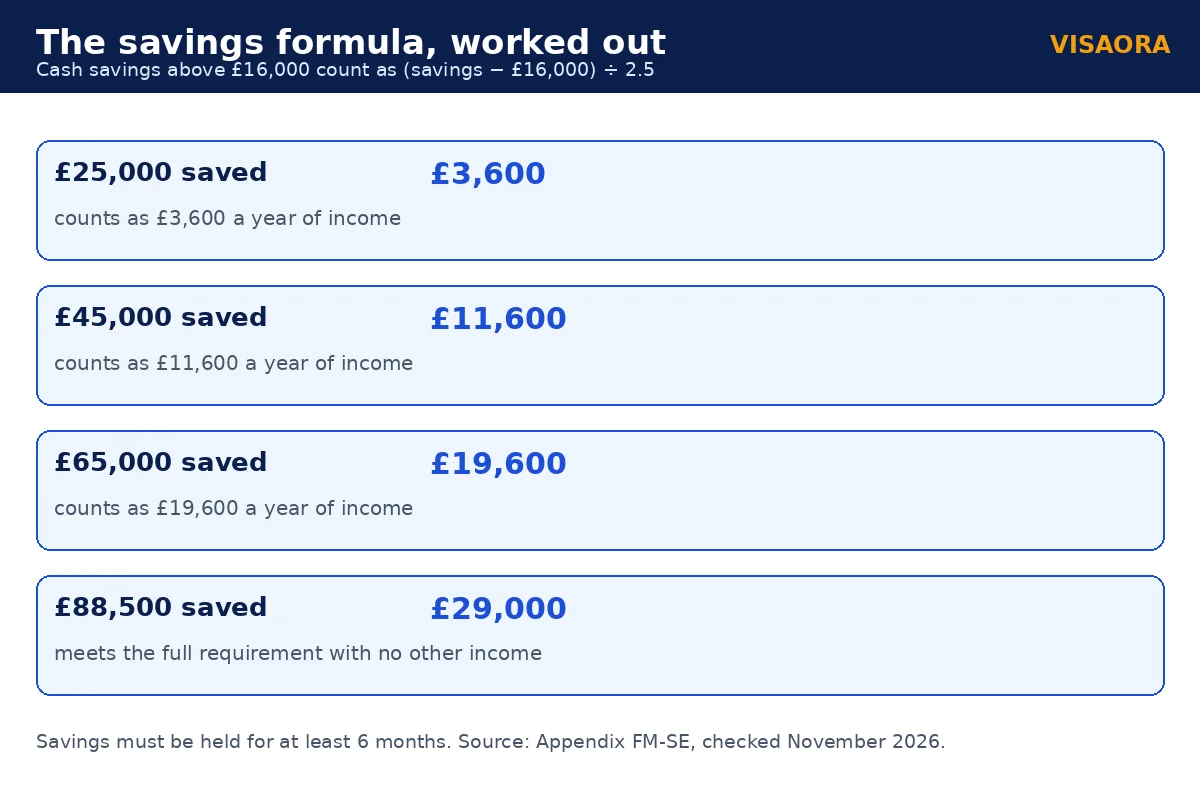
The savings formula is simple: only savings above £16,000 count, divided by 2.5 to give an annual income figure. The 2.5 reflects the 30 months of leave normally granted; the first £16,000 you hold contributes nothing.
Worked through: savings of £25,000 give (£25,000 − £16,000) ÷ 2.5 = £3,600 a year of counted income; £45,000 gives £11,600; £65,000 gives £19,600; and £88,500 gives the full £29,000 — (£29,000 × 2.5) + £16,000 = £88,500, the savings-only figure quoted everywhere.
| Cash savings held | Minus £16,000 baseline | Divided by 2.5 | Income still needed |
|---|---|---|---|
| £25,000 | £9,000 | £3,600 a year | £25,400 |
| £45,000 | £29,000 | £11,600 a year | £17,400 |
| £65,000 | £49,000 | £19,600 a year | £9,400 |
| £88,500 | £72,500 | £29,000 a year | £0 — requirement met |
Two conditions catch people out. First, the savings must have been held for at least six months, and the amount assessed is based on the lowest balance in that period — a recent lump sum does not work. Second, the money must be cash in an account in the applicant’s name, the sponsor’s name, or both jointly, and immediately withdrawable. Shares, property and business accounts do not count.
Can you combine income and savings?
Yes — combining is what the formula is built for. Take your qualifying income, work out the shortfall against £29,000, multiply it by 2.5 and add £16,000: that is the savings you must show.
Take a sponsor earning £24,000. The shortfall is £5,000, so the savings needed are (£5,000 × 2.5) + £16,000 = £28,500, held for six months. At £20,000 of income the shortfall is £9,000 and the savings jump to £38,500 — each £1,000 of missing income needs £2,500 of savings to replace it. Test your own combination in the free UK spouse visa income checker.
What if your sponsor works abroad in the UAE, Saudi Arabia or Qatar?
A sponsor working abroad can count that income in defined situations — most commonly where the sponsor returns to the UK with the applicant. That route requires current overseas employment meeting the threshold plus a confirmed UK job offer starting within three months of the return, also meeting the threshold alone or combined with permitted sources. Gulf-based sponsors use this route heavily, and their evidence is examined closely.
Overseas salary is converted at the official rate on the application date, so recheck a borderline dirham salary close to submission — currency movement can pull it under the line. Keep overseas employment letters on company letterhead, with start date, role and salary. If the sponsor stays abroad while only the applicant moves, the position is much harder: in most partner cases the sponsor must be in the UK, settled, or returning with the applicant.
Who is exempt from the £29,000 threshold?
You are exempt from the fixed threshold if your partner receives one of the benefits listed on GOV.UK — including Disability Living Allowance, Personal Independence Payment, Attendance Allowance, Carer’s Allowance, Severe Disablement Allowance and Armed Forces Independence Payment, plus devolved equivalents such as Adult Disability Payment. The list has changed as devolved benefits were introduced, so check the current GOV.UK list rather than an old printout.
Exemption does not mean no financial test. Instead of £29,000, you must show adequate maintenance: enough money to house and support yourselves without relying on additional public funds. The caseworker weighs your income against your housing costs, so a detailed household budget with rent or mortgage evidence matters more than any single number.
What evidence does Appendix FM-SE require?
Appendix FM-SE requires specified evidence in specified formats: payslips covering the exact period for your category, bank statements showing each payment landing, an employer’s letter confirming job, salary and start date, and, for savings, statements covering the full six months. A document that is almost right — a payslip missing the employer’s name — can be discounted entirely.
Work through these steps in order:
- Confirm your threshold: £29,000, the transitional scale, or adequate maintenance.
- Identify your category (A to G) and the exact evidence it demands.
- Run your figures through the formula and confirm a clear margin.
- Collect payslips, statements and employer letters as a matched set, with salary payments lining up across all three.
- Convert foreign-currency figures at the official rate for the application date.
- Fill gaps early: a missing statement month takes weeks to fix, not hours.
Common mistakes that lead to financial refusals
Most financial refusals are paperwork failures, not income failures:
- Using the wrong threshold. Claiming £18,600 without proving a pre-11 April 2024 first application, or adding child amounts that no longer exist.
- Counting the first £16,000 of savings. It contributes nothing, yet applicants regularly claim the full balance.
- Mismatched evidence. Payslips that do not match bank credits, or an employer’s letter showing a different salary.
- Short savings history. Money held for five months instead of six, or a balance that dipped mid-period.
- Wrong category evidence. Six months of documents for a Category B case that needs twelve.
- Currency risk. A Gulf salary that met the threshold when the job started but not at the application-date exchange rate.
Example scenario: a sponsor in Dubai returning to the UK
Example scenario (illustrative only): Ahmed, a British citizen working in Dubai on a salary converting to £31,000 a year, has a confirmed UK job offer at £30,000 starting six weeks after the couple’s planned return. His wife applies for entry clearance as a partner. Both salaries clear £29,000, so the returning-sponsor route works on income alone. Their £20,000 of savings adds only a margin, because just the £4,000 above the baseline would count — worth £1,600 a year. Their pack pairs his Dubai employment letter and payslips with the UK offer letter, every dirham figure converted at the application-date rate.
What can you do if you cannot meet the financial requirement?
If you cannot meet the requirement, GOV.UK states that you may still be able to apply if you have a child in the UK who is a British or Irish citizen, or who has lived in the UK for seven years and it would be unreasonable for them to leave, or if refusing you would breach your human rights. These are exceptional routes, assessed on the evidence about your family life.
Be clear-eyed: leave granted this way normally leads to settlement only after ten years, not five. For many couples, waiting until income or savings genuinely reach the line beats applying early on an exceptional basis.
Frequently asked questions
What is the UK spouse visa financial requirement in 2026?
For first applications made on or after 11 April 2024, the requirement is a combined gross income of at least £29,000 a year, with no extra amount for children. Couples extending with the same partner after first applying before that date stay on the older £18,600 scale, plus child amounts capped at £29,000.
Is the £29,000 figure before or after tax?
The £29,000 figure is gross income — before tax and National Insurance. Payslips are assessed on gross amounts, and self-employed sponsors on the profit figures in their tax returns for the relevant year. The gross figure in your evidence must reach the threshold for your category.
Can savings alone meet the spouse visa financial requirement?
Yes. Savings alone meet the requirement at £88,500 under the £29,000 rule, because only savings above £16,000 count and the excess is divided by 2.5. The money must be cash, in an account in your name, your partner’s name or both jointly, held for at least six months and immediately withdrawable.
Do children increase the £29,000 requirement?
No. Under the current rules there is no extra amount for children — the requirement stays at £29,000 however many children apply with you. Child additions of £3,800 for the first child and £2,400 for each additional child survive only in the transitional group who first applied before 11 April 2024, capped at £29,000.
Does a sponsor’s income from Dubai or the Gulf count?
It can count in the situations Appendix FM allows — most commonly where the sponsor returns to the UK with the applicant and holds a confirmed UK job starting within three months that also meets the threshold. Income is converted at the official rate on the application date, and payslips, letters and statements must match exactly.
Who is exempt from the minimum income requirement?
You do not need to meet the £29,000 threshold if your partner receives a listed disability or carer’s benefit, such as Personal Independence Payment, Disability Living Allowance, Attendance Allowance or Carer’s Allowance. Instead you must show adequate maintenance: enough income, after housing costs, to support your family without extra public funds.
Sources
- GOV.UK — Family visas: financial requirements if you’re applying as a partner or spouse: https://www.gov.uk/uk-family-visa/proof-income-partner
- GOV.UK — Immigration Rules, Appendix FM: family members: https://www.gov.uk/guidance/immigration-rules/immigration-rules-appendix-fm-family-members
- GOV.UK — Immigration Rules, Appendix FM-SE: specified evidence: https://www.gov.uk/guidance/immigration-rules/immigration-rules-appendix-fm-se-family-members-specified-evidence
- GOV.UK — Apply for a family visa as a partner or spouse: https://www.gov.uk/uk-family-visa/partner-spouse
Last checked: November 2026
Visaora provides software tools and general information, not legal advice. Rules change; always confirm with the official authority.
✈️ Planning Your Trip?
We may earn a commission — at no extra cost to you. Learn more