By Visaora Editorial Team · Updated November 2026 · 11 min read
Schengen Visa Fee 2026: €90 Fee, Service Charges and Total Cost
Quick Answer: The Schengen visa fee in 2026 is €90 for adults, €45 for children aged 6 to 11, and free under 6 — the same in every Schengen country since 11 June 2024. Most applicants also pay a centre service charge and need travel insurance with at least €30,000 of medical cover. The fee is never refunded if refused.
Visaora provides general information, not legal advice. Rules change; always confirm with the official embassy, consulate or government website before you apply.
Key facts (checked November 2026)
- Official fee since 11 June 2024: €90 adults · €45 children aged 6–11 · €0 children under 6, set by the European Commission for all Schengen states.
- Visa facilitation agreements keep a €35 fee for nationals of Armenia, Azerbaijan and Belarus; Cabo Verde nationals pay €67.50.
- The centre service fee (VFS Global, TLScontact or BLS) comes on top — confirm the amount on your centre’s official page, never through an agent.
- Your file also needs travel insurance covering at least €30,000 — compare compliant policies with the free Schengen travel insurance comparator.
- Single-entry and multiple-entry visas cost exactly the same fee.
Ask ten applicants what a Schengen visa costs and you will hear ten different numbers, because most people quote the total they paid — fee, service charge, insurance, photos, courier — as if it were one official price. It is not. The official fee is fixed in European law and identical from Lisbon to Helsinki, while everything around it varies by where you apply. This guide separates the two: the exact official fee table for 2026, who pays a reduced fee or nothing, what visa centres add on top, a realistic total-cost breakdown, and a worked family example. Before you budget, check the funds side of your application with the free Schengen proof of funds calculator.
What is the official Schengen visa fee in 2026?
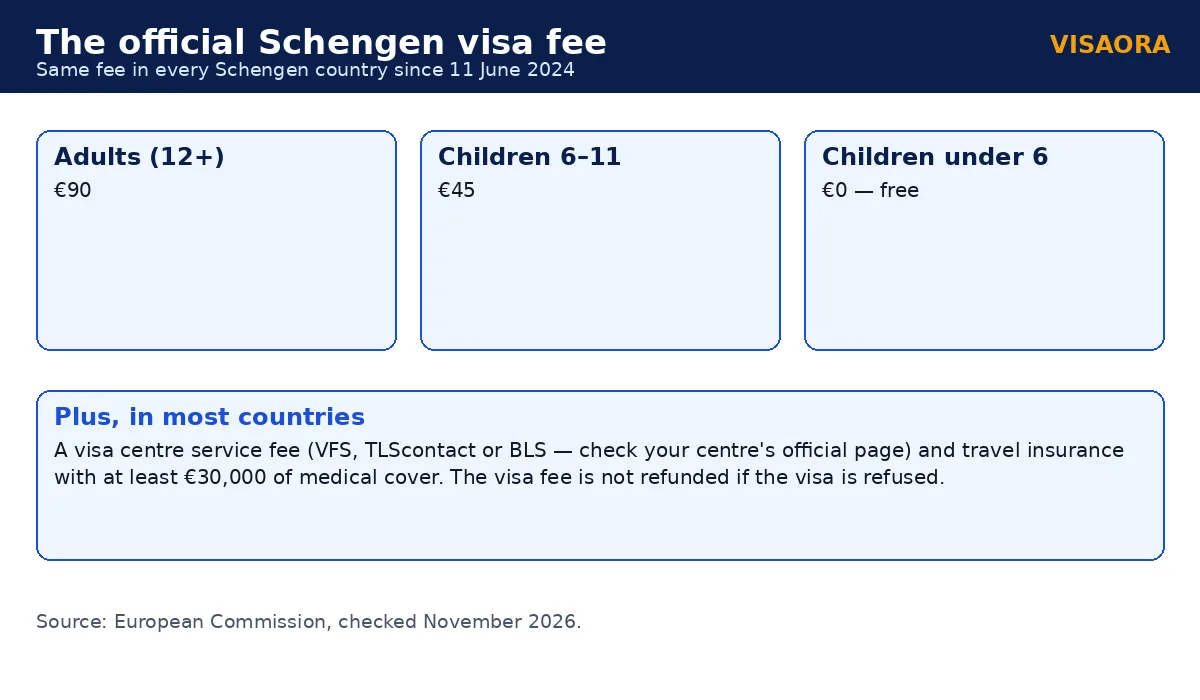
The official fee is €90 for adults, €45 for children aged 6 to 11, and nothing for children under 6. The Commission raised it from €80 on 11 June 2024 under the Visa Code’s three-year review, and it has not changed since — any site quoting €80 is out of date, and any agent quoting more for the fee itself is marking it up.
| Applicant | Official visa fee | Notes |
|---|---|---|
| Adult (12 years and over) | €90 | Same for single-entry and multiple-entry |
| Child aged 6 to 11 | €45 | Age on the date the application is lodged |
| Child under 6 | €0 | No visa fee; a centre service fee may still apply |
| Nationals of Armenia, Azerbaijan, Belarus | €35 | Under EU visa facilitation agreements |
| Nationals of Cabo Verde | €67.50 | Under the EU–Cabo Verde facilitation agreement |
The fee is charged in local currency in most countries, converted at the consulate’s official rate — which is why the dirham, riyal or rupee amount moves slightly between months. Consulates publish the current figure: the Italian Consulate in Muscat, for example, lists €90 as OMR 39.900 for October to December 2026. Take the figure from your consulate’s official page in the week you apply, and keep the receipt. See also our complete Schengen visa guide.
Who pays a reduced fee, and who pays nothing at all?
Reduced fees come from visa facilitation agreements, and full waivers cover defined categories such as young children, certain students and researchers, and family members of EU or EEA citizens exercising free-movement rights. Raise a waiver claim when you lodge the application and bring the document that proves the category — waivers are applied at the counter, not refunded later.
The main waiver categories in the Visa Code cover children under six; school pupils, students and accompanying teachers travelling for study; researchers travelling for scientific research; representatives of non-profit organisations aged 25 or under attending seminars and conferences; and spouses and family members of EU or EEA citizens travelling with them or joining them under the Free Movement Directive, who get a free and accelerated procedure. Nationals of Armenia, Azerbaijan and Belarus pay a reduced €35 fee, and Cabo Verde nationals pay €67.50, as the Commission’s applying-for-a-visa page confirms. A fee waiver never waives the other requirements — a student whose fee is waived still needs insurance, documents and an appointment, and may still owe the centre’s service fee.
Immigration agency? Qualify UAE leads free with Visaora Agency Leads → https://visaora.io/visaora-agency-leads/
What is the difference between the visa fee and the service fee?
The visa fee belongs to the consulate and is set in European law; the service fee belongs to the private company — VFS Global, TLScontact or BLS International — that collects your application, takes your biometrics and returns your passport. You pay both at the centre, usually in one transaction, which is exactly why the two get confused.
The Commission’s guidance notes only that an additional fee may apply through a visa service centre. The amount is set per country and contract, so check the fees page of the official centre website for your country of residence before you go, and treat third-party quotes as unverified. Never pay a third layer — an agent’s “processing fee” on top of both. Agents cannot speed up consulate decisions, the appointment itself is booked free through the official portal, and centre extras such as premium lounges, courier return and SMS updates are genuinely optional.
What is the total cost of a Schengen visa in 2026?
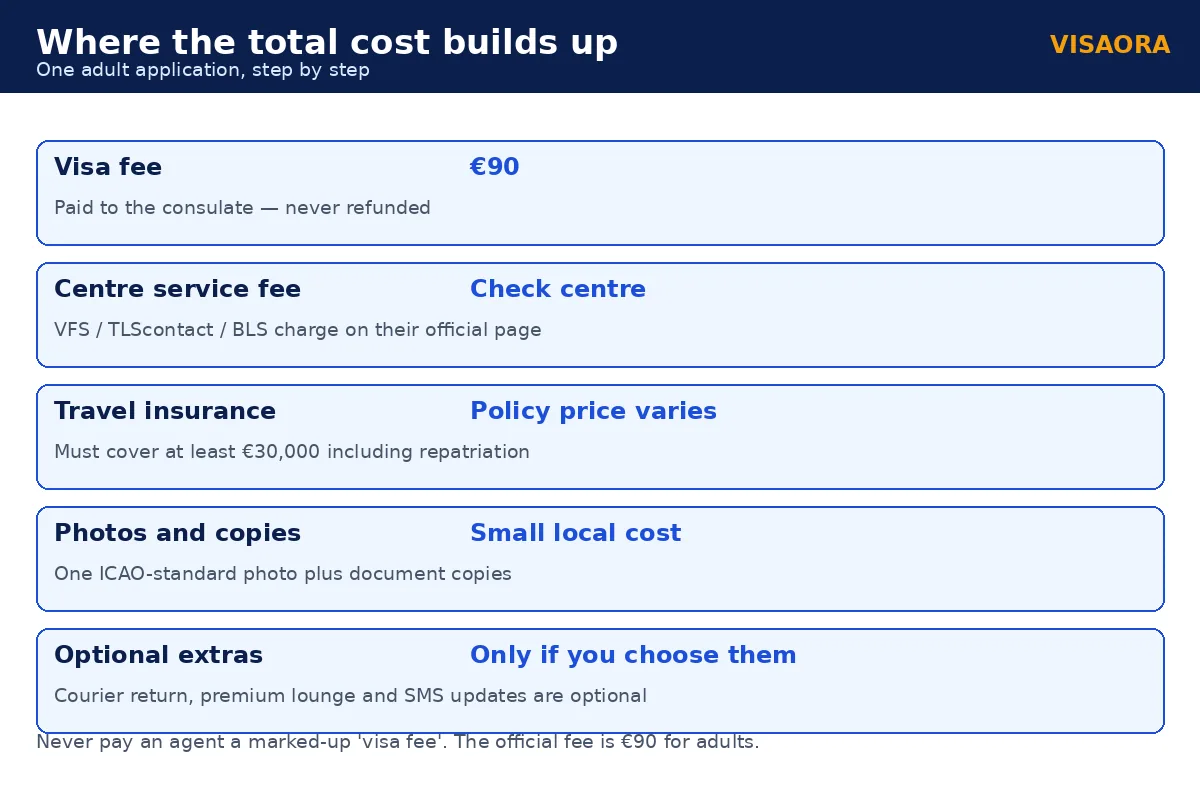
The realistic total for one adult is the €90 fee, plus the centre service fee, plus compliant travel insurance, plus small local costs for photos and copies. Budgeting only for €90 leaves applicants short at the payment counter.
| Cost line | Amount | Applies to |
|---|---|---|
| Visa fee — adult | €90 | Every adult applicant |
| Visa fee — child 6–11 | €45 | Each child in this age band |
| Visa fee — child under 6 | €0 | Free |
| Centre service fee | Varies — confirm on your centre’s official page | Most applicants using VFS, TLScontact or BLS |
| Travel insurance | Policy price varies by trip length and age | Must cover at least €30,000, including repatriation |
| Photo and document copies | Small local cost | One ICAO-standard photo plus copies |
| Optional extras | Only if you choose them | Courier, premium lounge, SMS updates |
Residents of the UAE, Saudi Arabia, Qatar, Kuwait and Oman apply through centres in their country of residence and pay the euro-denominated fee in local currency at the official rate — Saudi residents can follow the residence-specific steps in our Schengen visa from Saudi Arabia guide, and Kuwait residents in the Schengen visa from Kuwait guide. Applicants from Pakistan, India and the US follow the same structure: only the currency and the service fee change. If a “package price” cannot be broken into these lines, walk away.
Example scenario: what does a family of four from Dubai pay?
Example scenario (illustrative only): Two parents and two children, aged 8 and 4, apply from Dubai. The visa fees are fixed: €90 + €90 for the parents, €45 for the 8-year-old, €0 for the 4-year-old — €225 in total, paid in dirhams at the official rate. On top come four centre service fees at the centre’s published rate, one family insurance policy meeting the €30,000 rule, and photos for all four. The family declines the premium lounge and courier, collects passports in person, and keeps every receipt. If the visas were refused, the €225 would not come back.
What hidden costs catch applicants out?
The costs that catch people out are rarely large — a second trip to the centre because a document was missing, a new insurance policy because the first one’s cover fell below €30,000, or a fresh application fee after a refusal. A refusal is the most expensive outcome of all: you pay the full fee again to reapply.
Watch for these in particular: travel to the centre, which in several countries sits in one city only; photographs that miss the ICAO standard and must be retaken at centre prices; document copies printed on site; and courier return, which is convenient but optional — collecting in person is free. Insurance bought in a panic at the centre is usually the most expensive compliant policy you will ever buy; arrange it in advance using our Schengen travel insurance guide.
How and when do you pay the Schengen visa fee?
You pay when you lodge the application — the fee is taken before your file is processed, not after a decision. Most centres accept cards and issue a receipt with a tracking reference; a few consulates require specific methods, so check your centre’s official page for payment details.
Three habits protect you. Pay only at the official centre or consulate, never to an individual’s account. Keep the receipt until your passport is back — it carries your tracking reference. And if you must reschedule, ask whether a new service fee applies, because practice differs by operator; a no-show may forfeit the appointment and the service element.
Is the Schengen visa fee refunded if you are refused?
No. The fee pays for the examination of your application, not a positive result, and the Visa Code treats it as non-refundable whether the visa is granted, refused or withdrawn after lodging. The service fee is likewise earned once your file and biometrics are taken.
This is why preparation matters more than speed. A refused applicant who reapplies pays €90 a second time, plus a second service fee. If your refusal notice lists a curable reason — missing insurance, unclear funds, a weak itinerary — fix it fully before spending another fee. Paying twice for the same weak file is how applicants double their costs.
Does a multiple-entry Schengen visa cost more?
No — a multiple-entry visa costs exactly the same €90 as a single-entry visa. The fee buys the examination; the number of entries is a decision the consulate makes based on your travel history and the justification in your file, not a product you can upgrade at the counter.
Be suspicious of anyone selling a “multiple-entry package” at a higher official fee. What you can legitimately do is strengthen the file: show previous Schengen visas used correctly and explain the need for repeat travel. The Commission’s guidance confirms the same fee framework covers single-entry and multiple-entry short-stay visas.
How are long-stay national visa fees different?
Long-stay (D) visas are national, not Schengen-wide, so each country sets its own fee, exemptions and payment method. A German, French or Spanish long-stay fee will not match the €90 short-stay figure. Students and new employees trip over this most: they budget €90, then meet a different national fee plus legalisation and translation costs. If your stay exceeds 90 days, price the route from your destination consulate’s long-stay pages instead.
Common mistakes that waste money on Schengen applications
- Paying an agent a marked-up “visa fee”. The official fee is €90 for adults. Anything above that labelled as the visa fee is the agent’s margin.
- Budgeting only for €90. Service fees, insurance, photos and travel to the centre are real costs — budget the total, not the headline fee.
- Buying insurance with too little cover. Cover below €30,000, or without repatriation, makes the policy worthless for this application, however cheap it was.
- Assuming a refusal means a refund. It does not. The fee buys the examination; reapplying means paying again.
- Paying for optional extras under pressure. Premium lounges, courier and SMS updates are optional. Declining them does not affect your decision.
- Using last year’s figures. The fee rose from €80 to €90 in June 2024. Old blog posts and old agent price lists still circulate with the wrong number.
How can you keep the total cost down without risking a refusal?
Keep costs down by removing waste, never by cutting required evidence: book the free appointment yourself, buy compliant insurance in advance, decline optional extras, collect your passport in person, and prepare the file well enough to avoid a second fee.
Work through this sequence before you pay anything:
- Confirm your fee band — €90, €45, €0 or a facilitation rate.
- Check your centre’s official page for its service fee and payment methods.
- Buy insurance stating at least €30,000 of cover including repatriation, valid area-wide for all dates.
- Take ICAO-standard photos and make copies before you go.
- Decline extras you do not need; keep every receipt.
- If refused, fix the stated reasons properly before paying a second fee.
Frequently asked questions
What is the Schengen visa fee in 2026?
The fee in 2026 is €90 for adults and €45 for children aged 6 to 11, with no fee for children under 6. The Commission set these amounts on 11 June 2024, replacing the old €80 and €40 fees, and they apply identically in every Schengen country. A centre service fee and insurance come on top.
Is the Schengen visa fee the same in all countries?
Yes. The €90 adult fee and €45 child fee are set in the EU Visa Code and are identical whichever Schengen country you apply to. What changes is the currency you pay in, converted at the consulate’s official rate, and the visa centre’s service fee in your country of residence.
Do children pay the Schengen visa fee?
Children under 6 pay no visa fee. Children aged 6 to 11 pay €45, and from the 12th birthday the full €90 applies — age on the date the application is lodged decides the band. A centre may still charge its service fee for a child’s application even when the visa fee is waived.
Is the Schengen visa fee refunded if the visa is rejected?
No. The fee covers the cost of examining your application and is not refunded if the visa is refused, and it is also not refunded if you withdraw after lodging. The centre’s service fee is likewise kept once your application and biometrics have been taken. If you reapply after a refusal, you pay the full fee and service charge again.
Does a multiple-entry Schengen visa cost more than a single-entry one?
No. Single-entry and multiple-entry short-stay visas carry the same official fee — €90 for an adult. The number of entries is decided by the consulate from your application, travel history and stated need to travel repeatedly; it is not sold as an upgrade. Anyone charging you a higher “official fee” for a multiple-entry visa is adding their own margin.
Do family members of EU citizens pay the Schengen visa fee?
Family members of EU or EEA citizens who are travelling with the citizen, or joining them, under the Free Movement Directive are entitled to a free and accelerated visa procedure — the visa fee is waived. Bring the documents proving the family relationship and the citizen’s exercise of free-movement rights, and raise the entitlement when you lodge the application, because the waiver is applied at that point.
Sources
- European Commission — Applying for a Schengen visa: https://home-affairs.ec.europa.eu/policies/schengen/visa-policy/applying-schengen-visa_en
- European Commission — Schengen visa fee increased as of 11 June 2024: https://home-affairs.ec.europa.eu/news/schengen-visa-fee-increased-11-june-2024-2024-06-13_en
- German Federal Foreign Office (Germany.info) — Visa fees: https://www.germany.info/us-en/service/visa/visa-fee-923358
- Embassy of Italy in Muscat — Consular visa fees from 1 October 2026 (PDF): https://ambmascate.esteri.it/wp-content/uploads/2026/10/Consular-visa-fees-from-1st-October-2026.pdf
Last checked: November 2026
Visaora provides software tools and general information, not legal advice. Rules change; always confirm with the official authority.
✈️ Planning Your Trip?
We may earn a commission — at no extra cost to you. Learn more