EB-1A Extraordinary Ability Green Card: The 10 Criteria and How to Document Them
By Visaora Editorial Team · Updated November 2026 · 13 min read
Quick Answer: EB-1A is the first-preference green card for people at the very top of the sciences, arts, education, business or athletics. Qualify through sustained national or international acclaim — one major international award, or at least 3 of the 10 USCIS criteria — then pass a final merits review.
Visaora provides software tools and general information, not legal advice. Rules change; always confirm with the official authority.
Key facts
- Category: employment-based first preference (EB-1A) — sciences, arts, education, business or athletics.
- Core test: sustained national or international acclaim, extensively documented.
- Evidence threshold: one major international award, OR at least 3 of the 10 criteria, OR comparable evidence where a criterion does not fit.
- No employer needed: no job offer, no labor certification — you may petition for yourself.
- Petition: Form I-140; premium processing via Form I-907.
- Review: two steps — count the criteria met, then a final merits determination on the whole record.
- Fees: in the official USCIS Fee Schedule (Form G-1055); an incorrect fee means rejection.
Most EB-1A records fail on documentation, not talent. Build your list early with Visaora’s free document checklist generator, then map every item to the criterion it supports.
Table of contents
- What is the EB-1A extraordinary ability green card?
- Do you need a job offer or an employer for EB-1A?
- What are the 10 EB-1A criteria?
- How does the USCIS two-step analysis work?
- How do you document each criterion so USCIS credits it?
- What are the steps to file an EB-1A petition?
- How much does EB-1A cost in government fees?
- EB-1A, EB-1B or EB-1C: which first-preference path fits you?
- Common mistakes: what weakens an EB-1A petition?
- Example scenario: mapping a research record to the criteria
- Frequently asked questions
What is the EB-1A extraordinary ability green card?
EB-1A is for people whose expertise shows they are, in USCIS’s words, “one of that small percentage who have risen to the very top of the field of endeavor.” It is the extraordinary-ability branch of the first employment-based preference: sciences, arts, education, business and athletics.
What matters is not your job title but your record: sustained national or international acclaim, recognized through extensive documentation. “Sustained” is deliberately flexible — the Policy Manual sets no age limit and no fixed time frame, so early-career applicants can qualify if acclaim is maintained. Three elements must all be present: sustained acclaim; continuing work in the same area in the US; and entry that will substantially benefit the US. Still deciding whether a green card is the right instrument? Our guide to the difference between a visa and a green card explains it first.
Do you need a job offer or an employer for EB-1A?
No. EB-1A requires no job offer and no labor certification, and you can file the Form I-140 petition yourself — the self-petition route that makes this category unusual.
USCIS’s EB-1 page is explicit: anyone may file on the person’s behalf, including the person as self-petitioner. Two strings attach: show you will keep working in your area of extraordinary ability in the US, and that the work will substantially benefit the country. A petition built entirely on past glory is exposed on those points.
Immigration agency? Qualify UAE leads free with Visaora Agency Leads → https://visaora.io/visaora-agency-leads/
What are the 10 EB-1A criteria?
Unless you hold one major international award, you must present evidence meeting at least 3 of the 10 criteria in the regulation at 8 CFR 204.5(h)(3) — each below, with its documenting evidence.
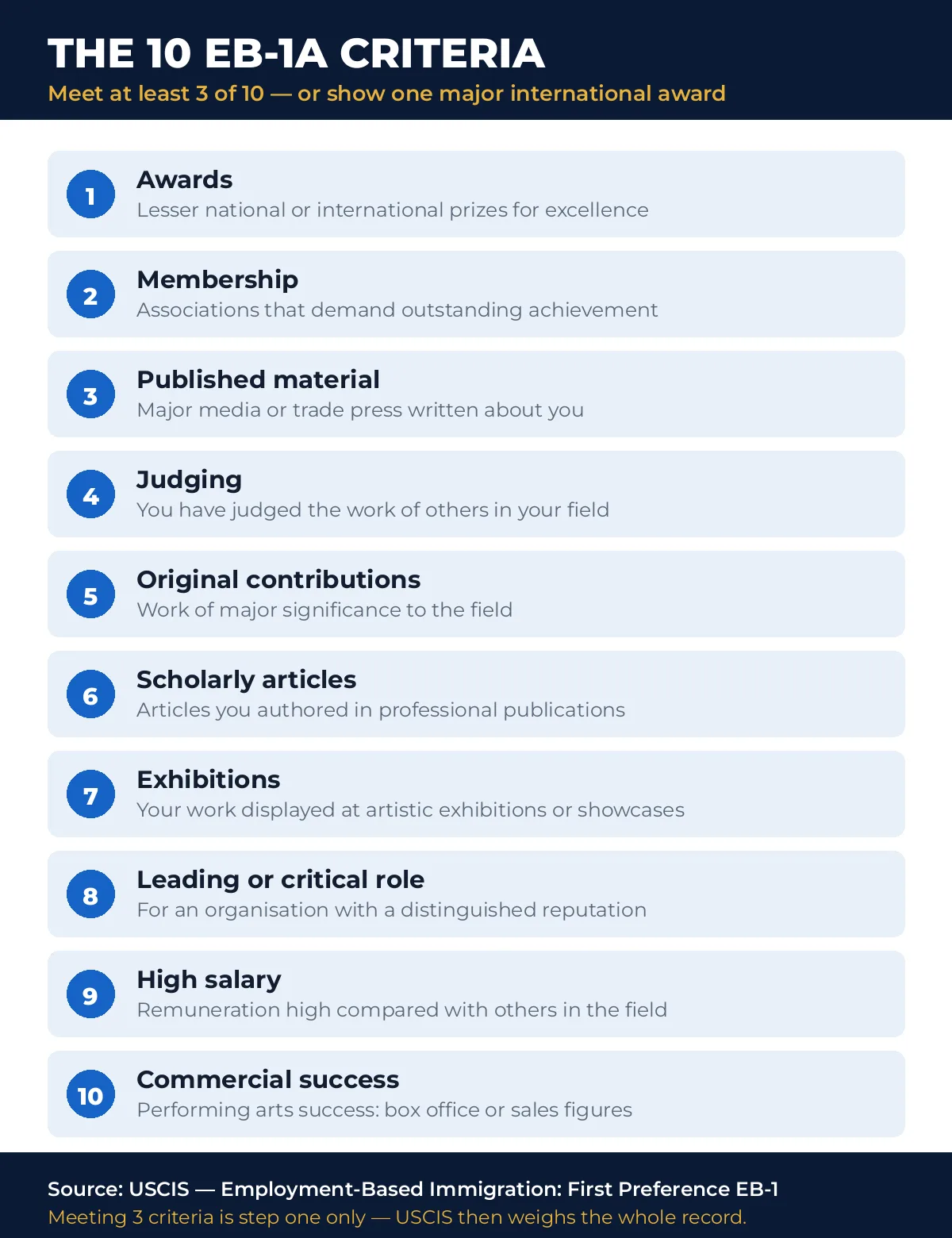
| # | Criterion | What documents it |
|---|---|---|
| 1 | Lesser nationally or internationally recognized prizes or awards for excellence | The award, its selection criteria, recipient numbers and significance. |
| 2 | Membership in associations that demand outstanding achievement of their members | Bylaws showing recognized experts judge members on outstanding achievement. |
| 3 | Published material about you in professional or major trade publications or other major media | The articles (title, date, author) plus circulation. Material must be about you and your work. |
| 4 | Judging the work of others, individually or on a panel | Invitation AND proof of completion — e.g. a confirmed review. |
| 5 | Original contributions of major significance to the field | Impact: citations high for your field, commentary, adoption, patents in real use, expert letters. |
| 6 | Authorship of scholarly articles in professional or major trade publications or other major media | Peer-reviewed papers or published conference presentations, with the venue’s standing. |
| 7 | Display of your work at artistic exhibitions or showcases | Proof the displayed work was yours and the venue was an artistic exhibition or showcase. |
| 8 | A leading or critical role in organizations with a distinguished reputation | Letters explaining your leading or critical role, plus the organization’s reputation. |
| 9 | A high salary or other significantly high remuneration compared with others in the field | Pay records or a credible contract, against reliable local wage data. |
| 10 | Commercial successes in the performing arts | Box office or sales figures, relative to others — not merely proof you performed. |
Every criterion asks for independent, verifiable proof, judged against your own field — hence the documentation habits below.
How does the USCIS two-step analysis work?
USCIS decides EB-1A petitions in two steps: it counts whether your evidence objectively meets at least three criteria, then weighs the whole record in a final merits determination.
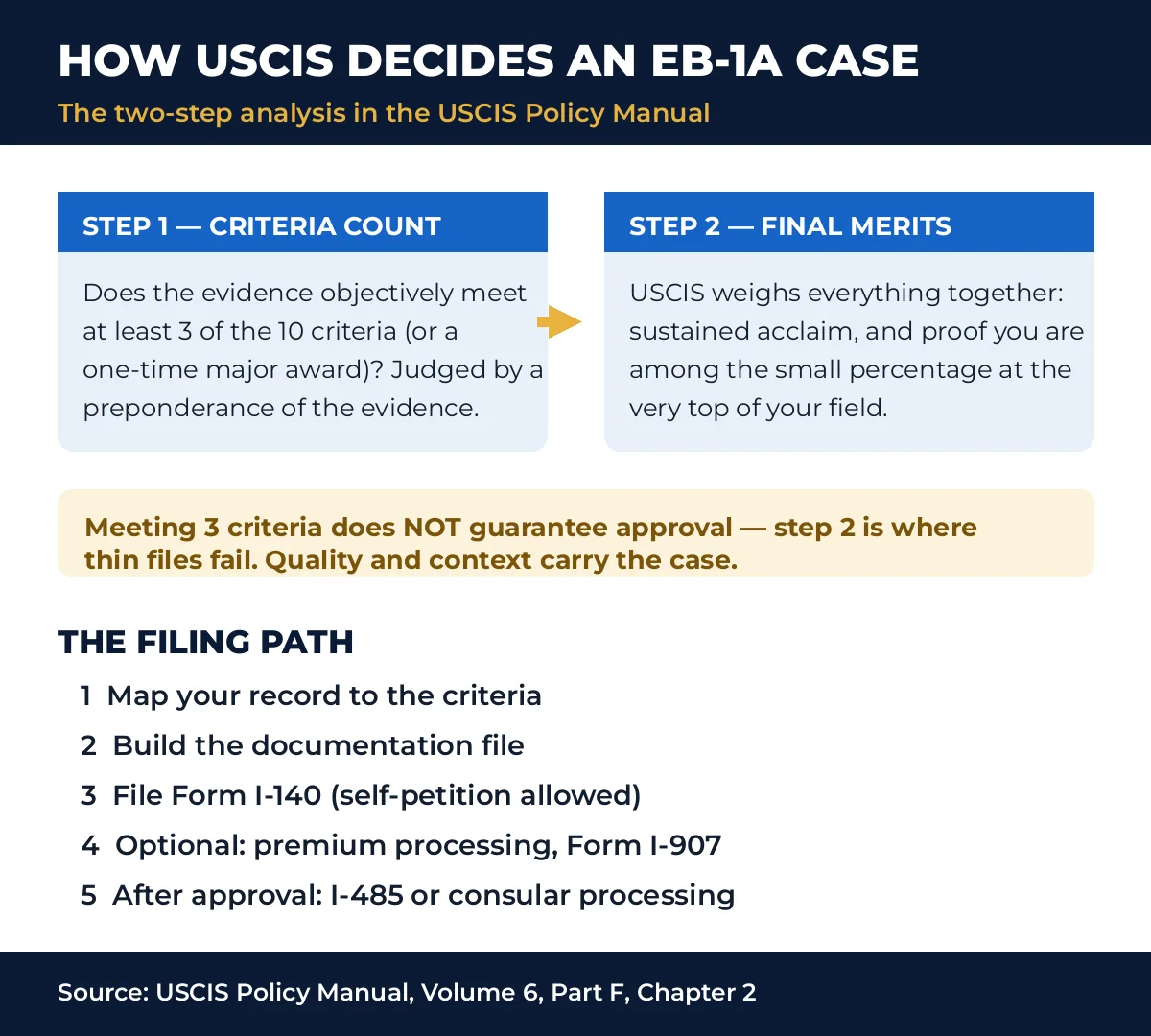
Step one — the criteria count. The officer decides, by a preponderance of the evidence (more likely than not), which submissions objectively meet each criterion. Top-of-field judgment is reserved for step two.
Step two — the final merits determination. The officer considers the petition in its entirety: sustained acclaim, and achievements recognized in the field, at the level of the small percentage at the very top. Evidence outside the criteria counts here too — highly ranked journals, a citation rate high for your field, a named-investigator role on a competitively funded US government grant.
The consequence: three thinly met criteria can still end in denial at step two — the count gets you reviewed, it does not win the case. But an officer may not deny a petition because one evidence type is absent, if three criteria are otherwise met. Build for both steps.
How do you document each criterion so USCIS credits it?
USCIS credits evidence that proves itself — file the documents that let an officer verify each achievement was yours.
Awards, memberships and media are about context. For an award, include who grants it, the criteria used and how many received it — an award limited to one employer or locality carries little national recognition. For membership, the rules must show your level required outstanding achievement judged by recognized experts; dues, a degree or service years do not qualify. Published material must be about you and your work — not your employer — with title, date, author and circulation figures.
Judging and contributions are about proof of impact. An invitation to judge is not enough: pair it with proof of completion. For contributions, USCIS separates originality from significance — funded, patented or published work shows originality; significance needs citations high for your field, commentary by others, or adoption. Expert letters help when they describe your specific contribution and its significance.
Roles, salary and criteria that do not fit. A title alone does not make a role leading or critical; USCIS examines what you did and whether the organization is distinguished — for a startup, funding helps; for a department, rankings and grants. For high salary, set pay records against reliable wage data for the same occupation and location; USCIS points officers to Bureau of Labor Statistics-type data and cautions that user-reported salary sites may not be credible. Where a criterion does not readily apply, comparable evidence is allowed — USCIS’s examples include a trade-show presentation for an industry applicant, and valued startup equity for a founder — if you explain why the criterion does not fit. One hard limit: no comparable evidence exists for a one-time major award.
What are the steps to file an EB-1A petition?
The petition is Form I-140, filed with USCIS with your evidence; the green card application follows after approval, once a visa number is available.
- Map your record to the criteria. Assign each achievement to a criterion (or the award route), favoring deep documentation.
- Build and explain the documentation file. Gather the proof above — rules, bylaws, circulation figures, completion confirmations, citation and wage data, with translations — and index each item against its criterion.
- Complete and sign Form I-140. Use the current edition and sign it — USCIS rejects unsigned forms. It may be filed at any time.
- Consider premium processing. Request it with Form I-907, with or after the I-140. USCIS guarantees action within its published timeframe — check the current timeframe and fee on USCIS’s website first.
- Pay the correct fees and file. Confirm every amount in the official Fee Schedule (Form G-1055); pay each fee separately. An I-140 can also carry an Asylum Program Fee — $600 in full, with reduced amounts for some petitioners (USCIS Form I-140 page).
- Respond to any Request for Evidence. An RFE is not a denial; it is a deadline-bound chance to supply the missing proof.
- Apply for the green card after approval. In the US with a visa number available, this is normally adjustment of status on Form I-485 (USCIS’s I-140 page gives assembly instructions for filing both together); abroad, consular processing. Your spouse and unmarried children under 21 may then be eligible as E-14 and E-15.
Visa availability moves monthly — check the current Visa Bulletin first, and treat timeline tools like Visaora’s free green card timeline estimator and visa bulletin priority date tracker — as planning aids only.
How much does EB-1A cost in government fees?
USCIS publishes every filing fee in its official Fee Schedule, Form G-1055 — that schedule is the figure to pay, because USCIS rejects filings with an incorrect fee.
Fees change: the current schedule edition (16 October 2026) added new statutory fees for several other forms — exactly why this guide does not print I-140 or I-485 amounts that could go stale. Budget for the I-140 fee, the Asylum Program Fee above, optional premium processing, and later I-485 or consular fees. Plan the total with Visaora’s free USCIS fee calculator, then verify each line on the official USCIS Fee Schedule (Form G-1055) in the week you file.
EB-1A, EB-1B or EB-1C: which first-preference path fits you?
EB-1A fits an individual with a personal record of acclaim who petitions independently; EB-1B and EB-1C run through a US employer — researchers, and transferring executives and managers. None requires labor certification.
| Feature | EB-1A Extraordinary ability | EB-1B Outstanding professor / researcher | EB-1C Multinational manager / executive |
|---|---|---|---|
| Who petitions | You (self-petition) or anyone on your behalf | Your US employer | Your US employer |
| Job offer | Not required | Required — tenure-track or comparable research role | Required — managerial or executive capacity |
| Evidence threshold | One major award, or 3 of 10 criteria, then final merits | At least 2 of 6 criteria, international recognition, 3 years’ experience | Qualifying company relationship; 1 year abroad in the preceding 3 years |
| Labor certification | Not required | Not required | Not required |
If no first-preference path fits, alternatives sit elsewhere — compare the lottery route in our H-1B lottery guide or the investment route in our E-2 investor visa guide — while you build an EB-1A record.
Common mistakes: what weakens an EB-1A petition?
The biggest mistake is treating the petition as a document dump. USCIS warns that voluminous documentation may still contain nothing persuasive — most errors concern proof and context, not effort.
- Counting criteria instead of proving them. Five criteria claimed thinly are weaker than three proven with complete documents.
- Achievements without context. A bare award certificate gives the officer nothing to credit.
- Your employer’s recognition, not yours. The awards and media criteria focus on you personally; company press rarely qualifies.
- Invitations without completions. Judging evidence needs proof you reviewed, not just an invitation.
- Expert letters full of praise, empty of facts. Letters should state your contribution, its significance, and how the writer knows.
- Skipping step two. A file that lists criteria but never argues sustained acclaim leaves final merits to chance.
- Paying the wrong fee. An incorrect fee means rejection before anyone reads the file; verify amounts at filing time.
Example scenario: mapping a research record to the criteria
Example scenario (hypothetical): Dr. L, a materials scientist working outside the US, tests her record first. This example is fictional — it shows the mapping exercise, not a prediction of any outcome.
Her record: 14 papers in peer-reviewed journals, one heavily cited relative to her sub-field; peer-review work for two journals, with completion confirmations kept; a named principal-investigator role on a competitively funded grant; fellowship-level society membership, awarded after review by existing fellows; and a salary above the published range for her occupation in her country.
Mapped honestly, that supports plausible claims to scholarly articles, judging, membership and a leading or critical role, plus original contributions if citations and expert letters show her work changed practice — high salary a possible sixth. What she does not claim matters too: no award she cannot contextualize, no “media coverage” really about her employer. The file gives the officer everything needed to say yes.
Frequently asked questions
Can you self-petition for EB-1A without an employer?
Yes. EB-1A does not require an employer: USCIS allows a petition to be filed for a person with extraordinary ability by anyone, including themselves as self-petitioner. You must still show you intend to keep working in your field in the US.
Does meeting 3 of the 10 criteria guarantee EB-1A approval?
No. Meeting three criteria only clears step one of the two-step analysis. In step two, the final merits determination, USCIS weighs all your evidence together and decides whether it shows sustained acclaim and a place at the very top of your field.
What counts as a one-time achievement for EB-1A?
A single major, internationally recognized award. USCIS gives the Nobel Prize as the classic example in its Policy Manual; its EB-1 page lists a Pulitzer, an Oscar and an Olympic medal. An award at this level satisfies the initial evidence requirement on its own.
Can team awards and past memberships count toward EB-1A?
Yes. The Policy Manual confirms a team award can support the awards criterion if you were a recipient, and present or past membership can support the membership criterion if that level required outstanding achievement judged by recognized experts. Dues-based membership does not qualify.
What if some of the 10 criteria do not fit your occupation?
USCIS allows comparable evidence. If a criterion does not readily apply to your occupation, submit evidence of comparable significance instead — for example, presenting at a major trade show where scholarly publishing is not the norm in your industry. You must explain why the criterion does not fit.
How do you check the current EB-1A filing fees?
Check Form G-1055, the official USCIS Fee Schedule, for current Form I-140 and I-485 amounts — USCIS rejects filings sent with an incorrect fee, and this guide does not print figures that can go stale. Estimate first with Visaora’s free USCIS fee calculator, then confirm.
Sources
- USCIS — Employment-Based Immigration: First Preference EB-1
- USCIS Policy Manual, Volume 6, Part F, Chapter 2 — Extraordinary Ability
- USCIS — Form I-140, Immigrant Petition for Alien Workers
- USCIS — Form G-1055, Fee Schedule
Visaora provides software tools and general information, not legal advice. Rules change; always confirm with the official authority.
✈️ Planning Your Trip?
We may earn a commission — at no extra cost to you. Learn more