Schengen Visa Photo Size 2026: 35×45 mm Requirements Explained
By Visaora Editorial Team · Updated November 2026 · 12 min read
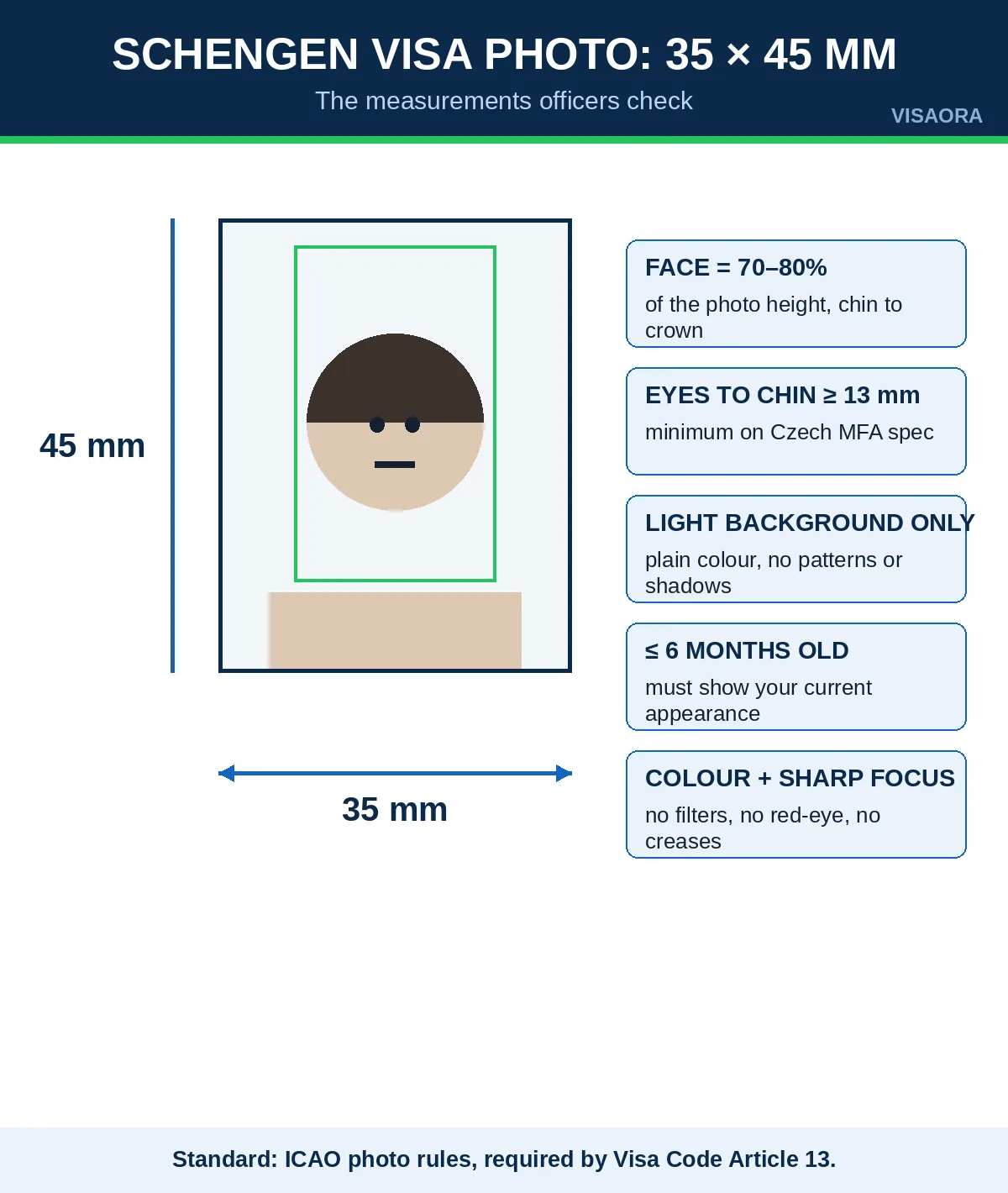
Quick answer: The Schengen visa photo size is 35×45 mm (about 1.38×1.77 inches), in colour, taken within the last 6 months, against a plain light background. Your face must fill 70–80% of the frame, and the photo must meet ICAO standards. A US 2×2 photo does not fit this specification.
Visaora provides general information, not legal advice. Rules change; always confirm with the official embassy, consulate or government website before you apply.
Key facts (checked November 2026)
- Photo size: 35 mm wide × 45 mm high, colour, full-face view.
- Face takes up 70–80% of the photograph (France-Visas photograph requirements, ISO/IEC sheet).
- The Czech Ministry of Foreign Affairs sets a numeric minimum: height from the eyes to the bottom of the chin of at least 13 mm.
- Taken within the last 6 months and showing your current appearance.
- Italy’s 2026 tourist checklist specifies a white background and states that scanned or photocopied photos are not accepted.
- A compliant photo is an admissibility requirement under Article 13 of the Visa Code: without one, the application is not accepted.
Of all the reasons a Schengen application stalls at the counter, the photograph is the most frustrating, because it is the cheapest to fix and the easiest to get wrong. Applicants arrive with American-size prints, studio photos taken against dark walls, or a favourite picture from three years ago, and watch the officer hand the file back. This guide sets out the Schengen visa photo size and every rule attached to it, using the documents consulates themselves publish, so your photo passes the first check instead of becoming the reason for a second trip.
What is the Schengen visa photo size in mm, cm, inches and pixels?
The Schengen visa photo size is 35 mm wide by 45 mm high. That single measurement is used by every Schengen consulate, and it is the same size used across most European identity documents. Here it is in every unit applicants ask about:
| Unit | Schengen photo size |
|---|---|
| Millimetres | 35 × 45 mm |
| Centimetres | 3.5 × 4.5 cm |
| Inches | Approx. 1.38 × 1.77 in |
| Pixels at 300 DPI | Approx. 413 × 531 px |
| Pixels at 600 DPI | Approx. 827 × 1,063 px |
The pixel figures are conversions for preparing a digital copy, not a separate standard: the printed photograph is judged in millimetres. If a studio offers you a digital file only, check it converts to 35×45 mm at print quality before you pay. And if a studio asks whether you want the “American size”, the answer is no; that is a different specification covered below.
Already have a photo? Run it through the free checker before your appointment: size, face proportion, background and brightness measured against the Schengen rules in seconds.
How big should your face be in the photo?
Your face must take up 70–80% of the photograph. France-Visas publishes this in its official photograph requirements: a close-up of your head and the top of your shoulders, with the face filling that share of the frame. Too far away is the most common studio error after background colour: the full upper body fits in the picture, the face shrinks to half the frame, and the officer cannot use it for biometric matching.
The Czech Ministry of Foreign Affairs expresses the same rule as a measurable minimum: the height from your eyes to the bottom of your chin must be at least 13 mm on the printed photo. Think of the two together. On a 45 mm photo, a face occupying 70–80% leaves small margins at the top and bottom, your eyes sit slightly above the middle, and both edges of your face stay clearly visible. If you can see your waist in the photo, it is wrong.
Immigration agency? Qualify UAE leads free with Visaora Agency Leads → https://visaora.io/visaora-agency-leads/
What background and lighting are accepted?
The background must be plain and light-coloured, evenly lit, with no patterns, objects or other people in frame. France-Visas requires uniform lighting with no shadows on the face or behind the head, no flash reflections on the skin and no red-eye. Italy goes one step further in its current tourist checklist and specifies a white background outright, which is why many studios serving Schengen applicants default to white or light grey.
Practically, this kills the home selfie. Curtains, doors and wall decorations behind you fail the plain test, and a window behind you creates the exact backlight shadow the rules ban. Use a studio, a photo booth, or a plain light wall with daylight falling on your face, not behind it, and retake until the background is a single flat tone.
What are the rules for expression, glasses and head coverings?
Face the camera squarely with a neutral expression and your mouth closed. Look directly at the lens with both eyes open and clearly visible, no hair across your eyes, and your head straight, not tilted or turned in portrait style. You must be alone in the frame: no chair backs, no child sitting with you, nobody’s shoulder at the edge.
Glasses are allowed only if your eyes remain fully visible: no tinted lenses, no flash reflection on the glass, and frames that do not cover any part of your eyes. France-Visas advises lighter frames if you have them; many applicants simply remove glasses for the photo, which is always safe. Sunglasses are never accepted. Head coverings are not permitted except for religious reasons or medical reasons, and even then your face must be fully shown from the bottom of the chin to the top of the forehead, with both edges of the face visible. The Czech specification adds the same condition in its own words: a permitted cover must not prevent identification.
What are the photo rules for children and babies?
Children need their own compliant photo at every age, in the same 35×45 mm size. The child must be alone in the picture: no parent’s hands, arms or shoulder supporting them in frame, no toys, and no dummy or pacifier. For babies, lay the child on a plain light sheet and photograph from above, or use a studio experienced with infant passport photos; the face must face the camera with eyes open where possible. Consulates apply the baby rules with some practical sense, but the background, size and alone-in-frame rules are enforced even for newborns, so do not submit a family photo with the baby cropped out of it.
Is a US 2×2 photo the same as a Schengen photo?
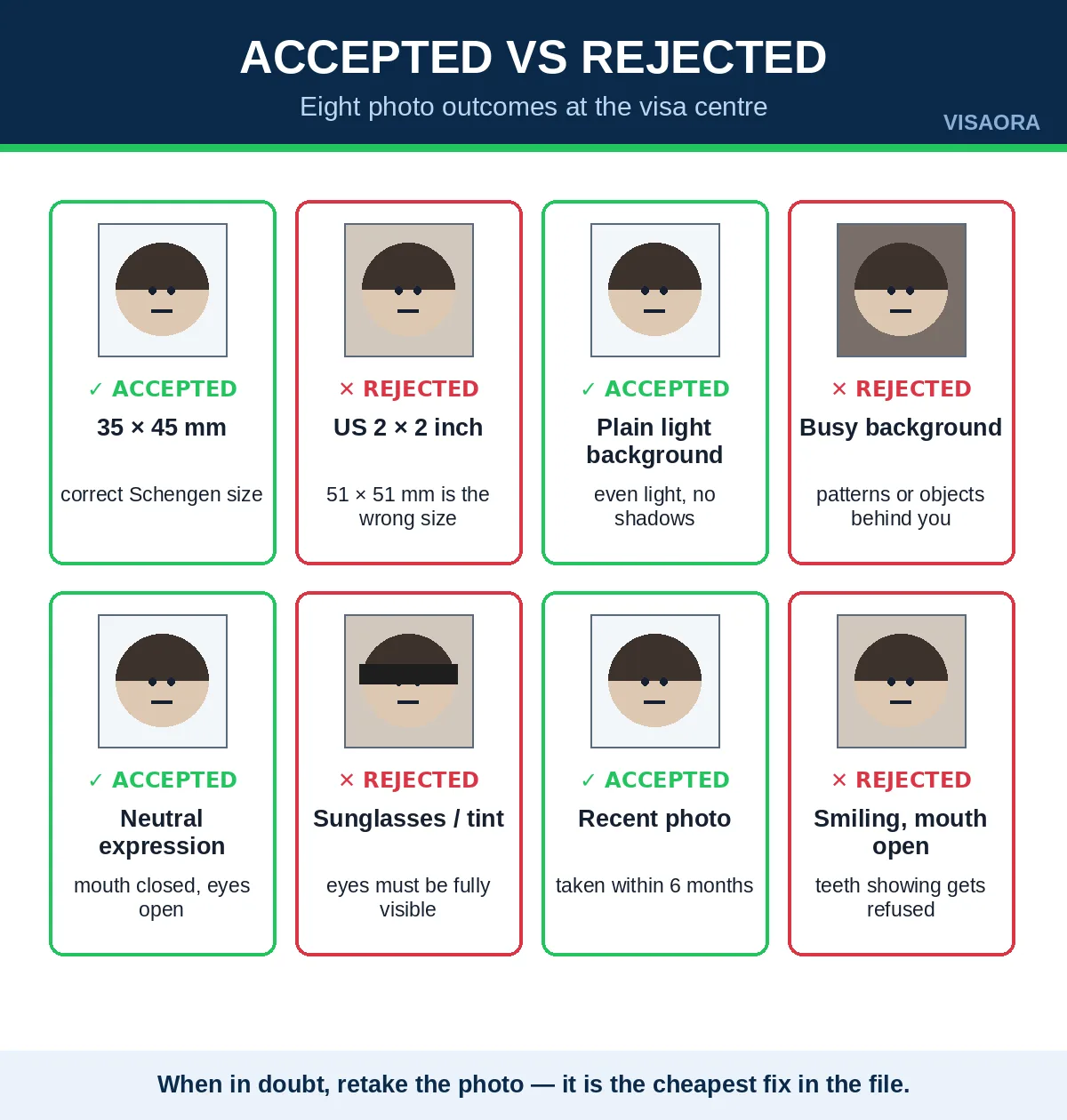
No. The American photo is square, 2×2 inches (51×51 mm), while the Schengen photo is a 35×45 mm rectangle. They are different shapes and different standards, and a consulate will not accept one in place of the other.
| Feature | Schengen photo | US photo |
|---|---|---|
| Size | 35 × 45 mm | 2 × 2 in (51 × 51 mm) |
| Shape | Rectangle | Square |
| Face share | 70–80% of the photo | Different US specification |
| Background | Plain light-coloured (Italy: white) | Plain white or off-white |
| Accepted for a Schengen visa? | Yes | No |
This confusion is understandable: many applicants apply for both systems in the same year, and studios keep one default template. It also catches people coming from the American diversity programme, where the digital photo is a 600×600 pixel square; our guide to DV Lottery and Schengen photo requirements compares that digital specification with this one. For Schengen, always order 35×45 by name.
Do France, Italy, Germany, Spain or the Netherlands add their own quirks?
The core specification is shared, but consulates publish it with different emphases, and a few add local instructions worth knowing before you print:
| Country | What its published guidance stresses |
|---|---|
| France | Detailed ISO/IEC sheet: face 70–80%, mouth closed, no more than 6 months old, printed on photo-quality paper at high resolution |
| Italy | Tourist checklist specifies one biometric colour photo, 35×45 mm, on a white background; scanned or photocopied photos are not accepted |
| Czechia | States the measurable minimum: eyes to the bottom of the chin at least 13 mm; photo required for the application to be admissible |
| Germany | Biometric 35×45 photo on a light background; missions remind applicants that documents must be complete at the appointment, photo included |
| Spain and the Netherlands | Apply the standard ICAO specification; centres may offer an on-site photo service, so confirm on your centre’s official page if you plan to rely on it |
The lesson is not that the rules differ wildly; it is that the strictest reading wins. Take a photo that satisfies the toughest version (white background, 70–80% face, recent, sharp) and it passes everywhere.
Printed photo or digital: what actually gets used?
Both, in sequence. You bring printed photographs to the appointment, and the centre scans one into the Visa Information System alongside your fingerprints. That is why print quality matters: France-Visas requires photographs printed on high-quality photo paper at high resolution, and Italy states plainly that scanned or photocopied photos will not be accepted as your submitted photo. A home inkjet print on plain paper fails on texture alone. If your application route asks for a digital upload as well, the same image must satisfy the same proportions; never upload a different, older photograph from the one you hand in.
Where can you get a compliant photo, and what should it cost?
Three reliable routes: a photo studio, which will know the 35×45 format if you name the destination; a photo booth in a mall or metro station with a European visa setting; or the photo service inside the application centre itself, which many VFS Global and partner centres offer on the day. Prices vary widely by city and country, so confirm the current charge on your centre’s official page rather than trusting any figure in a blog, including ours. What you are paying for is certainty: ask the studio to measure the print, and check the face proportion before you leave the shop, not at the visa counter.
What are the 10 most common photo rejection reasons?
Officers and centre staff see the same failures daily. All ten are avoidable:
| Do | Do not |
|---|---|
| Print exactly 35 × 45 mm | Submit a US 2×2 or passport sizes from other systems |
| Use a plain, light, even background | Stand against patterned walls, doors or dark backgrounds |
| Keep a neutral expression, mouth closed | Smile with teeth showing or open your mouth |
| Take a fresh photo within 6 months | Reuse a photo from an old passport or ID |
| Keep eyes fully visible, no glare | Wear sunglasses or tinted lenses |
| Print on photo paper, sharp and in colour | Hand in home prints, scans or photocopies |
| Fill 70–80% of the frame with your face | Submit a distant, full-torso shot |
| Remove hats and caps | Wear headwear outside the religious or medical exceptions |
| Shoot with even light, no shadows | Accept red-eye, flash glare or shadows across the face |
| Appear alone in the frame | Include a child, parent or anyone else’s shoulder |
How do you check your photo before you apply?
Run a four-point check at home. Measure the print with a ruler: 35 mm by 45 mm. Estimate the face share: chin to crown should cover roughly three quarters of the height. Hold it at arm’s length: the background should read as one flat, light tone with no shadow behind your head. Then check the date honestly: if the photo is older than 6 months, or you have changed significantly since it was taken, retake it.
For a measured check instead of an estimate, upload the photo to our free visa photo compliance checker, which tests size ratio, face position, background and brightness against the Schengen rules and tells you what to fix. Do that before you assemble the rest of the file with our document checklist generator, and read the complete Schengen visa guide for how the photo fits into the full document set.
Frequently asked questions
What is the Schengen visa photo size in inches?
The Schengen visa photo size is 35×45 mm, which converts to approximately 1.38×1.77 inches. Studios outside Europe sometimes round this to 1.4×1.8 inches, but the millimetre measurement is the standard the consulate applies, so always order and check the photo as 35×45 mm. If a studio can only work in inches, ask them to cut to the millimetre size and verify it with a ruler before you pay.
Can I use a US 2×2 photo for a Schengen visa?
No. A US photo is a 2×2 inch square (51×51 mm) made to a different specification, while Schengen requires a 35×45 mm rectangle with your face filling 70–80% of the frame. The shapes do not convert into each other: cropping a square print down changes the face proportion, and the centre can refuse it. Order a separate 35×45 photo for your Schengen application.
What background colour does a Schengen visa photo need?
A plain, light-coloured background with even lighting and no shadows, patterns or objects. Some consulates state the colour more strictly: Italy’s current tourist checklist specifies white, and light grey or off-white are widely used elsewhere. The safest choice across all Schengen countries is a plain white or very light background, evenly lit, with no shadow of your head visible behind you.
Can I wear glasses or a hijab in a Schengen visa photo?
Glasses are permitted only if your eyes stay fully visible, with no tinted lenses, no flash reflection and frames that do not cover your eyes; removing them is always safe. A hijab or other religious head covering is permitted, provided your face is fully shown from the bottom of the chin to the top of the forehead and both edges of the face are visible. Sunglasses and fashion headwear are not permitted.
How old can a Schengen visa photo be?
No more than 6 months old, and it must show your current appearance. France-Visas states the 6-month limit in its official photograph requirements, and Italy’s checklist repeats it. If your appearance has changed significantly, through weight change, facial hair or surgery, take a new photo even if the old one is technically within 6 months, because the photo is used to match you at the border and at biometrics.
Does VFS take my photo at the application centre?
Many VFS Global and partner centres offer a photo service inside the centre for an additional fee, and it is a practical fallback if your printed photo is rejected on the day. Availability and price differ by centre and city, so confirm on your centre’s official page before relying on it. Arriving with a compliant photo is still the safer plan: the on-site service can have queues of its own.
Sources
- France-Visas: Schengen visa photograph requirements (ISO/IEC) (checked 1 November 2026)
- Ministry of Foreign Affairs of the Czech Republic: Photo requirements (checked 1 November 2026)
- Embassy of Italy, Nairobi: Checklist for Tourism Schengen Visa (2026) (checked 1 November 2026)
- European Commission, Migration and Home Affairs: Applying for a Schengen visa (checked 1 November 2026)
Last checked: November 2026
Visaora provides software tools and general information, not legal advice. Rules change; always confirm with the official authority.
✈️ Planning Your Trip?
We may earn a commission — at no extra cost to you. Learn more