How to Get a Schengen Visa Appointment in 2026: Step-by-Step Booking Guide
By Visaora Editorial Team · Updated November 2026 · 13 min read
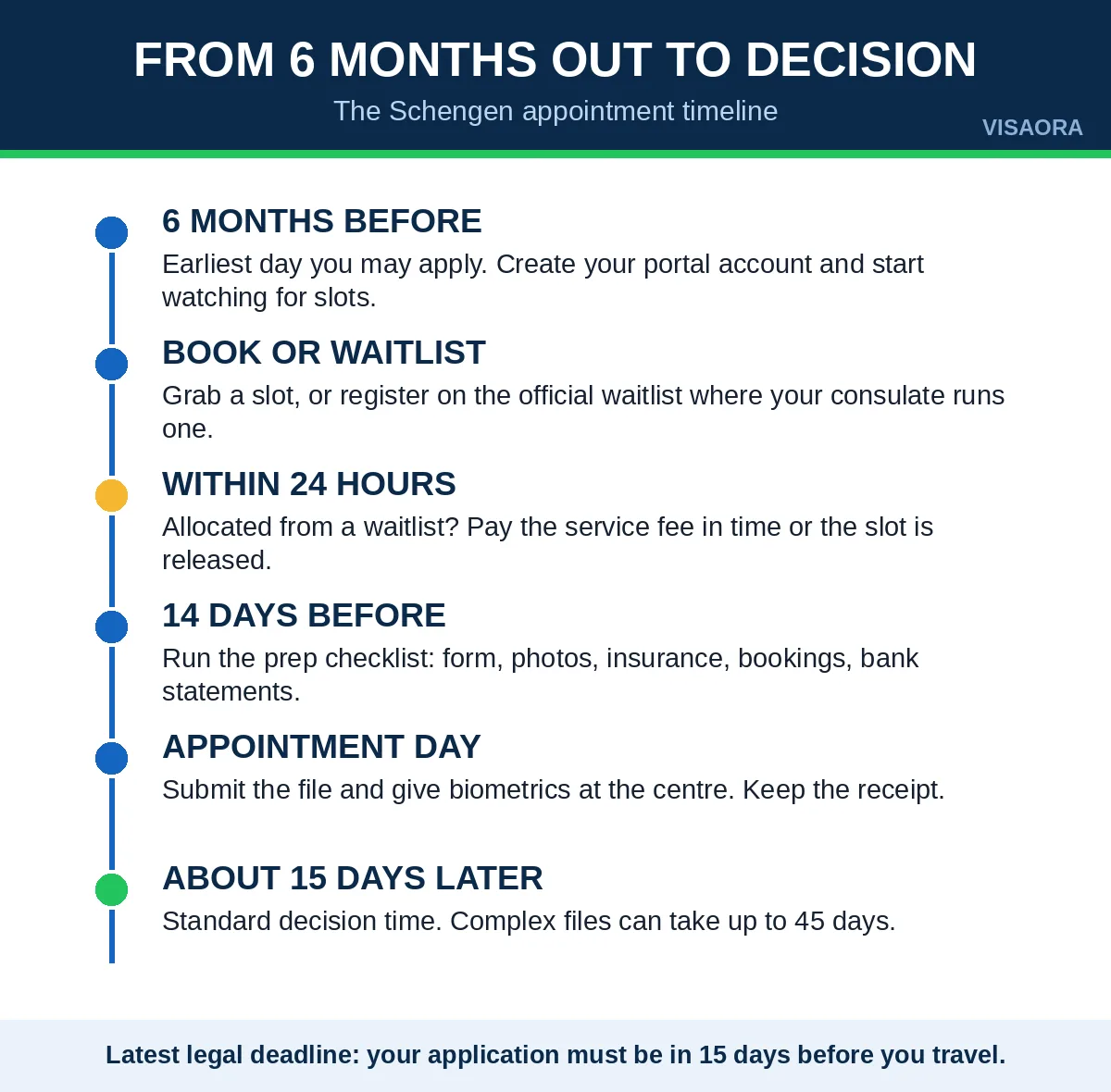
Quick answer: Book your Schengen visa appointment only through the official portal of your main-destination country, in the country where you legally live. You can apply from 6 months up to 15 days before travel. If no slots show, join the official waitlist where one exists. Never pay anyone for a slot.
Visaora provides general information, not legal advice. Rules change; always confirm with the official embassy, consulate or government website before you apply.
Key facts (checked November 2026)
- You apply to the consulate of your main destination; if nights are equal, the first country you enter decides.
- You apply from your country of legal residence, not from a country you are visiting.
- Application window: no earlier than 6 months before travel, and at least 15 days before you go.
- The visa fee is €90 for adults and €45 for children aged 6 to 12. A service-centre fee comes on top.
- A decision normally takes 15 calendar days, and can take up to 45 in individual cases.
- German missions in London and Manchester have run TLScontact waiting lists since 1 June 2026; an allocated slot is lost if the service fee is not paid within 24 hours.
Every week, applicants lose money on the same misunderstanding: they treat a Schengen visa appointment like a flight ticket that anyone can sell them. It is not. A slot belongs to one consulate, one centre and one named applicant, and it can only be booked through the official channel of the country you are actually visiting. This guide covers the whole process: choosing the right consulate, booking step by step, using official waitlists, and spotting the scams that empty bank accounts every peak season.
Which country’s consulate should you book with?
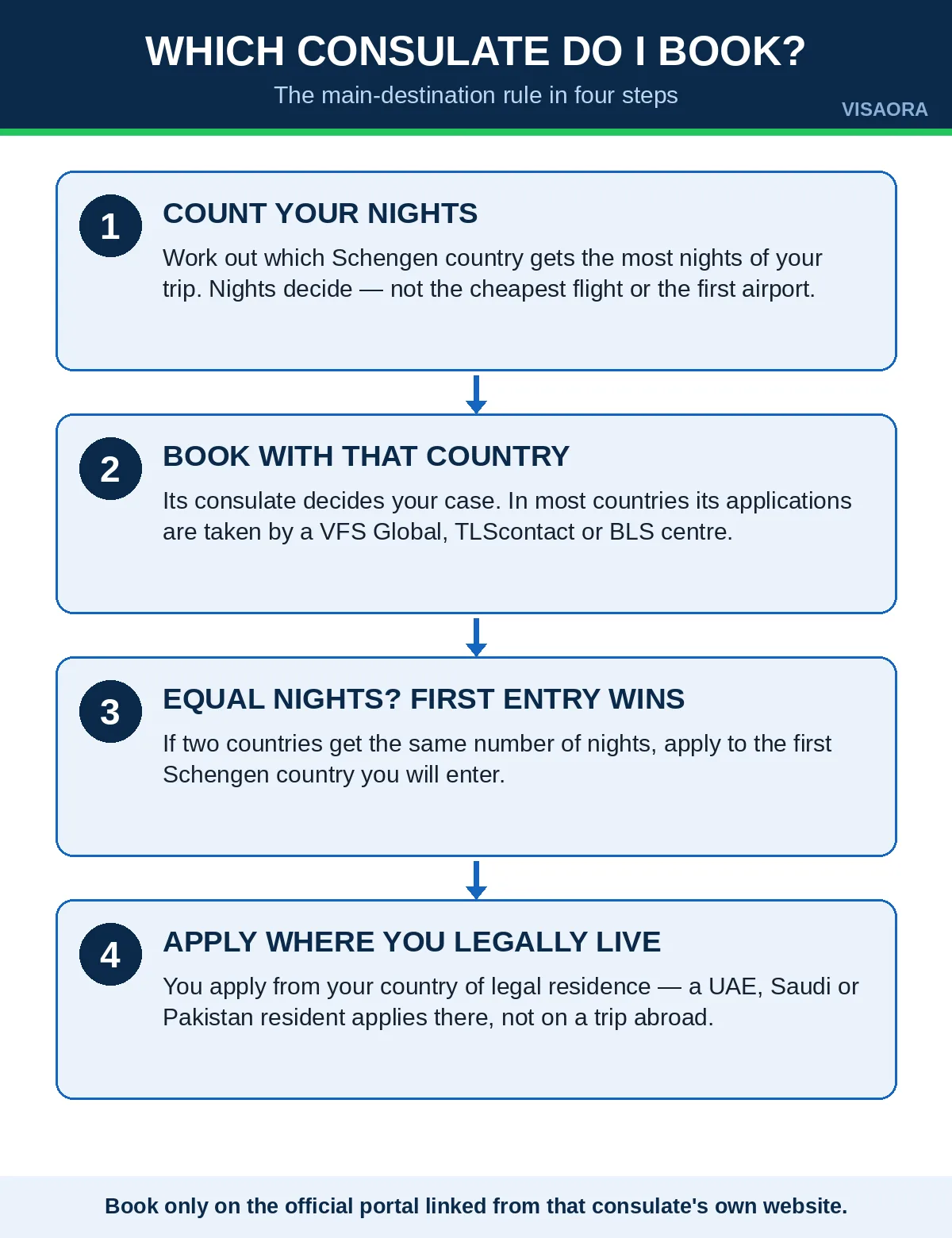
Book with the consulate of your main destination: the Schengen country where you will spend the most nights. The European Commission states the rule plainly. One country visited means that country decides; several countries means the longest stay decides; equal nights means the first country you enter decides.
Two worked examples. Five nights in Paris and three in Amsterdam means France is your main destination, so you book through the French route in your country of residence, even if your flight lands in Amsterdam first. Four nights in Berlin and four nights in Prague, entering through Berlin, means Germany decides, because the nights are equal and Germany is your first entry.
One more rule catches people out: you lodge the application in the country where you are legally resident. A Pakistani national working in Riyadh applies in Saudi Arabia; a student in London applies in the UK. You cannot fly somewhere with shorter queues and apply there as a visitor, and an application lodged with the wrong consulate can be declared inadmissible before anyone reads your documents.
Not sure which centre serves your city? Centres change operators more often than consulate websites admit. Check the official application centre for your destination and city first.
Who runs Schengen appointments: VFS Global, TLScontact, BLS or the embassy?
In most countries, consulates outsource appointment booking and file intake to a service company: VFS Global, TLScontact or BLS International. They book your slot, take your documents and biometrics, and pass the file to the consulate. They never decide your visa, and their staff cannot influence the outcome.
The pattern is simple: each destination country appoints one operator per country of application, and sometimes per city. France might use VFS in one country and TLScontact in another, and a smaller group of consulates still books directly. The only reliable way to know your combination is the consulate’s own website for your country: it names the operator and links to the correct portal. Start there every time, because a booking made on the wrong platform is worth nothing at the door.
Immigration agency? Qualify UAE leads free with Visaora Agency Leads → https://visaora.io/visaora-agency-leads/
Step-by-step: how to book a Schengen visa appointment
Book in this order and you will avoid almost every dead end:
- Confirm your main destination using the nights rule, and read that consulate’s page for your country of residence.
- Follow the consulate’s link to its appointed operator or its own booking page. Do not start from a search ad.
- Create your account with the exact name and passport number on your passport. German missions warn that mismatched details cost applicants their appointments.
- Choose the correct category — tourism, family visit or business. The wrong one is a common reason for being turned away.
- Pick a date and time, then complete any payment the portal asks for at booking; some collect the service fee upfront, others at the centre.
- Save and print the appointment confirmation. You will need it at the centre entrance.
- Start your 14-day preparation (below) as soon as the slot is confirmed.
Before fixing non-refundable travel dates, read our guide to current Schengen visa processing times.
What to do when there are no slots available
No available slots means released capacity is full, not that your application is hopeless. Operators release appointments in batches. Four moves actually work:
- Register on the official waitlist if your consulate runs one (next section). This is now the main route in high-demand locations.
- Check the official portal at different times. Cancelled bookings return to the pool without announcement.
- Start earlier next time. The window opens 6 months before travel; applicants who begin 3 to 4 months out rarely face empty calendars.
- Re-check your category and centre. Some cities have two centres for one destination, and categories can sit in separate queues.
What does not work: paying an agent who claims to hold slots, using bots, or booking through a different Schengen country just because it has space. That last one fails the main-destination rule.
How official Schengen appointment waitlists work in 2026
Waitlists are now a formal part of the system. The German Embassy in London explains why: demand exceeds capacity, and its waiting list, run by TLScontact in London and Manchester since 1 June 2026, protects applicants from fraudulent, expensive booking agencies. Registration is online only, appointments are allocated first come, first served, and the embassy cannot quote exact waiting times.
The mechanics matter. When the London list allocates you a slot, you must pay the service fee within 24 hours; miss that window and the appointment is cancelled and you rejoin from the back. VFS Global’s online waitlist, used by several consulates, works the same way: register, wait for your turn, confirm quickly.
Three habits keep your place safe. Register as soon as your travel purpose and approximate dates are known. Use one registration per applicant, with passport details copied exactly. Then watch the email address you registered with, including the spam folder, because allocation messages are time-sensitive.
Are Schengen appointment trackers and alerts safe to use?
An alert that tells you slots have opened can be harmless. A service that logs into your account, books on your behalf, or asks for your passport scan and portal password is not. Official slots are tied to your named registration, and handing your credentials to a third party puts that registration, and your personal data, in someone else’s hands.
Consulates are explicit on this point. The German Embassy in London states it is not necessary to engage an agency at all, and that the only fees are the provider’s service fee and the visa fee. If a tracker charges for the slot itself, or promises a date, it is selling something it does not own. Do the booking yourself, on the official portal, every time.
Appointment scams: red flags and what’s legitimately paid
Two charges are always legitimate: the visa fee set in the Visa Code (€90 for adults, €45 for children aged 6 to 12), and the centre’s service fee, published on the official portal. Optional extras such as courier return, SMS updates or a premium lounge are genuinely optional; refusing them cannot affect your decision.
| Charge | Legitimate? | What to know |
|---|---|---|
| Visa fee (€90 / €45) | Yes — official | Set by the Visa Code; paid as your centre instructs |
| VFS / TLS / BLS service fee | Yes — official | The only other standard charge; amount shown on the official portal |
| Courier, SMS, premium lounge | Yes — optional | Convenience extras; never required for a decision |
| “Guaranteed slot” fee to an agent | No | Slots cannot be sold, held or guaranteed by third parties |
| Payment to a personal account or in crypto | No | Official fees are never collected this way |
| Fee to “fast-track” or release a decision | No | Decisions follow the legal 15-day track, extendable to 45 days |
Classic red flags: a seller who will not name the consulate or centre, pressure to pay today, prices quoted in a messaging app, and a “confirmed appointment letter” offered before you have registered anywhere. Walk away from all four.
After you get a slot: your 14-day document preparation plan
A slot is only useful if the file is ready. Work backwards:
| When | Prepare |
|---|---|
| Days 14–12 | Completed application form; appointment confirmation printed; passport validity checked (3+ months beyond your return, 2 blank pages) |
| Days 11–9 | Compliant photographs; travel medical insurance covering the whole trip with at least €30,000 of cover |
| Days 8–6 | Bank statements for the period your consulate asks for; employment letter or business documents; leave approval |
| Days 5–3 | Hotel bookings and flight reservation (refundable where possible); day-by-day itinerary; cover letter |
| Days 2–1 | Photocopies of everything; the fee and a payment method the centre accepts; centre address and arrival time checked |
Our complete Schengen visa guide goes deeper on each document.
Booking from the Gulf, Pakistan or India: residence-country notes
Your operator depends on where you live and where you are going. This table shows the usual pattern; operators change, so confirm on the consulate page for your city before booking.
| Where you live | Destination examples | Usual operator (confirm on consulate page) |
|---|---|---|
| UAE | Most Schengen countries; Spain | VFS Global for most; BLS International for Spain |
| Saudi Arabia | Most Schengen countries; Spain | VFS Global for most; BLS International for Spain |
| Qatar | Most Schengen countries | VFS Global for most destinations |
| Kuwait | Most Schengen countries | VFS Global for most; some consulates use other partners |
| Pakistan | Germany, Italy, France and others | VFS Global for many countries; some consulates book directly or via another partner |
| India | Almost all Schengen countries; Spain | VFS Global for almost all; BLS International for Spain |
| UK | Germany, France; Italy, Spain and others | TLScontact for Germany and France; VFS Global or BLS for others |
| US | France, Italy, Germany and others | VFS Global for many countries; some consulates take direct bookings |
Residents of the Emirates face some of the longest queues in the region; our dedicated guide to Schengen appointments from Dubai when no slots show covers the local centres and waitlist routes in detail. Once booked, the Schengen visa day planner helps you count back from your travel date so documents line up.
Common booking mistakes that get you turned away at the centre
Centres turn people away daily for errors made weeks earlier, at a keyboard:
- Wrong consulate. Booking wherever slots existed, not your main destination.
- Wrong category. A family visit booked as tourism can mean a refused intake.
- Name or passport mismatch. Registration details must match the passport exactly.
- No printed confirmation. Many centres will not admit you on a screenshot alone; carry the printout.
- An incomplete file. A missing insurance certificate or unsigned form can end the appointment.
- Arriving late. Centres run on timed entry; 15 minutes late can mean rebooking.
Can you change or cancel a Schengen appointment?
Usually yes, within limits set by the operator. Most portals let you cancel from your account and some allow one reschedule; others treat a change as cancellation plus a fresh booking, which in peak season means rejoining the queue. Waitlist appointments are stricter: in the German London system, not paying the service fee within 24 hours cancels the slot outright.
Two practical consequences. Never book a placeholder date with details you may change later; a name or passport change typically cannot be edited and forces a new registration. And if your plans genuinely change, cancel promptly: released slots return to the pool, and a no-show can restrict future bookings on some portals.
Frequently asked questions
How early can I book a Schengen visa appointment?
You can apply from 6 months before your travel date, and that is also the earliest an appointment can lead to a valid application. The other end of the window matters just as much: your application must be lodged at least 15 days before you travel. In peak season, aim to book 3 to 4 months ahead rather than testing the deadline.
Why are there no appointments available when I check?
Demand is higher than the number of files consulates can examine, so centres release slots in limited batches that fill quickly. Peak travel months, school holidays and popular destinations run out first. Register on the official waitlist if your consulate has one, keep checking the official portal for released cancellations, and never switch to a different country just because it shows space.
Can I apply through another Schengen country that has earlier slots?
Only if that country is genuinely your main destination under the nights rule. Applying elsewhere purely for speed breaks the rule: the consulate can declare the application inadmissible, and a file built around a trip you do not intend to take damages your credibility for future applications. If your itinerary truly changes, rebuild it first, then book with the country your new itinerary points to.
Is booking a Schengen visa appointment free?
Creating an account and joining an official waitlist costs nothing. Money enters at two legitimate points: the visa fee of €90 for adults and €45 for children aged 6 to 12, and the application centre’s service fee, which the official portal publishes. Some portals collect the service fee when you book; others collect it at the centre. Anyone charging you for the slot itself is not part of the official system.
What happens if I booked the wrong category or miss my appointment?
A wrong category can mean the centre refuses your file at intake, because staffing and document checks differ by purpose of travel. A missed appointment normally means booking again from the start, and on waitlist systems it can mean rejoining the list. Registration mistakes are just as costly: German missions warn that details which do not match your passport will lose you the allocated appointment entirely.
Can an agent guarantee me a Schengen appointment slot?
No. Slots are allocated only through official portals and waitlists, in the order the system sets, and no agent, fixer or website can guarantee one. Embassies introduced waiting lists specifically to protect applicants from expensive booking agencies. An agent can legitimately help you prepare documents, but the booking itself should always be made by you, on the official portal, in your own name.
Sources
- European Commission, Migration and Home Affairs: Applying for a Schengen visa (checked 1 November 2026)
- Regulation (EC) No 810/2009 (Visa Code), Articles 5, 6 and 9: EUR-Lex
- German Embassy London: Introduction of appointment waiting lists in some C-visa categories (checked 1 November 2026)
- VFS Global: Online Waitlist Solution guide (checked 1 November 2026)
Last checked: November 2026
Visaora provides software tools and general information, not legal advice. Rules change; always confirm with the official authority.
✈️ Planning Your Trip?
We may earn a commission — at no extra cost to you. Learn more