
Saudi Premium Residency vs Iqama: 2026 Guide
By Team Visaora · Updated October 2026 · 9 min read
Last reviewed 25 October 2026
Saudi premium residency requirements are the first thing to pin down before you compare this route with a normal iqama, because the two statuses look similar on a residence card and behave very differently in daily life. Premium Residency (Iqama Mumayyaza) lets you live in Saudi Arabia without a single employer sponsor, while a standard work iqama ties your residence to that sponsor. Before you weigh either option, compare routes side by side with Visaora’s free residency-by-investment comparison tool.
All facts below were checked against the sources listed at the end on 25 October 2026. Where an official page could not be opened directly on the day, this guide says so and does not quote a figure from it.
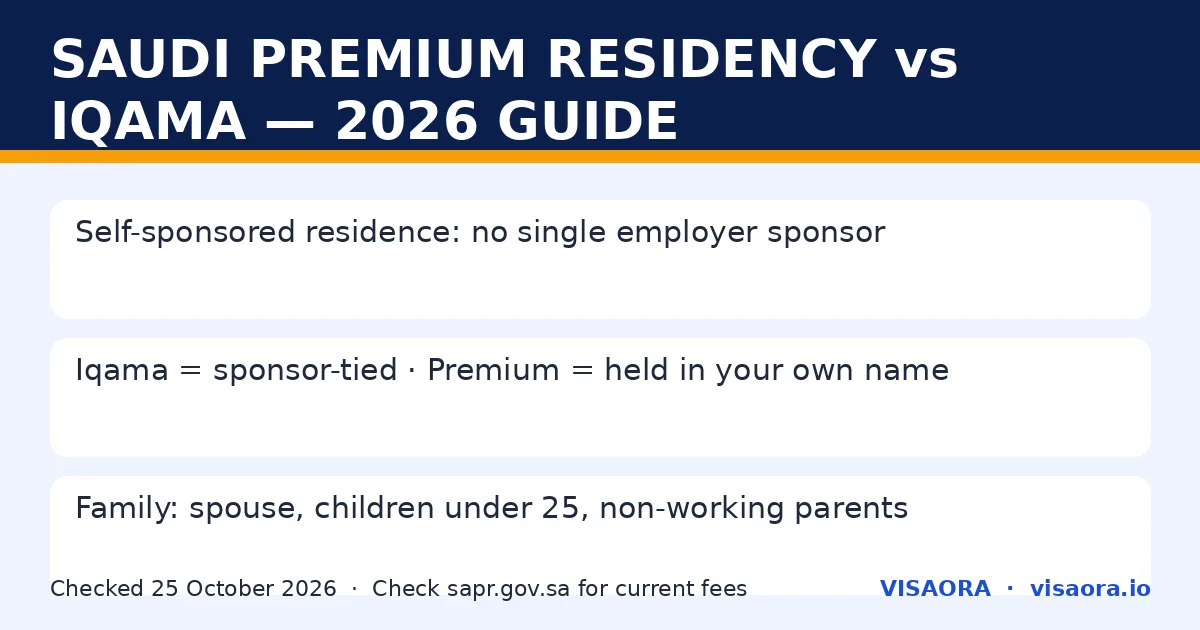
Quick Answer: Saudi premium residency requirements centre on a self-sponsored residence status: you hold residence in your own name rather than through one employer, you meet the conditions of your chosen product, and you show financial capability and valid medical cover. It is not citizenship, and it is not a cheaper version of a work iqama — it is a different status with different family, work and travel rules.
Key Takeaways
- Premium Residency is self-sponsored: no single employer sponsor (kafeel) controls your residence.
- A normal iqama is sponsor-tied; Premium Residency survives a change of employer.
- Family cover is wider: a spouse, children under 25 and non-working parents, plus visit visas for wider relatives.
- Since 6 October 2026, highly skilled workers can start family entry alongside their own work visa process.
- Fees are not quoted here: check sapr.gov.sa for current fees, because figures in older articles may be out of date.
On this page
- Premium Residency types
- Iqama vs Premium Residency
- Family and relatives benefits
- New 2026 skilled-worker family entry
- Who should not bother
- Common mistakes
- FAQ
What are the Premium Residency types?
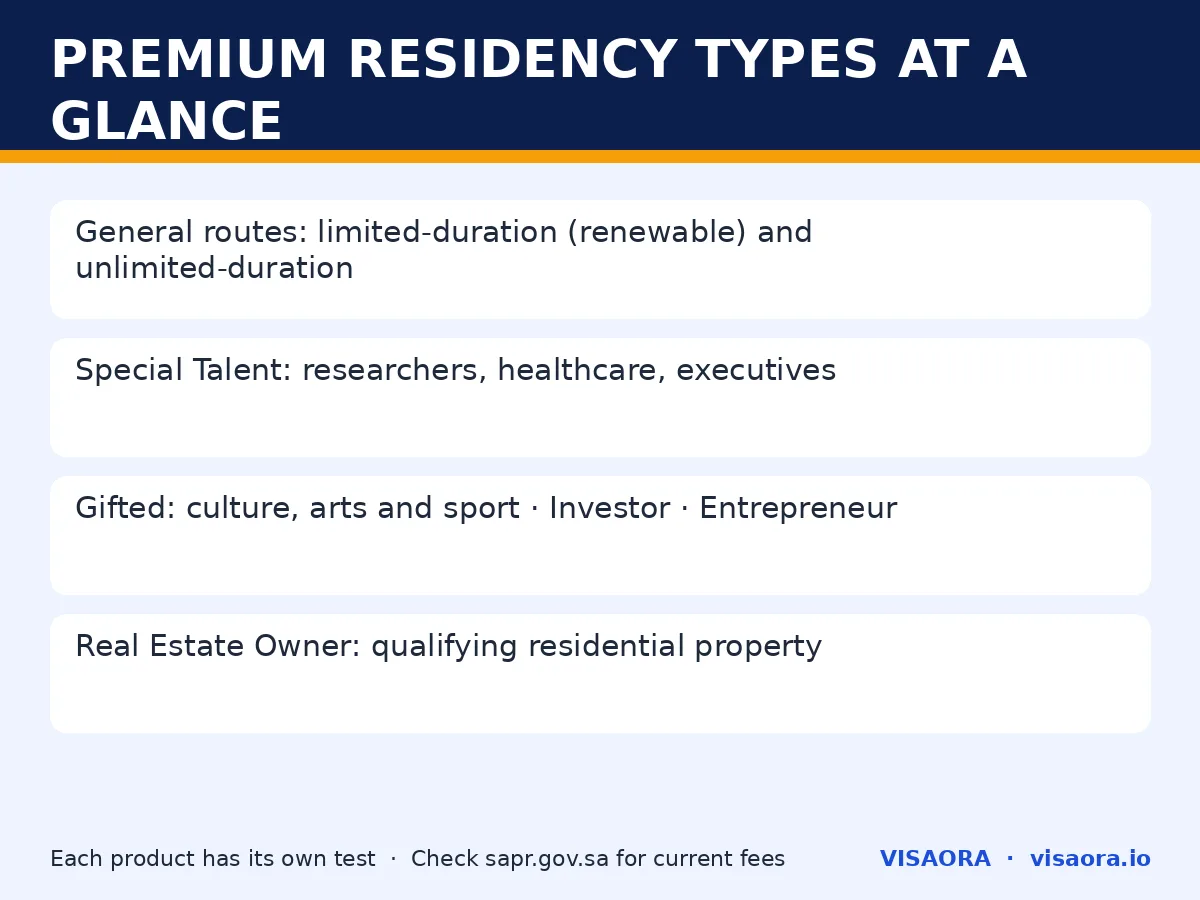
Think of Premium Residency as one programme with several doors. Two general routes sit at the centre: a limited-duration route that you renew, and an unlimited-duration route that does not need renewal. Around them sit product routes aimed at particular strengths: Special Talent, Gifted, Investor, Entrepreneur and Real Estate Owner. Each product has its own qualifying test, and passing one test does not mean you pass another.
Special Talent is the route most working expats ask about first. In programme summaries it covers researchers, healthcare and scientific professionals, and executives, each with its own salary, degree, experience and points conditions, and a job with an approved employer. Gifted covers recognised achievement in culture, arts or sport, with a ministry recommendation. Investor and Entrepreneur routes turn on capital invested or funding raised, plus job creation in some cases. Real Estate Owner turns on owning qualifying residential property. Treat every threshold in an older article as a prompt to check, not as a fact: product pages carry the note that conditions are subject to change.
Two general conditions apply across the programme and are worth stating plainly. First, the applicant is normally an adult with a clean record and the financial capability to support the application. Second, valid medical cover is part of the package, not an optional extra. Fees change. Check the official website before you pay, and check sapr.gov.sa for current fees before you budget anything at all. This guide deliberately gives no fee figure, because the official Premium Residency pages could not be opened directly for verification on 25 October 2026, and quoting a second-hand figure as official would mislead you.
How to use the types in practice:
- Start from your strongest asset: a scarce skill, a funded venture, capital to invest, or qualifying property.
- Match that asset to one product only, and read that product page end to end.
- List every condition you cannot yet evidence, and close those gaps before you pay anything.
- Compare the general routes against the product route on duration and renewal, not on headline appeal.
- Check the family page for the same product, because family rules are part of the decision, not an afterthought.
Iqama vs Premium Residency: side-by-side
The day-to-day difference is control. On a work iqama, your employer is your sponsor. Leave the job, and your residence position changes with it; transfer rules, exit and re-entry permits, and dependent sponsorship all run through that sponsor relationship. On Premium Residency, you are your own sponsor. You can move between private-sector employers, run a business under the Investment Law, and travel in and out without a separate exit and re-entry visa for each trip, subject to the programme rules and to jobs reserved for Saudi nationals.
| Day-to-day question | Normal work iqama | Premium Residency |
|---|---|---|
| Who sponsors your residence? | Your employer (or other sponsor) | Yourself, under the programme |
| Changing employer | Transfer process through sponsor rules | Move between private-sector employers under programme rules |
| Exit and re-entry | Exit/re-entry permit normally required | Leave and return without a separate exit/re-entry visa |
| Family you can include | Sponsor-based dependent rules apply | Spouse, children under 25, non-working parents; visit visas for wider relatives |
| Business and property | Limited by sponsor and visa type | Business under the Investment Law; property under programme rules, with restricted areas |
| Dependent fees | Expat dependent charges can apply | Programme summaries describe an exemption from expat and dependent fees |
| Citizenship | No | No — residence only |
Worked example. Take a hospital specialist, call him Omar, who has worked in Riyadh for four years on a sponsor-tied iqama. His contract ends and a Jeddah hospital offers him a better role. On a normal iqama, the move means a sponsor transfer with its own timing and paperwork, and his family’s residence follows the same sponsor chain. If Omar instead held Premium Residency, his residence would not depend on either hospital: he could accept the Jeddah role, keep his family’s residence under his own status, and travel without arranging a fresh exit and re-entry permit for the move. The example is illustrative, not a promise about any individual case: Omar’s real eligibility would still depend on the product conditions, his documents and the rules in force on the day he applied.
None of this makes Premium Residency “better” in every case. It costs more than keeping a work iqama, it demands evidence a sponsored worker never has to assemble, and it does not help at all if your real problem is a refused application or a missing document. For a worker who is happy with their employer and expects to stay, a normal iqama is usually the simpler, cheaper status. The premium route earns its place when sponsor dependence itself is the problem: frequent job moves, a business to run, property to hold, or a family whose residence you want anchored to you rather than to your employer.
Read the sponsor-transfer side of this in our guide to Saudi kafala transfer eligibility in 2026, and compare residence routes generally in Gulf visa tools.
What family and relatives benefits does Premium Residency give?
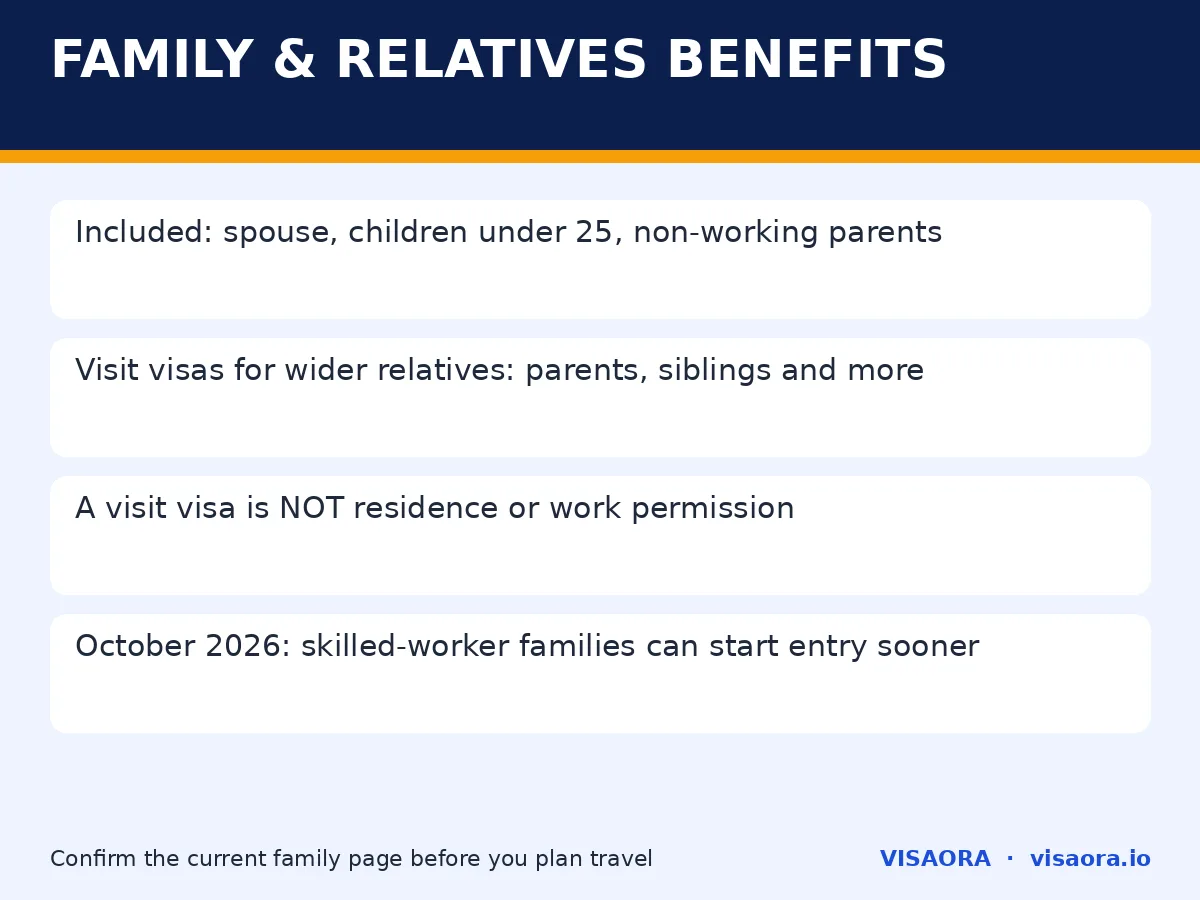
Family is where Premium Residency most clearly differs from a standard iqama, and where marketing pages most often blur the detail. The programme’s family provision covers a spouse, children under 25, and parents who do not work in Saudi Arabia. That parent inclusion is unusual: many residence schemes stop at a spouse and dependent children. Children with special needs and, in some summaries, unmarried daughters over 25 may stay linked to the holder’s record under the applicable rules — confirm the current wording, because age exceptions are exactly the kind of detail that changes without a headline announcement.
Beyond the household itself, holders can obtain visit visas for relatives. Programme summaries list parents, grandparents, children, siblings and their children among the relatives who may be invited on visit visas. That is a visit route, not residence: a relative on a visit visa does not gain the right to work or to stay indefinitely, and overstaying a visit visa creates a separate problem. Keep the two categories apart in every plan you make.
Family members covered under the holder’s status also share the practical benefits: they can move between private-sector employers under the programme rules, leave and return without a separate exit and re-entry visa, and use citizens’ lanes at airports, according to programme benefit lists. Spouses and dependants on a normal iqama do not automatically get the same package, and their status still runs through the sponsor.
One caution for families planning around schooling or healthcare: Premium Residency is not a promise of free public schooling or university, and access to services still follows provider rules. Budget for private schooling and medical cover as you would on any expat package, and confirm school admission rules separately. If a family member’s situation is unusual — a child near 25, a parent who works, a previous refusal — get that point confirmed before anyone resigns a job or ends a tenancy.
New 2026 skilled-worker family entry: what actually changed?
Separate from Premium Residency, a second October 2026 change helps skilled workers who are still on the ordinary sponsored track. On 6 October 2026, Saudi Arabia’s Ministry of Interior, in coordination with the Ministry of Foreign Affairs and the Ministry of Human Resources and Social Development, announced that highly skilled foreign workers can begin family entry procedures at the same time as their own work visa procedures, rather than waiting until their own residence process is complete.
The eligible family members named in the announcement are a spouse, sons under 25, and unmarried daughters. Entry visas for those family members can be issued concurrently with the worker’s employment visa procedures, provided the required conditions and documents are met. Once family members arrive, their residence permit procedures are completed under the applicable laws and regulations.
Three limits matter. First, this is an entry-timing change, not a new residence status: it lets families travel sooner, but residence permits still follow the normal process after arrival. Second, it applies to highly skilled workers — the announcement does not describe it as open to every worker, and the definition of “highly skilled” and the required documents are points to confirm on the official announcement or with the employer. Third, it is not Premium Residency: it does not give sponsor-free residence, business rights or the wider family package described above. Do not let a recruiter sell it as either.
For families, the practical sequence now looks like this: confirm the worker qualifies as highly skilled, prepare family documents in parallel with the work visa file, and only then book travel. Families who were previously told to wait months apart can now plan together — but “can start together” is not “will be approved together”, and each family member’s file still has to meet its own conditions. If you are weighing this track against Premium Residency, the comparison is timing versus status: the October change fixes waiting; Premium Residency fixes sponsor dependence. They solve different problems.
For a related Saudi check, see our Saudi eVisa rejection predictor before you submit any Saudi application.
Who should not bother with Premium Residency?
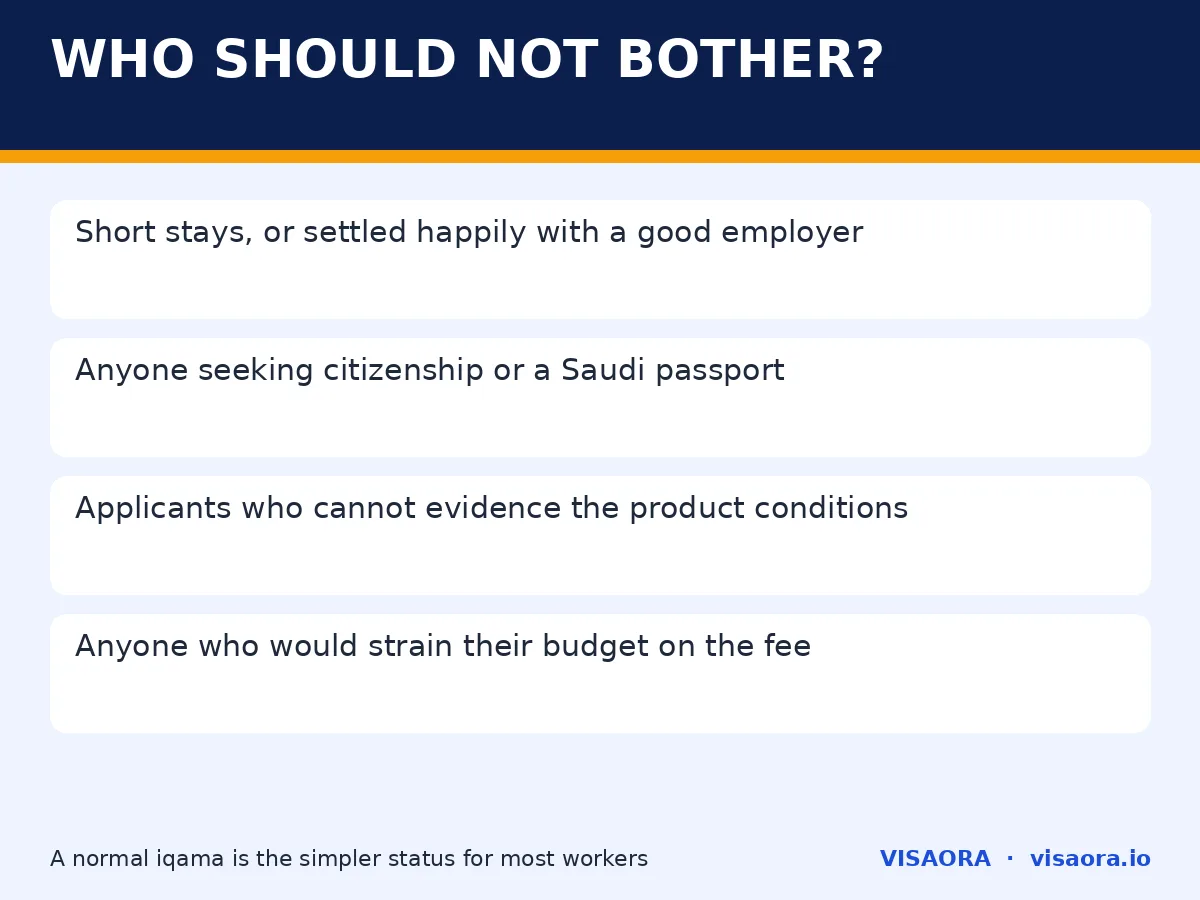
Premium Residency is a poor fit more often than its marketing suggests. Do not bother if your stay is short, if you are settled with a good employer and have no plan to move, run a business or buy property, or if you cannot evidence the financial or product conditions without stretching documents. Never stretch a document: a refused application with a questionable paper in it is worse than no application at all, and this guide does not suggest buying appointments, booking shortcuts or fabricated documents for any route.
Do not bother if what you actually want is citizenship, a Saudi passport, free movement across Gulf states, or a way around a previous refusal. Premium Residency gives none of those. Do not bother if your family situation does not fit the family rules — for example, adult children over 25 who need their own status — and you are unwilling to plan their route separately. And do not bother if the fee, whatever it is on the day you check sapr.gov.sa, would strain your household budget: residence security bought at the cost of financial security is a bad trade, and fees change, so a figure quoted last year is not a budget.
The honest test is a single question: does sponsor dependence cause you a real, recurring problem today? If the answer is no, the normal iqama is the right status, and the money and paperwork of Premium Residency buy you little. If the answer is yes — you change employers often, you run a business, your family’s residence keeps getting tangled in your job — then read one product page properly and decide on evidence, not on a brochure.
Common mistakes
- Quoting last year’s fee from a blog instead of checking sapr.gov.sa on the day you apply.
- Assuming Premium Residency leads to citizenship or a Saudi passport. It does not.
- Treating a relative’s visit visa as residence, work permission or a path to stay indefinitely.
- Applying for the wrong product: a strong CV does not make an Investor case, and capital does not make a Talent case.
- Letting an agent add a paper you cannot evidence. A refusal follows your record, not the agent.
- Confusing the October 2026 skilled-worker family entry change with Premium Residency. One fixes timing; the other changes status.
- Resigning or ending a tenancy before the family’s residence position is confirmed in writing.
Compare your options with the free residency-by-investment comparison tool, read our Saudi kafala transfer eligibility guide, and explore Gulf visa tools before you decide.
Agencies: turn this into a client-ready case file with Visaora Agency Leads.
FAQ
What are the saudi premium residency requirements in brief?
Premium Residency is a self-sponsored residence status, not tied to one employer sponsor. General routes require an adult applicant, a clean record, financial capability and valid medical cover, plus the conditions of the chosen product. Product rules differ, so read the product page on sapr.gov.sa before you assume you qualify.
How is Premium Residency different from a normal iqama?
A normal work iqama (residence permit) is tied to a sponsor, usually your employer, and ends or must transfer when that job ends. Premium Residency is held in your own name, so changing employers does not end your residence. It also allows wider family inclusion and business and property rights under the programme rules, subject to sector limits.
Can Premium Residency holders bring their parents?
Yes, in the sense that parents are among the family members covered by Premium Residency family provisions, alongside a spouse and children under 25. Parents who do not work in Saudi Arabia are the usual case described in programme summaries. Always confirm the current family page, because age, work and document conditions can change.
What changed in October 2026 for skilled workers and their families?
On 6 October 2026, Saudi Arabia’s Ministry of Interior, with the foreign and human resources ministries, said highly skilled workers can start family entry procedures at the same time as their own work visa procedures. Eligible family members are a spouse, sons under 25 and unmarried daughters, subject to the stated conditions and documents.
Does Premium Residency lead to Saudi citizenship?
No. Premium Residency gives residence rights, not citizenship and not a Saudi passport. That distinction matters when you compare it with investment migration programmes elsewhere. If citizenship is your goal, do not choose this route on that expectation, and confirm your long-term options with a licensed adviser.
How much does Premium Residency cost?
Check sapr.gov.sa for current fees. Fees change. Check the official website before you pay. The programme has general routes and product routes with different fee structures, and older articles may quote figures that no longer apply. Budget separately for medical cover, documents, translation and any professional help you use.
Who should not bother applying for Premium Residency?
Do not apply if you only need a short stay, cannot meet the financial or product conditions, or need a sponsor to keep a job you plan to leave soon anyway. It is also a poor fit if you want citizenship, free movement across the Gulf, or a shortcut around a refused application. A standard iqama may suit you better.
Sources
- Saudi Arabia Ministry of Interior announcement, 6 October 2026, on concurrent family entry for highly skilled workers (spouse, sons under 25, unmarried daughters), as reported by Gulf News, 6 October 2026 – Gulf News report
- The Peninsula Qatar, 6 October 2026, on the same Ministry of Interior announcement – The Peninsula report
- Saudi Premium Residency programme summaries citing pr.gov.sa product pages captured 20 October 2026 (types, family inclusion, benefit lists) – Programme summary citing official product pages
- Premium Residency benefit and family lists (spouse, children under 25, parents; visit visas for relatives) – Benefit list report
- Official Premium Residency portal (sapr.gov.sa / pr.gov.sa) and the Digital Government service page my.gov.sa/en/services/2696059 – linked for fee and product checks; direct page text could not be retrieved on 25 October 2026, so no fee figure is quoted from them in this guide.
All facts checked 25 October 2026. Rules change; always confirm with the official authority.
Visaora is software and does not provide legal advice. Requirements depend on your nationality and situation. Confirm with the official authority or a licensed adviser.
Agencies: turn this into a client-ready case file with Visaora Agency Leads.
What are the saudi premium residency requirements in brief?
Premium Residency is a self-sponsored residence status, not tied to one employer sponsor. General routes require an adult applicant, a clean record, financial capability and valid medical cover, plus the conditions of the chosen product. Product rules differ, so read the product page on sapr.gov.sa before you assume you qualify.
How is Premium Residency different from a normal iqama?
A normal work iqama (residence permit) is tied to a sponsor, usually your employer, and ends or must transfer when that job ends. Premium Residency is held in your own name, so changing employers does not end your residence. It also allows wider family inclusion and business and property rights under the programme rules, subject to sector limits.
Can Premium Residency holders bring their parents?
Yes, in the sense that parents are among the family members covered by Premium Residency family provisions, alongside a spouse and children under 25. Parents who do not work in Saudi Arabia are the usual case described in programme summaries. Always confirm the current family page, because age, work and document conditions can change.
What changed in October 2026 for skilled workers and their families?
On 6 October 2026, Saudi Arabia’s Ministry of Interior, with the foreign and human resources ministries, said highly skilled workers can start family entry procedures at the same time as their own work visa procedures. Eligible family members are a spouse, sons under 25 and unmarried daughters, subject to the stated conditions and documents.
Does Premium Residency lead to Saudi citizenship?
No. Premium Residency gives residence rights, not citizenship and not a Saudi passport. That distinction matters when you compare it with investment migration programmes elsewhere. If citizenship is your goal, do not choose this route on that expectation, and confirm your long-term options with a licensed adviser.
How much does Premium Residency cost?
Check sapr.gov.sa for current fees. Fees change. Check the official website before you pay. The programme has general routes and product routes with different fee structures, and older articles may quote figures that no longer apply. Budget separately for medical cover, documents, translation and any professional help you use.
Who should not bother applying for Premium Residency?
Do not apply if you only need a short stay, cannot meet the financial or product conditions, or need a sponsor to keep a job you plan to leave soon anyway. It is also a poor fit if you want citizenship, free movement across the Gulf, or a shortcut around a refused application. A standard iqama may suit you better.
✈️ Planning Your Trip?
We may earn a commission — at no extra cost to you. Learn more