
A client pays your fee, the visa is refused, and the argument starts: “You promised it would be approved.” Whether anyone actually said those words matters less than whether anything was written down. This guide sets out visa agency terms and conditions in plain language for Gulf agency owners: what a no-guarantee clause should say, which services sit inside your fee and which do not, refund triggers clients can understand, and a complaint process that stops small disputes becoming public ones. The templates here are a starting point, not legal advice — have a local lawyer review your final terms before you use them.
By Team Visaora · Updated October 2026 · 8 min read
Caption: No-Guarantee Visa Agency Terms — plain-language scope, refund triggers and complaint handling for Gulf visa agency owners.
Quick Answer: A written client agreement protects both sides: it states that the visa decision rests with the embassy or consulate, lists exactly what your fee covers, names the few situations that trigger a refund, and gives complaints a written clock. Put it in front of the client before payment — never after a refusal.
Key Takeaways
- Never promise an outcome you do not control: the decision belongs to the embassy or consulate, and your terms must say so in plain words.
- Separate your professional fee from government and centre charges on every quote and receipt — buried disbursements cause most invoice disputes.
- Name refund triggers by stage of work: agency error, service never started, duplicate payment, undelivered service — not the visa outcome.
- Document every piece of advice in a dated, versioned case file; verbal assurances are what clients remember differently later.
- Give complaints a written SLA — acknowledge in 1 business day, reply in 3, resolve or update in 7 — and name the escalation route.
In This Guide
- Why does a “guaranteed visa” promise backfire?
- Scope of service: what do you do — and not do?
- Refund triggers clients understand
- Documenting advice: the case file as evidence
- Complaint handling SLA
- Sample clause list (review with a lawyer)
- Common mistakes agencies make with terms
- Frequently asked questions
Why does a “guaranteed visa” promise backfire?
No agency issues visas. Embassies and consulates do — and they decide on evidence, not on who prepared the file. A promise of approval therefore sells something you cannot deliver, and every refusal that follows reads to the client as a broken promise rather than an unlucky outcome. That is when refund demands, chargebacks and public complaints start.
The market shows how costly loose guarantees get. In May 2025, Khaleej Times reported on fake travel agents in the UAE charging thousands of dirhams per person for Schengen appointments, including one Dubai resident who paid Dh4,000 to an agent who claimed to have guaranteed appointments and then disappeared. VFS Global told the paper that appointment slots are available free of charge on its official website and warned applicants to “beware of fraudulent third-party entities who offer appointment slots or guaranteed visas in exchange for a fee.” A legitimate agency must sound nothing like that operator — and written terms are how you prove the difference.
Regulators act on the same pattern in neighbouring markets. Saudi Arabia’s Ministry of Human Resources and Social Development has repeatedly suspended recruitment offices and revoked licences where offices failed to refund customers or resolve complaints — including suspensions and revocations reported in the first quarter of 2026. Those cases concern recruitment offices, not visa agencies, but the lesson transfers directly: mishandled refunds and unanswered complaints are what draw enforcement, not the refusal itself.
Watch your wording everywhere, not only in the contract. “100% visa”, “guaranteed approval” and “money back if refused” in ads, social posts or WhatsApp messages become evidence the moment a client is unhappy — even if your formal terms say the opposite. Replace them with one honest line, used consistently: “We prepare the strongest file the evidence supports. The decision rests with the mission.”
Scope of service: what do you do — and not do?
Most terms disputes are scope disputes: the client believed something was included that you never intended to sell. Write two lists into the agreement — included and excluded — in words a first-time client understands, and walk through them before payment.
| Included in your professional fee | Not included — unless separately quoted |
|---|---|
| Eligibility review and written assessment | The visa decision itself |
| Document checklist and verification | Government and centre fees |
| Forms, cover letter and submission support | Translations and attestations |
| Appointment booking through official channels | Flights, hotels and travel insurance |
| Status updates and refusal analysis | Any guarantee of outcome or timing |
Government and centre charges are pass-through costs, never part of your fee. List them separately on every quote and receipt, and add the line that protects you when official fees move: “Fees change. Check the official website before you pay.” A client who sees the split up front rarely argues about it later; a client who discovers it inside one blended number assumes the worst.
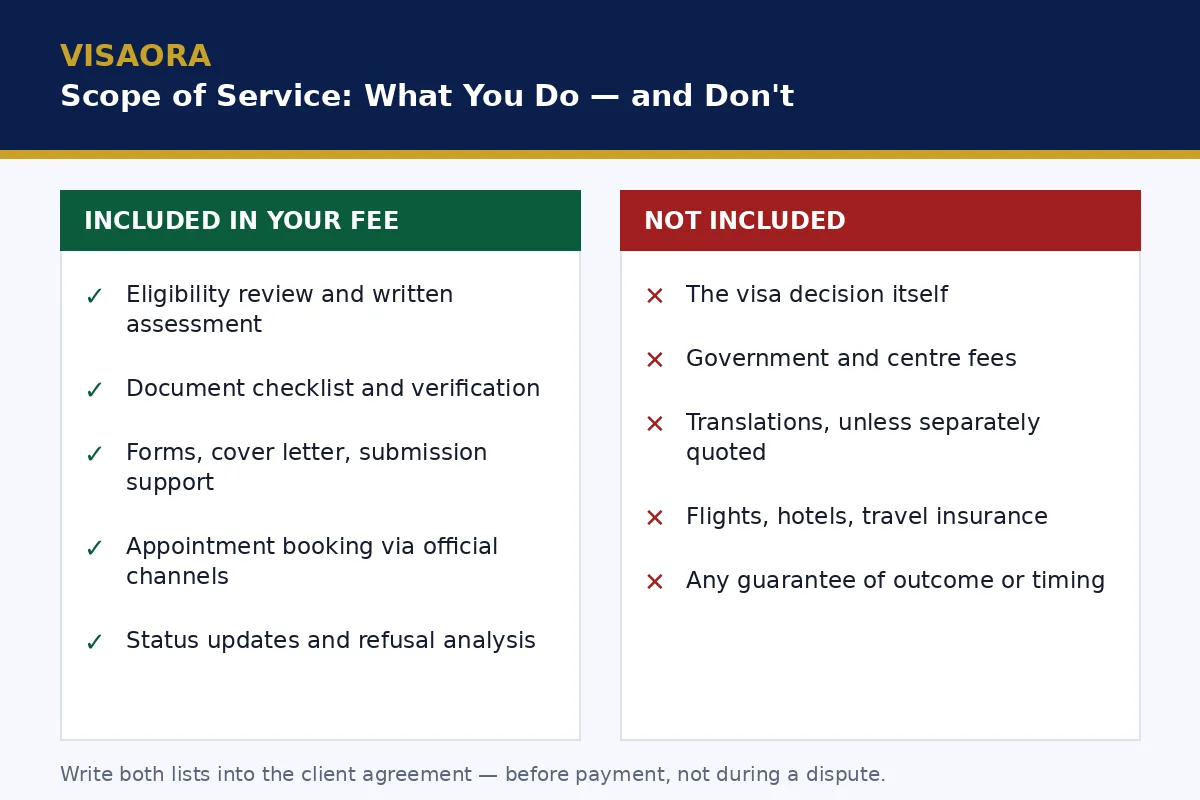
Caption: The two lists every client agreement needs: what the fee covers, and what it does not.
Refund triggers clients understand
A refund policy built on “refunds are at our discretion” is no policy at all — it guarantees an argument. Clients accept a no-refund rule on the service fee when the exceptions are named, tied to stages of work, and written down before payment. A workable visa consultant refund policy has four triggers:
- Agency error before submission. Wrong form filed, or a document you were given but never used — full service-fee refund, or a free rebuild, at the client’s choice.
- Service never started. No work done yet — service fee refunded in full.
- Duplicate payment. Charged twice by mistake — the duplicate refunded immediately, without a claim form.
- Agreed service not delivered. A route you closed, or work you stopped — pro-rata refund for the undone part.
Then state the other side plainly: refusal after full, correct work is not a refund trigger, because the fee paid for labour already delivered — document review, forms, cover letter, submission management — not for the outcome. Government and centre fees follow the authority’s own rules: refundable only if the authority refunds them, and never promised by you. Add two mechanics that prevent most arguments: a claim window (for example, 30 days from the decision) and a payment timeline (for example, approved refunds paid within 14 business days, by the original payment method).
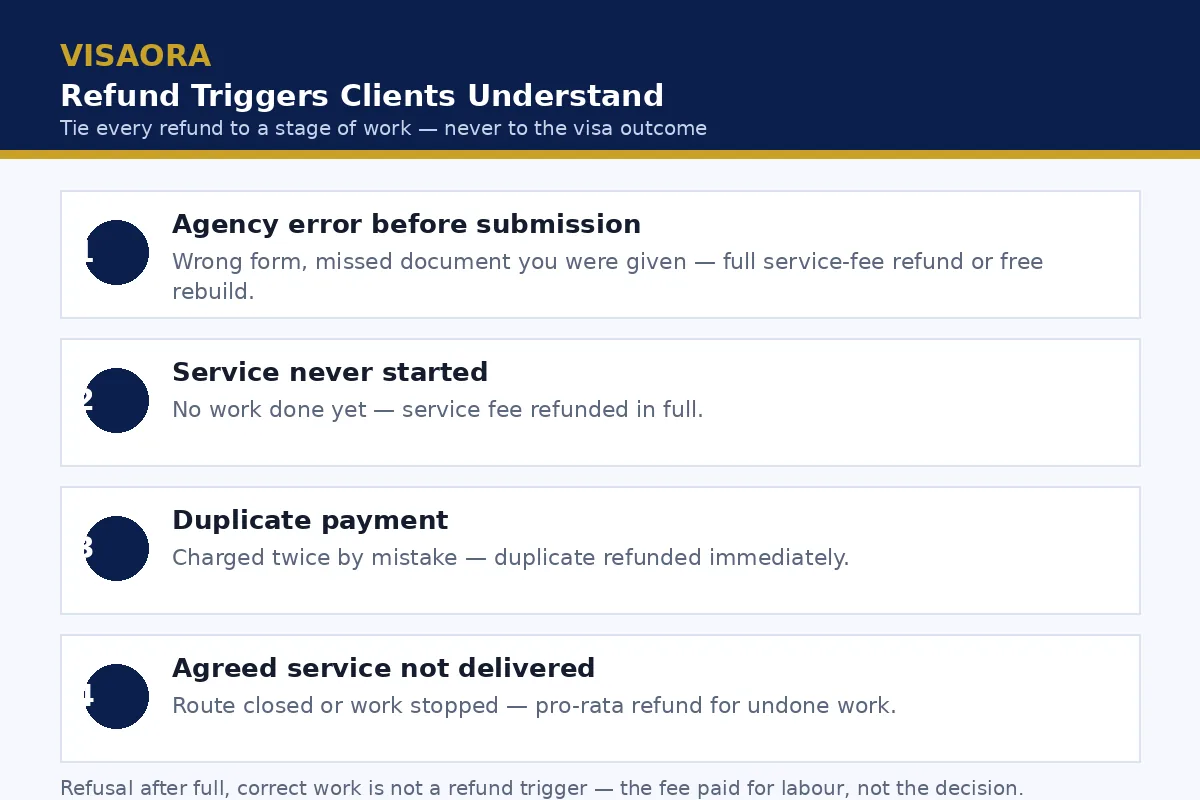
Caption: Four refund triggers tied to stages of work — never to the visa outcome.
Documenting advice: the case file as evidence
When a client says “nobody told me”, the only answer that settles anything is a dated document. Make the case file the record of the relationship: the client’s inputs, every document received (with dates), the advice you gave, the risks you flagged, and the submission record. If advice was given verbally, follow it the same day with a written summary the client can see.
A professional case file also changes how your agency is perceived. It turns “the agent said so” into a document the client keeps, forwards to family, and shows the next agency. Per-file tools fit here precisely because they produce a deliverable: the Visaora Agency Leads builds a white-label case file per client, which complements a CRM rather than replacing it — the CRM holds the relationship and pipeline, the case file holds the evidence. For how a documented file reduces refusals, see our guide on how agencies reduce client visa rejections.
Worked example — a refusal dispute settled by the file (illustrative)
A client demanded a full refund after a refusal, saying the agency never warned him his bank evidence was weak. The dated assessment note in his case file showed the flag, the recommended fix, and his written acknowledgement to proceed anyway. The agency declined a refund of completed work, offered a rebuild at the agreed fee, and the complaint closed the same week — because the paper trail, not memory, decided it.
Complaint handling SLA
Complaints are not a reputation problem to be managed; they are a process problem to be timed. Give every complaint a written clock, a named handler, and a reference number, and publish the same SLA in your terms so clients know what to expect before they complain.
| Step | Action | Target |
|---|---|---|
| Acknowledge | Confirm receipt in writing, name the handler, give a reference number | 1 business day |
| Substantive reply | State what happened, what the agreement says, and the next step | 3 business days |
| Resolve or update | Close it — or explain in writing why it needs longer, with a new date | 7 business days |
| Escalate | Unresolved complaints go to a named manager or owner | Named in the terms |
Three habits keep the SLA honest. First, log every complaint in one place — spreadsheets, inboxes and memory are not a log. Second, never let the person complained about handle the complaint alone. Third, never delete messages: a deleted chat thread is read as guilt by every third party who later sees the gap. And do not hide the client’s outside options: in Dubai, consumer complaints about licensed businesses go through the Department of Economy and Tourism’s consumer protection channels, and the UAE Ministry of Economy runs a consumer protection helpline (800 1222). Telling clients this route exists costs you nothing and buys credibility; clients discover it on their own anyway.
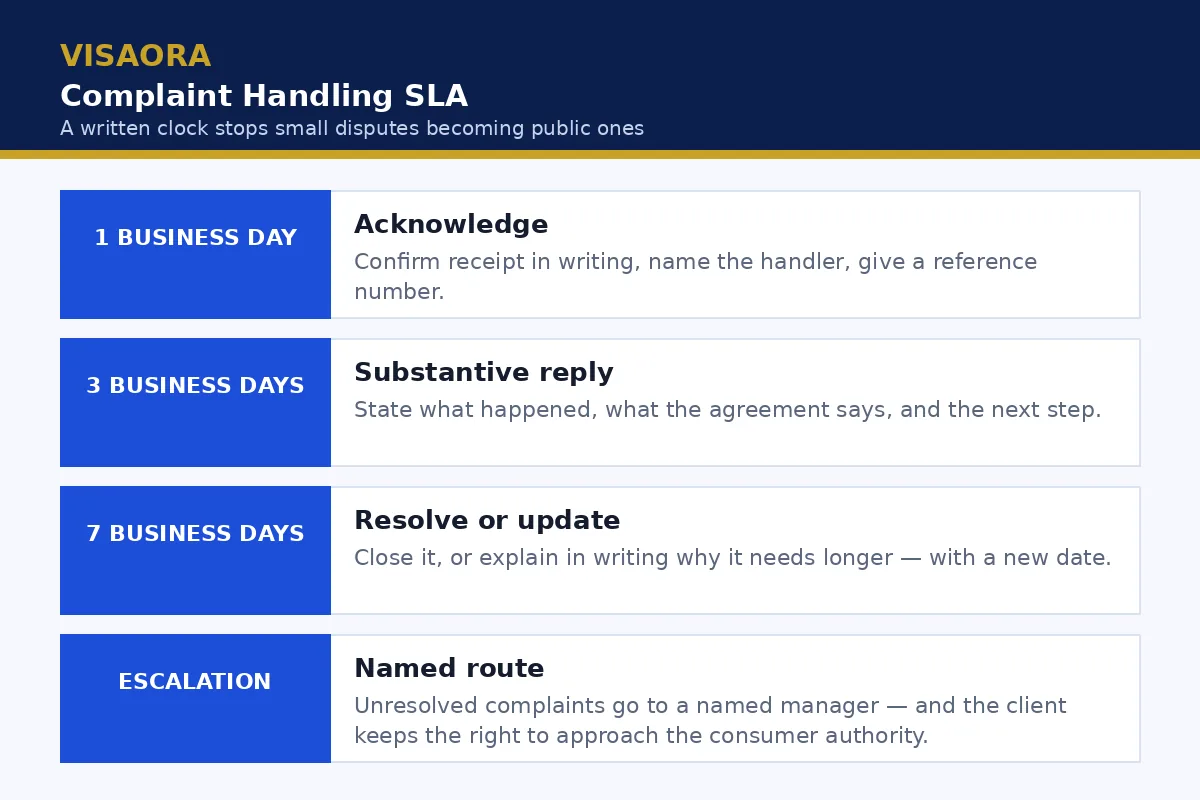
Caption: The complaint clock: acknowledge in 1 business day, reply in 3, resolve or update in 7.
Sample clause list (review with a lawyer)
Use this list as the skeleton of your agreement. Each clause is one or two sentences in your final document — plain language first, legal precision added by your lawyer. This list is general information, not legal advice, and it cannot cover every emirate, licence type or service model:
- No guarantee of outcome or timeline. The visa decision and processing time rest solely with the embassy, consulate or authority.
- Scope and exclusions. The included and excluded lists from the scope section, word for word.
- Client duties. True and complete documents, supplied by agreed deadlines; the client owns the consequences of false or missing documents.
- Fees and disbursements. Professional fee and government/centre charges shown separately; official fees may change without notice.
- Payment stages. Deposit to start, balance before submission; no file work begins on an unpaid promise.
- Refund triggers and limits. The four triggers above, the claim window, and the payment timeline.
- Complaint route and SLA. How to complain, the response clock, and the named escalation contact.
- Data and governing terms. How client data is stored and shared, and which law and forum govern the agreement — confirmed by your lawyer.
Both sides sign and date the agreement before any payment is taken, and the client receives a copy — paper or PDF — the same day. An unsigned terms page on your website protects you far less than a signed agreement in the case file. For what legal help costs in this market, see how much an immigration lawyer costs in 2026, and keep your own public terms current on your terms and conditions page.
Common mistakes agencies make with terms
- Verbal promises, nothing signed. “We’ll sort it” is not a term — and it is remembered generously by the client.
- “Guaranteed visa” in ads or social posts while the contract says the opposite. The ad is the evidence clients quote.
- Government fees buried in the service fee. One blended number makes you look expensive and leaves you exposed when official fees change.
- A refund policy invented during the argument. If it was not written before payment, it will not be believed after a refusal.
- Deleting chats or losing the complaint log. Gaps in the record are read against the agency.
- Copying another agency’s terms. Wrong jurisdiction, wrong licence type, wrong service model — a borrowed contract protects no one.
- Staff freelancing terms per client. If every adviser quotes different refund rules, you have no policy at all.
Give every client a professional case file
Visaora Agency Leads builds white-label visa case files with readiness and refusal-risk analysis under your agency’s name. Packs from $149.
Request a Free Sample Case File →Want more qualified leads? Get a free branded visa checker that sends leads to your WhatsApp: Visaora Agency Leads
Frequently asked questions
Can a visa agency guarantee a visa approval?
No. The decision rests solely with the embassy or consulate, never with the agency, no matter how strong the file. Promising an approval turns a normal refusal into a broken promise, and broken promises produce refund demands, public complaints and regulator attention. Sell the quality of your preparation, not the outcome — that is the honest product.
Are agency service fees refundable if the visa is refused?
Usually not, once the work is done. The fee pays for professional labour — document review, forms, cover letter and submission management — not for the outcome, which the consulate alone decides. State this in writing before payment, with one defined exception, such as an agency error before submission, and a clear claim deadline.
What should a visa agency client agreement include?
Scope of service and exclusions, your professional fee with government and centre charges listed separately, payment stages, refund triggers and claim deadlines, the client’s document duties, a no-guarantee clause, the complaint route with response times, and data handling. Both sides sign and date it before any payment is taken.
When should an agency refund a client?
When the agency failed: an error before submission, a service that never started, a duplicate payment, or an agreed service it can no longer deliver. Tie the amount to the stage of work — full refund before work starts, pro-rata after. A refusal following full, correct work is not a refund trigger, because the fee paid for labour already delivered.
How fast should an agency answer a complaint?
Acknowledge it in writing within one business day, give a substantive reply within three, and resolve it — or explain in writing why it needs longer, with a new date — within seven. Name one escalation contact and log every complaint. Silence is what turns a private complaint into a public review or a regulator filing.
Do agency terms need a lawyer’s review?
Yes. This guide is general information, not legal advice, and templates cannot cover every emirate, licence type or service model. A local lawyer adapts the wording to the law where you operate, checks your refund and data clauses, and confirms the agreement is enforceable. One review now costs far less than one dispute later.
What evidence protects an agency in a dispute?
The signed agreement, dated advice notes, the versioned case file, receipts showing fees and disbursements separately, and the full message log. If advice was given verbally, follow it with a written summary the same day. In a dispute, the agency with the paper trail is believed; the agency with only memories is not.
Last reviewed 25 October 2026. Fees change. Check the official website before you pay.
Sources
- Khaleej Times — “Schengen visa scam in UAE: Fake travel agents charging Dh4,000, experts warn” (30 May 2025; fetched 25 October 2026)
- Saudi Ministry of Human Resources and Social Development — penalties against recruitment offices for non-payment of refunds and unresolved complaints (hrsd.gov.sa announcement; verified via search 25 October 2026)
- Gulf News — HRSD revokes licences of 11 recruitment offices and suspends 3 more over refund delays and unaddressed complaints, first quarter 2026 (verified via search 25 October 2026)
- Gulf News — How to file a consumer complaint in Dubai (DET consumer protection channels; verified via search 25 October 2026)
- Visaora Agency Leads
- Visaora Terms and Conditions
Related reading: Visaora Agency Leads · Terms and Conditions · How Agencies Reduce Client Visa Rejections · How Much Does an Immigration Lawyer Cost in 2026?
Running an agency in the Gulf and want every client file documented from day one? Request a free sample case file and see the case-file format your clients would receive. Agencies: turn this into a client-ready case file with Visaora Agency Leads.
Visaora provides software tools and general information, not legal advice. Rules change; always confirm with the official authority.
Can a visa agency guarantee a visa approval?
No. The decision rests solely with the embassy or consulate, never with the agency, no matter how strong the file. Promising an approval turns a normal refusal into a broken promise, and broken promises produce refund demands, public complaints and regulator attention. Sell the quality of your preparation, not the outcome — that is the honest product.
Are agency service fees refundable if the visa is refused?
Usually not, once the work is done. The fee pays for professional labour — document review, forms, cover letter and submission management — not for the outcome, which the consulate alone decides. State this in writing before payment, with one defined exception, such as an agency error before submission, and a clear claim deadline.
What should a visa agency client agreement include?
Scope of service and exclusions, your professional fee with government and centre charges listed separately, payment stages, refund triggers and claim deadlines, the client’s document duties, a no-guarantee clause, the complaint route with response times, and data handling. Both sides sign and date it before any payment is taken.
When should an agency refund a client?
When the agency failed: an error before submission, a service that never started, a duplicate payment, or an agreed service it can no longer deliver. Tie the amount to the stage of work — full refund before work starts, pro-rata after. A refusal following full, correct work is not a refund trigger, because the fee paid for labour already delivered.
How fast should an agency answer a complaint?
Acknowledge it in writing within one business day, give a substantive reply within three, and resolve it — or explain in writing why it needs longer, with a new date — within seven. Name one escalation contact and log every complaint. Silence is what turns a private complaint into a public review or a regulator filing.
Do agency terms need a lawyer’s review?
Yes. This guide is general information, not legal advice, and templates cannot cover every emirate, licence type or service model. A local lawyer adapts the wording to the law where you operate, checks your refund and data clauses, and confirms the agreement is enforceable. One review now costs far less than one dispute later.
What evidence protects an agency in a dispute?
The signed agreement, dated advice notes, the versioned case file, receipts showing fees and disbursements separately, and the full message log. If advice was given verbally, follow it with a written summary the same day. In a dispute, the agency with the paper trail is believed; the agency with only memories is not.
✈️ Planning Your Trip?
We may earn a commission — at no extra cost to you. Learn more