If you live in the UAE and have seen websites, ads or social posts offering to “apply for ETIAS now” or “pre-register for ETIAS,” stop before you pay anything. As of 20 October 2026, the European Union’s official ETIAS page states that the system is not in operation and that no travel authorisation applications are being collected. This guide explains who will need ETIAS when it eventually launches, what it will cost, how it differs from a Schengen visa and the EES — and how to spot the fake ETIAS sites already charging travellers. Check your own situation with the free ETIAS eligibility checker.
Last reviewed: 20 October 2026
Quick Answer: ETIAS is still not in operation as of 20 October 2026, and no travel authorisation applications can be submitted. UAE passport holders — who enter Schengen visa-free today — will need ETIAS when it launches; expats whose passports require a Schengen visa will keep needing the visa, not ETIAS. No launch date has been announced.
Key Takeaways
- ETIAS is not in operation and no applications are collected — the official line, verified 20 October 2026.
- ETIAS is about your passport nationality, not your UAE residence. Residence in the UAE changes nothing.
- UAE passport holders (visa-exempt today) will need ETIAS when it launches.
- Expats with passports that need a Schengen visa keep needing the visa — never ETIAS.
- The fee will be EUR 20 when applications open. Fees change — check the official website before you pay.
- The EES biometric border system is already fully operational at Schengen borders (since 10 April 2026).
In This Guide
ETIAS for UAE residents: status today (still not live)
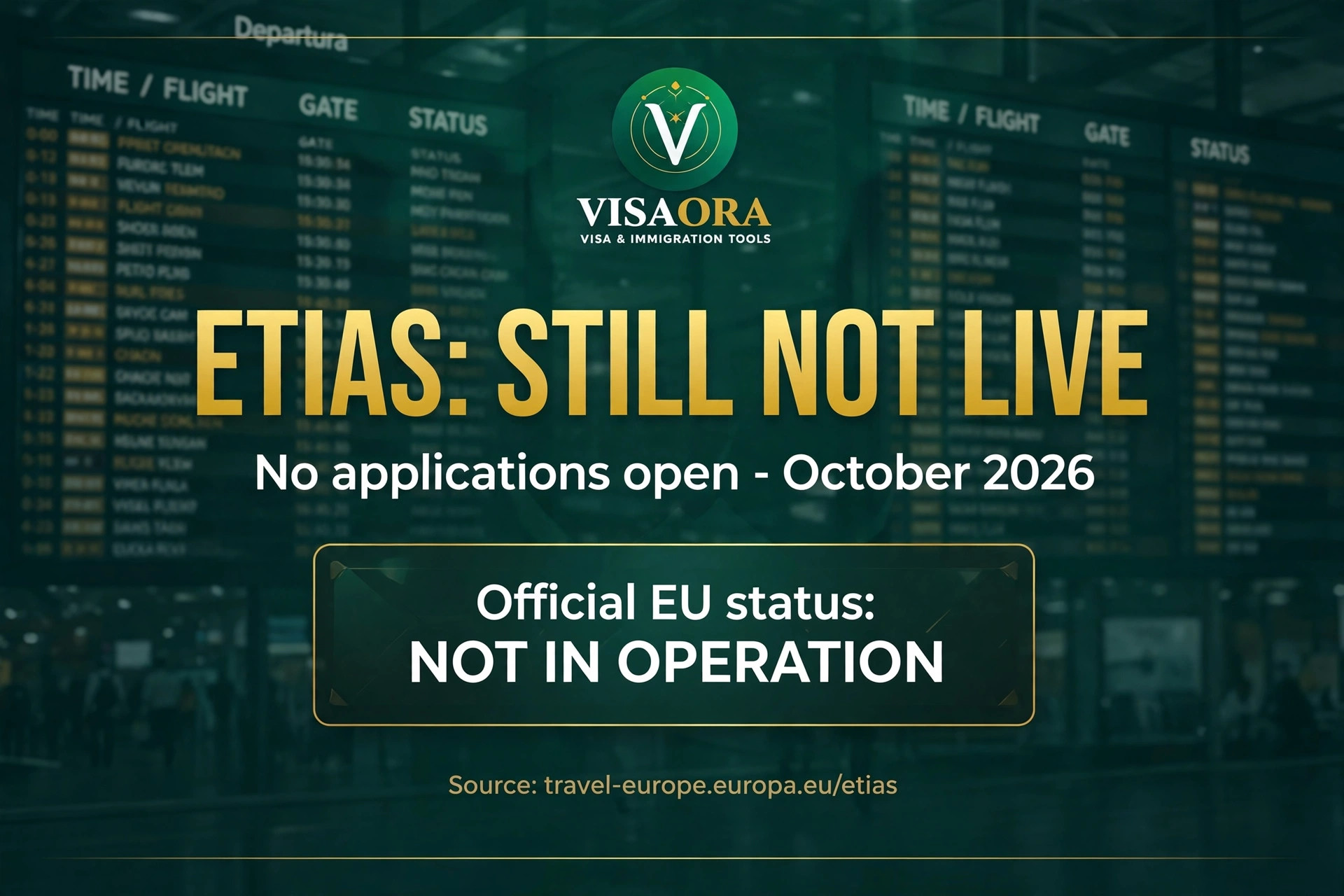
Here is exactly what the EU’s official ETIAS page says as of 20 October 2026:
“ETIAS is currently not in operation and no applications for travel authorisations are collected at this point.”
The same page adds that the European Union will announce the specific start date several months before launch. That is the entire official position: no applications, no open portal, no announced date. The official page also lists the planned steps — apply, pay the EUR 20 application fee, get the authorisation — but none of this is available yet. (travel-europe.europa.eu/etias — verified 20 October 2026.)
So what happened to the launch date? For much of 2025 and 2026, travel media reported a Q4 2026 target for ETIAS. That window has now been withdrawn, according to travel industry reporting: ABTA reported at its October 2026 travel convention that the planned fourth-quarter ETIAS launch has been dropped. The EU itself has not published a new target date, and no official source has confirmed a replacement. If a website quotes you a firm ETIAS start date, it is quoting speculation — there is no official date to quote.
The honest position: ETIAS will exist, it is not here yet, and nobody outside the EU’s system-builders can tell you when.
Who will need ETIAS: your passport decides, not your residence
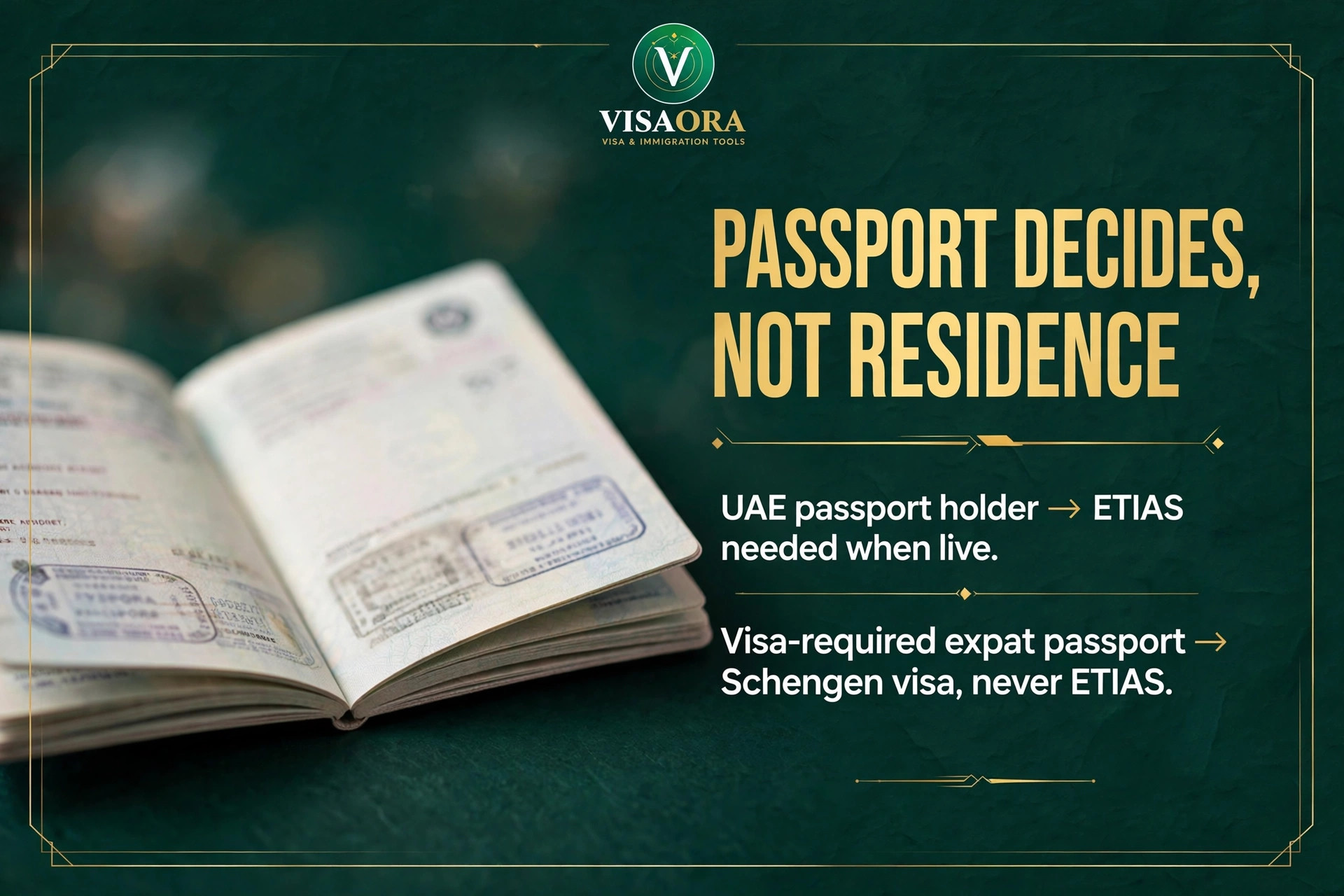
ETIAS is an entry requirement for nationals of visa-exempt countries travelling to the European countries that use the system. The rule attaches to the passport you hold — not to where you live, not to your UAE residence visa (إقامة).
This is the single most misunderstood point for Gulf residents, because the UAE is home to two groups:
- Emirati citizens, who hold a UAE passport and enter the Schengen area visa-free today.
- Millions of expats, who live in the UAE on residence visas but hold passports from India, Pakistan, the Philippines, Egypt, and dozens of other countries.
ETIAS will apply to the first group and to any expat whose passport is visa-exempt (British, American, Canadian, Australian passports, for example). It will never apply to expats whose passports require a Schengen visa — those travellers already go through a full visa process at a consulate, and ETIAS does not replace that.
Memorise this line and you will never be confused again: passport decides; residence does not.
UAE passport holders vs expats living in the UAE
| Your passport | Your situation today | When ETIAS launches |
|---|---|---|
| UAE passport | Enter Schengen visa-free, up to 90 days in any 180-day period | You will need ETIAS before travel |
| Visa-exempt expat passport (e.g. British, American, Canadian, Australian) | Enter Schengen visa-free today | You will need ETIAS before travel |
| Visa-required expat passport (e.g. Indian, Pakistani, Filipino, Egyptian) | Need a Schengen visa from a consulate | You keep needing the Schengen visa — ETIAS never applies to you |
Three worked examples make the table concrete (hypothetical travellers):
- Ahmed — UAE passport, lives in Dubai. He flies to Paris visa-free today with just his passport. When ETIAS launches, he will apply online and pay the EUR 20 fee before his trip. Right now: nothing to do.
- James — British passport, lives in Abu Dhabi on a residence visa. His UK passport is visa-exempt for Schengen, so despite living in the UAE, he will need ETIAS when it launches. His UAE residence changes nothing.
- Priya — Indian passport, lives in Sharjah on a residence visa. She needs a Schengen visa from a consulate before every Europe trip, and that does not change with ETIAS. Any site telling her to “apply for ETIAS” is selling her something she will never need.
If you are unsure which group you are in, run your passport through the ETIAS eligibility checker — it takes seconds and costs nothing.
ETIAS vs Schengen visa vs EES
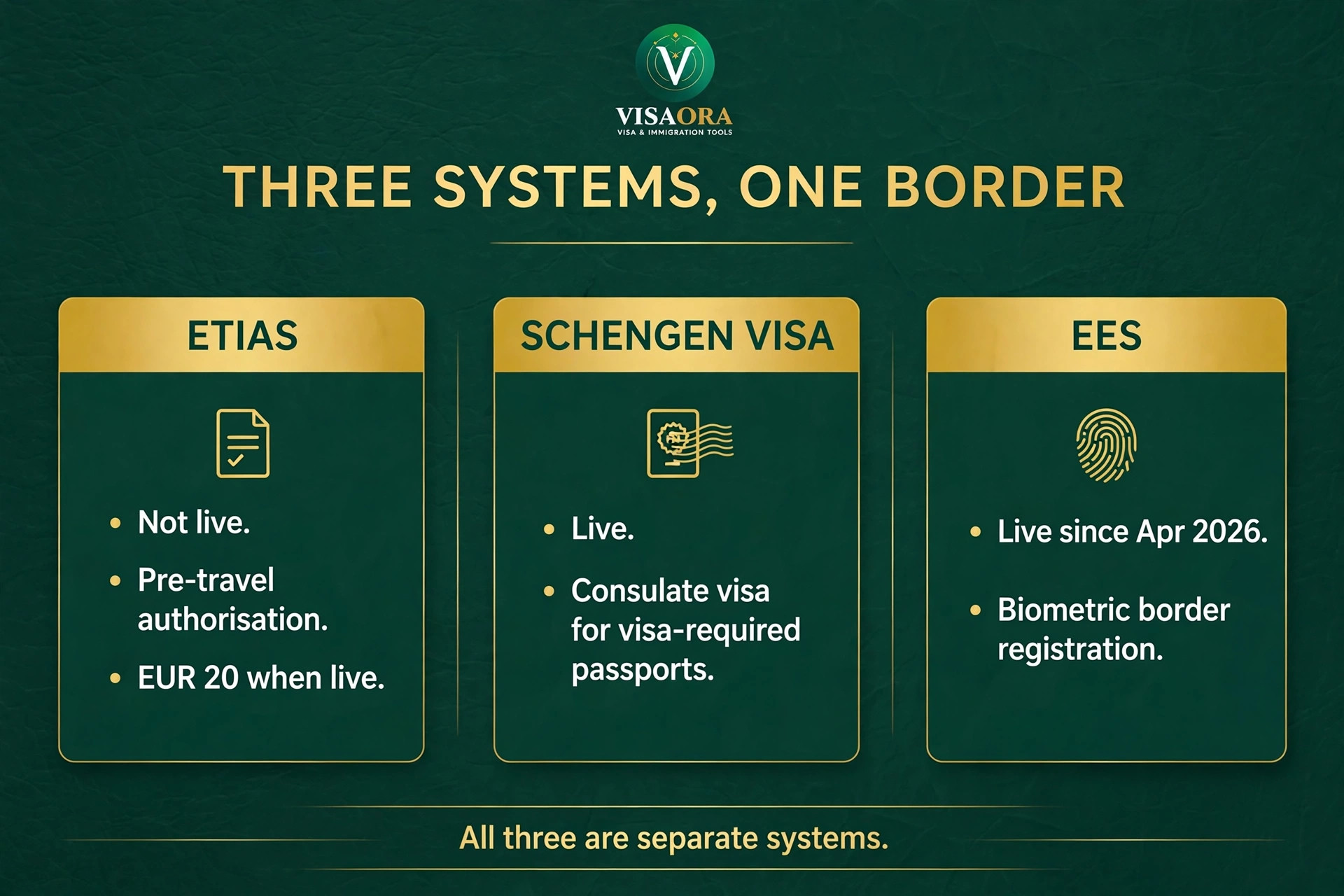
Three different systems keep getting mixed up. Here is the clean comparison, as of 20 October 2026:
| ETIAS | Schengen visa | EES | |
|---|---|---|---|
| What it is | Pre-travel authorisation (like a boarding pre-clearance) | A visa issued by a consulate | A biometric entry/exit register at the border |
| Status | Not live — no applications open | Live and required for visa-required nationalities | Fully live since 10 April 2026 |
| Who it applies to | Nationals of visa-exempt countries, when it launches | Nationals of visa-required countries | All non-EU nationals on short stays |
| Where you deal with it | Online, before travel | Consulate or visa centre, before travel | At the border crossing itself |
| Cost | EUR 20 when live (official page, as of 20 October 2026) | Consulate fee per application | Free |
Two points matter for UAE residents right now:
- 1. The EES is already affecting your trips. Since 10 April 2026, the Entry/Exit System has been fully operational at all external Schengen border points. It registers non-EU travellers’ entry and exit data, including fingerprints and a facial image. Whether or not ETIAS ever launches, every short-stay visit to Schengen is now digitally recorded. Track your entries with the EES entry tracker — and remember that the 90/180-day stay limit still applies, which the Schengen 90/180 counter helps you monitor.
- 2. ETIAS will not replace the EES or the Schengen visa. When it launches, ETIAS will sit on top of the existing system: visa-exempt travellers get ETIAS before travel, then still pass through EES registration at the border. Visa-required travellers skip ETIAS entirely and continue with consulate visas.
With every entry and exit now recorded automatically, overstaying is far harder to hide than in the passport-stamp era. If you are worried about a previous trip, read the Schengen overstay and EES ban guide before your next booking.
Avoid fake ETIAS sites: the red flags
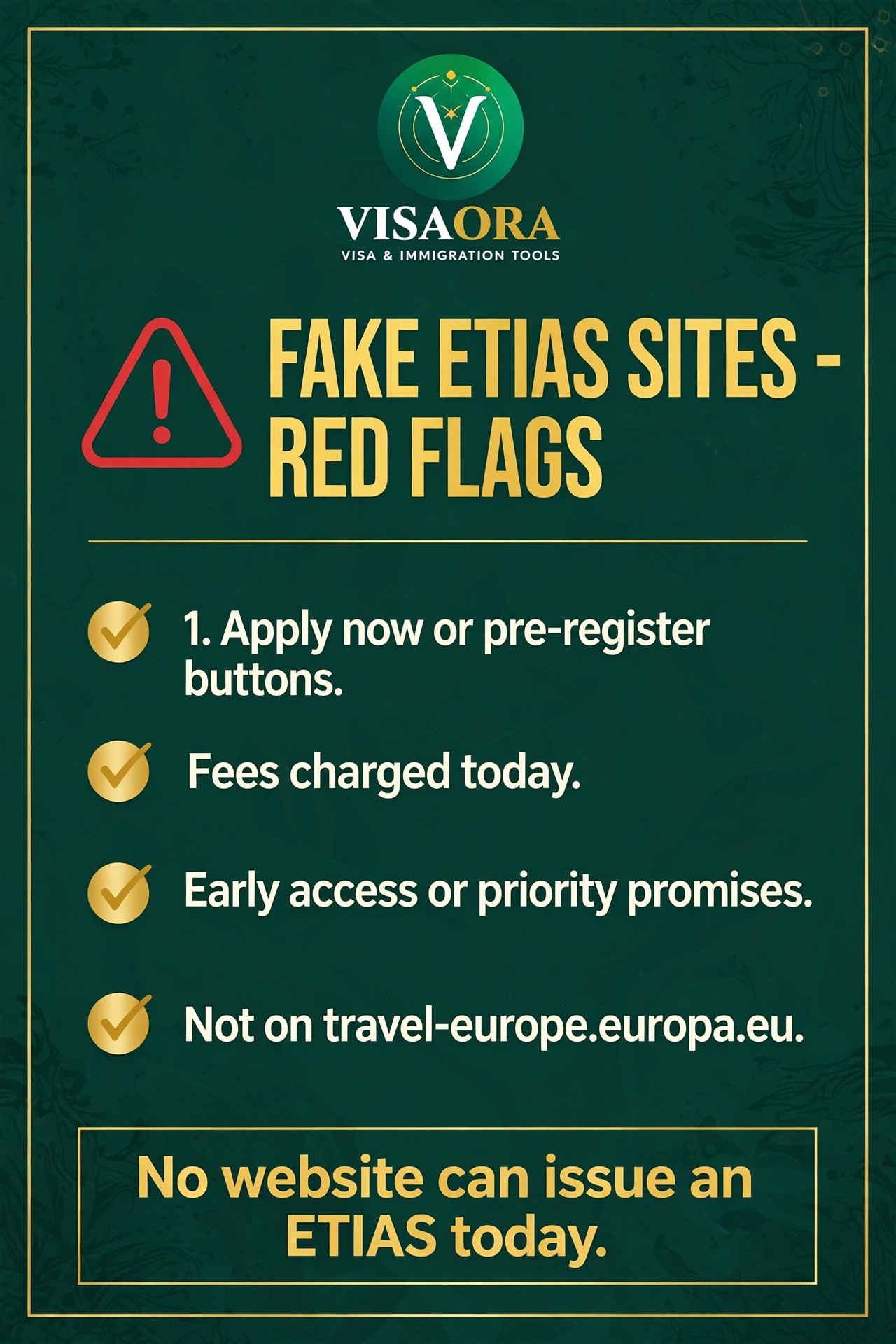
Because ETIAS is real-but-not-live, scammers have filled the gap with sites that take your money and your passport details today. Treat any of these as a hard stop:
- The site lets you “apply now” or “pre-register.” Impossible — the official portal is closed and no applications are collected anywhere.
- It charges you an ETIAS fee today. The EUR 20 fee will only ever be payable on the official system, when it opens.
- It promises early access, priority approval or guaranteed authorisation. None of these exist. There is no early-access scheme and no guaranteed approvals.
- It is not on the official domain. The only official source is travel-europe.europa.eu. Anything else selling applications is unofficial.
- It pressures you with countdowns or “limited slots.” Scarcity tactics around a system that is not live are pure fiction.
- It asks for passport scans and card details through chat, email or social DMs. That is identity theft, not an application.
If you already paid one of these sites: stop any further payments, contact your bank about the charge, and watch your identity documents for misuse. And repeat the rule to anyone who will listen — no website can issue an ETIAS today.
What to do for your Europe trips now
Nothing about ETIAS changes how you travel today. Work through this checklist instead:
- Travel as normal. Visa-exempt travellers need no authorisation yet; visa-required travellers follow the normal consulate process.
- Pay nothing to any ETIAS site. Not a fee, not a “pre-registration,” not an “express” add-on.
- Watch the one official page. The EU will announce the launch date on travel-europe.europa.eu/etias several months before it goes live. That page is your only source of truth.
- Expect biometrics at the border. The EES registers fingerprints and a facial image for non-EU short-stay travellers — budget a little extra time at passport control on arrival.
- Mind your 90/180 days. The stay limit is unchanged and now digitally enforced. Use the Schengen 90/180 counter before you book a long trip.
- Check your passport group once. If you have never confirmed whether your passport is visa-exempt, the ETIAS eligibility checker settles it in seconds.
Fees change. Check the official website before you pay. The EUR 20 figure is from the official ETIAS page as of 20 October 2026; treat any other number you see online as unverified until the EU confirms it.
Frequently Asked Questions
Is ETIAS required for UAE residents in 2026?
No. As of 20 October 2026, ETIAS is not in operation and no applications are being collected, so no UAE resident needs one for 2026 travel. The EU will announce the launch date several months in advance. Until then, travel continues exactly as before — visa-exempt travellers with just a passport, visa-required travellers with a consulate visa.
Do UAE citizens need ETIAS?
Not yet, but they will. UAE passport holders are visa-exempt for the Schengen area today, and ETIAS is designed for exactly this group — nationals of visa-exempt countries. When the system launches, Emirati travellers will apply online and pay the EUR 20 fee before each trip. Right now there is nothing to apply for.
What is the ETIAS launch date?
There is no official launch date. The previously reported Q4 2026 target has been withdrawn according to travel industry reporting (ABTA, October 2026), and the EU has not published a replacement. The official ETIAS page says only that the start date will be announced several months before launch. Any site quoting a firm date is speculating.
How much does ETIAS cost?
The official ETIAS page lists a EUR 20 application fee, as of 20 October 2026. Fees change — check the official website before you pay. The fee will only be payable through the official EU system once applications open; no legitimate payment can be taken today, so any site charging you now is a scam.
What is the difference between ETIAS and a Schengen visa?
ETIAS is a light pre-travel authorisation for nationals of visa-exempt countries, applied for online. A Schengen visa is a full visa issued by a consulate for nationals of visa-required countries. They serve different passport groups and never overlap: if you need a Schengen visa, you will never need ETIAS, and vice versa.
Does ETIAS replace the EES?
No. ETIAS (pre-travel authorisation, not yet live) and the EES (biometric entry/exit registration at the border, fully live since 10 April 2026) are separate systems that will work together. When ETIAS launches, visa-exempt travellers will get ETIAS before travel and still be registered in the EES at the border.
Can I apply for ETIAS now through an agency or website?
No. No agency, website or app can submit an ETIAS application today because the official system is closed and no applications are being collected. Any service offering ETIAS applications, pre-registration or early access is not legitimate — do not pay and do not share passport details.
Disclaimer: Visaora is software and does not provide legal advice. Requirements depend on your nationality and situation. Confirm with the official authority or a licensed adviser.
Sources
- Official ETIAS page, European Union — “ETIAS is currently not in operation and no applications for travel authorisations are collected at this point” (verified 20 October 2026): https://travel-europe.europa.eu/etias.html
- European Commission, Migration and Home Affairs — “The Entry/Exit System is fully operational since 10 April 2026” (published 27 July 2026, updated 17 September 2026): https://home-affairs.ec.europa.eu/news/entry-exit-system-fully-operational-10-april-2026-who-exempt-2026-07-27_en
- Travel industry reporting — ABTA Travel Convention (October 2026) reported the planned Q4 2026 ETIAS launch has been dropped: https://travelgossip.co.uk/latestnews/ees-checks-can-be-suspended-until-end-of-2026-as-etias-launch-date-is-dropped/
- Gulf News — list of visa-exempt countries for Europe (European Commission source), confirming UAE nationals: https://gulfnews.com/travel/list-changes-for-citizens-of-visa-exempt-countries-visiting-europe-1.500361155
Related reading: ETIAS Eligibility Checker · EES Entry Tracker · Schengen 90/180 Counter · Schengen Overstay 2026: EES Ban Guide
CTA: Use the free ETIAS eligibility checker to confirm your passport group in seconds. Agencies: turn this into a client-ready case file with Visaora Agency Suite.
✈️ Planning Your Trip?
We may earn a commission — at no extra cost to you. Learn more