
Bahrain Work Visa Processing Time 2026: How Long It Really Takes
Wondering what the Bahrain work visa processing time looks like in 2026? You are not alone — it is one of the most-searched questions among professionals planning a move to the Kingdom. The short version is refreshingly clear: the LMRA (Labour Market Regulatory Authority) states 21 working days for workers applying from outside Bahrain and 3 working days for workers already inside the country. But that headline figure covers only the work-permit approval stage. Below is the full journey — permit application, entry visa, medical, and residence permit — plus the delays that catch people out and how to avoid them.
⚡ Quick Answer
The Bahrain work visa processing time for 2026 is 21 working days for applicants outside Bahrain and 3 working days for applicants already inside Bahrain, per the LMRA’s official new work permit service page. The full end-to-end journey — employer application, approval, entry visa, travel, post-arrival medical and biometrics, and residence permit/CPR card — usually runs about 4–6 weeks for overseas hires when documents are complete and fees are paid on time.
📌 Key Takeaways
- LMRA official processing: 21 working days (outside Bahrain) vs 3 working days (inside Bahrain).
- Only your Bahraini employer can apply — via the LMRA Expat Management System (EMS).
- Unpaid admin and job-advertisement fees cancel the application automatically.
- Overseas medicals must be from a Wafid-accredited centre and no older than two months.
- After arrival, the employer prints the residence permit via Bahrain’s National Portal, then the CPR card follows.
📑 Table of Contents
- The Official LMRA Bahrain Work Visa Processing Time for 2026
- Bahrain Work Visa Processing Time: Stage-by-Stage Breakdown
- Inside Bahrain vs Outside Bahrain: Why 3 Days vs 21 Days
- Documents That Keep Your Application Moving
- Bahrain Work Visa Delays: Why Processing Takes Longer — and How to Avoid It
- How to Track Your Application Status
- After Approval: What Happens Next
- Bahrain Work Visa Processing Time — FAQs

The Official LMRA Bahrain Work Visa Processing Time for 2026
Let us start with the number that actually matters, straight from the source. On its New Work Permit service page, the Labour Market Regulatory Authority (LMRA) lists its processing time as:
- 3 working days — for expatriate employees applying from inside the Kingdom of Bahrain (LMRA approval).
- 21 working days — for expatriate employees applying from outside the Kingdom of Bahrain.
That is the work permit approval clock — the time the LMRA needs to review your employer’s application once it is submitted and the invoices are settled. It does not include the time you spend gathering documents beforehand, or the post-arrival steps like the local medical, biometrics, and CPR card. For an overseas hire, a realistic end-to-end estimate is roughly 4–6 weeks from a complete submission to residence permit in hand.
One important detail many people miss: when the LMRA issues the application ID, it also raises invoices for the BHD 5 admin fee and, for overseas workers, the BHD 30 job-vacancy advertisement fee. If those invoices are not paid before the due date, the application is cancelled outright — the processing clock never even starts. This single missed step causes more “delays” than anything else.
Not sure you meet the basic requirements before your employer files? Our free Gulf Work Visa Eligibility Checker takes a couple of minutes and highlights anything that might slow you down.
Bahrain Work Visa Processing Time: Stage-by-Stage Breakdown
A Bahrain work visa is not one single application — it is a sequence of stages handled by the employer, the LMRA, and you. Here is how the timeline typically unfolds in 2026:
| Stage | Typical Duration | Handled By |
|---|---|---|
| 1. Employer submits work permit application on the LMRA EMS, pays admin + ad fees | 1–2 days (preparation); clock starts after payment | Employer |
| 2. LMRA verification and approval | 3 working days (inside Bahrain) / 21 working days (outside Bahrain) | LMRA |
| 3. Entry visa / travel arrangements | A few days — the permit approval is what authorises travel | Employer / worker |
| 4. Arrival and post-arrival formalities (local medical, biometrics) | Usually a few days to about a week | Worker (employer coordinates) |
| 5. Residence permit printed via Bahrain’s National Portal; CPR card issued | A few days after arrival formalities | Employer / NPRA |
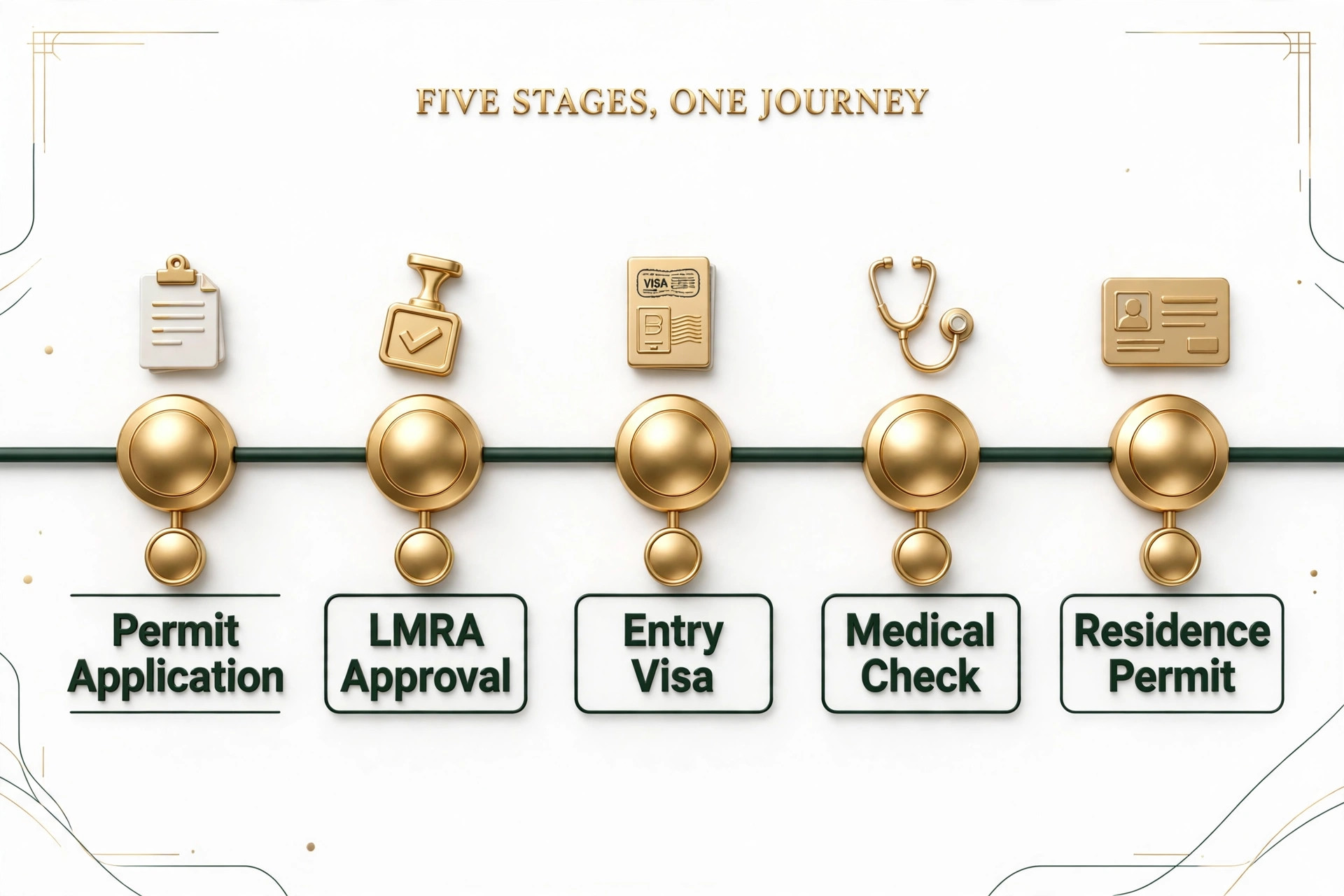
Note that the stages before arrival run on paperwork, while the stages after arrival run on your presence. For overseas workers, the 21-working-day LMRA review is the longest single stretch — everything else is typically measured in days, not weeks, provided nothing is flagged.
The medical stage deserves a special mention. If you are outside Bahrain, your employer needs a Wafid medical report from a Gulf Health Council–accredited centre — no older than two months, with a “fit to work” result. If you are already in Bahrain, no pre-arrival medical certificate is required at all, and no medical is needed for dependants. Where no accredited centre exists in your area, the LMRA accepts its non-Wafid medical form stamped by an official medical centre.
Inside Bahrain vs Outside Bahrain: Why 3 Days vs 21 Days
The seven-fold difference between the two official timelines is the most misunderstood part of the Bahrain work visa processing time — so it is worth unpacking.
Workers already in Bahrain (3 working days): The LMRA can verify your identity, immigration record, and existing personal number (if you were issued one before) directly in its own systems. No pre-arrival medical certificate is required, no overseas verification loops, and the residence permit can be printed through the National Portal without waiting for an arrival. It is an in-system, largely automated check.
Workers outside Bahrain (21 working days): The file has to travel further — passport data, a Wafid medical from your home country, contract details, and employer quota checks all need cross-checking. The LMRA also needs the BHD 30 job-vacancy advertisement process to run its course for overseas hires. Three calendar weeks is simply the more thorough pipeline.

A practical takeaway: if you are outside Bahrain, do not count calendar days — count working days. Bahrain’s official work week runs Sunday to Thursday, so 21 working days is essentially four weeks plus a day on the calendar. Add document preparation before submission and post-arrival steps after it, and most overseas hires should plan for roughly a month to six weeks in total.
✈️ Planning a Gulf Move?
Before your employer files, see how strong your work-visa profile really is — job history, documents, and risk factors reviewed in one professionally prepared report.
Check My Score →Documents That Keep Your Application Moving
Most timeline overruns trace back to paperwork. The LMRA publishes a clear required-documents list for the new work permit — get these right the first time and your file sails through verification:
- Passport copy: valid for at least 6 months (the LMRA strongly recommends 2 years of validity). The first page must show your first name plus father or family name, the page stating the father’s or spouse’s name (for Indian and Pakistani nationals), and the old passport number page.
- Employment contract: optional but wise. If submitted, it should be in Arabic — or bilingual including Arabic — on company letterhead or government paper, and state the commercial registration name and number, 1- or 2-year duration, your name as per passport, passport number, nationality, occupation, salary, employment terms, and notice periods. It must be signed by both parties and stamped/sealed by the employer. The permit period must match the contract.
- Medical examination report: required only for workers outside Bahrain. Must be no older than two months from issue, show a fit-to-work result, and come from a Wafid-accredited centre (or the stamped non-Wafid form where no accredited centre exists). No medical needed for dependants or in-country applicants.
- Approval / no-objection letter: required for specialised occupations such as teachers, doctors, engineers, and banking-sector roles.
- Previous personal number: if you worked in Bahrain before and were issued a personal number, the same number must be reused on the new application.
Two procedural conditions are easy to overlook: any multiple-entry permit you hold must be cancelled before the application is filed, and if you fail the required medical, the employer is obliged to process your deportation immediately. Harsh — but knowing the rules in advance beats discovering them mid-process.
Bahrain Work Visa Delays: Why Processing Takes Longer — and How to Avoid It
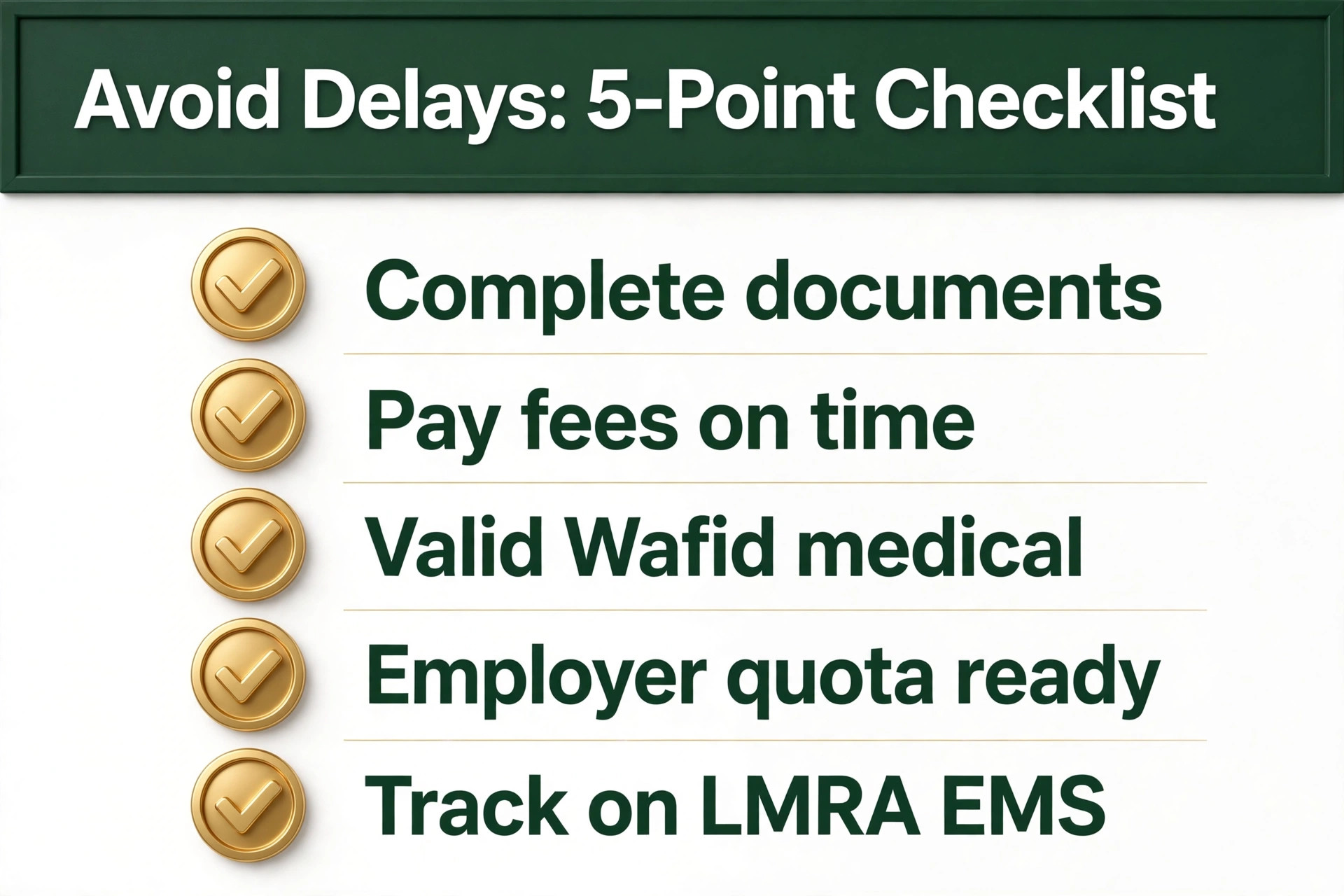
Here are the most common reasons a Bahrain work visa stretches beyond the official timeline, and what to do about each:
- Unpaid admin or advertisement fees. The LMRA cancels the application automatically if the BHD 5 admin fee (and BHD 30 ad fee for overseas hires) is not paid by the invoice due date. Fix: confirm payment in the EMS the day the application is submitted — and get a receipt.
- Incomplete or mismatched documents. A missing father-name page, a contract without the Arabic version, or a permit period that does not match the contract all bounce the file back. Fix: send your employer clean, complete scans the first time.
- Expired or non-Wafid medical report. A report older than two months, or one from a non-accredited clinic when a Wafid centre exists, is rejected. Fix: book the Wafid medical early and keep the result under two months old.
- Medical unfit result. A failed medical ends the process — the employer must arrange deportation if you are in-country. Fix: get the screening done privately before your employer files, so there are no surprises.
- Specialised-occupation approvals pending. Teachers, doctors, engineers, and banking staff need an extra no-objection letter from the relevant authority. Fix: start that parallel process early; do not wait for the LMRA to ask.
- Old personal number not reused. Previously resident workers must reuse their old personal number; a new application with fresh details creates a conflict. Fix: tell your employer your old number before they file.
- Employer-side issues. Applications can stall if the sponsoring establishment has quota or compliance problems. Fix: deal only with established employers and confirm their LMRA account is in good standing.
How to Track Your Application Status
You are not expected to wait in the dark. The LMRA offers two straightforward ways to check where your application stands:
- Through your employer: the employer can log into the Expat Management System (EMS) at any time and see the live status of every application they have filed. Ask your employer (or recruiter) for the application ID issued at submission — a genuine filing produces one immediately. No ID usually means nothing has been filed yet.
- Directly: the LMRA Contact Centre on +973 17506055 handles status enquiries. Phone service hours are 7:30 AM to 5:00 PM, Sunday to Thursday (Bahrain time). Service counters are available at the LMRA headquarters in Sanabis, Executive Services, and Seef Mall in Al Muharraq.
Once your permit is approved, your employer pays the remaining permit fees — BHD 195 for one year or BHD 390 for two years (BHD 90 for dependants) — through the EMS or an accredited bank, then prints the work permit from the system.
After Approval: What Happens Next
Approval is the biggest hurdle, but it is not the finish line. Here is what typically follows:
- Permit fee payment and printing: the employer pays the permit fee (BHD 195/390) and prints the work permit from the EMS.
- Travel: you fly to Bahrain on the approved permit. Keep a copy of the printed permit with your passport.
- Arrival formalities: post-arrival medical, biometric data collection, and document verification — usually completed within days.
- Residence permit and CPR card: for workers arriving from outside Bahrain, the employer prints the residence permit via Bahrain’s National Portal once you have arrived; in-country workers print it through the same portal. The CPR (Central Population Register) card — your official ID in Bahrain — follows from the NPRA.
From touchdown to CPR card, most workers report the post-arrival steps taking roughly one to two weeks when everything is in order. Add that to the ~21 working days of LMRA review and you land squarely in the 4–6 week total we quoted at the top.
📋 Want a Professionally Prepared Readiness Report?
The Visaora Intelligence Suite reviews your work-visa documents, timelines, and risk factors — and gives you a clear readiness score before you commit to the process.
Check My Score →Bahrain Work Visa Processing Time — FAQs
How long does a Bahrain work visa take in 2026?
The LMRA’s official processing time is 21 working days for workers outside Bahrain and 3 working days for workers already inside the Kingdom. Counting document preparation, travel, and post-arrival medical, biometrics, and residence permit steps, overseas hires should realistically plan for about 4–6 weeks from submission to completion.
Can I apply for a Bahrain work visa myself?
No. Only a Bahraini employer can submit a new work permit application, and it must go through the LMRA’s Expat Management System (EMS). You provide your documents and medical report, but the filing, fee payments, and status tracking are all handled by your sponsoring employer. Be cautious of anyone offering to file on your behalf.
What medical test is required for a Bahrain work visa?
Workers outside Bahrain need a Wafid medical report from a Gulf Health Council–accredited centre, no older than two months, showing a fit-to-work result. If no accredited centre exists where you live, the LMRA accepts its stamped non-Wafid medical form. Workers already in Bahrain and dependants do not need a pre-arrival medical certificate.
How can I check my Bahrain work visa application status?
Ask your employer for the application ID and have them check the live status in the LMRA Expat Management System, where employers can view every filing. You can also call the LMRA Contact Centre on +973 17506055 between 7:30 AM and 5:00 PM, Sunday to Thursday. A genuine submission always produces an application ID immediately.
Why is my Bahrain work visa taking longer than expected?
The most common causes are unpaid admin or job-advertisement fees (which auto-cancel the application), incomplete or mismatched documents, an expired or non-Wafid medical report, a pending no-objection letter for specialised occupations, an old personal number not being reused, or employer-side quota issues. Confirming each of these with your employer usually identifies the bottleneck.
How long does the residence permit take after arriving in Bahrain?
Once you arrive, your employer prints the residence permit through Bahrain’s National Portal, typically within a few days after the post-arrival medical and biometrics are complete. The CPR (Central Population Register) card — your official identity document — is then issued by the NPRA. Most workers finish the post-arrival steps within about one to two weeks.
Do I need a medical certificate if I am already in Bahrain?
No. The LMRA does not require a medical examination certificate for expatriate employees who are already residing in the Kingdom of Bahrain. The medical requirement applies to workers applying from outside Bahrain, who must provide the Wafid medical report. No medical examination is required for dependants in either case.
How long must my passport be valid for a Bahrain work visa?
Your passport must be valid for at least 6 months when the work permit application is filed. The LMRA strongly recommends at least 2 years of validity, since permit periods run 1–2 years and a passport expiring mid-permit creates renewal complications. Renewing your passport before the process starts avoids unnecessary delays.
Sources: All processing times and fees in this guide are taken from the LMRA’s official New Work Permit service page (last updated 30-12-2025). Timelines are subject to change — always confirm current figures with your employer and the LMRA before making travel plans.
✈️ Planning Your Trip?
We may earn a commission — at no extra cost to you. Learn more