⚡ QUICK ANSWER
In 2026, a Kuwait resident needs a minimum salary of KD 800 per month to sponsor a family residence visa (Article 22) for a spouse or children. The salary is checked against the figure registered on the sponsor’s official work permit — not just take-home pay. A family visit visa, for short stays, is a completely different permit and follows different rules — it does not carry the same KD 800 salary requirement for immediate family members. Confusing the two is the most common and costly mistake applicants make.
Kuwait Family Visa Salary Requirements 2026: The KD 800/Month Rule Explained
If you live and work in Kuwait and want your family to join you, one figure decides almost everything: KD 800 per month. That is the minimum salary Kuwait’s Ministry of Interior requires a resident to earn before they can sponsor a family residence visa under Article 22 in 2026. Miss it, and the application is rejected. Meet it, keep it documented, and the door opens — provided the rest of your paperwork is in order.
This guide breaks down the Kuwait family visa salary requirements for 2026 in plain language: who the KD 800 rule applies to, which professions are exempt, what documents prove your income, and — critically — how the family visit visa differs from the family residence visa. They share a name, but they are not the same permit, and treating them alike leads straight to refusal.
📌 KEY TAKEAWAYS
- KD 800/month is the minimum registered salary to sponsor a family residence visa (Article 22) in Kuwait.
- The figure comes from the salary on your official work permit, not your bank statement alone.
- Nine professional categories are exempt from the salary rule, mostly in government, education, health and engineering.
- A university degree is no longer required — that condition was dropped in 2024.
- The family visit visa (short stay) is separate from the residence visa and follows different salary rules.
- If your salary drops below KD 800 after approval, authorities can give you one month to regularise before dependents must leave.
📑 IN THIS GUIDE
- The KD 800 rule: what it is and who it applies to
- Family visit visa vs family residence visa (Article 22)
- Who can sponsor a family residence visa
- Exempt professions and special cases
- Documents you will need in 2026
- What happens if your salary drops below KD 800
- Converting a visit visa to a residence visa
- 8 frequently asked questions
The KD 800/Month Rule: Kuwait Family Visa Salary Requirements in 2026
The KD 800 salary threshold is not new, but it is now firmly embedded in Kuwait’s residency framework. It was first introduced in January 2024 under Ministerial Resolution No. 56, and it was reconfirmed in the executive regulations of the foreigners’ residence law announced in late 2025, which took effect in December 2025. Kuwaiti media outlets including Times Kuwait and Arab Times have reported the figure consistently: an expatriate who wants to bring family members to live with them in Kuwait must earn at least KD 800 every month.
Three things make this rule stricter than it sounds. First, the salary is assessed against the figure tied to the profession on your residency and work permit — authorities check that the registered salary meets the threshold, so an informal raise that was never registered may not help you. Second, the rule is enforced on an ongoing basis, not only at application time: the Residence Affairs Investigations Department runs targeted checks on residents whose registered income has fallen below KD 800 since their family’s visas were issued. Third, even a small shortfall counts — if the registered salary is even slightly under KD 800, the application is rejected.
One positive change over the past two years: when the rule first appeared, applicants also needed a university degree in a matching field. An amendment in July 2024 removed the degree requirement entirely. The Ministry of Interior has emphasised that the family visa process is open to expatriates of all nationalities and educational backgrounds — the salary condition is the deciding factor, and your declared job title must match the work you actually do.
Family Visit Visa vs Family Residence Visa (Article 22): The Critical Difference
This is where most applicants go wrong. Kuwait operates two entirely separate family visa tracks, and the salary rules, durations, documents and outcomes are different for each. Read this section carefully before you do anything else.
The family visit visa is a short-stay permit. It lets relatives enter Kuwait temporarily — for visits, family occasions or short stays — and then leave. According to Kuwaiti media reporting on the 2025 reforms, the general minimum salary requirement for family visit visas covering spouses and children was scrapped, widening eligibility considerably. Visit visas now cost KD 10 per issuance, can be valid for up to three months, are renewable for a further period up to a total of one year, and multiple-entry versions can run up to a year with each stay capped at around a month. Eligible relatives extend to blood relations up to the fourth degree and relatives by marriage up to the third degree — a very wide net. One caution: some MOI notices and service channels have cited salary guidance of KD 400 for parents and KD 800 for other relatives on certain visit-visa categories, so rules can differ by issuance channel. Confirm the current requirement at the Residency Affairs office when you apply.
The family residence visa (Article 22) is dependent residency — your spouse or children actually live with you in Kuwait long-term, hold residency, and can renew it year after year. This is the permit the KD 800/month salary rule belongs to. It demands the full document set, medical fitness tests, health insurance for every dependent, and annual renewal fees. It cannot be substituted with a visit visa, and a visit visa does not automatically convert into one.
| Feature | Family Visit Visa | Family Residence Visa (Article 22) |
|---|---|---|
| Purpose | Short stay — relatives visit, then leave | Long-term dependent residency — family lives in Kuwait |
| Salary rule | No general KD 800 requirement for spouse/children (2025 reforms); some categories may cite KD 400–800 guidance | KD 800/month minimum, checked on the registered work-permit salary |
| Duration | Up to 3 months, renewable up to 1 year total; multiple-entry up to 1 year (~1 month per stay) | Renewable long-term residency, tied to the sponsor’s own residency |
| Fees | KD 10 per visit visa issuance | Annual renewal: KD 20/person for spouse and children; KD 300/person for other relatives |
| Documents | Lighter set: passport copies, proof of kinship, sponsor’s Civil ID | Full set: salary certificate, attested marriage/birth certificates, Civil ID, medical test, health insurance |
| Conversion | Does not convert automatically; limited conversion cases exist under Article 16, subject to approval | — |

Who Can Sponsor a Family Residence Visa in Kuwait?
The primary sponsor is normally the father: a resident father holding a valid work residency can sponsor his spouse and children once the KD 800 threshold is met. The sponsor’s registered job title must genuinely reflect their actual work in Kuwait — mismatches between the declared profession and the real job are a frequent cause of rejection under the current enforcement climate.
Women can sponsor too, but under narrower conditions. Kuwaiti immigration practice allows a mother to sponsor her children on dependent visas — meeting the same KD 800 salary rule — when the husband is deceased, when she is divorced and holds custody, or when the husband has left Kuwait permanently. A mother whose husband is alive and simply living abroad generally cannot sponsor her children on her own residency, even if she earns above the threshold.
Parents and other relatives fall into a harder category. Sponsoring relatives beyond a spouse and children carries an annual fee of KD 300 per person and faces much tighter scrutiny. Parent sponsorship is widely reported as extremely difficult and rarely approved — plan for that reality rather than against it.
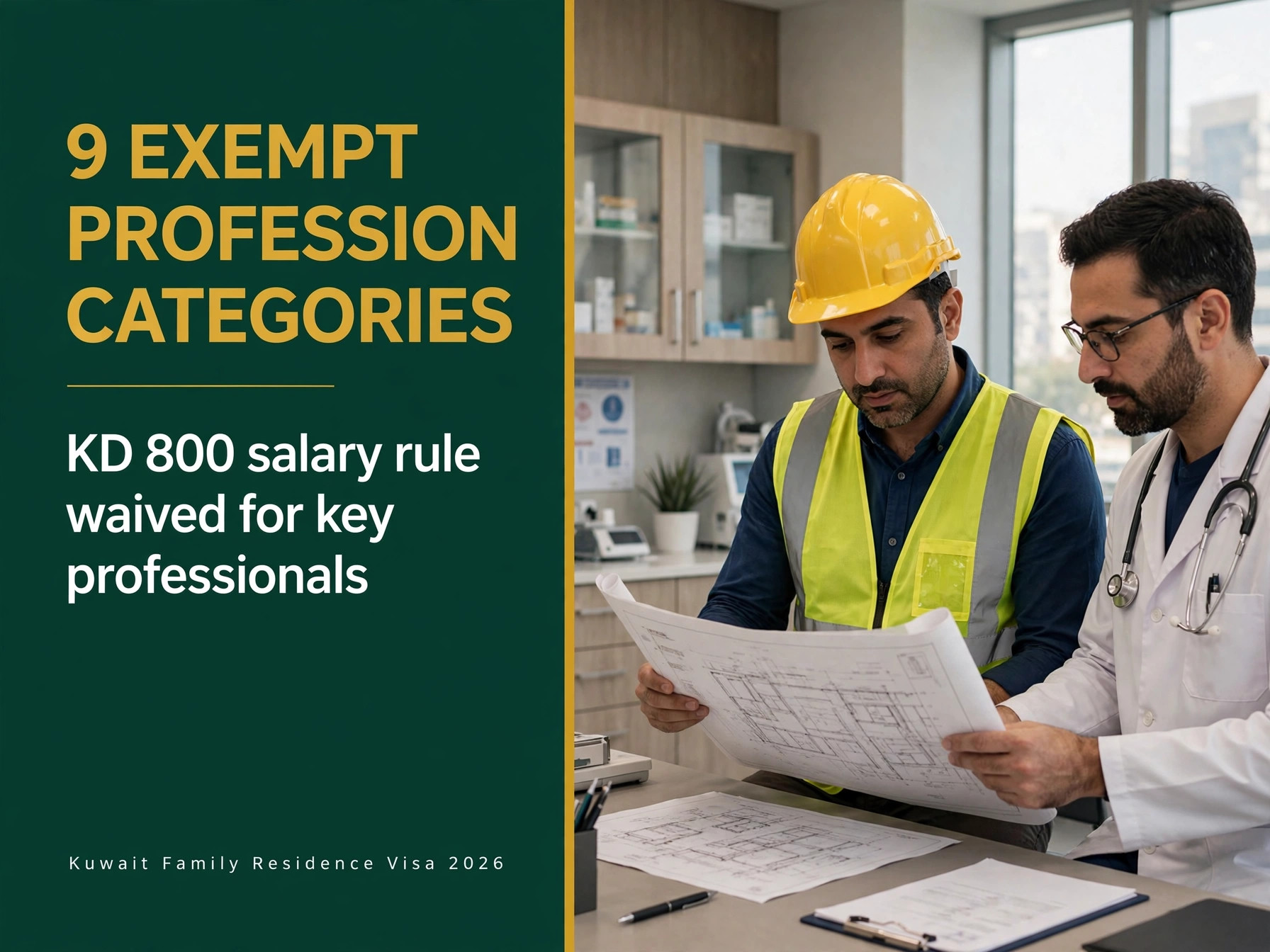
Nine Profession Categories Exempt From the KD 800 Salary Requirement
The executive regulations carve out exemptions for nine professional categories. If your job falls into one of these groups and aligns with your qualifications, you may be released from the KD 800 salary condition:
- Legal researchers in the government sector
- University and higher-education faculty (professors, lecturers)
- Teachers, mentors, social workers and psychologists in the public sector
- Engineers (government and private sectors)
- Religious personnel — mosque imams, preachers, muezzins and Quran memorisers
- Health workers — Ministry of Health and military medical staff, including pharmacists, nurses, paramedics and medical technicians
- Journalists and correspondents with international news agencies
- Sports players and coaches affiliated with federations and clubs
- Workers responsible for preparing and burying the deceased
Beyond these categories, the Director General of the General Department of Residence Affairs can grant discretionary exceptions in humanitarian cases — most notably for children under five born abroad to resident parents and for residents born in Kuwait. These are handled case by case, not granted automatically, so do not assume an exception will apply to you.
VISAORA INTELLIGENCE SUITE
Is Your Kuwait Application Actually Ready?
Get a structured, rules-based readiness check on your family visa application — salary threshold, document gaps and timeline risks, scored before you file.
Check My Score →Documents Required for a Kuwait Family Residence Visa in 2026
Applications are filed in person: book an appointment through the government’s Meta Portal using the sponsor’s Civil ID and serial number, then visit the General Department of Immigration in your governorate. Arrive with originals and copies — incomplete files are the second most common reason applications stall, after the salary threshold itself.
- Completed official entry/residence visa application form
- Sponsor’s Civil ID (original and copy) and valid residency
- Official salary certificate from the employer confirming at least KD 800/month — get it fresh; a gap between the certificate date and the application date can trigger requests for a newer one
- Work permit showing the registered profession and salary
- Attested marriage certificate (for sponsoring a spouse), translated into Arabic where required
- Attested birth certificates (for sponsoring children), proving the biological relationship
- Passports of all family members, with sufficient validity
- Medical fitness test results for each dependent
- Valid health insurance for every family member — mandatory before the residency is stamped
- Passport photographs (white background, recent)
A word on attestation: marriage and birth certificates generally need attestation from the issuing country’s authorities and the relevant embassy, plus certified Arabic translation. Start this process early — attestation is the part of the file that most often runs longer than expected.
What Happens If Your Salary Drops Below KD 800 After Approval?
This catches people off guard. The KD 800 rule is not a one-time gate — the Residence Affairs Investigations Department actively looks for residents whose registered income has fallen below the threshold after their family’s visas were issued, whether through a job change, a pay cut or a move to a lower-paid role.
If you are flagged, you are typically summoned and given about one month to regularise your status — for example by restoring your registered salary to KD 800 or more. If you cannot, your dependents may have to leave Kuwait. The practical lesson: do not change jobs or accept a salary reduction without first checking what it does to your family’s residency. A fresh salary certificate is cheap insurance before any employment change.
To compare how Kuwait’s threshold stacks up against the rest of the region, see our Gulf family visa salary comparison tool covering all six Gulf states.
Can a Family Visit Visa Be Converted to a Residence Visa?
Short answer: not automatically, and usually not at all. Under Article 16 of the updated regulations, Kuwait defines five specific cases in which a visit visa may be converted into a regular residence permit — including, in defined circumstances, a family visit visa where the purpose is to join an immediate family member legally residing in Kuwait. Every conversion is subject to individual approval by the General Administration of Residence Affairs, some categories need clearance from senior Interior Ministry officials, and hundreds of applications have been rejected for not meeting the conditions.
Crucially, visit visas issued for spouses and children cannot simply be flipped into Article 18 work permits either. If your goal is long-term family residency, apply for the Article 22 family residence visa from the start and meet the KD 800 salary rule — do not bring family in on visit visas hoping to convert them later.
VISAORA INTELLIGENCE SUITE
Don’t Guess on a KD 800 Decision
A structured pre-filing review flags salary documentation gaps, profession mismatches and missing attestations — before they cost you months.
Check My Score →Kuwait Family Visa Salary Requirements 2026: 8 Frequently Asked Questions
1. What is the minimum salary for a Kuwait family visa in 2026?
You must earn at least KD 800 per month to sponsor a family residence visa (Article 22) for your spouse or children. The figure is checked against the salary registered on your official work permit. Nine professional categories are exempt, and discretionary exceptions exist for young children and residents born in Kuwait.
2. Can I combine my salary with my spouse’s to reach the KD 800 threshold?
No. Only the sponsoring parent’s registered salary counts toward the KD 800 requirement — combined household income is not accepted. If you are the sponsor, your own work-permit salary alone must meet the threshold, regardless of what your spouse earns.
3. Do I need a university degree to sponsor my family in Kuwait?
Not anymore. A university degree was briefly required when the salary rule launched in January 2024, but the requirement was removed by amendment in July 2024. Your registered salary and a job title that matches your actual work are what matter now.
4. Can a mother sponsor her children for residence in Kuwait?
A mother can sponsor her children on a dependent visa if the father is deceased, divorced (with custody), or has permanently left Kuwait — and she meets the same KD 800 salary rule. If the husband is alive and simply living abroad, she generally cannot sponsor the children on her own residency.
5. What documents prove my salary for the family visa application?
An official salary certificate from your employer confirming at least KD 800/month, plus your work permit showing the registered profession and salary. Get the certificate close to your application date — authorities may ask for a fresh one if too much time has passed since it was issued.
6. Can a family visit visa be converted into a residence visa in Kuwait?
Conversion is not automatic. Article 16 lists five specific cases where a visit visa may convert to a residence permit, subject to approval by the Residence Affairs administration. Many applications have been rejected, so if you want long-term residency, apply for the Article 22 family residence visa directly.
7. What happens if my salary falls below KD 800 after my family’s visa is approved?
The Residence Affairs Investigations Department may summon you and give you about one month to regularise — for instance, by restoring your registered salary. If you cannot, your dependents risk having to leave Kuwait, so check the impact before any job change or pay cut.
8. Who is exempt from the KD 800 family visa salary requirement?
Nine categories are exempt, including government legal researchers, university faculty, public-sector teachers, engineers, religious personnel, health and military medical staff, journalists, sports professionals and funeral workers. The Director General of Residence Affairs may also grant exceptions for children under five and residents born in Kuwait.
Sources & verification: This guide is based on Kuwaiti press reporting of the Ministry of Interior’s executive regulations on the foreigners’ residence law, including Times Kuwait, Arab Times, Khaleej Times, Gulf News, and the Arab Times legal desk. Immigration rules change — always confirm current requirements with the General Department of Residence Affairs before applying. This article is informational and does not promise any visa outcome.
✈️ Planning Your Trip?
We may earn a commission — at no extra cost to you. Learn more