Schengen Visa Rejected? 7 Real Reasons Why in 2026 (And How to Fix Each One)
Quick answer: A Schengen visa is usually rejected for one of seven fixable reasons: weak finances, an unclear travel purpose, weak home ties, missing insurance, document problems, a past overstay, or applying at the wrong consulate. Your refusal letter ticks the exact boxes. Fix those specific issues, strengthen your file, and reapplying gives you a genuine second chance.
✅ Key Takeaways
- Your refusal letter ticks the exact legal grounds — read every box. That is your fix list.
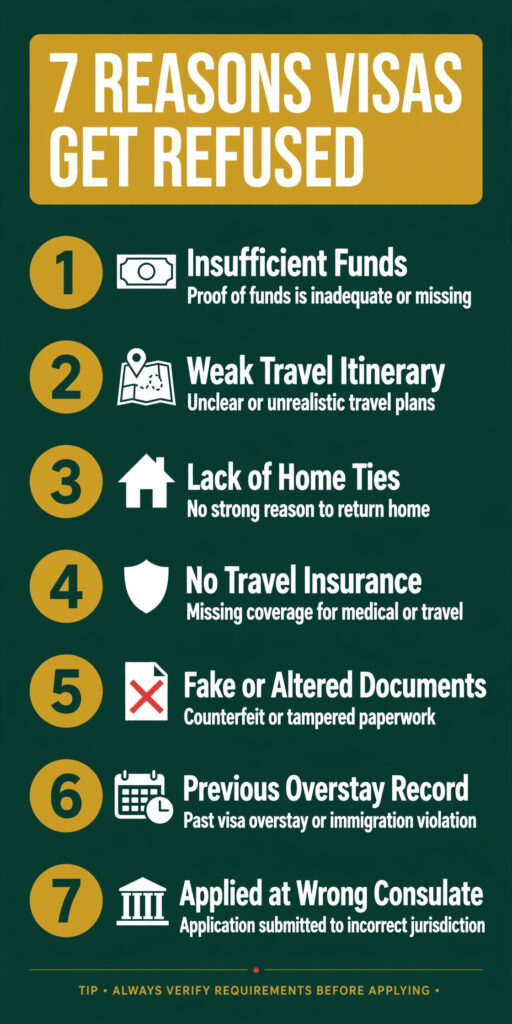
- The 7 common reasons: unclear funds, unclear travel purpose, weak home ties, insurance problems, document issues, a past overstay, or the wrong consulate.
- A single refusal is not a ban, and there is no mandatory waiting period — but never reapply with an unchanged file.
- Reapply when the reasons are fixable (most cases). Appeal only when the decision was factually wrong and you can prove it.
- Refusals are recorded in the shared Visa Information System — always declare previous refusals honestly.
- Never submit a document you cannot explain or verify. Fraud findings can haunt future applications for years.
📋 In This Guide
Getting that refusal letter feels personal. You planned the trip, gathered the papers, paid the fee, waited weeks — and then one word: refused. If your Schengen visa was rejected, you are not alone, and this is not the end of your Europe plans. Most rejections happen for a small set of very fixable reasons.
The good news: the consulate tells you why. Every Schengen refusal comes with a standard letter where the officer ticks the exact legal grounds. Once you decode that letter, you know precisely what to fix. Here are the 7 real reasons Schengen visas get rejected in 2026, with a practical fix for each — plus how to choose between appealing and reapplying.
First: Decode Your Refusal Letter
Under the EU Visa Code (Regulation (EC) No 810/2009), every refused applicant receives a standard refusal form with ticked boxes matching the legal grounds — insufficient means, unproven travel purpose, or doubts about your intention to leave before the visa expires. See the official framework on EUR-Lex, the EU’s official law portal.
Your job is simple: find the ticked boxes, match them to the reasons below, and fix exactly those issues before you reapply. A rejection is not a permanent black mark — it is a to-do list.
The 7 Real Reasons Your Schengen Visa Was Rejected
❌ The 7 Real Refusal Reasons
Your refusal letter ticks one or more of these boxes. Fix exactly those issues.
Unclear funds
Low balance, unexplained deposits, statements not matching income.
Unclear purpose
Vague plans, no bookings, or a nonsensical itinerary.
Weak home ties
Officer doubts you will return before the visa expires.
Insurance problems
Missing, expired, or below the €30,000 minimum.
Document issues
Inconsistent or unverifiable papers — never faked ones.
Past overstay
Now visible to all Schengen states through the EES.
Wrong consulate
Applied where it was easy, not where you spend most nights.
1. Insufficient or Unclear Funds
This is one of the most common Schengen visa rejection reasons. The officer must see you can afford the trip and your return home. Red flags: a low balance, large unexplained deposits just before applying, or statements that don’t match your claimed income.
The fix: Submit 3–6 months of bank statements showing a stable balance and regular income. Avoid sudden big deposits — if a large credit is legitimate (a bonus, a sale), attach proof and explain it in your cover letter.
2. Weak or Unconvincing Travel Purpose
“Purpose and conditions of stay could not be ascertained” is refusal-form language for: we don’t believe this trip is real. Vague plans, no bookings, or a nonsensical itinerary (five countries in four days) trigger this box.
The fix: Build a day-by-day itinerary — dates, cities, hotels, transport between them. Attach refundable hotel bookings and a flight reservation. If visiting family or attending an event, include the invitation letter.
3. Weak Ties to Your Home Country
The officer’s core question is always: will you come back? If you are young, single, between jobs, or self-employed with thin paperwork, they may doubt your intention to leave before your visa expires.
The fix: Prove your life is waiting for you. An employment letter stating your role, salary, and approved leave dates is the single strongest document. Add family ties, property papers, business registration, or enrollment letters. Each tie is a reason to return — stack several.
4. Missing or Inadequate Travel Insurance
Schengen rules require travel medical insurance with minimum coverage of €30,000, valid in all Schengen states for your entire stay. No insurance, expired insurance, or a policy that excludes Schengen countries is an instant refusal ground.
The fix: Buy a compliant policy from a recognized insurer before you apply, covering every day of your trip. Check the fine print: coverage amount, geographic validity, and medical + repatriation cover.
⚡ Visa Rejected? Don’t guess — get your RiskScan™
Find your exact refusal risk + missing documents in 60 seconds. From $12.
5. Fake, Inconsistent, or Unverifiable Documents
This is the most dangerous box to have ticked. Forged documents — or even genuine ones with contradictory details (mismatched dates, different job titles, bookings the consulate can’t verify) — destroy trust. Officers verify: they call employers and check bookings.
The fix: Never fake anything — a fraud finding can haunt future applications for years. Make every document consistent and verifiable: same name spellings, matching dates, real refundable bookings, an employer phone number that actually answers.
6. Previous Overstay or Visa Violations on Record
If you overstayed a previous Schengen visit, that record now follows you. In 2026 the EU’s Entry/Exit System (EES) digitally records every entry and exit — fingerprints, face scan, exact dates — visible to all Schengen states. There is no more “they won’t notice.” See our guide to Schengen overstay rules under EES in 2026 and the official EES info at travel-europe.europa.eu.
The fix: You cannot erase history, but you can outshine it. Wait a reasonable period, then reapply with an exceptionally strong file. A brief honest explanation in your cover letter — acknowledging the past overstay and showing what changed — works better than silence.
7. Wrong Consulate or Jurisdiction
You must apply at the consulate of your main destination — the country where you’ll spend the most days. Applying to the “easiest” consulate while spending your trip elsewhere is a classic refusal trigger.
The fix: Count your nights per country and apply to the right one. If two countries tie, apply to the country of first entry.
Example: Turning a Refusal Into a Stronger File
Illustrative example
An applicant is refused with two boxes ticked: insufficient means and unproven travel purpose. Instead of reapplying immediately, she waits five weeks and rebuilds: six months of clean bank statements with no new lump-sum deposits, a day-by-day itinerary with refundable hotel bookings, an employment letter confirming her role and approved leave, and a cover letter that calmly addresses each ticked reason and lists the new evidence. The second file answers the exact questions the first one left open.
Illustrative example only — it shows how to structure a fix, not a promise of any outcome.
How to Reapply After a Schengen Visa Rejection: 6 Steps
🔄 6 Steps to Reapply Successfully
A rejection is a to-do list, not a ban. Work the sequence.
Read the letter
Note every ticked box — that is your exact fix list.
Do not rush back
A hasty identical application gets refused again.
Rebuild weak documents
Fresh statements, realistic itinerary, compliant insurance.
Address the refusal
Cover letter: what changed for each ticked reason.
Check jurisdiction
Right consulate, matching dates and names everywhere.
Submit complete
Track your days with the 90/180 counter once approved.
A rejection is not a ban on reapplying. Follow this sequence:
- Read the refusal letter line by line. Note every ticked box — those are your exact fix list. If anything is unclear, the letter also states your appeal rights and deadlines.
- Don’t rush back the next day. Give yourself time to genuinely fix each issue. A hasty identical application gets refused again.
- Rebuild the weak documents. Fresh 3–6 month statements, a realistic day-by-day itinerary, verifiable bookings, compliant insurance.
- Write a cover letter that addresses the refusal. Briefly acknowledge the previous decision, state what changed for each ticked reason, and list your supporting documents. Calm, factual, respectful.
- Double-check jurisdiction and consistency. Right consulate, matching dates and names across every page, reachable employer contacts.
- Submit a complete, honest file. Then track your travel days properly once approved — our free Schengen 90/180 day counter keeps you safely inside the limit so you never overstay.
Before you submit, run through Visaora’s free Schengen visa tools — document checklists, funds calculators, and itinerary planners built to catch the exact gaps officers look for.
Appeal vs Reapply: Which Is Right for You?
⚖️ Appeal
Choose this when the decision was factually wrong and you can prove it (e.g. the officer misread genuine bank statements). Best when your file was already strong. Deadlines and procedures differ by country — check your refusal letter.
🔄 Reapply
Choose this when the reasons are fixable — funds, itinerary, ties, insurance, jurisdiction. This covers the vast majority of cases and a fresh application is usually faster than an appeal. Never reapply with the same unchanged file.
Under Article 32(3) of the EU Visa Code, you have the right to appeal — but the process, deadline, and authority differ by country, and appeals can take months with no guarantee.
- Appeal when the decision was factually wrong and you can prove it — for example, the officer misread genuine bank statements. Best when your file was already strong.
- Reapply when the refusal reasons are fixable — funds, itinerary, ties, insurance, jurisdiction. This covers the vast majority of cases, and a fresh application is usually faster than an appeal.
Honest rule of thumb: if you can fix it, reapply. If it was their error, appeal. Never reapply with the same unchanged file.
⚡ Visa Rejected? Don’t guess — get your RiskScan™
Find your exact refusal risk + missing documents in 60 seconds. From $12.
Schengen Visa Rejection: FAQs
Can I reapply immediately after a Schengen visa rejection?
Yes — there is no mandatory waiting period in the EU Visa Code. But reapplying the next day with the same file almost guarantees another refusal. Take time to fix every ticked reason on your refusal letter first, then submit a genuinely stronger application.
Does a Schengen rejection affect future visa applications?
A single refusal is not a ban, and it does not automatically block future applications. However, refusals are recorded in the Visa Information System (VIS) shared by Schengen states, so always declare previous refusals honestly — hiding one is far worse than the refusal itself.
Should I appeal or reapply after a refusal?
Reapply if the reasons are fixable (funds, itinerary, ties, insurance) — this covers most cases and is usually faster. Appeal only if you believe the decision was factually wrong and you can prove it. Appeal deadlines and procedures differ by country, so check your refusal letter.
How much bank balance do I need for a Schengen visa?
There is no single EU-wide number — each country sets its own daily minimum. As a rule, show 3–6 months of statements with a stable balance comfortably covering your daily costs, accommodation, flights, and a buffer. Sudden large deposits without explanation are a red flag.
Will the EES record my visa refusal or overstay?
Yes. The Entry/Exit System digitally records entries, exits, and overstays for non-EU travelers, and refusal data lives in the shared Visa Information System. In 2026, all Schengen states can see this history — which is why a clean, honest new application matters more than ever.
Can I apply to a different Schengen country after rejection?
You must apply to the country of your main destination (most nights spent), not the one you think is “easiest.” Applying to the wrong consulate is itself a refusal ground. Switching countries without changing your itinerary looks evasive — fix the real reasons instead.
Your Next Application Can Be the One That Works
A Schengen visa rejection stings, but it is also the clearest feedback you will ever get: the refusal letter tells you exactly what to fix. Work through the seven reasons above, rebuild each weak document, and address the decision head-on in your cover letter.
Don’t leave it to guesswork. Run your file through Visaora’s free Schengen visa tools to catch gaps before the officer does — or get a full RiskScan™ from the Intelligence Suite (from $12) to see your exact refusal risk and missing documents in 60 seconds. Make the next application count.
✈️ Planning Your Trip?
We may earn a commission — at no extra cost to you. Learn more
Pingback: Schengen Business Visa Requirements 2026: Full Guide
Pingback: Best Schengen Travel Insurance 2026: €30,000 Rule Guide
Pingback: Schengen Visa for Freelancers from Pakistan (2026 Guide)
Pingback: Best Travel Insurance for Schengen Visa 2026 (Compared)
Pingback: Schengen Visa Bank Balance Requirements 2026 Guide