Schengen Business Visa Requirements 2026: Documents, Invitation Letter & Application Guide
Planning a work trip to Europe? The Schengen business visa requirements for 2026 are stricter than many travelers expect: beyond the standard tourist documents, you must prove a genuine business purpose with an invitation letter from a European company, a cover letter from your employer, and evidence of your professional ties back home. This guide walks you through every document, the €90 fee, realistic processing times, and the mistakes that get business applications rejected — so your file is complete before you book that VFS appointment.
Quick Answer: A Schengen business visa (Type C) lets you attend meetings, conferences, and trade fairs across 29 Schengen countries for up to 90 days. In 2026 you need all standard Schengen documents plus an invitation letter from the EU host company, an employer cover letter or NOC, and proof of business ties. The fee is €90 for adults, and decisions usually arrive within 15 calendar days.
Key Takeaways
- Business visas use the same Type C short-stay form as tourist visas — you simply tick “Business” as the purpose of travel.
- The invitation letter from your EU host company is the single most scrutinized document in the file.
- Fee in 2026: €90 for adults, €45 for children aged 6–11, free under 6 — plus the VFS/TLS service charge.
- A business visa covers meetings, conferences, and trade fairs — not paid employment in Europe.
- Apply at the consulate of your main destination (where you spend the most days), not necessarily your first entry point.
- Previous Schengen compliance (no overstays) significantly strengthens a business application.
In This Guide
What Is a Schengen Business Visa?
A Schengen business visa is a Type C short-stay visa that allows non-EU nationals to enter the Schengen Area for business purposes — client meetings, conferences, trade fairs, contract negotiations, and corporate training — for up to 90 days in any 180-day period across all 29 Schengen countries. There is no separate “business visa” form: you complete the standard Schengen application and select “Business” as your purpose of travel (field 29 of the official form).
The critical distinction: a business visa authorizes business activities, not employment. Attending a trade fair in Frankfurt or negotiating a contract in Milan is fine; taking a paid job with a European employer is not — that requires a national work visa. Consulates reject applications when the stated purpose looks like disguised employment, so your documents must tell a coherent story of a short, purposeful trip with strong reasons to return home. For the broader Schengen rules that apply to every applicant, see our Schengen Visa 2026 Complete Guide.
Schengen Business Visa Requirements 2026: The Full Document Checklist
Every Schengen business visa application has two layers: the standard documents every applicant submits, and the business-specific documents that prove your professional purpose. Missing anything from either layer is the most common reason files get delayed or refused.
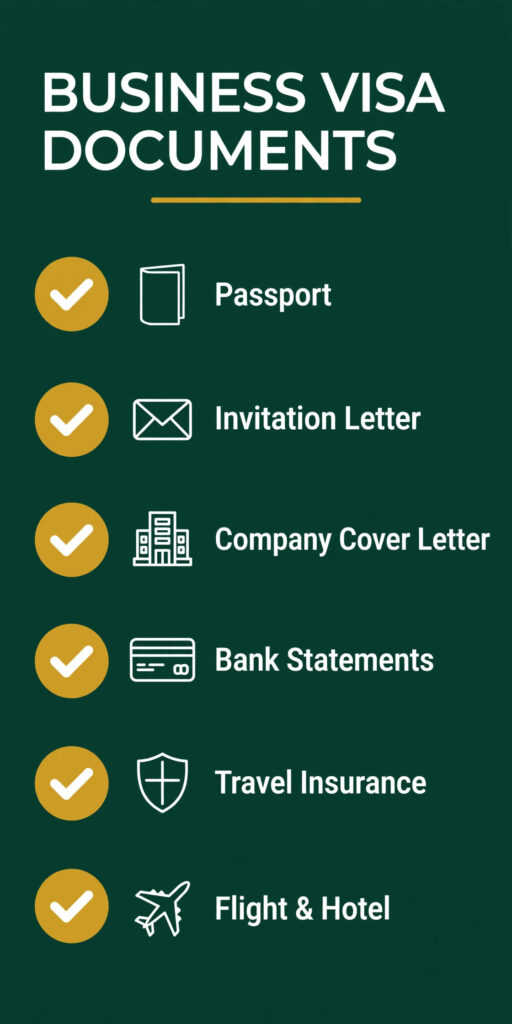
📋 The Six Document Groups (Two Layers)
Every business application has a standard layer and a business layer. Miss anything from either and the file stalls.
📂 Standard documents (all applicants)
- Passport + application form + photo
- Travel insurance (≥ €30,000)
- Flight reservation + hotel bookings
- 3 months’ bank statements
💼 Business documents (deciding layer)
- Invitation letter from EU host company
- Employer cover letter / NOC
- Proof of business relationship
- Trade fair registration (if any)
Standard documents (all applicants)
- Passport — issued within the last 10 years, valid at least 3 months beyond your planned Schengen departure date, with at least 2 blank pages.
- Completed application form — signed; the official form is published by the EU’s diplomatic service (official Schengen visa application form, PDF).
- Biometric photo — 35×45mm, white background, taken within the last 6 months.
- Travel medical insurance — minimum €30,000 coverage for emergency hospitalization and repatriation, valid in all Schengen states for the entire trip.
- Flight reservation — an itinerary or reservation is enough; do not buy non-refundable tickets before approval.
- Accommodation proof — hotel bookings for every night, or a host declaration.
- Proof of funds — typically 3 months of bank statements showing stable income; sudden large deposits just before applying are a classic red flag.
Business-specific documents (the deciding layer)
- Invitation letter from the EU host company — on official company letterhead, stating the purpose of your visit, exact dates, and who covers your travel and living costs, with a named contact person and their details.
- Employer cover letter / NOC — from your own company on letterhead: your position, salary, length of employment, approved leave dates, and confirmation you will resume your role after the trip.
- Proof of business relationship — prior correspondence, contracts, invoices, or trade history with the inviting company. First-time visitors should include extra context explaining how the relationship began.
- Trade fair / conference proof — registration confirmation, exhibitor pass, or event tickets if that is the purpose of travel.
- Company registration documents — required if you are self-employed or a business owner: trade license, company registration certificate, and company bank statements.
- Tax and income proof — recent payslips or, for business owners, business tax filings that corroborate the income in your bank statements.
Documents not in English (or the consulate’s language) generally need certified translation — submit both the original and the translation. And remember the EES factor: since the EU’s Entry/Exit System became fully operational in April 2026, your entries, exits, and any refusals are recorded digitally at every Schengen border, so a clean travel history now follows you automatically.
The Invitation Letter: What It Must Contain
If one document decides your application, it is the invitation letter. Consulates read it as the anchor of your entire story: who invited you, why, when, and who pays. A vague one-line email printout (“we invite Mr. X for business”) is one of the fastest routes to a refusal. Ask your EU host company for a formal letter on company letterhead containing all five elements:
✉️ The Invitation Letter: 5 Must-Have Elements
Consulates read the invitation as the anchor of your story. A vague one-line email gets refused.
Letterhead & details
Full legal name, address and contact info of the inviting company.
Specific purpose
“Contract negotiations for the Q1 2026 distribution agreement” beats “business meetings”.
Exact travel dates
Arrival and departure dates matching flights and hotels precisely.
Who pays
Clear statement of who covers travel, stay and daily costs, with proof.
Named contact
Full name, title, phone and email of someone the consulate can reach.
- Company letterhead and registration details — the inviting company’s full legal name, address, and contact information.
- Purpose of the visit — specific, not generic: “contract negotiations for the Q1 2026 distribution agreement” beats “business meetings.”
- Exact travel dates — arrival and departure dates that match your flight reservation and hotel bookings precisely.
- Who covers the costs — a clear statement of whether the host company, your employer, or you personally pay for travel, accommodation, and daily expenses, with supporting financial proof from whoever pays.
- Named contact person — full name, job title, phone, and email of someone at the host company the consulate can actually reach.
Pro tip: ask the host to email you a signed PDF and send the original by courier if time allows. Some consulates (Germany is notably strict) may verify the letter by contacting the company directly — warn your host contact in advance so a verification call does not go unanswered.
Schengen Business Visa Requirements 2026: Fees and Processing Time
The business visa costs exactly the same as any other short-stay Schengen visa — there is no “business surcharge.” Since the EU-wide fee increase of 11 June 2024, the rates are:
| Applicant | Visa fee (2026) |
|---|---|
| Adults (12 years and above) | €90 |
| Children (6–11 years) | €45 |
| Children under 6 | Free |
On top of the government fee, budget the VFS Global or TLScontact service charge (varies by country, paid at the application center) — and note that visa fees are generally non-refundable, even if your application is refused. Processing time is normally up to 15 calendar days from the day your file reaches the consulate; during peak travel seasons or if an interview is requested, allow up to 30–45 days. The golden rule: apply no earlier than 6 months and no later than 15 days before your trip, but for business travel with fixed meeting dates, aim for 6–8 weeks ahead.
Business vs Tourist Schengen Visa: Key Differences
Both are Type C visas with identical fees, validity rules, and the 90/180-day limit. The entire difference lies in purpose documentation — what you must prove and what the consulate scrutinizes:
💡 Same visa, different proof: a business visa is the same Type C short-stay visa as a tourist visa — identical €90 fee, identical validity, identical 90/180-day rule. The entire difference is purpose documentation: what you must prove and what the consulate scrutinizes.
| Aspect | Business Visa | Tourist Visa |
|---|---|---|
| Key document | Invitation letter from EU company | Hotel bookings + travel itinerary |
| Employment proof | Employer letter / NOC mandatory | Employment letter still expected |
| Funds scrutiny | Higher — income must match stated role | Standard — sufficient personal funds |
| Typical refusal trigger | Weak/vague invitation letter | Unclear travel purpose or weak ties |
| Multi-entry chances | Better — regular business travel history helps | Granted on travel history |
One strategic note: consulates tend to look more favorably on business applicants with a track record. If this is your first Schengen visa, a clean, complete business file — with a verifiable invitation — can actually outperform a thin tourist application. And if you have been refused before, read our breakdown of the 7 real Schengen rejection reasons before reapplying.
Step-by-Step: How to Apply for a Schengen Business Visa in 2026
🚀 5 Steps: Invitation Letter to Visa in Hand
Do them in this order — everything hangs on step one.
Secure the invitation
Get the formal letter first. Dates in every other document must match it.
Assemble the file
Originals plus one full photocopy set, in checklist order.
Book your appointment
VFS/TLS slots fill weeks ahead — book as soon as the letter arrives.
Attend in person
Submit the file, pay €90 + service charge, give biometrics.
Track and collect
No non-refundable purchases until the visa is in your passport.
- Secure the invitation letter first. Everything else hangs on this. Get the formal letter from your EU host company before you book anything — dates in every other document must match it.
- Assemble the full file. Work through the checklist above. Keep originals and one full photocopy set; many application centers require both.
- Book your VFS/TLS appointment. Slots in busy cities fill weeks ahead — book as soon as your invitation letter is in hand, even if minor documents are still being finalized.
- Attend the appointment. Bring the complete file, pay the €90 fee plus service charge, and provide biometrics (fingerprints and photo) if you have not done so in the last 59 months.
- Track and collect. Most centers offer SMS/passport tracking. Do not make non-refundable travel purchases until the visa is in your passport.
Where to apply: submit at the consulate (or its authorized center) of your main destination — the country where you will spend the most days. If time is split equally, apply where you first enter. Applying at the wrong consulate is a valid reason for them to decline to process your file.
A Realistic Example: Trade Fair in Frankfurt
Illustrative example — an export manager from Karachi
He is invited to a four-day trade fair in Frankfurt by his German distributor. His file: a formal invitation letter on the distributor’s letterhead (exact dates, purpose, a statement that the distributor covers the hotel, plus a named contact with phone and email), an employer NOC confirming his role, salary and approved leave, last year’s order emails and invoices proving the business relationship, his exhibitor registration, and flight and hotel bookings matching the invitation dates to the day. Nothing is left for the officer to guess.
Illustrative example only — it shows the shape of a complete file, not a promise of any outcome.
5 Pro Tips for Business Applicants
- Ask for the invitation early — then check it twice. Host companies are slow with paperwork. Request the letter weeks ahead and verify every detail (dates, names, cost statement) before you build the rest of the file around it.
- Warn your host contact about verification calls. Some consulates phone the inviting company directly. Make sure the named contact expects the call and can confirm your visit.
- Document the relationship, not just the trip. Old emails, contracts and invoices with the inviting company turn a first-time invitation from suspicious to credible.
- Keep income consistent with your role. If you state you are a senior manager, your bank statements and payslips should look like a senior manager’s. Mismatches invite scrutiny.
- Apply 6–8 weeks ahead, not 15 days. Business travel has fixed dates — a delayed decision should not cost you the meeting. Early filing is the cheapest insurance.
7 Mistakes That Get Business Visas Rejected
- A generic invitation letter. “Business meetings” with no detail, no dates, and no named contact reads as unverifiable — and unverifiable gets refused.
- Mismatched dates. Invitation says 12–18 March, flights say 10–20 March, hotel covers 12–17. Every date across every document must align exactly.
- Fresh, unexplained bank deposits. A large lump sum appearing two weeks before your appointment suggests borrowed funds. Consulates specifically watch for this.
- No proof of the business relationship. First-time invitation with zero prior correspondence and no explanation of how you connected looks like a purchased letter.
- Weak home ties. No property, no family, no stable job history, no prior international travel — the officer must believe you will return.
- Applying at the wrong consulate. Five days in France, two in Germany, but you applied in Germany because the appointment was sooner. File jurisdiction matters.
- Previous refusal not disclosed. Refusals are stored in the Visa Information System — the officer will see it. Disclose it and address what changed since.
Schengen Business Visa FAQs
What documents are required for a Schengen business visa in 2026?
You need a passport valid 3+ months beyond departure, the signed application form, a biometric photo, €30,000 travel insurance, flight reservation, hotel bookings, and 3 months of bank statements. Business-specific additions: an invitation letter from the EU host company, an employer cover letter or NOC, proof of the business relationship, and trade fair registration if applicable.
Do I need an invitation letter for a Schengen business visa?
Yes — it is the most important document in a business application. The letter must be on the host company’s letterhead and state the purpose of your visit, exact travel dates, who covers your costs, and a named contact person with phone and email. Vague or unverifiable invitation letters are one of the most common reasons business visas are refused.
How much does a Schengen business visa cost in 2026?
The fee is €90 for adults and €45 for children aged 6–11; children under 6 are free. These rates have applied EU-wide since 11 June 2024. You also pay the VFS Global or TLScontact service charge at the application center. Fees are non-refundable, even if your visa is refused, so submit a complete file the first time.
How long does it take to process a Schengen business visa?
Most applications are decided within 15 calendar days of reaching the consulate. During peak seasons, or if the consulate requests an interview or additional documents, processing can extend to 30–45 days. Apply no earlier than 6 months before your trip; for business travel with fixed dates, submitting 6–8 weeks ahead is the safest window.
Can I work in Europe with a Schengen business visa?
No. A Schengen business visa covers business activities such as meetings, conferences, trade fairs, and contract negotiations — not paid employment. Taking a job with a European employer, freelancing for EU clients for income, or any paid work requires a national work visa or permit. If a consulate suspects disguised employment, the application will be refused.
What is the difference between a Schengen business visa and a tourist visa?
Both are Type C short-stay visas with the same €90 fee and 90/180-day rule — the difference is purely in supporting documents. Business applicants must provide an invitation letter from an EU company, an employer letter, and proof of business ties. Tourist applicants instead submit hotel bookings and a travel itinerary. Business files face heavier scrutiny on income matching the role.
Can I attend a trade fair in Germany with a Schengen business visa?
Yes — trade fairs are one of the classic purposes of a Schengen business visa. Include your exhibitor or visitor registration confirmation alongside the invitation letter from the organizer or your German business partner. Apply at the German consulate or its VFS center as Germany is your main destination, and ensure your fair dates match your flights and hotel bookings exactly.
What should my employer include in the cover letter for a Schengen business visa?
The employer letter must be on company letterhead and confirm your job title, salary, employment start date, and the approved leave dates for the trip. It should state the business purpose of travel and confirm you will resume your position afterward. Include a contact person at your company, since consulates sometimes verify employment details directly.
✈️ Planning Your Trip?
We may earn a commission — at no extra cost to you. Learn more