Gulf clients have learned to be careful. Khaleej Times has reported fake travel agents in the UAE charging clients thousands of dirhams for Schengen visa help that never existed, and Saudi Arabia’s Ministry of Human Resources and Social Development has suspended offices over unresolved client complaints. In that market, agencies win repeat business by showing their work — in writing. A structured visa case file template is how: every client gets the same written assessment, built from a fixed set of sections, instead of advice scattered across chat threads. Tools like Visaora Agency Suite generate that file, but the structure matters more than the software. This guide walks through it section by section.
By Team Visaora · Updated October 2026 · 8 min read
Quick Answer: A complete visa case file has eight sections: client profile, eligibility and readiness summary, document checklist with evidence gaps, plain-language risk flags, cover letter consistency check, filing timeline, a dated action plan, and disclaimers with a version history. Agencies use this template to turn chat-based advice into a written deliverable clients can read and keep.
Key Takeaways
- A case file is not a folder of documents. It is the written assessment your client receives: what was checked, what is weak, and what happens next.
- Eight sections cover the whole job: profile, readiness summary, checklist and gaps, risk flags, cover letter check, timeline, action plan, disclaimers and version history.
- Risk flags describe evidence and options. They never predict or promise an outcome.
- Version control protects you on re-submissions and complaints: never overwrite an old version, always supersede it.
- A template makes the standard repeatable across staff, so file quality does not depend on who handled the case.
In This Guide
- Why does a written case file beat a WhatsApp voice note?
- What are the 8 sections of a good visa case file?
- How do you flag risks without promising outcomes?
- What disclaimers and no-guarantee language should every case file carry?
- How does version control work when a client re-submits?
- Example: a Schengen case file for a Dubai applicant
- How does Visaora generate the case file?
- What are the most common case file mistakes agencies make?
- Frequently Asked Questions
Why does a written case file beat a WhatsApp voice note?
Because a voice note cannot be searched, signed for, or produced later when a client disputes what they were told. Most Gulf agencies advise clients in chat threads and calls. The advice may be good, but it leaves no record either side can rely on. When a visa is refused, the client remembers a promise; the agency remembers a warning. Neither can prove it.
A written case file settles that in advance. It records the assessment on the day it was made, in language the client can re-read with family before deciding. It also travels well: the client forwards a PDF, not a screenshot of half a conversation. And when a regulator or a payment dispute asks what service was delivered, the file is the deliverable — a dated, acknowledged file ends arguments that a chat thread never will.
What are the 8 sections of a good visa case file?
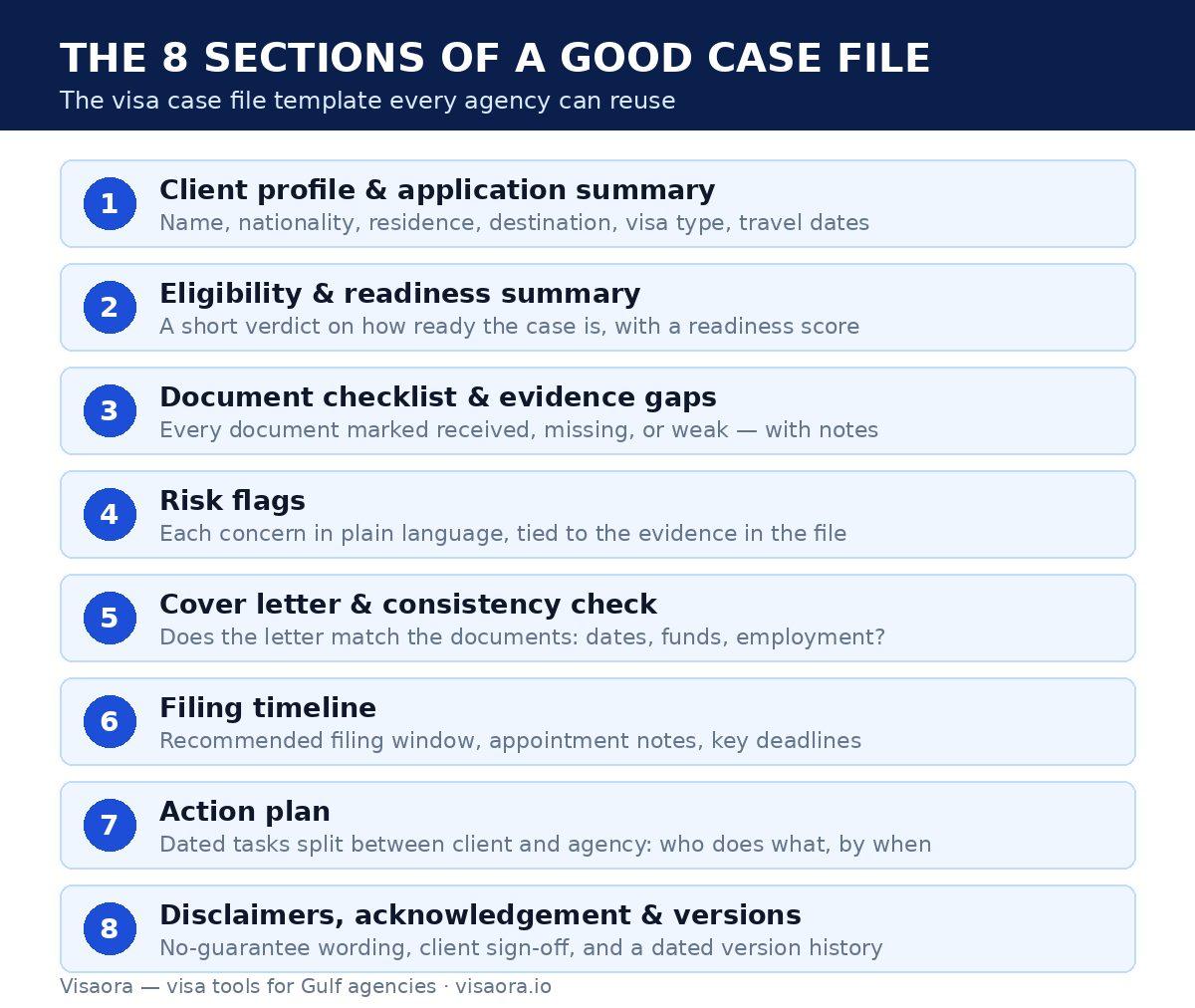
A good case file follows the same eight sections for every client, whatever the destination. Consistency is the point: staff know where everything goes, and nothing important depends on memory. That is the point of a shared visa case file template: one structure, used by the whole team.
| # | Section | What it contains | Why it matters |
|---|---|---|---|
| 1 | Client profile & application summary | Name, nationality, residence, destination, visa type, travel dates | Fixes the scope in one place |
| 2 | Eligibility & readiness summary | A short verdict on how ready the case is, with a readiness score where your system provides one | The headline before the detail |
| 3 | Document checklist & evidence gaps | Every document marked received, missing, or weak, with notes | Turns “send your documents” into a precise work list |
| 4 | Risk flags | Each concern in plain language, tied to the evidence | Shows what could hurt the application — and why |
| 5 | Cover letter & consistency check | Whether the letter matches the documents: dates, funds, employment, travel history | Contradictions are a common refusal trigger |
| 6 | Filing timeline | Recommended filing window, appointment notes, deadlines | Stops late or mistimed submissions |
| 7 | Action plan | Dated tasks split between client and agency | Next steps both sides can track |
| 8 | Disclaimers, acknowledgement & version history | No-guarantee wording, client sign-off, dated version log | Proves what the client was told, and when |
Section 3 is where the familiar immigration case file checklist lives — but here it goes further than received-or-missing. Each item also carries a quality note: a bank statement can be present and still cover the wrong period, and a tick-box checklist will miss that. Free tools like Visaora’s document checklist generator build the list itself; the case file is where the list becomes an assessment.
How do you flag risks without promising outcomes?
You describe the evidence, name the concern, and state what would strengthen it — you never put a probability on the decision or suggest the outcome is in your hands. The decision belongs to the embassy or consulate, and the file should read that way from first page to last.
Write: “Your bank statement shows a large deposit two weeks before the application, with no explanation in the file. Officers may question whether these funds are genuinely available to you. Adding the source document for this deposit would address the point.”
Never write: “Your case is strong, approval is very likely.”
The first version is more useful and safer: it tells the client exactly what to fix, and stays true whatever the officer decides. Consumer tools such as a visa approval predictor can help clients grasp the idea of readiness, but inside a paid client visa assessment report your language stays with evidence and options, not predictions.
What disclaimers and no-guarantee language should every case file carry?
Every file should carry a short disclaimer block covering four points: the decision rests solely with the embassy or consulate; the assessment is based on the documents provided up to the stated date; new documents or rule changes can change the assessment; and the file is your agency’s professional assessment, not legal advice. Under it, add an acknowledgement line — client name, date, signature — confirming receipt. Make this block a fixed part of your visa case file template, so no one on the team ever sends a file without it. The message you send with the file should follow the same discipline:
Dear [client name], attached is your visa case file, version [number], dated [date]. It shows what is complete, what is still needed, and your next steps before submission. Please read the risk notes carefully and reply to confirm you have received it. The final decision on your application rests with the [embassy/consulate].
In a market where Saudi Arabia’s HRSD has suspended offices over unresolved complaints, that paper trail is the difference between a complaint you can answer and one you cannot.
How does version control work when a client re-submits?
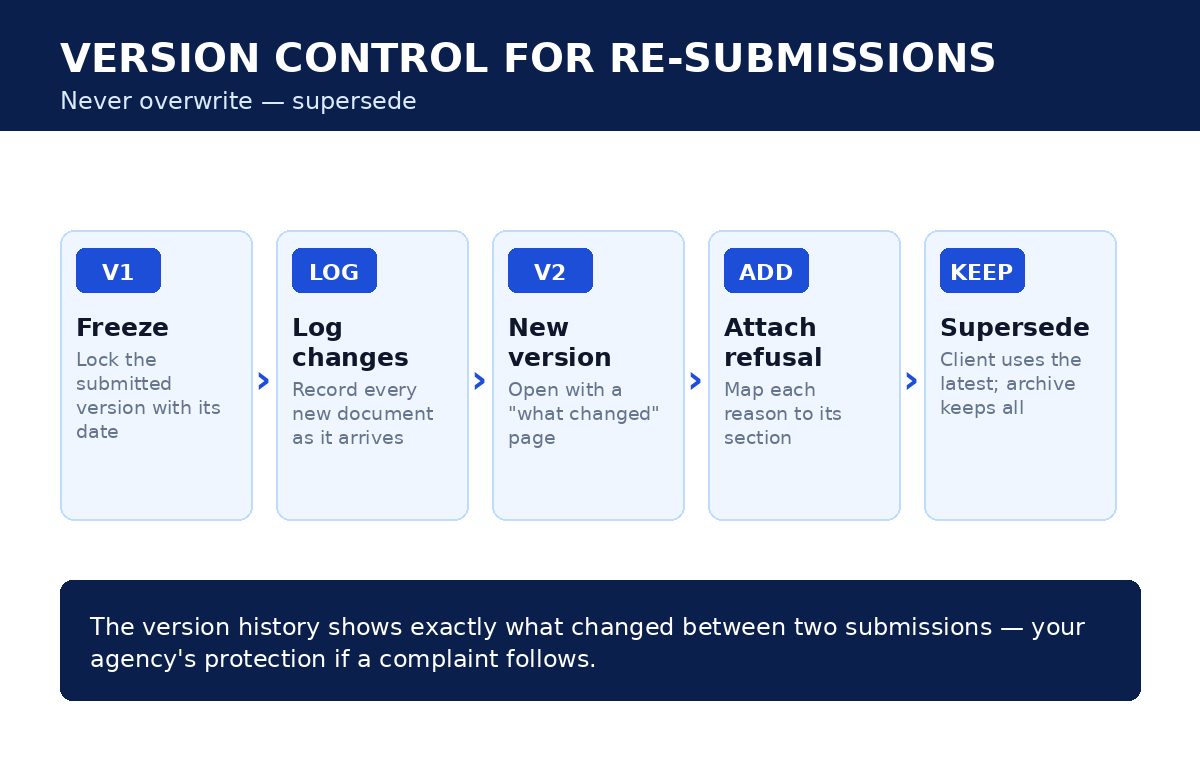
Version control means every change creates a new dated version, and old versions are never edited. Re-submissions, reapplications after refusal, and simple document updates all follow the same five steps:
- Freeze the submitted version. When a file goes to the embassy, save a locked copy with the version number and submission date.
- Log every new document as a change. Record what arrived and when — never silently swap a document in.
- Issue a new version with a “what changed” page. Sections affected, evidence added, risk flags updated.
- Attach refusal documents to the same file. Map each refusal reason to the section it touches before any rebuild starts.
- Supersede, never overwrite. The client works from the latest version; your archive keeps all of them, in order.
This makes a refusal rebuild honest work instead of guesswork: you can show the client, side by side, what the first file contained and what the new one adds.
Example: a Schengen case file for a Dubai applicant
Example — illustrative only. This is not a real client, and the details below are a teaching example, not advice for any specific application.
A Dubai agency takes on an employed resident applying for a short-stay Schengen tourist visa — a file built around the standard supporting documents listed on the European Commission’s Schengen visa policy page. The profile records the applicant, destination, and travel dates. The readiness summary notes the case is “ready with two fixes”. The checklist marks passport, residence visa, and employer letter as received; bank statements are flagged received but weak, because the most recent month is missing; travel medical insurance is marked missing. The risk section explains that an incomplete statement period can raise questions about funds. The cover letter check finds the letter says “two weeks” while the bookings cover twelve days — corrected before submission. When the missing statement page arrives, the file moves to version 2 with a one-line change note, and the client signs the acknowledgement.
Nothing in that example is dramatic — and that is the point. Every small thing was written down before it could become a refusal reason or a complaint.
How does Visaora generate the case file?
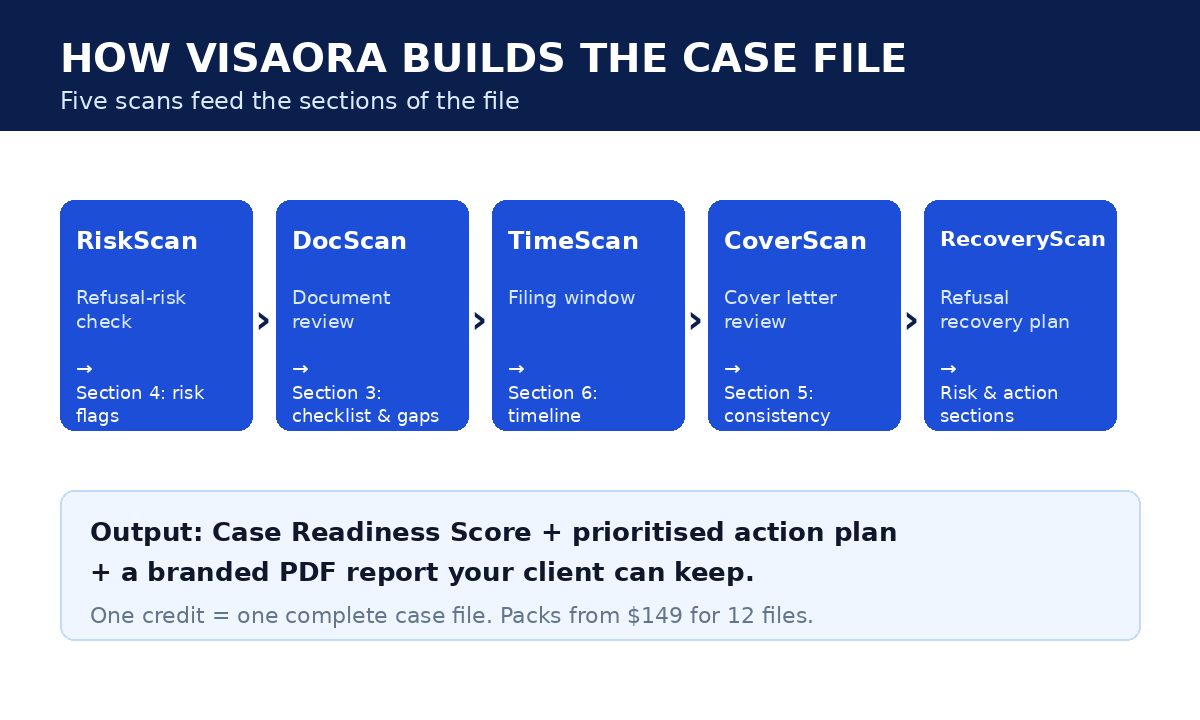
Visaora Agency Suite builds the file from five scans, and each scan feeds specific sections of the template. RiskScan produces the risk flags (section 4). DocScan checks the document set and marks the gaps (section 3). TimeScan works out the filing window (section 6). CoverScan compares the cover letter against the documents (section 5). RecoveryScan, for clients refused before, shapes the rebuild plan inside the risk and action sections. Together they produce a Case Readiness Score and a prioritised action plan, delivered as a PDF report. In other words, it follows the visa case file template set out above — the scans simply fill it in.
The same five scans power the traveller-facing Visaora Intelligence Suite; the agency product wraps them into a deliverable under your own handling. One credit produces one complete case file. Packs cost $149 for 12 files (about $12.40 per file), $399 for 40 (about $10 per file), and $699 for 100 (about $7 per file); credits stay valid for 12 months. Growth and Enterprise add white-label branding — the white label visa report carries your agency’s logo and colours, not Visaora’s — plus a dedicated portal link. A founding offer is available for the first agencies; ask via the form on the Agency Suite page for details. Comparing options? See our guide to the best visa consultant software in 2026. Or see the format free first: request a sample case file with your agency’s logo from the Agency Suite page.
Prices checked on the Visaora Agency Suite page, 20 October 2026.
What are the most common case file mistakes agencies make?
The same handful of mistakes shows up again and again:
- Assessing in chat only. The advice exists, but there is no file — no proof, no structure, no deliverable.
- Promising outcomes in writing. One “strong case” line becomes the client’s evidence when the answer is no.
- Overwriting old versions. Editing the original file destroys the record of what the client was originally told.
- A checklist without quality notes. A wrong-period bank statement marked “received” because the box was ticked.
- No client acknowledgement. Without a signed receipt, clients can honestly say they never saw the risk notes.
- One shared file for a whole family. Group cases need per-applicant sections; a blended file hides one person’s gaps behind another’s strong documents.
Give every client a professional case file
Visaora Agency Suite builds white-label visa case files with readiness and refusal-risk analysis under your agency’s name. Packs from $149.
Request a Free Sample Case File →Want more qualified leads? Get a free branded visa checker that sends leads to your WhatsApp: Visaora Agency Leads
Frequently Asked Questions
What is a visa case file template?
A visa case file template is a fixed structure an agency uses to assess every client the same way. It covers the client profile, eligibility summary, document checklist with gaps marked, plain-language risk flags, filing timeline, action plan, disclaimers and version history. Using one template means no client’s advice lives only in a chat thread, and every client receives the same professional standard of written assessment.
What should a client visa assessment report include?
A client visa assessment report should include who the client is and what they are applying for, a readiness summary, the document checklist with missing or weak evidence marked, risk flags explained in plain language, a filing timeline, and a dated action plan. It should end with no-guarantee disclaimers, the client’s acknowledgement, and a version history so later updates never overwrite the original advice.
How is a case file different from a document checklist?
A checklist only tracks paper: received or missing. A case file does that too, but it also records the agency’s assessment — the readiness summary, the risk flags behind each gap, the recommended filing window and the exact advice given to the client. If a client later disputes what they were told, the checklist shows documents; the case file shows the advice itself, dated and versioned.
Can a case file improve a client’s chances of approval?
A case file cannot change how an embassy decides, and no agency should suggest otherwise. What it can do is make sure weak evidence is spotted and fixed before submission, the cover letter matches the documents, and the file is lodged inside a sensible filing window. Stronger, more consistent applications are the result of that preparation — the decision itself always rests with the visa officer.
How should agencies handle a case file when a client reapplies after a refusal?
Keep the refused version frozen and open a new version. Add the refusal letter, map each refusal reason to the section it affects, and record what new evidence answers it. The version history then shows exactly what changed between the two submissions. Never edit the original file — if a complaint or a second refusal follows, the dated history is your agency’s protection.
What disclaimers should a visa case file include?
At minimum: the decision rests solely with the embassy or consulate; the assessment is based on the documents provided up to the stated date; new documents or rule changes can change the assessment; and the file is general information from your agency, not legal advice. Add a client acknowledgement line — name, date and signature — confirming the client received and read the file.
How much does it cost an agency to produce a case file for each client?
With Visaora Agency Suite, one credit produces one complete five-scan case file. Packs are $149 for 12 files, $399 for 40 and $699 for 100 — roughly $12.40, $10 or $7 per client file. Credits stay valid for 12 months, and Growth and Enterprise add white-label branding, so the report carries your agency’s name.
Sources
- Khaleej Times — fake travel agents charging thousands of dirhams: khaleejtimes.com
- Saudi HRSD — office suspensions over unresolved complaints: hrsd.gov.sa
- European Commission — Schengen visa policy: home-affairs.ec.europa.eu
Related reading: Visaora Agency Suite · Visaora Intelligence Suite · Document Checklist Generator · Visa Approval Predictor · Best Visa Consultant Software 2026
CTA: Running an agency? Request a free sample case file from Visaora Agency Suite and see the full eight-section format with your own logo on it. Agencies: turn this template into a client-ready case file with Visaora Agency Suite.
Visaora provides software tools and general information, not legal advice. Rules change; always confirm with the official authority.
✈️ Planning Your Trip?
We may earn a commission — at no extra cost to you. Learn more