
Spain Digital Nomad Visa: Taxes & Cost (2026)
Spain digital nomad visa taxes are the part most applicants get wrong — and the part that decides whether the move is a bargain or an expensive surprise. The good news: the Spain digital nomad visa cost of actually applying is small. The real money question is what you pay every month after you arrive: income tax, social security, insurance, and rent. This guide breaks down every figure with 2026 numbers, explains the Beckham Law flat rate in plain language, and shows you the mistakes that cost remote workers thousands.
QUICK ANSWER
A single applicant needs about €2,849/month of income to qualify. Government fees are only about €100 in total. On taxes, qualifying employees can pay a flat 24% under the Beckham Law for six tax years; everyone else pays progressive rates of 19%–47%. Freelancers generally do not qualify for the flat rate.
KEY TAKEAWAYS
- Minimum income for 2026: about €2,849/month (200% of Spain’s minimum wage).
- Beckham Law: flat 24% tax up to €600,000 for qualifying employees — but you must apply within 6 months.
- Freelancers and autónomos usually pay standard progressive rates (19%–47%) plus monthly social security.
- Private health insurance typically costs €50–€100/month and must have no co-payments.
- A single person needs roughly €1,900–€2,500/month to live in Madrid, less in Valencia.
IN THIS GUIDE
- What Is the Spain Digital Nomad Visa?
- Spain Digital Nomad Visa Cost: The Full Breakdown
- Income Requirement: How Much You Must Earn
- Spain Digital Nomad Visa Taxes Explained
- Beckham Law vs Standard Rates: Worked Examples
- Social Security: Employees vs Freelancers
- Monthly Cost of Living in Spain
- 7 Common Tax Mistakes Digital Nomads Make in Spain
- FAQs

What Is the Spain Digital Nomad Visa?
Spain’s digital nomad visa, officially the telework visa, lets non-EU citizens live in Spain while working remotely for companies or clients based outside Spain. It was created under Spain’s Startup Act (Law 28/2022) and refined by Royal Decree 1155/2024. The consulate route usually grants a one-year visa, while applying from inside Spain through the UGE-CE can grant a residence permit of up to three years, renewable toward five years and eventually permanent residency.
Two rules shape everything about taxes and cost. First, at least 80% of a freelancer’s income must come from outside Spain — no more than 20% may come from Spanish clients. Second, the visa itself does not decide your tax bill. Your employment status does. An employed remote worker and a freelancer on the same visa can face very different tax rates, as the next sections explain.
For a line-by-line budget, use the free Spain digital nomad visa cost breakdown, and see how day counts affect residency with the expat tax residency simulator.
Spain Digital Nomad Visa Cost: The Full Breakdown
Compared with many visa routes, the Spain digital nomad visa cost is refreshingly low. Government fees are a small share of what you will spend. The bigger lines are insurance, document preparation, and optional legal help.
| One-time cost | Typical amount (2026) | Notes |
|---|---|---|
| Consular visa fee | About €80 | Varies by nationality; some consulates charge more. Confirm at yours. |
| NIE (foreigner ID number) fee | €10–€20 | Required before or during the application. |
| TIE residence card fee | About €16 | Paid on form Tasa 790-012 after arrival. |
| Apostilles / legalisation | €30–€100 per document | Varies by issuing country. |
| Sworn translations | €20–€50 per page | Spanish translations by a sworn translator. |
| Legal support (optional) | €500–€1,500+ | Helpful for complex files; not required. |
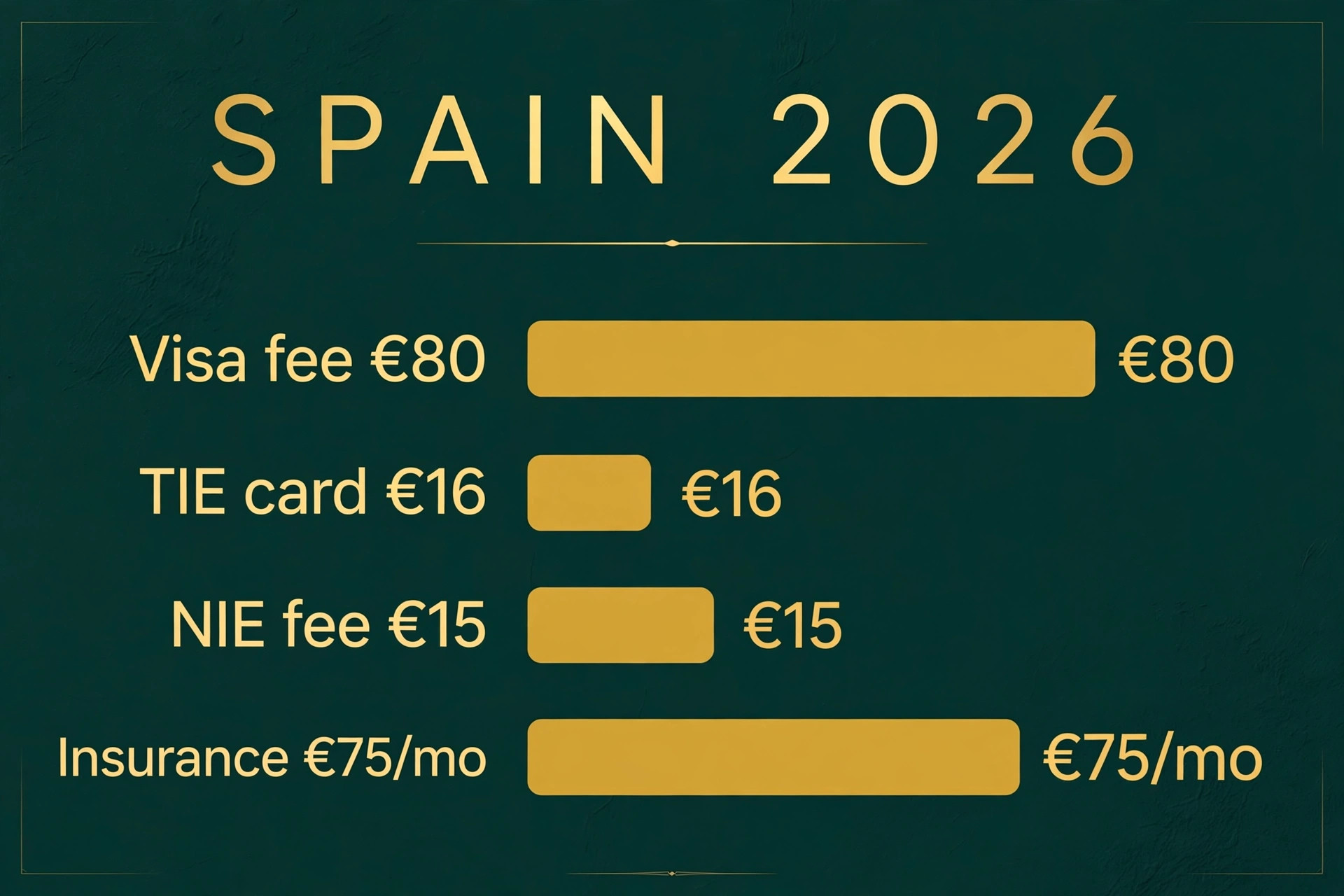
Private health insurance is the largest recurring application cost. Most applicants under 40 pay €50–€100 per month for a compliant policy. The policy must come from a Spain-authorized insurer and must have no co-payments and no waiting periods — consulates reject policies that include them. Travel insurance does not count.
All in, budget roughly €1,000–€2,000 for the full application (fees, insurance for the first months, translations, apostilles), before flights and your first month of rent. That is the honest range — the government fees alone are only about €100.
Spain Digital Nomad Visa Requirements: The Income Threshold
The Spain digital nomad visa requirements cost question starts with income, not fees. You must prove stable monthly income of at least 200% of Spain’s minimum wage (SMI). Spain raised the SMI in February 2026 to €1,221 per month in 14 payments — €17,094 per year. That puts the thresholds at:
| Applicant | Share of SMI | Monthly income (2026, approx.) |
|---|---|---|
| Single applicant | 200% | €2,849 |
| Couple (main + spouse/partner) | 275% | €3,918 |
| Each additional dependent | +25% | +€357 |
Consulates look for consistency, not a single good month. Expect to show several months of bank statements, payslips, or a contract that matches the income you claim. Irregular deposits or income that does not match your contract are common refusal triggers. The SMI is revised most years, so re-check the current figure before you apply — the 200% rule stays the same, but the euro amount moves.
Planning a move to Spain?
Check your case-file score before you apply — documents, timing, and weak points in one review.
Spain Digital Nomad Visa Taxes Explained
Digital nomad Spain taxes work differently from the tourist rules most people know. The key concept is tax residency. Spain generally treats you as a tax resident if you spend more than 183 days in Spain during a calendar year. Once you are a tax resident, which tax regime applies depends on your situation — and that is where the famous digital nomad visa Spain tax advantage comes in.
The Beckham Law: the 24% flat rate
The Beckham Law (formally the special regime for inbound workers) lets qualifying newcomers pay a flat 24% on Spanish-source income up to €600,000 per year, for the year they arrive plus five more years — six tax years in total. Income above €600,000 is taxed at 47%. During the regime, foreign-source income such as overseas dividends, interest, and rental income is generally exempt from Spanish tax, and you are not required to file the annual overseas-assets declaration (Modelo 720) or pay wealth tax on assets outside Spain.
To qualify, you generally must:
- Not have been a Spanish tax resident in the five years before your move.
- Be employed by a non-Spanish company (or in another qualifying arrangement) — freelancers and autónomos generally do not qualify.
- File Modelo 149 with the Spanish tax agency (Agencia Tributaria) within six months of starting work or registering in Spain. The deadline is strict, and the regime is not automatic.
This is the single most valuable tax break on the visa — and the single most misunderstood. If you are self-employed, do not budget as if the 24% rate applies to you. Multiple advisory sources confirm that freelancers are taxed under the standard rules instead.
The standard regime: progressive IRPF rates
If the Beckham Law does not apply, you pay Spain’s standard personal income tax (IRPF), a progressive system combining national and regional rates. The combined brackets for 2026 are approximately:
| Taxable income | Combined marginal rate (approx.) |
|---|---|
| Up to €12,450 | 19% |
| €12,451 – €20,200 | 24% |
| €20,201 – €35,200 | 30% |
| €35,201 – €60,000 | 37% |
| €60,001 – €300,000 | 45% |
| Over €300,000 | 47% |
Two things soften these numbers. First, the rates are marginal — the 47% rate applies only to income above €300,000, not to your whole salary. Second, Spain allows a personal allowance (mínimo personal) of €5,550 per year, plus deductions such as social security contributions. Regional rates vary: Madrid is typically lower, while Catalonia and Valencia are higher, so where you live in Spain changes your bill. Savings income (interest, dividends, capital gains) is taxed in a separate base at rates of roughly 19%–28%.
Under the standard regime, Spanish tax residents pay tax on worldwide income, including foreign earnings. Double-taxation treaties with most countries can reduce the bill, but you must still declare the income. The Spanish tax year runs January to December, and returns are filed April to June of the following year.
Beckham Law vs Standard Rates: Worked Examples
These illustrative comparisons use Spanish-source income before deductions and exclude social security, to show the gap the regime creates:
| Annual income | Beckham Law (24% flat) | Standard IRPF (approx.) | Illustrative saving |
|---|---|---|---|
| €50,000 | €12,000 | ~€15,200 | ~€3,200 |
| €80,000 | €19,200 | ~€27,400 | ~€8,200 |
| €120,000 | €28,800 | ~€45,600 | ~€16,800 |
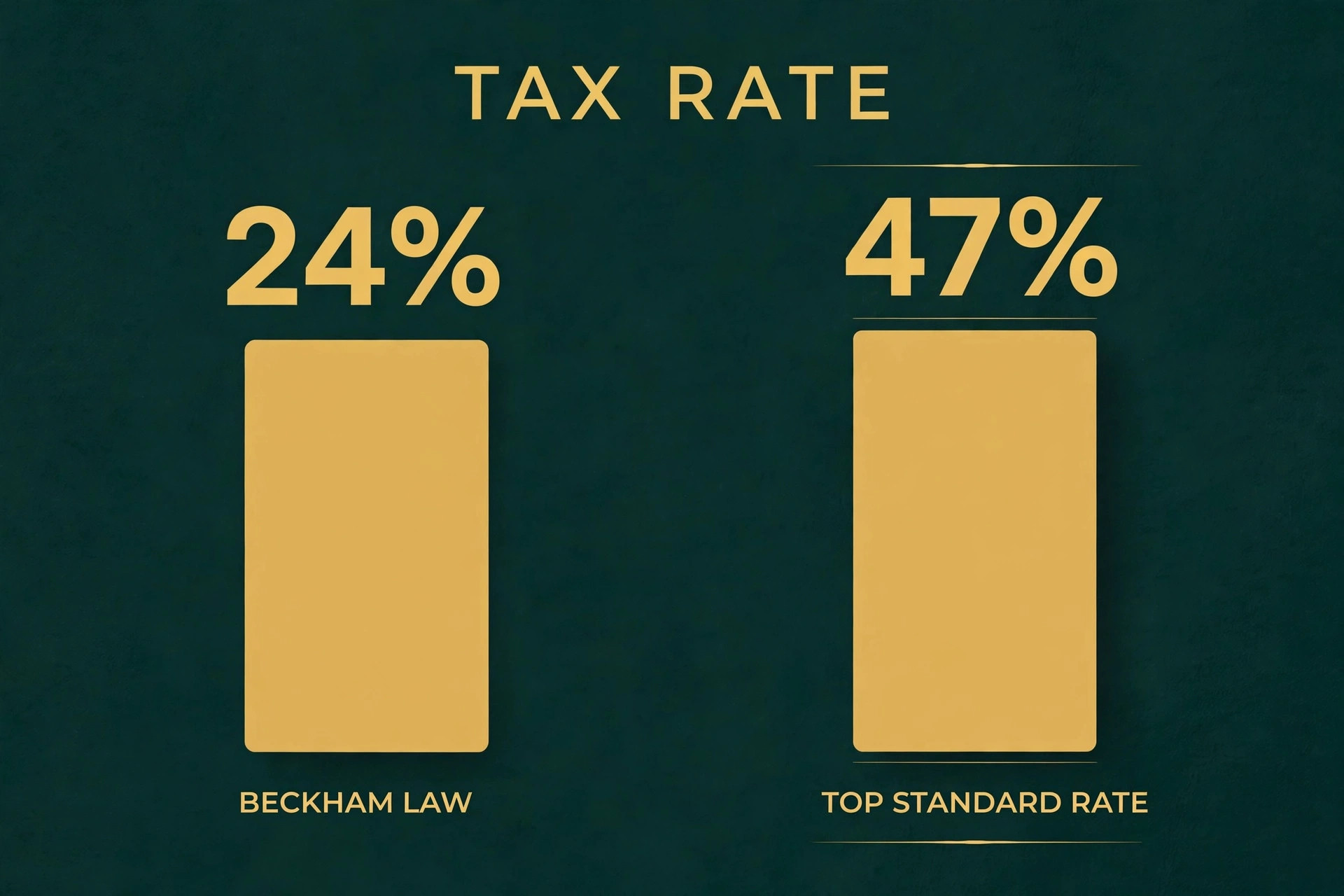
The gap grows with income, which is why high-earning remote employees benefit most. At €50,000 the difference is modest; at €120,000 it is large. But remember: the comparison only matters if you actually qualify. A freelancer earning €120,000 pays the standard rates regardless of the visa in their passport.
Estimate your bill with a Spain digital nomad visa tax calculator
Before you move, run your numbers through a reputable Spain income tax calculator. Enter your gross annual income, compare the Beckham Law flat rate against the standard progressive rates, and add social security on top — calculators usually show income tax only. Treat the result as a planning estimate, not a filing, and confirm it with a qualified tax adviser before you rely on it.
Social Security: Employees vs Freelancers
Income tax is only part of the digital nomad Spain tax rate picture. Social security is the other part, and it works very differently for employees and freelancers.
Employees pay roughly 6.5% of gross salary in employee social security contributions, deducted from pay. Your employer pays a much larger share on top. In return you are covered by Spain’s public healthcare system.
Freelancers (autónomos) pay their own monthly contribution (cuota), set by an income-based bracket system. In 2026 the monthly quota runs roughly €200 to €600+ depending on net income, with higher earners paying more. New autónomos may qualify for a reduced flat rate (tarifa plana) in the first year — around €80 per month in recent years, though you should confirm the current amount when you register. Most freelancers also pay a gestor (accountant) around €50–€150 per month to handle quarterly filings: quarterly income tax and VAT returns (Modelo 130 and Modelo 303), plus the annual return (Modelo 100).
One genuine advantage for autónomos: once registered and paying in, you gain access to Spain’s public healthcare. After one year of legal residency, residents who are not covered may also join the public system through the Convenio Especial for roughly €60 per month under 65 (about €157 over 65), depending on the region.
Monthly Cost of Living in Spain
Taxes decide what you keep; rent decides what you spend. A one-bedroom apartment in the city centre averages roughly €1,300–€1,450 in Madrid and Barcelona and €1,125–€1,215 in Valencia, with smaller cities lower still. Day-to-day costs — groceries, utilities, transport — are moderate by Western European standards.

| Monthly budget (single person) | Madrid | Valencia |
|---|---|---|
| Rent (1-bedroom, city centre) | €1,300–€1,450 | €1,125–€1,215 |
| Groceries | €200–€400 | €200–€350 |
| Utilities + internet | €115–€220 | €100–€200 |
| Transport pass | €40–€60 | €40–€60 |
| Health insurance (if private) | €50–€100 | €50–€100 |
| Realistic total | €1,900–€2,500 | €1,700–€2,200 |
These totals exclude income tax and social security, which come out of your gross income first. A useful rule of thumb: if your net income after tax is at least double your rent, Spain is comfortable. On the minimum qualifying income of €2,849 per month, Madrid is tight but workable; Valencia is noticeably easier. That is one reason so many digital nomads pick Valencia, Málaga, or Alicante over the two big cities.
Before you book the flight
Get a clear read on your documents, timing, and weak points — one review, before you spend on applications.
7 Common Tax Mistakes Digital Nomads Make in Spain
- Missing the Modelo 149 deadline. The Beckham Law election must be filed within six months of starting work or registering. Miss it and you lose the regime for that move — there is no extension.
- Assuming the 24% rate applies to freelancers. It generally does not. Freelancers pay standard progressive rates plus autónomo social security. Budget on that basis.
- Breaking the 20% Spanish-income cap. Freelancers may earn at most 20% of their income from Spanish clients. Cross it and you risk your visa status, not just your tax bill.
- Forgetting worldwide income. Under the standard regime, Spanish tax residents are taxed on worldwide income. Foreign earnings still have to be declared, even if a treaty reduces the tax.
- Buying insurance with co-payments. Policies with co-pays or waiting periods are a leading cause of preventable refusals and renewal problems. The policy must have neither.
- Not tracking the 183 days. Tax residency usually starts at 183 days in a calendar year. Keep a day count — it decides when Spanish tax obligations begin.
- Ignoring regional rates and quarterly filings. Your region changes your IRPF bill, and autónomos must file quarterly returns (Modelo 130 and Modelo 303). A gestor is worth the monthly fee.
Frequently Asked Questions
How much tax do digital nomads pay in Spain?
It depends on which regime applies. Qualifying employees under the Beckham Law pay a flat 24% on Spanish-source income up to €600,000 for six tax years. Everyone else pays the standard progressive IRPF rates of 19% to 47%, plus social security. Your employment status decides which regime you fall under, so check eligibility before budgeting.
What is the Spain digital nomad visa tax rate for freelancers?
Freelancers and autónomos generally do not qualify for the Beckham Law flat rate, even on the digital nomad visa. They pay standard progressive IRPF rates from 19% to 47% on taxable income, plus income-based monthly social security contributions. Because the flat rate is the main tax advantage of the visa, employed remote workers usually keep more of their income.
How much does the Spain digital nomad visa cost in total?
Government fees are small: roughly €80 for the visa and about €16 for the TIE card, plus €10–€20 for the NIE. The larger costs are private health insurance at €50–€100 per month, sworn translations at €20–€50 per page, and apostilles. Budget roughly €1,000–€2,000 for the full application, before flights and your first month of living costs.
What is the minimum income for the Spain digital nomad visa in 2026?
A single applicant must show monthly income of at least 200% of Spain’s minimum wage (SMI), which works out to about €2,849 per month in 2026. Add roughly €1,069 per month for a spouse and about €357 per month for each additional dependent. Consulates want stable, verifiable income, so show several months of bank statements or payslips.
Do digital nomads pay tax on foreign income in Spain?
It depends on the regime. Under the Beckham Law, foreign-source income such as overseas dividends, interest, and rental income is generally exempt from Spanish tax. Under the standard regime, Spanish tax residents pay tax on worldwide income, including foreign earnings. Double-taxation treaties may reduce the bill, but you must still declare the income.
How do I apply for the Beckham Law?
File Modelo 149 with the Spanish tax agency (Agencia Tributaria) within six months of starting work or registering in Spain. The regime is not automatic, and missing the deadline means losing it for that move. You will need your NIE, proof that you were not a Spanish tax resident in the previous five years, and evidence of your employment arrangement.
Can I use a Spain digital nomad visa tax calculator?
Yes. A reputable Spain tax calculator can estimate your bill under both the Beckham Law flat rate and the standard progressive rates before you move. Enter your gross annual income, select the regime, and remember to add social security on top. Treat the result as a planning estimate, not a filing, and confirm it with a qualified tax adviser.
Do I need private health insurance for the Spain digital nomad visa?
In most cases, yes. Applicants must show health coverage, usually a private policy from a Spain-authorized insurer with no co-payments and no waiting periods, costing roughly €50–€100 per month for applicants under 40. If you register as autónomo and pay into Social Security, public healthcare can replace private cover. Check your consulate’s exact wording before buying.
Disclaimer: This article is general information, not tax or legal advice. Tax rates, thresholds, and fees change — confirm all figures with the Agencia Tributaria, your consulate, or a qualified tax adviser before you apply or file. Figures reflect sources checked in October 2026.
Sources: Spanish Ministry of Inclusion (Digital Nomad Visa information) via inclusion.gob.es; SpainGuru — 2026 SMI increase; CountryTaxCalc — Beckham Law guide; CostaLuz Lawyers — DNV fees and tax comparison; Health Insurance for Spanish Visas — DNV insurance costs; Expatica — cost of living in Spain 2026. More than 100+ free visa tools and related guides are on the Visaora blog.
✈️ Planning Your Trip?
We may earn a commission — at no extra cost to you. Learn more