Canada Visitor Visa Checklist 2026: Documents Required by IRCC
By Visaora Editorial Team · Updated November 2026 · 13 min read
Quick answer: A complete Canada visitor visa checklist starts with a valid passport, the online IRCC application and the documents on your personalised checklist. For most applicants that means about 6 months of bank statements, an employer letter on letterhead, a travel itinerary, and an invitation letter with proof of relationship if you are visiting family.
Visaora provides general information, not legal advice. Rules change; always confirm with the official embassy, consulate or government website before you apply.
Key facts (checked November 2026)
- Your passport should be valid for at least 6 months from the date you plan to travel (canada.ca).
- Applications are made online; the portal generates a personalised document checklist from your answers.
- The visitor visa fee is CAD $100 per person; biometrics cost CAD $85 per person (family maximum $170).
- Bank statements should show at least 6 months of account details, including balances.
- An employer letter must sit on official letterhead and be dated no earlier than 3 months before you apply.
- IMM 5484 is the paper checklist. Online applicants use the portal checklist instead and do not submit the PDF.
Ask ten refused applicants what went wrong and most will tell you the same thing: the documents. Not the interview, not luck. Canada decides visitor visas almost entirely on paper, and the officer reads your file looking for three answers: who you are, whether you can pay for this trip, and whether you will leave at the end of it. This Canada visitor visa checklist organises every document IRCC asks for around those three questions, with the exact specifications canada.ca publishes, so you can build a file that answers them cleanly.
What is the IRCC personalised checklist, and why does it rule your file?
When you apply online, IRCC builds a personal document checklist from the answers you give in the eligibility questionnaire and inside your account. That list, not any generic checklist on the internet, defines what your application must contain. Upload everything on it, in the slots provided, because an officer can refuse an application as incomplete without ever weighing your circumstances.
The downloadable IMM 5484 checklist still exists for paper applications, and it is a useful preparation tool. But IRCC is clear that online applicants do not submit the PDF: your portal checklist replaces it. Use IMM 5484 to gather and organise, then upload against the personalised list. If your local visa office asks for extra documents, those appear in your instructions too, which is another reason the portal list always wins over a blog checklist, including this one. Our Canada visa tools page collects the calculators and generators that help you prepare each piece.
Want this checklist as a printable, personalised list? Answer a few questions about your profile and generate a document checklist you can tick off as you prepare each item.
Which core documents does every applicant need?
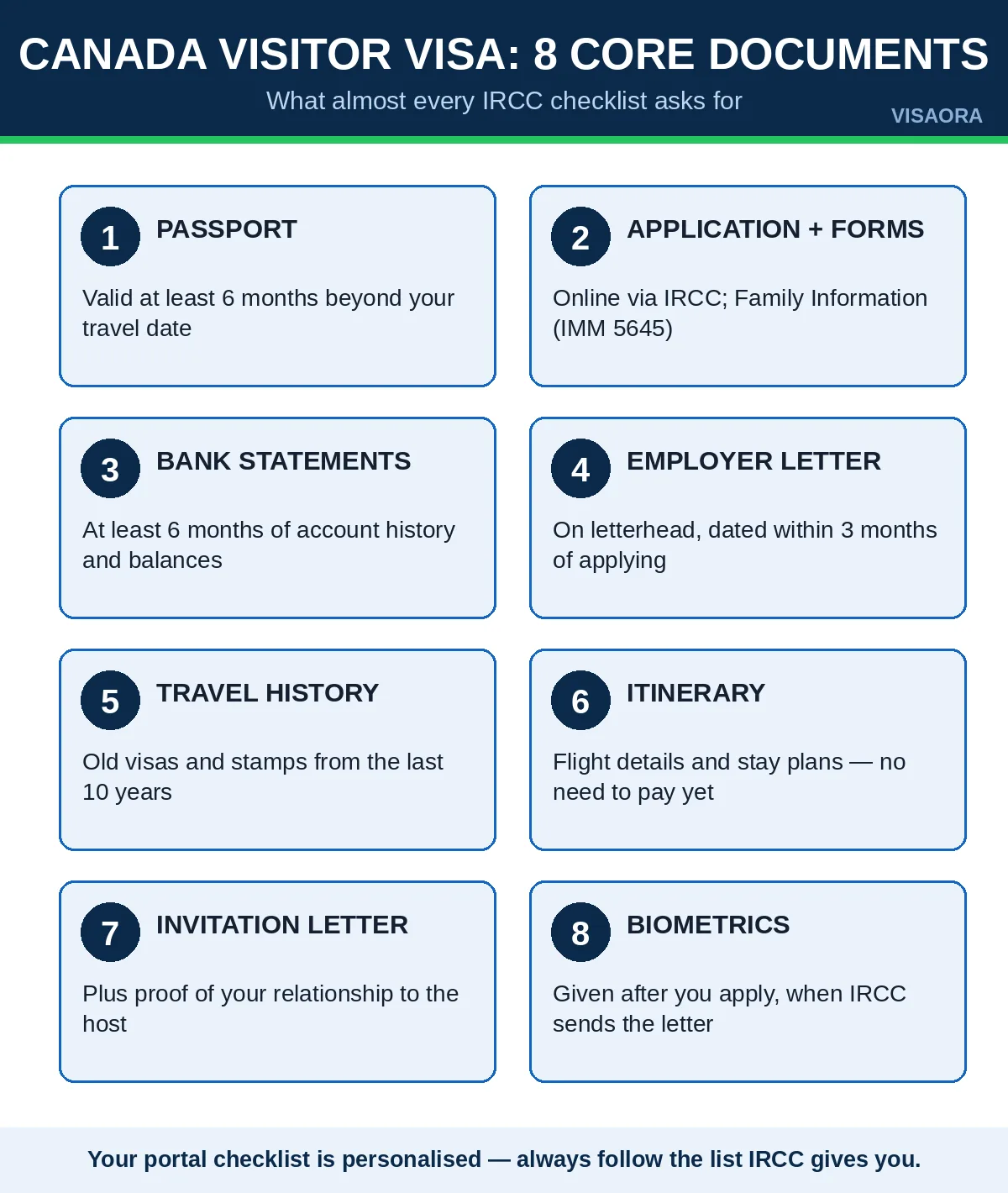
Whatever your profile, a core set of documents appears on nearly every checklist. Treat this table as your master list, then add the profile-specific items in the next sections.
| Document | Who needs it | Key detail |
|---|---|---|
| Passport | Everyone | Colour copy of the bio page plus pages with stamps, visas or markings; valid 6+ months beyond travel |
| Application forms | Everyone | Completed online; Family Information (IMM 5645); representative form (IMM 5476) only if you use one |
| Bank statements | Everyone (or your sponsor) | At least 6 months of account details including balances, with bank name and contact details |
| Employer letter | Employed applicants | Official letterhead, dated within 3 months, confirming job, start date, duties and salary |
| Travel history | Recommended for everyone | Previous passports and visas used in the last 10 years, entry and exit stamps, old permits |
| Itinerary | Everyone | Flight details, accommodation and planned activities showing length and purpose of stay |
| Invitation letter | Visiting family or friends | From your host in Canada, plus proof of your relationship to them |
| Photograph / digital photo | As your checklist specifies | Follow the size and format your portal slot asks for |
| Biometrics | Most applicants | Given after you apply, once IRCC sends the biometrics instruction letter |
Two habits protect this core file. First, scan complete documents, not crops: a statement missing its final page or a passport copy without the stamps page invites a refusal for incompleteness. Second, keep names and dates identical across every document. An employer letter that spells your name differently from your passport creates work the officer did not ask for.
Immigration agency? Qualify UAE leads free with Visaora Agency Leads → https://visaora.io/visaora-agency-leads/
How much bank history do you need? Proof of funds and bank statements
IRCC asks for bank statements showing at least 6 months of account details, including balances, so the officer can understand your financial situation. The statement should show the bank’s name and contact information and prove the account is yours, with your name and address on it. That specification explains why a one-page balance certificate so often disappoints: it shows a number, but no history, and history is what the officer is reading for.
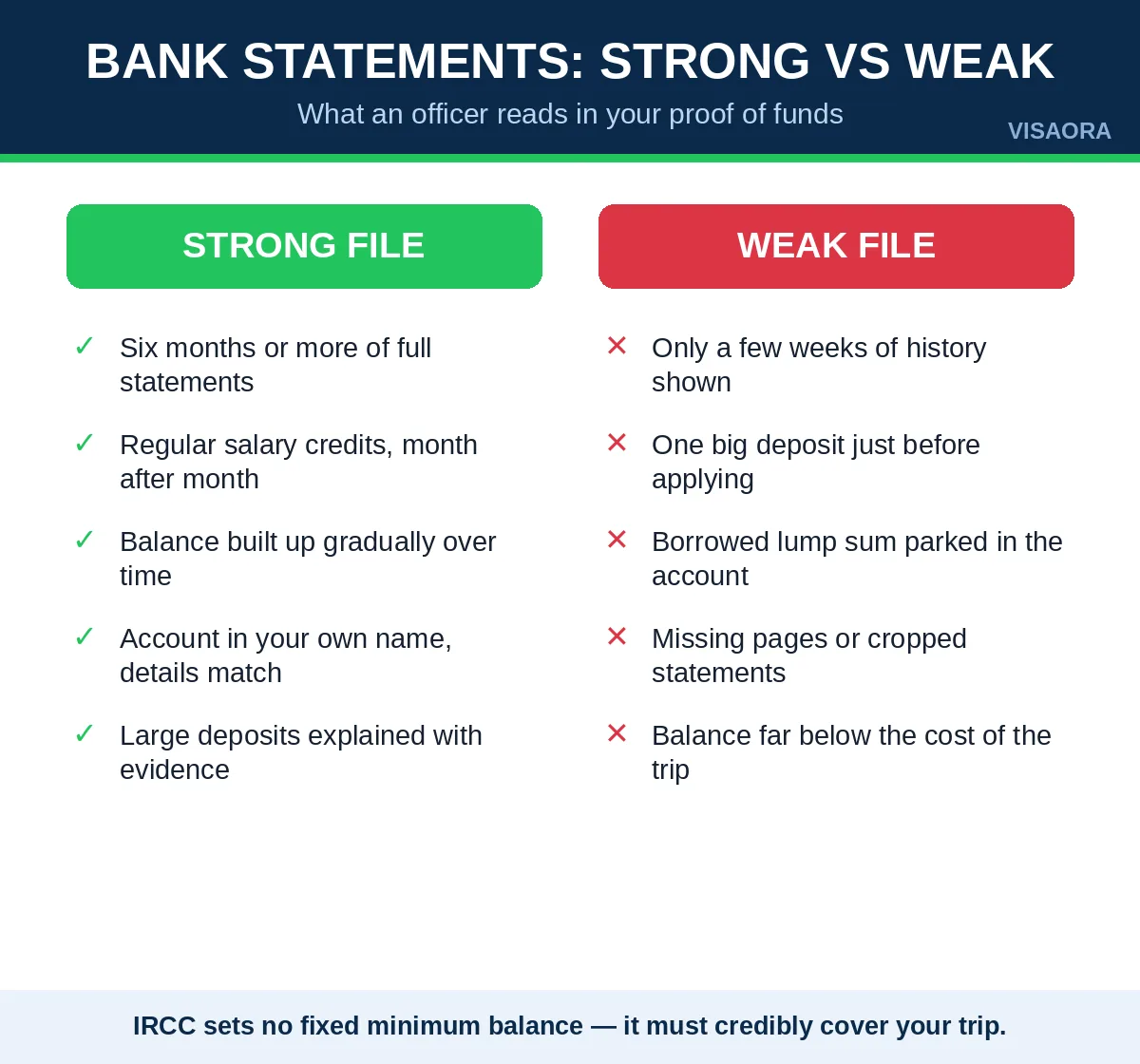
There is no published minimum balance for a visitor visa. The real test is credibility: could this account, with this pattern of income, fund this trip and still leave your life at home intact? A steady salary arriving monthly, a balance that grew gradually, and a trip cost that sits comfortably below the balance reads far better than a large, sudden deposit with no explanation.
| Do | Do not |
|---|---|
| Show 6 months or more of complete statements | Submit only a few weeks of history |
| Keep regular salary credits visible month by month | Move one large lump sum in just before applying |
| Explain any unusually large deposit with evidence (sale deed, bonus letter) | Park borrowed money in the account to inflate the balance |
| Include every page, with your name, address and bank contact shown | Upload cropped screenshots or statements with missing pages |
| Make sure the trip cost fits the balance and income pattern | Claim a trip that costs more than the account has ever held |
What must your employer letter include?
An employer letter does two jobs at once: it supports your funds, and it is one of your strongest ties to home, because it confirms a stable job you will return to. IRCC specifies the format precisely: printed on the employer’s official letterhead, dated no earlier than 3 months before you apply, and signed by your manager or human resources contact.
| Field | What to write |
|---|---|
| Date | Within 3 months of your application date |
| Employee | Your full name and date of birth, exactly as on your passport |
| Role | Job title and a brief description of your duties |
| Start date | The date you started the job |
| Salary | Your current salary |
| Leave | Approved leave dates matching your itinerary (best practice, widely requested) |
| Contact | Manager’s name, phone and email; company name and full address |
| Signature | Printed name and signature of the manager or HR contact |
A letter missing the salary or the start date wastes its potential. Length of service plus a confirmed return date is the combination officers look for, and it costs your employer ten minutes.
Which documents change with your profile?
Beyond the core file, your checklist shifts with how you earn and live. Prepare the row that matches you:
| Profile | Add these documents |
|---|---|
| Employee | Employer letter (above), recent payslips if your checklist asks, employment contract if requested |
| Self-employed | Business registration and licence, business bank statements, tax returns, client contracts or invoices |
| Student | Enrolment letter from your institution, student ID, leave approval for term-time travel, sponsor’s documents if a parent pays |
| Retiree | Pension statements or pension account history, property or savings evidence, family details in Canada and at home |
| Sponsored by family | Sponsor’s bank statements and employment proof, a signed support letter, and proof of the relationship between you |
The principle is consistent: whatever you claim in the questionnaire, a document must prove. Claim self-employment income without business records and the claim carries no weight.
Visiting family in Canada: the invitation letter and relationship proof
If you are visiting family or friends, IRCC expects two connected items: an invitation letter from your host in Canada, and proof of your relationship with that person. The invitation should identify the host, state their status in Canada, give their address, and describe the visit: who is coming, when, for how long, and where you will stay. The relationship proof is the part applicants forget: a birth or marriage certificate linking you, or other records that show the connection is real.
The invitation supports your purpose of visit; it does not replace your own file. You still show your funds or your sponsor’s, your ties at home, and your itinerary. Hosts sometimes offer to show their income as well, which helps when they are covering your stay, and a draft itinerary for the visit makes the plan concrete. If you need help structuring the trip itself, our travel itinerary generator turns dates and cities into a clean day-by-day plan you can upload.
Applying as a GCC resident, not a citizen
Thousands of applicants apply for Canada from the Gulf, where they live and work on residence permits. That is completely normal: you apply from your country of residence, and your file should prove that residence and employment clearly. Add your residence permit copy, your local employment letter, and statements from the account your salary actually lands in. Your ties argument rests on your job, your lease and your life in the Gulf, so document them like they matter, because they do.
Residents of the Emirates should also read our guide to the Canada visitor visa from the UAE, and Saudi-based applicants our walkthrough of the Canada visitor visa from Saudi Arabia, which cover the local visa-office patterns for each.
What extra documents do minors need?
A child travelling to Canada needs a letter of authorisation from the parent or parents who are not travelling, and IRCC may ask for more depending on whether the child travels alone, with one parent, or with another adult. Carry or upload the child’s birth certificate, the consent letter with the non-travelling parent’s contact details, and custody documents where they exist. A family application should list every child consistently across the Family Information form and the parents’ files, because mismatched family details are an avoidable reason for delays.
How should you handle translations and uploads?
Any document that is not in English or French needs a certified translation, uploaded together with a copy of the original. Keep the pair together in the same slot so the officer never has to hunt for the matching original. Upload clear, complete scans in the format and size your portal allows, in colour where the original is in colour. Name files so they identify themselves, for example Bank-Statements-Jan-Jun.pdf, and re-open every upload before submitting. Blurry or truncated files are treated as missing documents, and missing documents are treated as an incomplete application.
When do you give biometrics?
After you submit, not before. Most applicants must give fingerprints and a photograph, and IRCC sends a biometrics instruction letter telling you to book at a collection centre. Book promptly: your application does not move to a decision until biometrics are in, and the visa cannot be issued for longer than your biometrics remain valid. The biometrics fee is CAD $85 per person, capped at CAD $170 for a family applying together, and it is paid with the application, not at the centre. If you have given biometrics for a previous Canadian application within the last 10 years, they may still be valid; your account will tell you.
Which document mistakes cause refusals?
The patterns repeat every year. Statements that cover only a few weeks, or that hide the account holder’s name. A large deposit days before applying, with no explanation. An employer letter on plain paper, undated, or missing the salary. An itinerary that claims three weeks in Canada on a balance that cannot fund it. A missing relationship proof behind an invitation letter. And the quietest killer of all: answers in the questionnaire that the documents do not support. Build the file so every claim has a document behind it, and most of these never happen.
Frequently asked questions
Which documents are required for a Canada visitor visa in 2026?
The exact list is the personalised checklist IRCC generates in your account, but almost every file contains the same core: a valid passport, the online forms including Family Information (IMM 5645), at least 6 months of bank statements, an employer letter if you work, travel history, an itinerary, and an invitation letter with relationship proof if you are visiting family. Your visa office can add items to that list.
How much bank balance do I need for a Canada visitor visa?
IRCC publishes no fixed minimum balance for a visitor visa. The officer checks whether your statements credibly cover your trip: your income pattern, how the balance was built, and whether the trip cost fits your financial life. A moderate balance with 6 months of steady salary credits usually reads stronger than a large amount deposited last week without an explanation.
Are 3 months of bank statements enough?
Usually not a good idea. Canada.ca asks for at least 6 months of account details, including balances, so the officer can understand your financial situation over time. Submitting only 3 months when 6 were requested can make the application look incomplete. If one account is new, add statements from your older main account as well, with a short note explaining the two accounts.
Do I need an invitation letter for a Canada visitor visa?
Only if you are visiting someone. Tourists staying in hotels do not need an invitation; they show their itinerary and accommodation plans instead. If you are visiting family or friends, the host’s invitation letter is expected, together with proof of your relationship, such as a birth or marriage certificate. The invitation supports your purpose of visit, but your own funds, ties and history still decide the file.
Can I apply for a Canada visitor visa as a resident rather than a citizen?
Yes. You apply from the country where you legally live and work, such as the UAE or Saudi Arabia, and thousands of Gulf residents are approved this way. Document that life properly: residence permit, local employer letter, the account your salary is paid into, and evidence of your ties there. Your citizenship decides whether you need a visa; your residence decides where and how you apply.
Should I book flights before I apply for a Canada visitor visa?
You need an itinerary, not paid tickets. IRCC asks for documents showing how long you plan to stay and what you will do, and flight details or a reservation satisfy that without risking money on a booking you may never use. Many applicants use refundable reservations or a generated itinerary. Pay for non-refundable flights only after the visa is issued.
Sources
- Immigration, Refugees and Citizenship Canada: How to apply for a visitor visa (checked 1 November 2026)
- IRCC: Document Checklist: Temporary Resident Visa (IMM 5484)
- IRCC: Common supporting documents
- IRCC Help Centre: What is a personal document checklist? (checked 1 November 2026)
Last checked: November 2026
Visaora provides software tools and general information, not legal advice. Rules change; always confirm with the official authority.
✈️ Planning Your Trip?
We may earn a commission — at no extra cost to you. Learn more