
By Visaora Editorial Team · Last updated: 24 Oct 2026 · 14 min read
Quick answer
If you live in Qatar on a valid residence permit, you can apply for a Schengen visa in Doha through the embassy of your main destination, usually via VFS Global. The standard fee is EUR 90 (about QR 383) plus a QR 102 VFS service charge, your passport must be valid at least 3 months beyond your planned Schengen departure, and the EU’s Entry/Exit System is now fully operational at borders. The GCC unified tourist visa is confirmed as a project but has no launch date, fee or portal yet. Residents who also sponsor family can check the Qatar family visa salary checker.
Key takeaways
- Only Qatari nationals and legal Qatar residents can apply in Doha; visitors cannot.
- The adult fee is EUR 90 (QR 383) plus a QR 102 VFS service charge, both non-refundable.
- Your QID must stay valid past your return; your passport needs 3+ months beyond Schengen departure.
- The EU Entry/Exit System is fully operational since 10 April 2026; stamps are now digital records.
- The GCC unified visa is real but not open: no date, no fee, no applications. Sites selling one are scams.
On this page
- Who can apply for a Schengen visa in Doha?
- What are the QID and passport validity rules?
- Where do you actually submit your application in Qatar?
- What documents and funds do you need?
- What is the step-by-step application timeline?
- How do the EES and the 90/180 rule affect your 2026 trip?
- What is confirmed, reported and unknown about the GCC unified visa?
- Who is the GCC unified visa for?
- What should you use today instead of the unified visa?
- How do you spot a fake “GCC visa” website?
- Example: a Doha resident’s Schengen application
- Common mistakes applicants in Qatar make
- Frequently asked questions
Part 1 — Schengen visa from Qatar
Who can apply for a Schengen visa in Doha?
You can apply in Doha if you are a Qatari national or a legal resident of Qatar with a valid residence permit. The official VFS Global page for Switzerland in Qatar states it plainly: “Only Qatari nationals and nationals of third countries who are legal residents in Qatar can apply.” On a visit visa or visa-free entry, you cannot apply here; you must apply from your country of residence. The rule applies per person, not per family.
Before you go further, run your numbers through the Schengen proof-of-funds calculator and browse the Schengen visa tools hub. Knowing whether your finances meet the bar before you pay any fee is the cheapest decision in this whole process.
What are the QID and passport validity rules?
Two documents decide whether your application is even accepted at the counter. Your QID must be valid, and its validity must extend past your planned return: the German Embassy’s official VFS one-pager for non-Qatari nationals requires a copy of the residence permit, and the Switzerland page specifies validity of at least 3 months beyond your intended return date. If your QID expires in two months and your trip is in three, renew the QID first.
Your passport must be valid for at least 3 months after your intended departure from the Schengen area, issued within the last 10 years, with at least 2 blank pages. A passport issued 11 years ago fails even with years of validity left, because the count runs from the issue date.
Where do you actually submit your application in Qatar?
Through the embassy of your main destination country in Doha, usually a VFS Global centre. Apply to the country where you will spend the most days, or the country of first entry if the stay is split evenly. Applying to the “easiest” embassy when you are really going elsewhere is a classic refusal trigger.
VFS Global is the outsourced partner for several Schengen states in Doha. Italy’s embassy states VFS Global is the only agency authorized to receive its visa applications. The Dutch government directs Qatar-based applicants for the Netherlands, Slovakia and Sweden to VFS Global; Germany and Switzerland also process through VFS in Doha. Each country publishes its own official one-pager on the VFS website, so open the page for your specific destination rather than a generic checklist.
What documents and funds do you need?
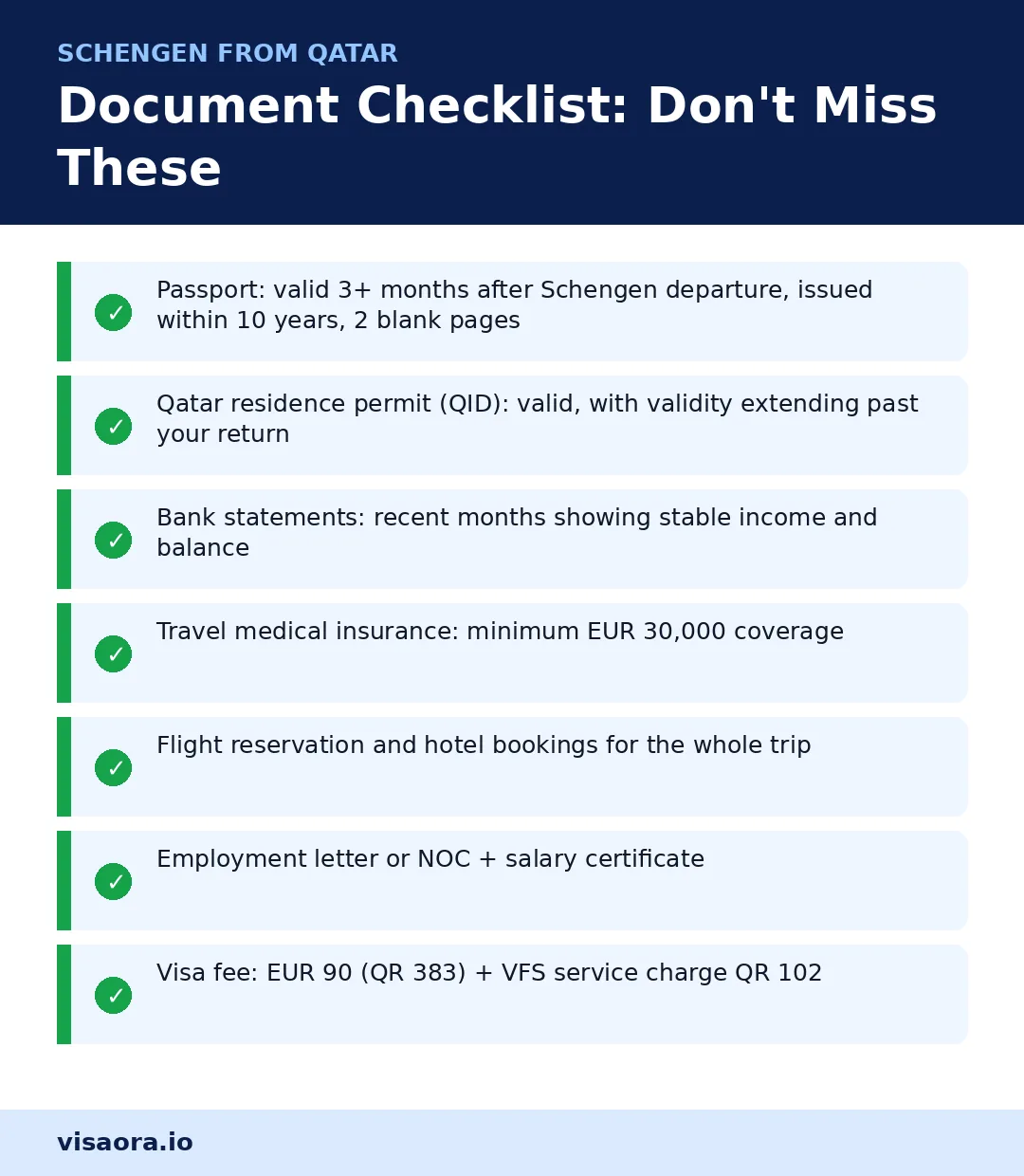
The document list is standard across Schengen states, with small country variations. Below is the core set from the official VFS pages, followed by the fee table. Treat the fees as current as of October 2026 and re-check the official page before you pay, because consular exchange rates can shift the QR amounts without notice.
| Document | What the official pages require |
|---|---|
| Passport | Valid 3+ months beyond Schengen departure; issued within last 10 years; 2 blank pages |
| Qatar residence permit | Valid QID; validity extending at least 3 months past your intended return |
| Application form + photos | Completed form; recent photos meeting Schengen photo standards |
| Travel medical insurance | Minimum EUR 30,000 coverage, valid across the Schengen area for the whole trip |
| Flight + hotel bookings | Reservations covering the full itinerary (refundable bookings are fine) |
| Proof of funds | Recent bank statements showing stable income; requirements vary by country and trip length |
| Employment proof | NOC or employment letter, salary certificate; business owners add company documents |
| Fee | Amount (from the official VFS page) |
|---|---|
| Adult (12+) | QR 383 (EUR 90) |
| Child 6–12 | QR 191 (EUR 45) |
| Child under 6 | Free |
| Reduced fee (listed nationalities) | QR 150 (EUR 35) for nationals of Albania, Ukraine, Moldova, Serbia, Montenegro, North Macedonia, Armenia, Azerbaijan, Bosnia and Herzegovina, Belarus |
| VFS service charge | QR 102 per application, on top of the visa fee |
Last checked: October 2026 — Source: official VFS Global page for Switzerland, Qatar. All fees are non-refundable and the QR amounts can change with the consular exchange rate.
On funds: there is no single “minimum bank balance” for a Schengen visa. Consulates look for stable income and a balance that credibly covers the trip. A salary that lands every month and a balance that grows steadily beats a large lump sum deposited a week before the appointment. See our Schengen visa bank balance guide for the full breakdown.
What is the step-by-step application timeline?
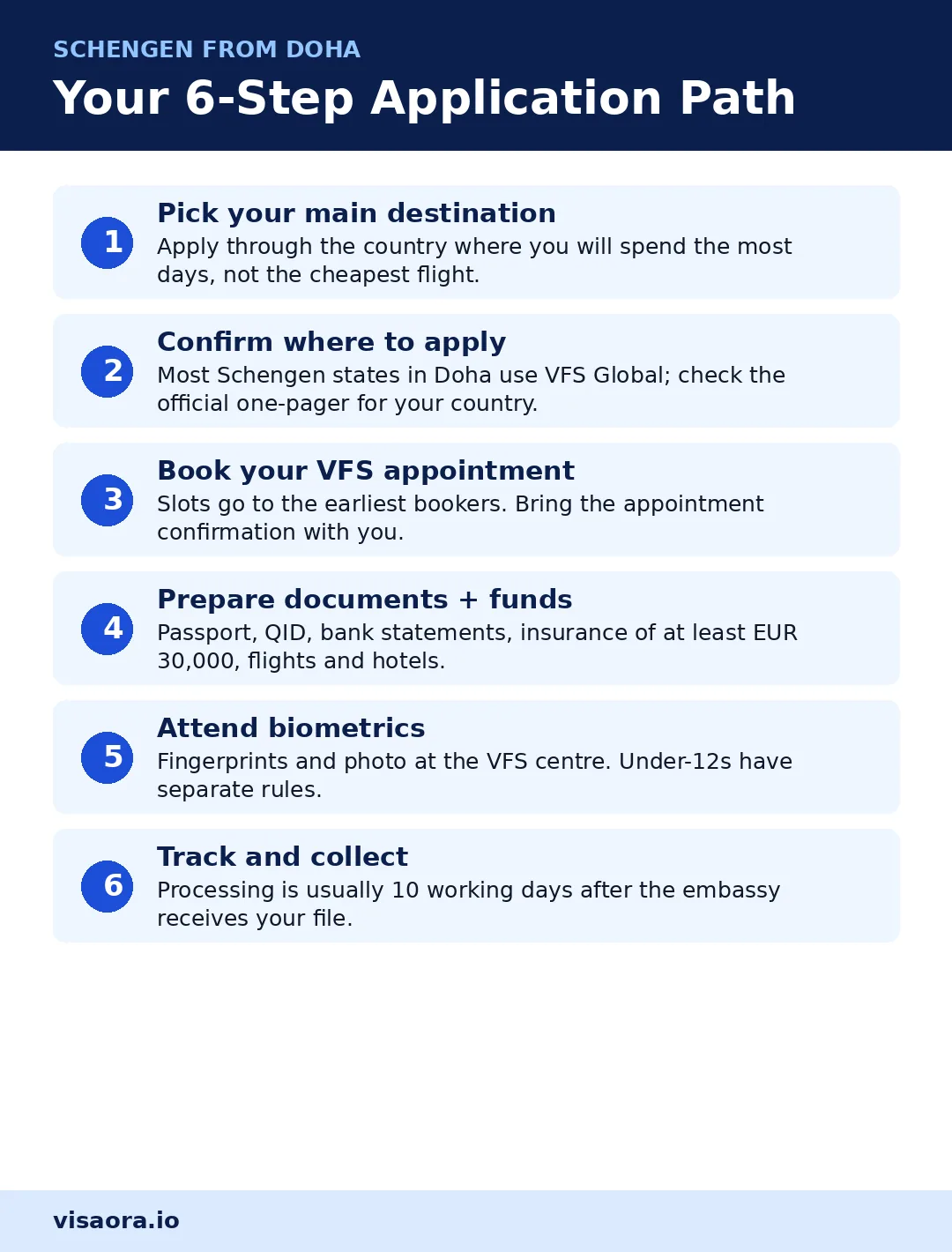
Six steps, in order. Most Doha delays come from doing them out of sequence, especially booking flights before confirming where to apply.
- Pick your main destination. The country where you spend the most days gets your application.
- Confirm where to apply. Open the official VFS one-pager or embassy site for that country and read its document list.
- Book your VFS appointment. Do this early; gather documents while you wait for the slot.
- Prepare documents and funds. Bank statements, EUR 30,000+ insurance, bookings, employment letter.
- Attend biometrics. Fingerprints and photo at the VFS centre on appointment day.
- Track and collect. Usually 10 working days after the embassy receives your complete file. Apply well before travel; peak seasons stretch everything.
That 10-working-day figure is the standard case, not a promise. Incomplete files go to the back of the queue, which is why preparing documents matters more than booking early. For typical waiting periods, see Schengen visa processing times.
How do the EES and the 90/180 rule affect your 2026 trip?
The Entry/Exit System (EES) is no longer a future project. The European Commission confirms it became fully operational across all Schengen countries on 10 April 2026, after a rollout that began in October 2025. Passport stamps are being replaced with digital entry and exit records for non-EU nationals on short stays, including facial images, fingerprints and personal data from the travel document.
Expect biometric capture on entry and allow extra time at the border, especially in the first year. The 90/180 rule stands: no more than 90 days in any 180-day period, now counted automatically. Overstaying is a database record, not a stamp an officer might miss. Our EES overstay guide explains the penalties.
One confusion to clear up: ETIAS, the separate authorisation for visa-exempt travellers, is not the EES and is not in operation. If you need a Schengen visa, ETIAS does not apply to you. Do not pay any website for “ETIAS registration” alongside your application.
Part 2 — GCC unified tourist visa update
What is confirmed, reported and unknown about the GCC unified visa?
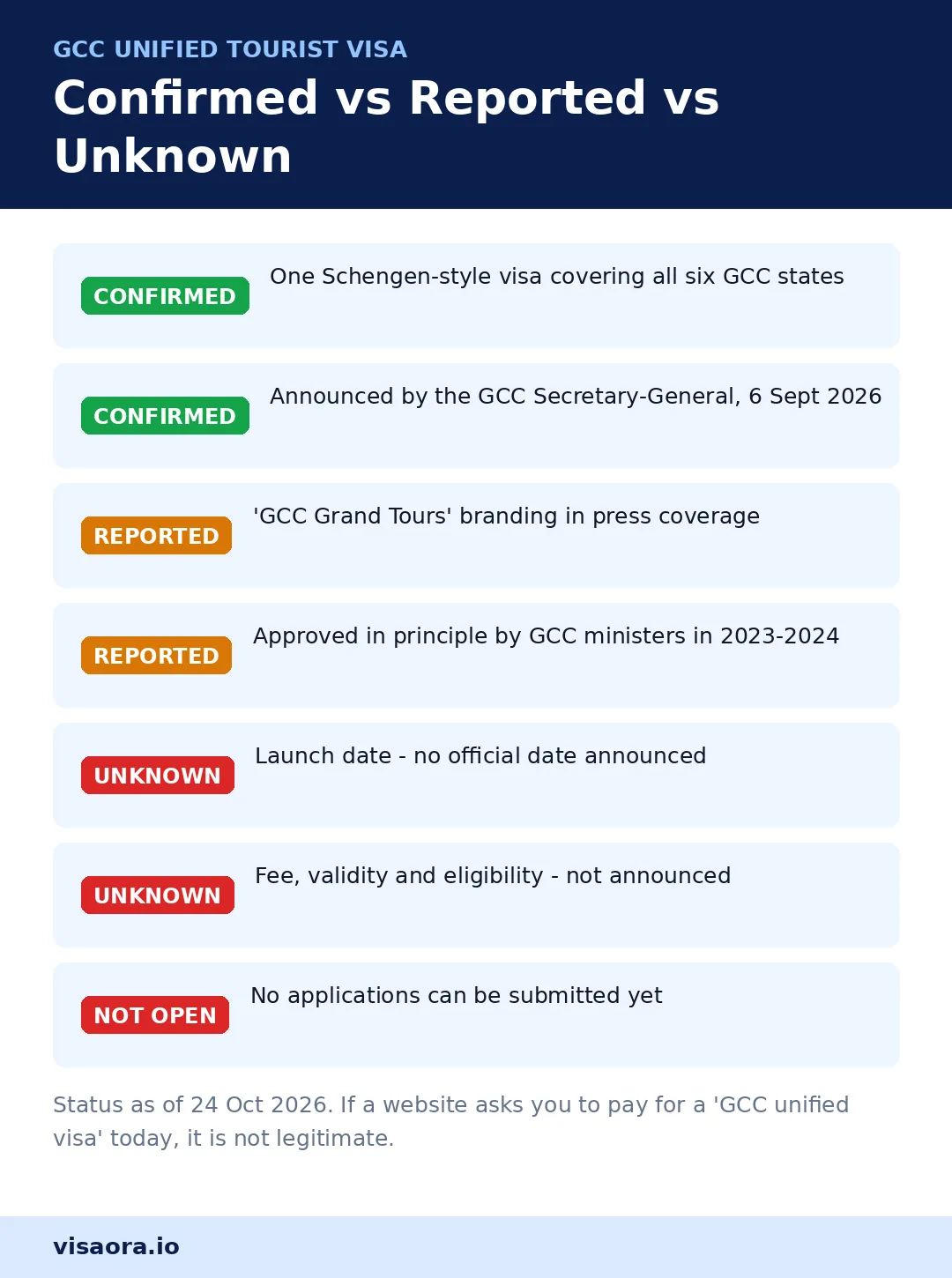
The GCC unified tourist visa is the most asked-about travel topic in the Gulf, and the most misunderstood. Here is the honest picture as of 24 October 2026.
| Item | Status |
|---|---|
| One Schengen-style visa covering all six GCC states (UAE, Saudi Arabia, Qatar, Kuwait, Oman, Bahrain) | Confirmed — announced by the GCC Secretary-General, 6 Sept 2026 |
| “GCC Grand Tours” branding | Reported — press coverage, Sept 2026 |
| Approval in principle (tourism ministers Oct 2023, interior ministers Nov 2023, Supreme Council Dec 2024) | Reported — multiple outlets |
| Launch date | Unknown — no official date exists |
| Fee, validity period, eligibility criteria, application portal | Unknown — none officially announced |
| Whether applications are open | Not open — nothing can be submitted yet |
The most recent authoritative statement came from GCC Secretary-General Jasem Albudaiwi at a Riyadh conference on 6 September 2026: the visa “will be launched soon” as a step toward Gulf integration. As The Peninsula reported (secondary reporting): “Details regarding the launch date, fees, validity and eligibility criteria have yet to be announced.”
Be blunt about what this means: anyone quoting a launch month, a fee in dollars, or a validity period is guessing. Figures like “USD 100” or “30 days” circulating online are commentator estimates, not official announcements. We will update this post the day an official launch date appears.
Who is the GCC unified visa for?
When it launches, the unified visa is meant for tourists visiting more than one Gulf country on a single trip: a family combining Dubai and Doha, or a traveller doing a week across the UAE, Oman and Qatar without three separate applications. That is the stated purpose: easier movement of visitors among the six member states.
What it is not, based on everything announced so far: not a residence visa, not a work permit, and not a shortcut around existing entry rules. Until eligibility criteria are published, nobody can say which nationalities it will cover or whether GCC residents will need it at all.
What should you use today instead of the unified visa?
Use the visas that exist. The unified visa changes nothing about today’s applications. For the UAE, the standard tourist visa through airlines, hotels or agencies. For Saudi Arabia, the eVisa for eligible nationalities, check the Saudi eVisa cost calculator. For Oman, GCC residents may qualify for simplified entry, check the Oman GCC resident eligibility tool. For Qatar, the Hayya platform; for Bahrain and Kuwait, standard eVisa and visa-on-arrival routes.
How do you spot a fake “GCC visa” website?
Because the unified visa is famous and not yet open, it is a perfect scam product. The rule is simple: no official launch date, fee or portal has been announced, so any website currently selling a “GCC unified visa” is not legitimate.
Red flags: a site taking payment for the unified visa; a countdown to a “launch date” no GCC body announced; a fee quoted as official; testimonials from people who “already got” it; an application form for a visa with no published eligibility criteria. Real announcements will come from GCC Secretariat channels and member-state ministries, not from a blog with a payment button.
Example: a Doha resident’s Schengen application
The following is a labelled example scenario, not a real applicant case.
Omar is an Egyptian engineer who has lived in Doha for three years on a work residence permit. He wants 10 days in France and 4 in Italy in December, so France, his main destination, gets the application at the VFS Global centre in Doha. His passport was issued 4 years ago with 6 years left, and his QID is valid for 14 more months, clearing both validity rules.
Fee math: QR 383 plus the QR 102 VFS service charge, QR 485 total. He gets EUR 30,000 travel insurance, prints 6 months of salary bank statements, and books refundable hotels. At the French border, his entry is recorded under the EES instead of a stamp. Preparation: one weekend plus the VFS appointment. The step most applicants skip is the funds check before paying anything.
Common mistakes applicants in Qatar make
- Applying to the wrong embassy. File with your main destination. “Visa shopping” for the supposedly easiest consulate is a refusal risk, not a shortcut.
- Ignoring the QID validity rule. A QID expiring soon after your trip fails the residency check. Renew it before booking the VFS slot.
- Non-refundable bookings before the decision. Refundable reservations satisfy the requirement without risking your money.
- A lump sum deposited before applying. A sudden large deposit reads as borrowed funds. Steady salary credits win.
- Forgetting the EES at the border. First-time travellers should allow extra time at Schengen entry points for biometric capture.
- Paying for a “GCC unified visa”. It is not open. Any payment today goes to a scammer, not a government.
Before your VFS appointment, run your documents through the Schengen visa tools and check your finances with the proof-of-funds calculator — both are free, and both take minutes.
Frequently asked questions
Can I apply for a Schengen visa in Doha on a visit visa?
No. Only Qatari nationals and legal residents of Qatar with a valid residence permit can apply in Doha. On a visit visa or visa-free entry, you must apply from your country of legal residence.
How much is the Schengen visa fee in Qatar in 2026?
EUR 90 (about QR 383) for adults, plus a QR 102 VFS service charge per application. Children 6 to 12 pay EUR 45 (QR 191), under-6s are free, and a reduced EUR 35 (QR 150) applies to listed nationalities. All fees are non-refundable.
How long does Schengen visa processing take in Doha?
Usually 10 working days after the embassy receives your complete application, per the official VFS page. Incomplete files take longer, so prepare documents carefully and apply well ahead of travel.
What is the EES and does it affect my Schengen visa?
The Entry/Exit System is the EU’s digital border system, fully operational since 10 April 2026. It replaces passport stamps with digital entry and exit records, including facial images and fingerprints, for non-EU nationals on short stays. It does not change how you apply, but it makes the 90/180 day rule strictly enforced.
Is the GCC unified tourist visa available now?
No. It has been announced by the GCC Secretary-General, but no launch date, fee, validity or portal has been officially published, and no applications can be submitted. Any website selling a “GCC unified visa” today is not legitimate.
What is the “GCC Grand Tours” visa?
The branding used in press coverage for the planned GCC unified tourist visa: one Schengen-style visa for the UAE, Saudi Arabia, Qatar, Kuwait, Oman and Bahrain. The branding comes from media reporting, not from an official GCC launch announcement.
Does my passport need 6 months validity for a Schengen visa?
No. The official requirement is 3 months beyond your intended Schengen departure, issuance within the last 10 years, and 2 blank pages. Six months is a common myth; the VFS checklist states 3 months.
Can I visit multiple Schengen countries on one visa?
Yes. A Schengen visa is valid across all Schengen states. Apply through the embassy of your main destination (most days spent), then travel freely within the area for up to 90 days in any 180-day period.
Sources
- VFS Global — Switzerland visa information, Qatar (fees, documents, eligibility, processing): official VFS page
- European Commission, Migration and Home Affairs — Entry/Exit System fully operational (10 Apr 2026): official announcement
- EU official Entry/Exit System portal: travel-europe.europa.eu/en/ees
- The Peninsula, 10 Sept 2026 (secondary reporting on the GCC unified visa): GCC unified tourist visa to be launched soon
Update log
- 24 Oct 2026: Published. All fees, document rules and EES status verified against official sources on this date. GCC unified visa section reflects the latest GCC Secretary-General statement (6 Sept 2026): no launch date announced.
Visaora provides software tools and general information, not legal advice. Rules change; always confirm with the official authority.
✈️ Planning Your Trip?
We may earn a commission — at no extra cost to you. Learn more