By Visaora Editorial Team · Last updated: 24 Oct 2026 · 8 min read
Quick answer
A white-label visa report is a professional case file an agency delivers under its own brand: checklist, funds summary, refusal-risk analysis and interview prep. It works when every page carries the agency’s logo, the wording promises nothing about approval, and it is delivered in English and Arabic.
Key takeaways
- White-label means the client sees your agency’s brand on every page, never the software vendor’s.
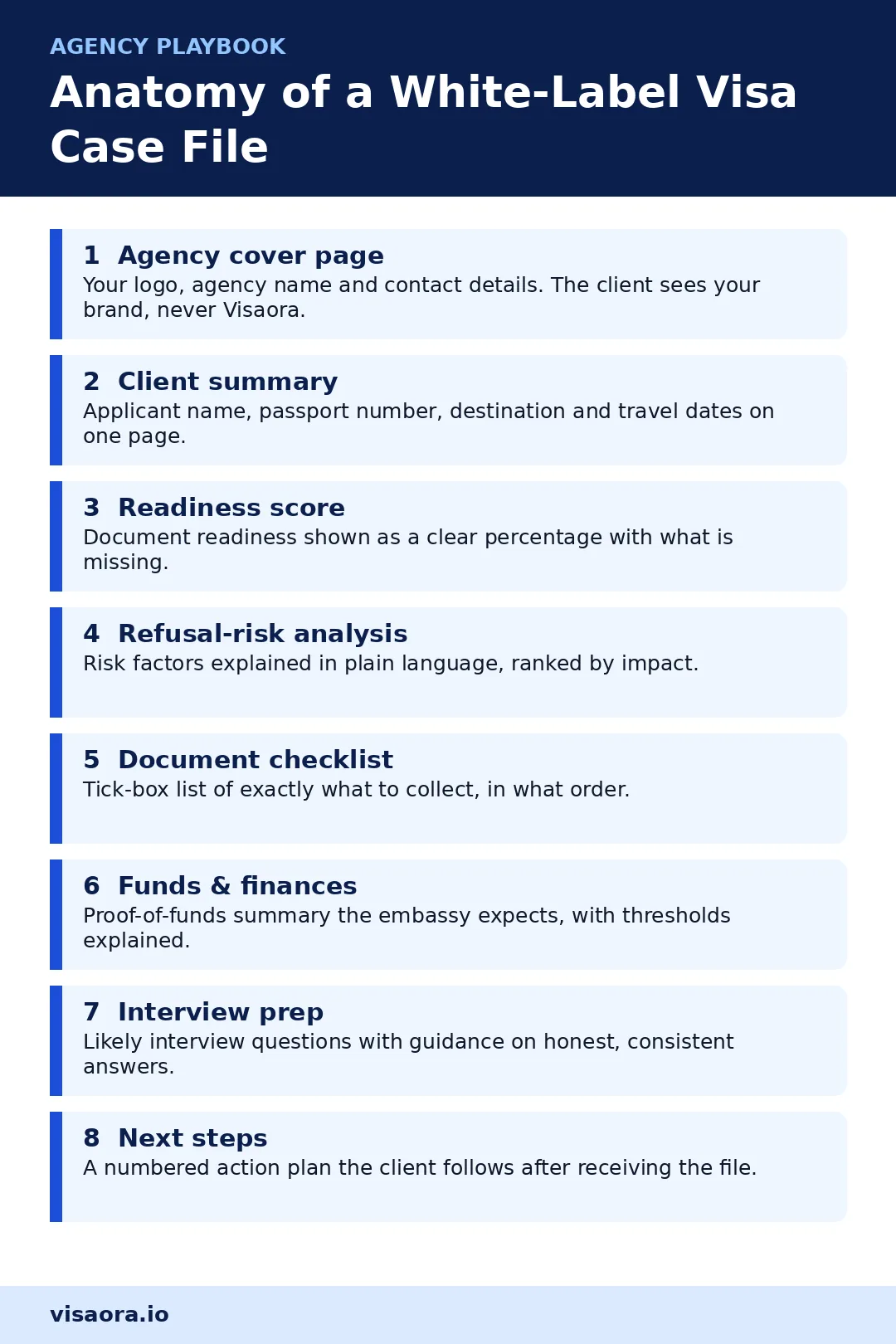
- A strong report has eight sections: cover page, client summary, readiness score, refusal-risk analysis, document checklist, funds summary, interview prep and next steps.
- Compliant wording never promises approval; call the report informational analysis.
- Measure trust with repeat business and referrals, not downloads.
On this page
- What does “white-label” actually mean for a visa report?
- How do you brand a report without misrepresenting it?
- Should client reports be in English, Arabic, or both?
- Portal vs PDF vs WhatsApp: which delivery channel works best?
- How do you measure whether client reports build trust?
- Example: a Dubai agency’s first white-label case file
- What does the setup checklist look like before your first client?
- Common mistakes agencies make with white-label reports
- Frequently asked questions
What does “white-label” actually mean for a visa report?
White-label means the report is produced under your agency’s name. Your logo sits on the cover, your contact details sit in the footer, and the client never learns which software prepared it. The vendor stays invisible; the agency takes the credit and the responsibility.
A client choosing between two agencies rarely compares processing times. They compare professionalism. A structured, branded case file makes an agency look established; a few scanned PDFs over WhatsApp makes it look temporary. In a business where clients pay before they travel, that first impression is the sale.
The typical case file has eight sections: cover page, client summary, readiness score, refusal-risk analysis, document checklist, funds summary, interview prep and next steps. See the infographic below.
How do you brand a report without misrepresenting it?
Put your brand everywhere, but keep the wording honest. Your logo and contact details belong on the cover and every footer. Nothing in the report may suggest you control the outcome: embassies decide; agencies prepare.
Three wording rules keep reports compliant. First, call the analysis informational: “informational analysis of your application readiness; not a promise of visa approval.” Second, describe risk factors as risk factors, never verdicts. Third, when citing official requirements, name the official source, for example the EU’s official Entry/Exit System page, and tell the client to confirm there.
Should client reports be in English, Arabic, or both?
Both, in the Gulf. English is the language of the visa process: forms, embassy websites and refusal letters are all in English. Arabic is the language of the relationship: it is how most Gulf clients read comfortably and share the report with family.
The practical setup is a mirrored report: the full case file in English, then the same file in Arabic with identical page order and section numbers. Two details matter most. First, dates and numbers must match exactly across both versions; one digit off makes the client question the whole file. Second, make the contact page bilingual too, because the client’s first call usually goes to the Arabic page while the staff answering speaks English.
Portal vs PDF vs WhatsApp: which delivery channel works best?
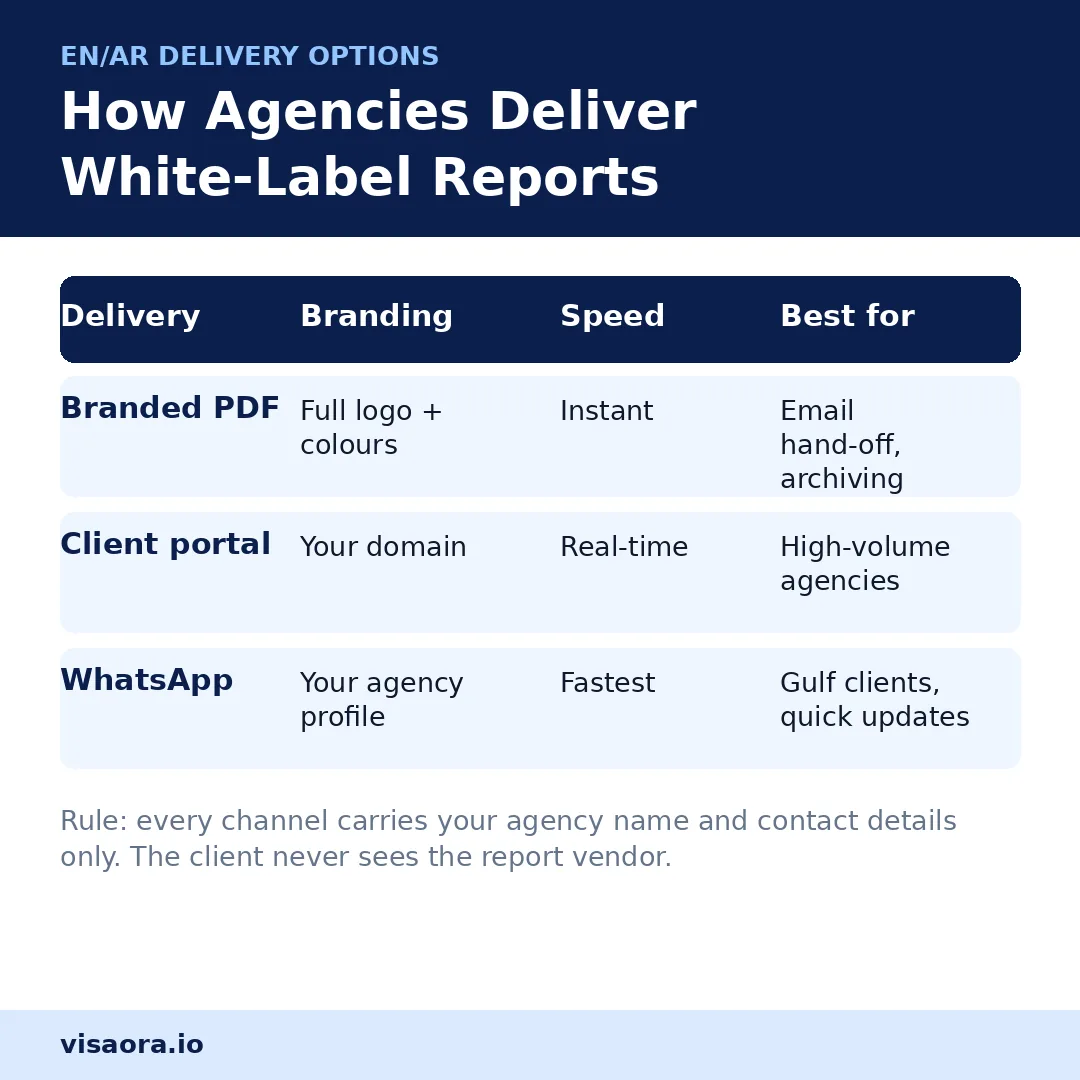
A branded PDF works for almost everyone, a client portal works best at high volume, and WhatsApp is the fastest way to reach Gulf clients. Most successful agencies use two of the three.
| Channel | Branding | Speed | Best for |
|---|---|---|---|
| Branded PDF | Full logo and colours | Instant | Email hand-off, archiving, printing |
| Client portal | Your domain and theme | Real-time updates | High-volume agencies, corporate clients |
| Your agency profile | Fastest | Gulf clients, quick updates, reminders |
The branded PDF is the workhorse: emailable, printable and archivable without losing your branding. A portal adds real-time updates for corporate clients. WhatsApp is where Gulf clients actually read things. Whichever you use, every version must carry your agency’s name only, never the vendor’s name or watermark. That is what makes the report white-label rather than just branded.
How do you measure whether client reports build trust?
Track repeat business and referrals, not downloads. Three measures work well: the re-booking rate (clients starting a second application within a year), the referral share (new clients who name an existing client), and the document turnaround time (days from request to full document set). A clear checklist shortens the third, because the client knows exactly what to bring.
Also watch how many clients call asking “what do I do next?” after receiving the report. That number should fall, because the final section is a numbered action plan. It is the same logic behind a solid refusal-rebuild workflow: structure replaces panic.
Example: a Dubai agency’s first white-label case file
The following is a labelled example scenario, not a real client case.
A five-person agency in Deira, Dubai takes on a Pakistani engineer on a UAE residence visa who wants a Schengen visa for a two-week holiday in Spain and France. The agency’s old process was a WhatsApp thread: “Send your bank statement”, “Send your NOC”. The client sent documents in random order and called four times asking what was missing.
With a white-label case file, the agency sends one branded PDF after intake: logo and client summary on page one, a readiness score of 62% with three missing items on page two (travel insurance of at least EUR 30,000 per the official VFS Global requirements page; a hotel booking for the second week; a salary certificate), and five numbered next steps in English and Arabic on the final page. The client sent everything within three days and referred two colleagues within a month.
What does the setup checklist look like before your first client?
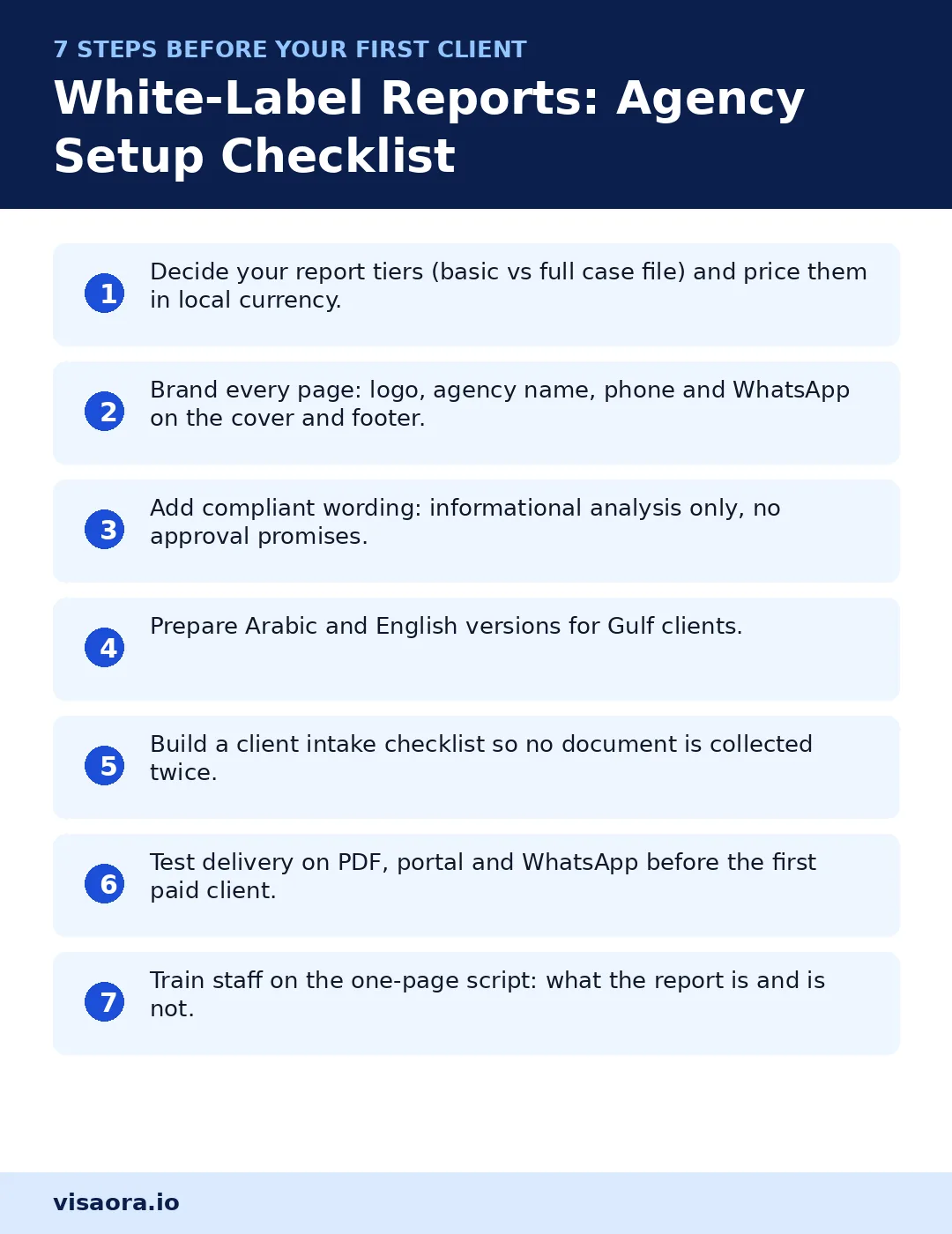
Seven steps, done once, reused forever.
- Decide your report tiers. A basic checklist report and a full case file, priced in local currency.
- Brand every page. Logo, agency name, phone and WhatsApp on the cover and in every footer.
- Add compliant wording. Informational analysis, never a promise of approval.
- Prepare Arabic and English. Mirror the section order; check every date and number matches.
- Build an intake checklist. One standard document list, so nothing is collected twice.
- Test all three channels. Send a test report through PDF, portal and WhatsApp first.
- Train staff on the script. One minute on what the report is and is not.
Common mistakes agencies make with white-label reports
- Leaving the vendor’s watermark on. One visible software brand inside “your” report and the client stops believing it is yours. Check every page of every export.
- Promising outcomes. “Our reports ensure approval” is the fastest way to lose a dispute and your reputation.
- Sending one language only. An English-only report to an Arabic-speaking family gets forwarded to someone else to explain.
- Burying the next steps. If the action plan sits on page nine in small print, clients will still call you. Put it last, numbered, impossible to miss.
- Mixing client data between files. Copy-pasting between reports is how the wrong passport number lands in the wrong file. Under rules like Saudi PDPL (see our PDPL guide), it is a compliance risk too.
Give every client a professional case file
Visaora Agency Leads builds white-label visa case files with readiness and refusal-risk analysis under your agency’s name. Packs from $149.
Request a Free Sample Case File →
Want more qualified leads? Get a free branded visa checker that sends leads to your WhatsApp: Visaora Agency Leads
See how white-label reports work in practice: Visaora Agency Leads builds branded case files under your agency’s name, and Visaora free tools shows the consumer version your clients would recognise.
Frequently asked questions
What is a white-label visa report?
A professional case file an agency delivers under its own brand: document checklist, proof-of-funds summary, refusal-risk analysis and interview preparation, with the agency’s logo and contact details on every page and no trace of the software vendor.
How much should an agency charge for a white-label case file?
Most Gulf agencies bundle the report into their service fee or charge it as a premium tier. Price it in your local currency, keep it proportional to your total fee, and offer a basic and a full tier.
Can white-label reports mention approval chances?
They can describe refusal risks, but never promise an outcome. Say the report provides informational analysis of application readiness, and rank risk factors without stating verdicts.
Should reports be in English or Arabic for Gulf clients?
Both. English is the language of the visa process; Arabic is how most Gulf clients read comfortably and share the report with family. Mirror the section order in both versions and check every figure matches.
How do clients usually receive these reports?
Branded PDF by email, a client portal on the agency’s own domain, or WhatsApp. Most agencies use a branded PDF as the standard hand-off and WhatsApp for speed.
How long does it take to set up white-label reporting?
About a week for the checklist, branding, compliant wording and both language versions. After that, each report takes minutes once templates are in place.
Sources
- European Commission, Migration and Home Affairs: Entry/Exit System fully operational (10 Apr 2026) — official announcement
- EU official Entry/Exit System portal — travel-europe.europa.eu/en/ees
- VFS Global, Switzerland visa information, Qatar (fee and document requirements) — official VFS page
Visaora provides software tools and general information, not legal advice. Rules change; always confirm with the official authority.
✈️ Planning Your Trip?
We may earn a commission — at no extra cost to you. Learn more