Most Gulf visa agencies collect documents on WhatsApp. A passport scan arrives at midnight, a bank statement follows as six blurry photos, the salary certificate turns up three days later in Arabic with no translation. It works — until a missing NOC or a stale statement turns a winnable file into a refusal letter. This guide lays out a visa agency document collection workflow built for the Gulf: the document set by destination, a 3-stage intake that replaces chat-chasing, recency and format rules, privacy basics, and how documents become a proper case file. The Visaora Agency Suite can turn that finished collection into a client-ready case file, but the collection discipline has to come first.
By Team Visaora · Updated October 2026 · 8 min read
Quick Answer: Good visa agency document collection has three stages: (1) chat intake that captures the client profile and sends a published checklist on day one; (2) secure upload with document-by-document verification; and (3) case-file assembly with written client acknowledgement and version control. Gulf files also need residence items like Emirates ID or iqama, and translations and attestations must start early.
Key Takeaways
- Consulates decide on paper: a complete, consistent file removes the most common administrative refusal grounds.
- A 3-stage intake ends the WhatsApp chase and creates a paper trail that protects the agency.
- Gulf files need residence-specific documents: Emirates ID or iqama, salary certificate, tenancy proof, and an NOC in Arabic where required.
- Stale statements and missing translations are the top file-killers — check recency first.
- Privacy basics: collect with consent, store securely, keep data only as long as needed, and check local rules with counsel.
In This Guide
- What does a Gulf client’s document set look like by destination?
- How does a 3-stage intake replace WhatsApp chasing?
- What recency and format rules should your intake enforce?
- How do data protection rules affect client files in the UAE and Saudi Arabia?
- How do collected documents become a case file?
- Which checklist templates should every agency keep ready?
- Common mistakes agencies make collecting documents
- Frequently asked questions
What does a Gulf client’s document set look like by destination?
The core documents are the same everywhere — passport, photos, form, itinerary, accommodation, insurance — but every destination adds twists, and the Gulf adds a residence layer. Schengen asks for travel medical insurance of at least EUR 30,000 including repatriation. The UK has no fixed minimum balance — caseworkers judge whether funds look credible and consistent. The UK visit visa fee is GBP 135 as of October 2026 (fees change; check GOV.UK before paying).
Then comes the Gulf layer, where agencies add real value. An applicant in Dubai is not just a tourist-visa applicant — they are a UAE resident whose file must prove legal residence:
| Destination | Core set | Gulf residence items your intake must capture |
|---|---|---|
| Schengen (tourist) | Passport, photos, form, insurance EUR 30,000+, itinerary, hotel bookings | Emirates ID (front/back), residence visa page, salary certificate, Ejari/tenancy contract, NOC from employer (often in Arabic) |
| UK (visitor) | Passport, form, employer letter, bank statements, travel history | Emirates ID or iqama copy, salary certificate, 6-month stamped statements, tenancy proof, exit/re-entry beyond travel dates (KSA) |
| US (B1/B2) | Passport, DS-160, ties evidence, interview prep | Emirates ID or iqama, salary certificate, bank statements, proof of long Gulf residence |
| Canada (visitor) | Passport, forms, family information, biometrics, funds | Iqama or Emirates ID, salary certificate, bank statements, NOC with approved leave dates |
The pattern holds: identity, residence, employment, money, travel. Link your immigration client document checklist in every intake message so the client sees the full list on day one instead of discovering items one chat message at a time.
How does a 3-stage intake replace WhatsApp chasing?
Most whatsapp document collection runs entirely in chat threads. The fix is structural: stage one keeps chat in its lane. When the enquiry arrives, capture the profile — do not collect the documents. Send the published checklist link and record five facts in writing: nationality, residence country, destination, travel dates, and travel/refusal history. No promises in chat: the chat record is a profile, not an assessment.
Stage two moves collection off chat and onto a secure route. Passports, bank statements and IDs go through your office, a client portal, or a secure upload link. Per-file tools complement your CRM here: the CRM holds the relationship and reminders; the checklist and the verification pass hold file quality. Wire the intake into your immigration agency CRM so follow-ups run automatically.
Stage three assembles the verified documents into a case file: checklist matched item by item, gaps listed with deadlines, client acknowledges in writing, and the file is versioned — v1, v2, never overwritten.
The 3-stage intake, step by step
- Profile capture (Day 0–1, in chat). Send the checklist link. Record nationality, residence, destination, travel dates, travel history and prior refusals. Log which checklist version was sent.
- Document request (Day 1–2). One message lists every required document with one deadline. Ask for PDFs, one document per file, named clearly. No photos of screens.
- Secure collection (Day 2–7). Client uploads via portal, office visit, or secure link. Sensitive originals stay out of the chat thread.
- Verification pass (Day 7). Check every document against the checklist: names and dates match, formats are right, nothing is stale. Flag all gaps in one consolidated message.
- Assembly and acknowledgement (Day 7+). Build the case file, note gaps, get written client acknowledgement. Version it.
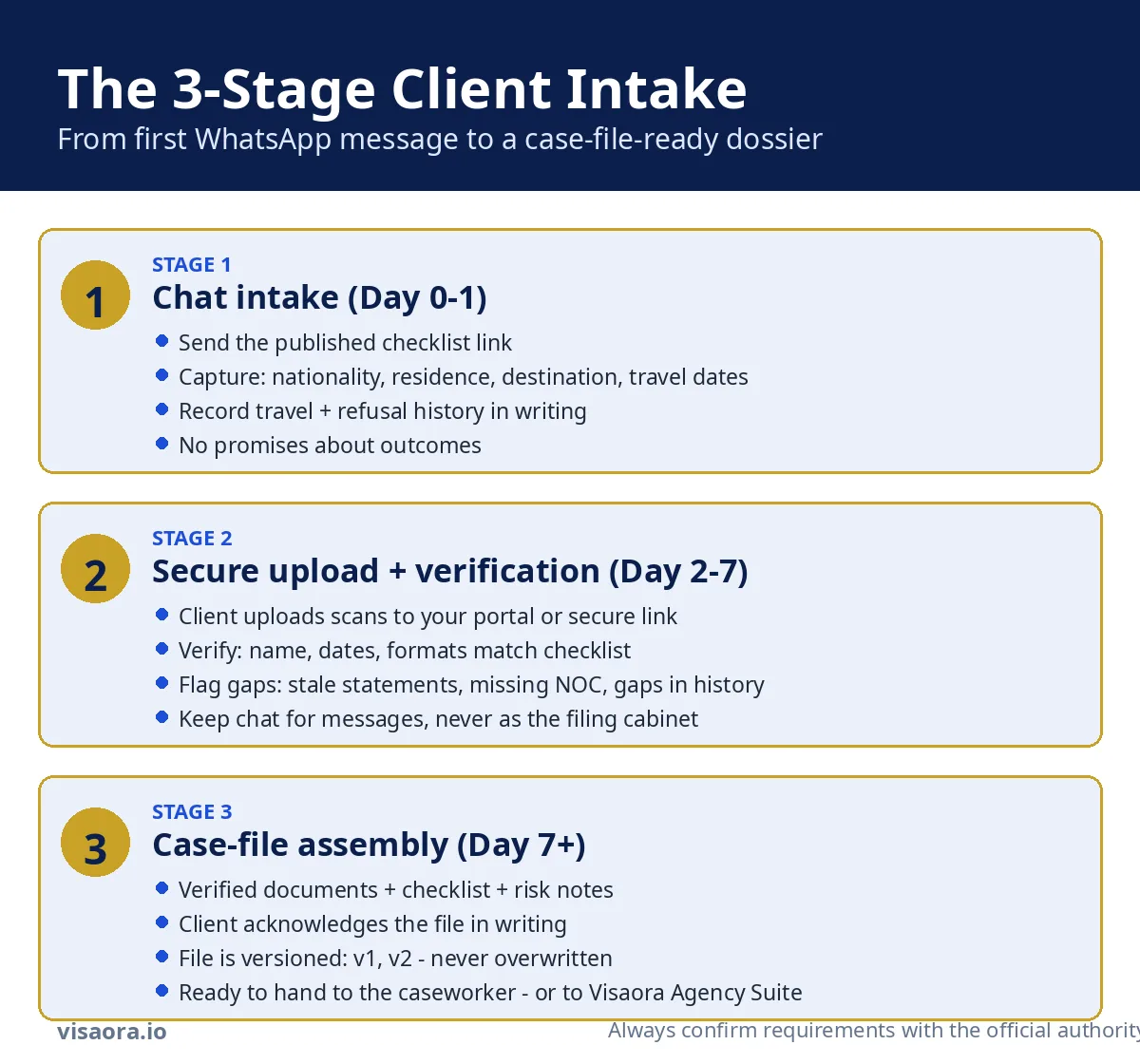
Caption: The 3-stage intake: profile in chat, documents through a secure route, everything verified before the case file is assembled.
What recency and format rules should your intake enforce?
Documents rot: a file assembled over three months and filed with a month-one bank statement gets refused. Run these five checks on every file:
- Bank statements must be recent at filing. Six months of history is the common ask, but the newest statement should be days — not weeks — old at submission. Flag unexplained deposits near the filing date.
- Police certificates have the longest lead time and a short life. They can take weeks to obtain and many destinations accept them only inside a limited validity window. Start them first.
- Translations must be certified where required, and exact. Schengen posts often expect sworn translators; the UK requires a full translation the Home Office can verify independently, with the translator’s confirmation, date, name, signature and contact details. One mistranslated name creates a discrepancy across the whole file.
- Attestations take weeks — plan the chain. Gulf routes commonly need home-country attestation plus embassy plus MOFA. Each step has its own queue; start the day the document exists.
- Residence documents must outlast the trip. Emirates ID and iqama should be valid beyond the travel dates.
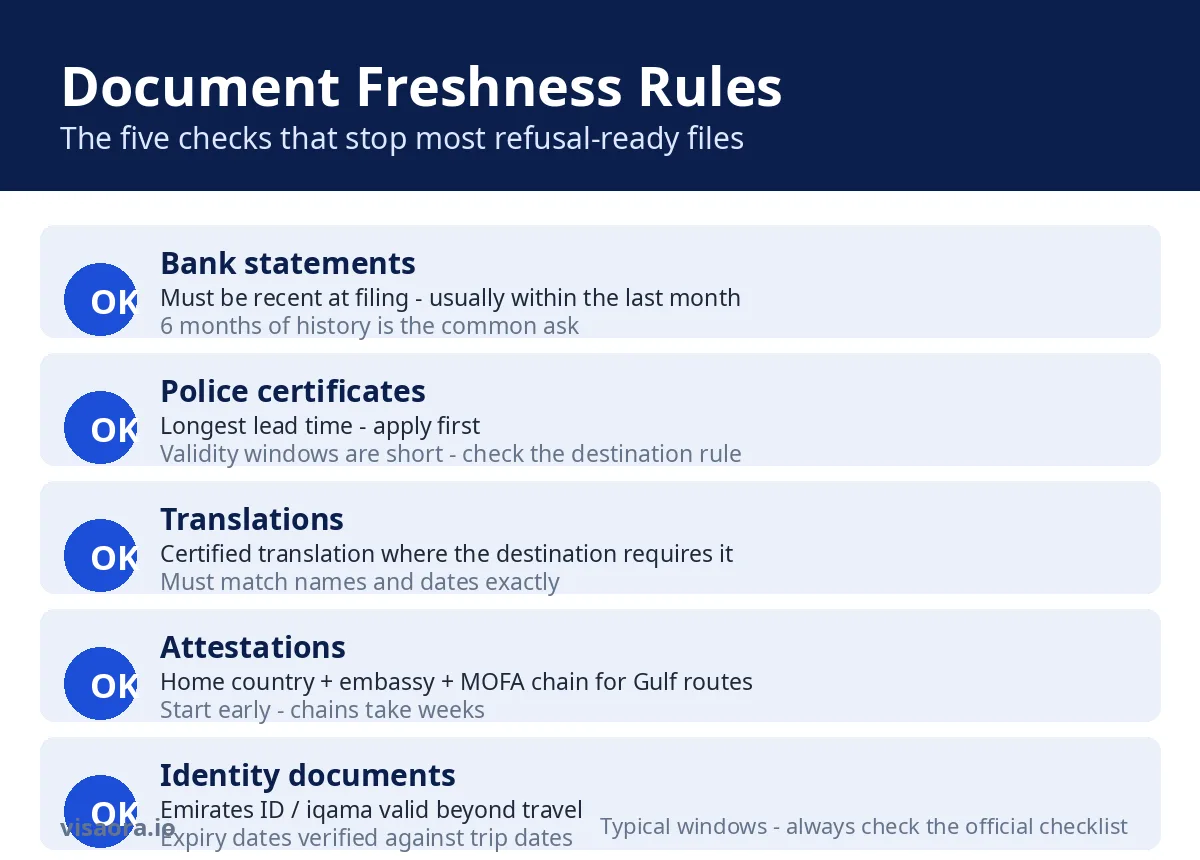
Caption: Five freshness checks to run on every file before submission — with the destination’s official checklist as the final word.
How do data protection rules affect client files in the UAE and Saudi Arabia?
You collect the most sensitive documents a person owns — passports, bank statements, salary details, family records. Two Gulf data protection laws now sit over that work, and agencies should know they exist even if the fine detail needs a lawyer.
In the UAE, Federal Decree-Law No. 45 of 2021 on the Protection of Personal Data has been in force since 2 January 2022. It covers personal data of people in the UAE — including by controllers outside the country — with carve-outs for free zones and government data. In Saudi Arabia, the Personal Data Protection Law was issued by Royal Decree M/19 in 2021, amended by Royal Decree M/148 in 2023, and has been fully enforceable since 14 September 2024, with the Saudi data authority (SDAIA) enforcing it.
The practical takeaways are the same in both markets:
- Collect with consent. State what you are collecting and why in the intake message itself. Keep that message.
- Keep chat out of the filing cabinet. WhatsApp is where clients talk; it is not where passport scans should live. Move sensitive files to controlled storage on arrival and clear stray copies from phones and shared inboxes.
- Limit access and retention. The caseworker needs the file; the whole office does not. Keep client data only as long as the case — and any complaint window — requires, then dispose of it securely.
This is general information, not legal advice, and the regulations behind both laws are still being completed. Check the position with local counsel before writing your agency’s privacy policy — but do write one. A one-page policy the client sees at intake beats a perfect one nobody reads.
How do collected documents become a case file?
Collection is the raw material; the case file is the product. Once the visa document verification pass is clean, the documents feed four things: the checklist with gaps closed, the cover-letter consistency check (every date and name the same everywhere), plain-language risk notes without promises, and the filing timeline. That is where structured collection pays twice: a stronger file, and a written record of what was checked.
If a client later disputes what they were told, or a regulator asks what service was delivered — Saudi Arabia’s HRSD has suspended recruitment offices over unresolved client complaints — the versioned case file is the deliverable. A chat thread is not. For the assessment side of the same discipline, see our post on how agencies reduce client visa refusals.
Example (illustrative): A Dubai-based sales manager wants a Schengen tourist visa for a 10-day France trip in December. Day 1: the agency sends the checklist link and records her profile — Indian passport, UAE residence visa valid to 2028, no prior refusals. Day 3: she uploads documents through the secure link. Verification finds two gaps: bank statements ending six weeks before filing, and an NOC in English only while an Arabic version exists. Day 5: both arrive, everything matches, and the file is assembled as v1 with her acknowledgement.
Which checklist templates should every agency keep ready?
Six templates, kept current, sent as links — never retyped in chat:
- Schengen tourist — EUR 30,000 insurance line, photo spec, Gulf residence items.
- UK visitor — employer letter format, 6-month statements, translation rules for Arabic documents.
- US B1/B2 — DS-160 data consistency, ties evidence, interview-prep items.
- Canada visitor — family information forms, biometrics note, funds presentation.
- Employment add-on — CV format rules per destination (the CV resume format helper covers country conventions), experience letters with exact dates, degree attestations.
- Refusal rebuild — prior refusal letter, what changed since, fresh evidence only.
Generate the base versions with the Document Checklist Generator, then add your Gulf-specific items. Review each template quarterly against the official embassy checklists — an outdated template teaches staff the wrong file.
Common mistakes agencies make collecting documents
- Treating WhatsApp as the filing system. Documents disappear into scrollback, get forwarded to the wrong thread, and cannot be searched when a dispute arrives.
- Requesting documents one at a time. “Now send your tenancy contract” after the client thought the file was complete destroys trust. Send the whole list once, with one deadline.
- Accepting photos of screens. A phone photo of a statement on a laptop screen is illegible at best, rejected at worst. Ask for source PDFs — bank-generated, stamped where required.
- Skipping the verification pass. Collecting is not checking. The officer will compare names and dates across documents if you don’t.
- Starting translations and attestations last. They have the longest lead times in the file. Starting them on day 20 of a 30-day plan fails the plan.
- Overwriting versions. Supersede the file (v1 → v2) when a client re-submits. The history is your evidence if the file is ever questioned.
Give every client a professional case file
Visaora Agency Suite builds white-label visa case files with readiness and refusal-risk analysis under your agency’s name. Packs from $149.
Request a Free Sample Case File →Want more qualified leads? Get a free branded visa checker that sends leads to your WhatsApp: Visaora Agency Leads
Frequently asked questions
How should a visa agency collect client documents?
Use a 3-stage intake: capture the client profile and send the full checklist in chat on day one, collect documents through a secure portal or office visit rather than the chat thread, then verify every document against the checklist before assembling a versioned case file with written client acknowledgement.
What documents do Gulf agencies need from visa clients?
Beyond the standard set (passport, photos, form, itinerary, bookings, insurance), collect residence proof: Emirates ID or iqama, the residence visa page, salary certificate, tenancy contract, bank statements, and an employer NOC — often in Arabic. Match the exact list to the destination’s official embassy checklist.
Is it safe to collect documents over WhatsApp?
WhatsApp suits messages and the checklist link, but it is a poor filing cabinet. Sensitive scans in a shared thread are hard to control, easy to forward wrongly, and difficult to delete. Collect passports, bank statements and IDs through a secure upload route, and clear stray copies from phones and shared inboxes.
How do agencies verify client documents?
Run a document-by-document verification pass: identical names and dates across every document, formats matching the destination spec (photo size, PDF, certified translations), recency inside the destination’s windows, and complete attestation chains. Flag every gap in one consolidated message with one deadline, then re-verify on resubmission.
What is a client portal for a visa agency?
A client portal visa agency setup gives clients a secure space to upload documents, track checklist status, and receive updates — replacing scattered chat threads. It pairs with a CRM: the CRM manages the relationship and reminders, while the portal and the checklist hold file quality. Per-file case-file tools complement both.
How long should an agency keep client documents?
Keep them only as long as the case requires plus any period needed for complaints or disputes, then dispose of them securely. Both the UAE and Saudi Arabia have personal data protection laws expecting data minimisation and purpose limitation. Write a short retention rule into your agency policy and check the details with local counsel.
What should a document checklist template include?
The full document list for one destination, the required format per item (PDF, certified translation, attestation chain), the recency rule, who it applies to (employed, self-employed, family), and your agency’s submission deadline. Review templates quarterly against official embassy checklists, because requirements change.
Sources
- European Commission — Schengen visa policy (insurance and document basics): home-affairs.ec.europa.eu
- GOV.UK — Guide to supporting documents, visiting the UK (translations, evidence): gov.uk
- Saudi HRSD — office suspensions over unresolved client complaints: hrsd.gov.sa
- SDAIA — Saudi Personal Data Protection Law knowledge centre: dgp.sdaia.gov.sa
- UAE Federal Decree-Law No. 45 of 2021 on the Protection of Personal Data (in force 2 January 2022); Saudi PDPL, Royal Decree M/19 (2021), amended M/148 (2023), fully enforceable since 14 September 2024 — summarised from multiple legal analyses; check with local counsel for your agency’s position.
Related reading: Visaora Agency Suite · Document Checklist Generator · CV Resume Format Helper · Do You Need an Immigration Agency CRM? · How Agencies Reduce Client Visa Rejections
CTA: Running an agency? Request a free sample case file and turn your collected documents into a white-label client deliverable with Visaora Agency Suite. Agencies: turn this intake workflow into client-ready case files with Visaora Agency Suite.
Visaora provides software tools and general information, not legal advice. Rules change; always confirm with the official authority.
✈️ Planning Your Trip?
We may earn a commission — at no extra cost to you. Learn more
Pingback: How UAE Visa Agencies Price Services in 2026 - Visaora