A refused Schengen file is not a dead file — it is a diagnosis. The EU’s standard refusal notice (Annex VI of the Schengen Visa Code) ticks numbered reason codes, and a schengen refusal reapply agency workflow starts there: decode every ticked code, run the appeal-versus-fresh-application decision tree before the national deadline, and reapply only with a materially stronger file. Deadlines are short (France: 30 days, Germany: one month), a fresh application costs a new €90 visa fee, and the same facts earn the same refusal — so the rebuild has to be real, documented, and honest about what cannot be promised.
Last reviewed: 20 October 2026
Quick Answer: A refused Schengen visa means the EU’s standard refusal notice ticked one or more numbered reason codes. Your agency’s rebuild job: (1) map every ticked code to a specific fix, (2) run the appeal-vs-fresh-application decision tree before the national deadline — France: administrative appeal within 30 days of notification, Germany: remonstration within one month — and (3) reapply only with a materially stronger file. Document each step in a dated 5-scan rebuild report the client can hold.
Key Takeaways
- The refusal form (Annex VI, Schengen Visa Code) lists numbered reason codes — decode the ticks before doing anything else.
- Appeals follow national law and the deadlines are short: France administrative appeal within 30 days of notification (2023 rules); Germany remonstration within one month. The refusal notice itself carries the competent authority and deadline — read it the day it arrives.
- A fresh application needs materially new evidence plus a new €90 visa fee (as of 20 October 2026, per the European Commission). Identical files get refused again — refusal data is shared Schengen-wide through the Visa Information System (VIS).
- Build an evidence-delta table: every ticked ground → what was weak → what the new file contains.
- Since 10 April 2026 the Entry/Exit System (EES) records entries and exits digitally — travel history is now verifiable, which sharpens readings of overstay and ties grounds.
- Price the professional work, never the outcome. Schengen appointments are free — never sell them.
In This Guide
Read the refusal form: standard reason codes every schengen refusal reapply agency must decode
Every Schengen refusal arrives on the same EU-wide form — the standard form for notifying and motivating refusal, annulment or revocation of a visa (Annex VI of the Visa Code). The officer ticks the reason codes that apply, and the form must also tell the applicant how to appeal: the national-law reference, the competent authority, and the time limit. That last part matters — the notice itself is your deadline source of truth.
The form lists ten refusal grounds. Here they are in the form’s own phrasing, with the rebuild direction for each:
| Code | The form says | Rebuild direction |
|---|---|---|
| 1 | False/counterfeit/forged travel document presented | Not a rebuild case — licensed adviser only |
| 2 | Purpose and conditions of stay not justified | Day-by-day itinerary with dated bookings |
| 3 | Means of subsistence not proven, or not lawfully acquirable | Salary-credited statements, not lump-sum deposits |
| 4 | Three months already stayed in the current six-month period | Wait out the 90/180 window; check the digital record |
| 5 | SIS alert issued for refusing entry | Legal advice; consider the appeal route |
| 6 | Threat to public policy, security, public health or relations | Not a rebuild case — licensed adviser only |
| 7 | Adequate and valid travel medical insurance not provided | Schengen-compliant policy for the full stay |
| 8 | Information on purpose/conditions of stay not reliable | Consistency audit across every document |
| 9 | Intention to leave before visa expiry not ascertained | Ties package: job, iqama, tenancy, family, history |
| 10 | Insufficient proof justifying a border visa application | Rare in Gulf practice; read the notice |
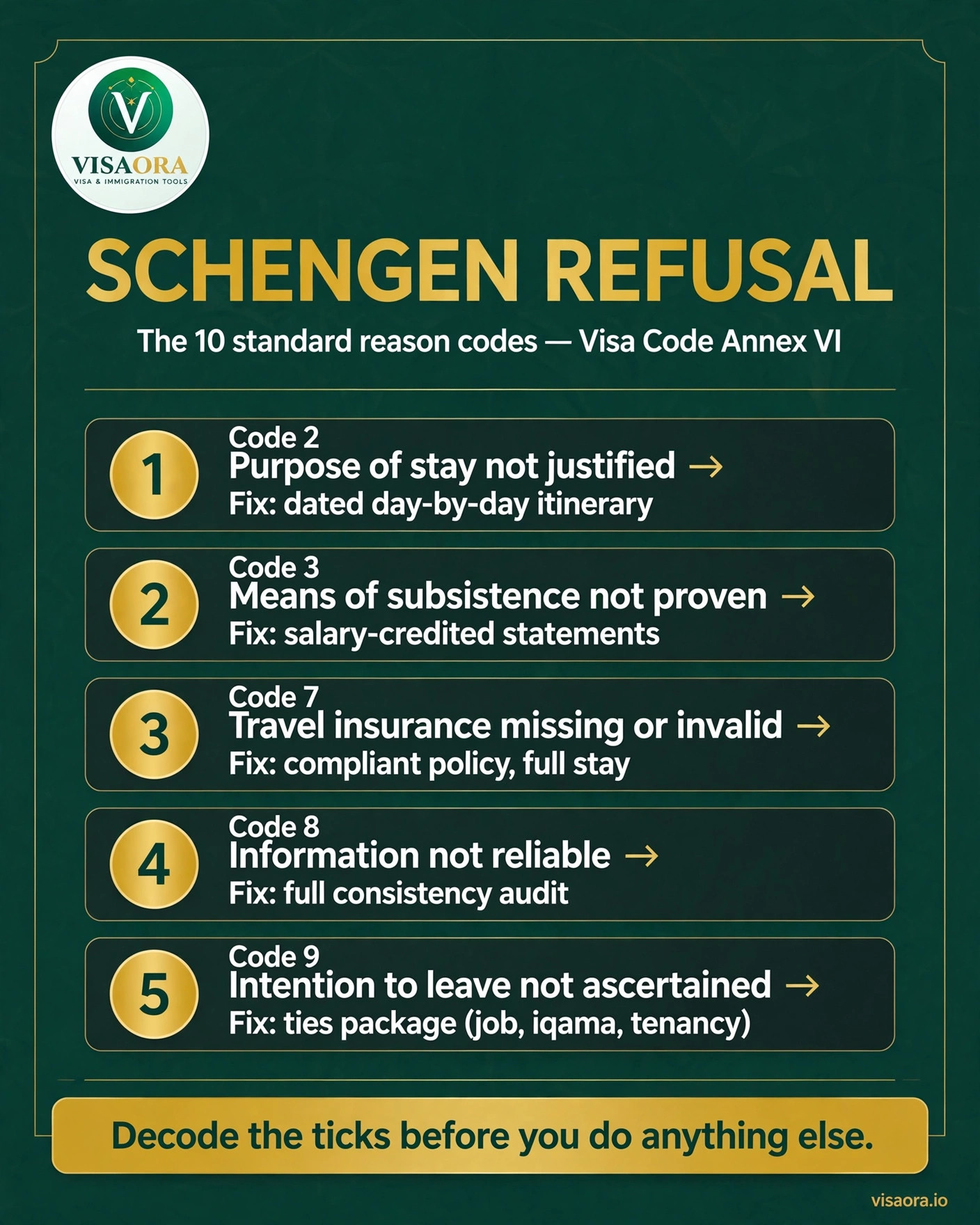
The three codes Gulf agencies see most — 2, 3 and 9 (purpose, funds, ties) — are also the most fixable. That is exactly why refusal recovery is a sellable agency product: the fix is professional document work, not luck.
A worked example. Take a hypothetical client, Imran: Pakistani passport, Dubai residence visa, first-time applicant, refused under codes 2 and 9. His purpose read “tourism — 10 days”; his statement showed one large deposit a week before applying. The rebuild: a dated day-by-day itinerary with bookings in his name, six months of salary-credited statements, an employment letter with approved leave dates, and his tenancy contract. Each tick answered by specific evidence — that is the product.
Appeal vs fresh application: a decision tree (no guarantees)
Once the codes are decoded, the file takes one of three paths. Decide within 48 hours of receiving the refusal — deadlines run from notification.
| Path | Choose it when | Watch out |
|---|---|---|
| Appeal | A ticked ground is factually wrong — valid insurance misread, a SIS alert under the wrong identity — and travel dates still work | Costs time, not a new fee; does not suspend the refusal |
| Fresh application | The ground is fixable — missing documents, weak funds, unclear purpose — and the file can be materially strengthened | New €90 visa fee (as of 20 October 2026); the old refusal sits in VIS |
| Neither yet | Codes 1 or 6 (fraud, security) — legal advice first; code 4 (overstay) — the window must be waited out | Reapplying without clearance deepens the record |
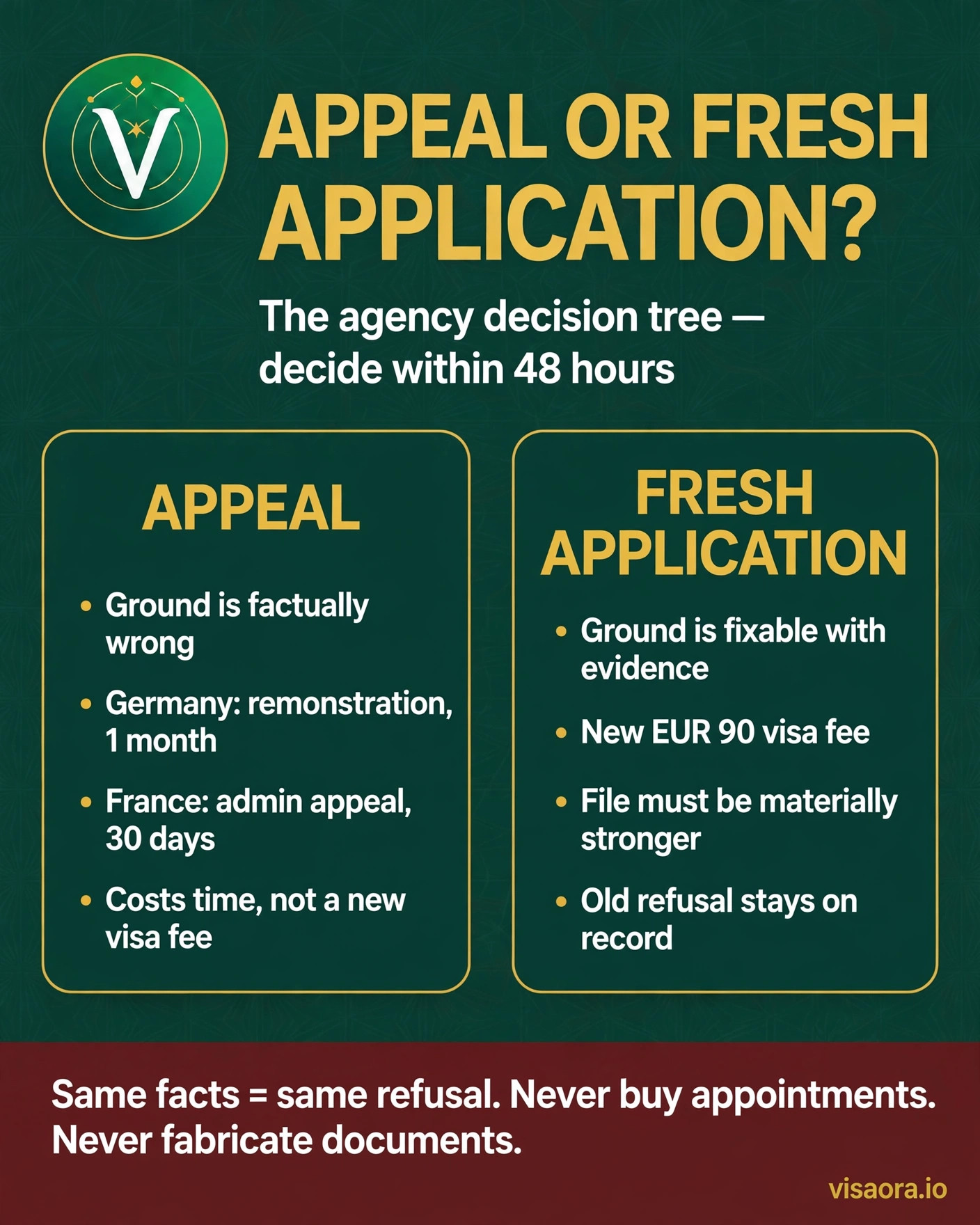
Know the deadlines. Germany: the remonstration — a written objection asking the mission to re-examine the refusal — can be filed within one month of receipt (Federal Foreign Office guidance; no fee for the objection itself). France: since the January 2023 reform, the administrative appeal must be filed within 30 days of notification (Article D312-4 of the CESEDA) — older guides still say two months; that figure is outdated. For every other Member State, the refusal notice names the competent authority and the time limit: read it the day it arrives and calendar the deadline.
The trap to warn clients about. Reapplying through a different Schengen country to dodge the refusal does not work: refusal data sits in the VIS for all Schengen states to see, and the main-destination rule still requires applying through the country of the longest stay. Run the old file through our Schengen visa rejection predictor first — a fast way to show the client which grounds the next file must beat. For appeal mechanics (who writes to whom, in what language, by which channel), attach our Schengen rejection appeal guide.
And never, at any stage, suggest buying an appointment, booking fake hotels, or “fixing” a document. VFS states publicly that Schengen appointments are free and released up to six months ahead — a parallel market of bots resells them, and your agency must stay out of that market entirely.
Evidence delta: what changed since last file
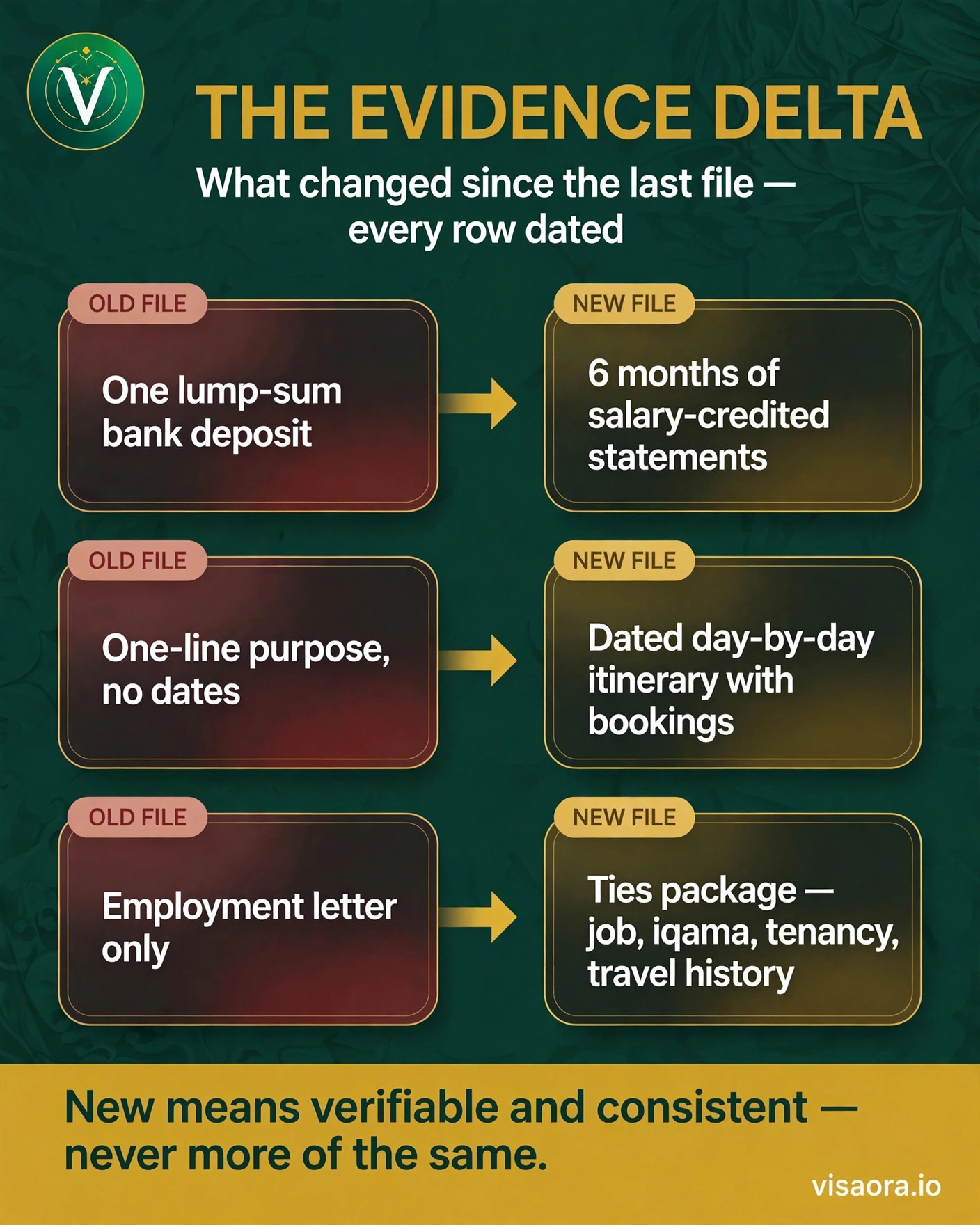
This is the heart of the rebuild SOP. For every ticked ground, write three columns: what the old file had, what was wrong, what the new file contains. “New” does not mean “more” — it means verifiable and consistent. Consulates verify documents; a fabricated payslip turns a fixable code-3 refusal into a code-1 problem and poisons every future application.
| Ticked ground | Old file had | New file must have |
|---|---|---|
| 2 — purpose not justified | One-line purpose, no dates | Dated day-by-day itinerary: cities, dates, hotels in the applicant’s name, internal transport reservations |
| 3 — means of subsistence | Single large deposit before applying | Six months of statements with salary credits matching the salary certificate; unusual deposits explained in writing with proof |
| 7 — insurance | Generic policy, wrong dates | Schengen-compliant insurance for the full stay — check the consulate checklist for required coverage |
| 8 — not reliable | Job title on the form differs from the letter | Consistency audit: names, dates, titles, amounts identical across form, letter, bookings, insurance — two-staff sign-off |
| 9 — intention to leave in doubt | Employment letter only | Ties package: leave letter, salary slips, tenancy contract (Ejari), iqama validity, family ties, prior travel with on-time returns |
One change since April sharpens every ground-4 and ground-9 read: the Entry/Exit System has been fully operational at all external Schengen border crossing points since 10 April 2026 (European Commission, updated 17 September 2026), recording entries, exits, travel-document data and biometrics. Travel history is now digitally checkable — a clean EES record is real evidence of compliance. Run the client’s history through our Schengen travel-history analyzer and file the result.
A worked example. Take a hypothetical client, Sana: Indian passport, Saudi iqama, refused under codes 3 and 8. Her statements showed genuine salary credits — plus two unexplained deposits, and a job title that differed from the application form. The fix: the same six months of statements with a one-page written explanation for each anomaly, and a corrected letter with matching title. Nothing invented, everything explained. That is an evidence delta.
Building the rebuild case file (5 scans)
A rebuild without a file is a story. A rebuild with a file is a service you can price, defend and repeat. One case file per refused client, five scans:
- 1. Client profile & refusal intake — passport and residence details (iqama/Emirates ID validity), the refusal notice scanned with ticked codes highlighted, the original application copy, and the appeal deadline calendared from the notice date.
- 2. Reason-code analysis — each ticked ground restated in plain language, with your agency’s read of why the officer ticked it.
- 3. Evidence delta — the before/after table above, every change dated and attributed to a staff member.
- 4. Fresh-file checklist — every document in the new application, issue date, recency check, two-person consistency sign-off before submission.
- 5. Client report — the deliverable (template below), with the client’s signed acknowledgment of receipt.
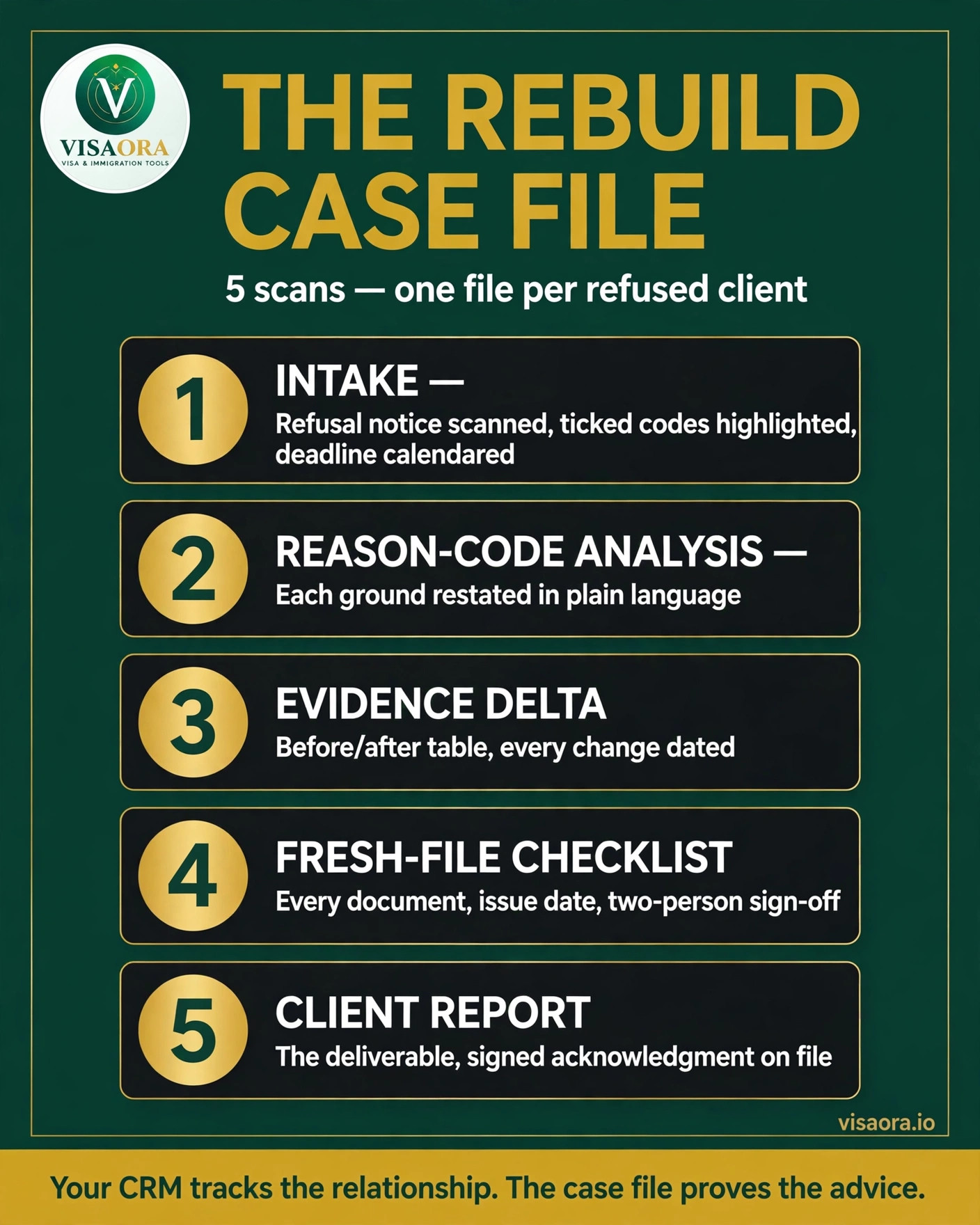
Per-file client deliverables that complement your CRM: the CRM tracks the relationship; the case file proves the advice. See the model in how agencies reduce client visa rejections, and request a free sample case file to see how the five scans read in your own branding.
Pricing a rebuild service ethically
Refusal recovery is premium work — price the work, never the outcome.
- Charge for the assessment, the rebuild, and appeal drafting as separate line items. Never tie the fee to approval — “pay X if approved” is guarantee language, and that is where complaints begin.
- Disclose the consulate fee separately. The short-stay visa fee is €90 for adults and €45 for children aged 6 to under 12 (European Commission, effective 11 June 2024) — paid to the mission or visa centre, non-refundable on refusal, and not your revenue. State that in writing. “Fees change. Check the official website before you pay.” — the Commission’s fee notice.
- Never sell appointments. VFS states appointments are free; bots and unofficial sellers charge for them anyway. If your agency touches that market, it owns the reputational risk.
- Sell the no-go call too. If a file cannot be fixed — codes 1 or 6, an active SIS alert, a fresh overstay — say so, charge only the assessment, and put the refusal to reapply in writing. Clients remember the agency that refused their money.
Demand context for sales conversations: VFS told Gulf News that Schengen demand has grown nearly 10% year on year and is up almost 22% since 2022. More applications mean more refusals — and a bigger market for agencies that rebuild files properly.
Client report template
The report is the product the client takes home. One to two pages, plain language:
- Cover — agency letterhead, client name, file reference, report date.
- What happened — refusal date, issuing consulate, ticked reason codes quoted from the notice.
- Code-by-code reading — each ticked ground in plain language: what the officer saw.
- Evidence delta — before/after table: what was weak, what changed.
- The plan — appeal or fresh application, with the deadline (appeal) or the €90 fee and resubmission timing (reapply).
- What we need from you — document list, each with a due date.
- Costs — service-fee breakdown plus the €90 consulate fee, paid to the mission and non-refundable on refusal. “Fees change. Check the official website before you pay.”
- No-guarantee statement — “We cannot guarantee any visa outcome or timeline. Our service is professional document preparation and advice.”
- Sign-off — client acknowledgment signature and date; a copy stays in the file.
File the signed copy with the five scans. If a client later disputes what they were told, the dated report is your evidence.
Frequently Asked Questions
Can my client reapply immediately after a Schengen refusal?
For most refusal grounds there is no mandatory waiting period — reapply as soon as the file is materially stronger. But an unchanged file is usually refused again, and the earlier refusal is visible to every Schengen state through the VIS. Fix the ticked grounds first, then reapply.
Is it better to appeal or reapply after a Schengen refusal?
Appeal when a ticked ground is factually wrong — the evidence was there but misread. Reapply when the ground is fixable: missing documents, weak funds, unclear purpose. Appeals cost time rather than a new fee; fresh applications cost a new €90 fee and need genuinely new evidence.
How long do Schengen visa appeals take?
It varies by Member State. Germany’s remonstration often gets a reply within weeks; France’s administrative appeal can sit unanswered for two months (silence counts as rejection), and court routes take many months. The filing deadlines matter most: one month for Germany, 30 days for France.
Does a Schengen refusal affect future applications?
Yes — refusals are recorded in the VIS and visible to all Schengen consulates. That is why the rebuild must answer the old grounds explicitly: a new file that reads as if the refusal never happened invites the same decision. A documented evidence delta turns the record into a strength.
Can the client apply through a different Schengen country after a refusal?
No — applicants must apply through the country of the longest stay, and all Schengen states share refusal data through the VIS. Switching countries to dodge a refusal backfires: the officer already sees the record, and the move adds a credibility problem to the file.
Which refusal reasons are the hardest to fix?
Codes 1, 5 and 6 — false documents, SIS alerts, security or public-health threats — are not rebuild work; they need a licensed legal adviser, and fabrication makes everything worse. Code 4 (prior overstay) needs time, and since April 2026 the EES records it digitally.
Disclaimer: Visaora is software and does not provide legal advice. Requirements depend on your nationality and situation. Confirm with the official authority or a licensed adviser.
Sources
- European External Action Service — Standard form for notifying and motivating refusal, annulment or revocation of a visa (Annex VI, Visa Code): https://www.eeas.europa.eu/sites/default/files/annex_vi_visa_refusal_form_en_0.pdf
- EUR-Lex — Visa Code summary (refusal grounds, Article 32 appeal rights, standard form): https://eur-lex.europa.eu/legal-content/EN/TXT/?uri=LEGISSUM%3Ajl0028
- European Commission, Migration and Home Affairs — Schengen visa fee increased as of 11 June 2024 (€90 adults / €45 children 6 to under 12): https://home-affairs.ec.europa.eu/news/schengen-visa-fee-increased-11-june-2024-2024-06-13_en
- European Commission, Migration and Home Affairs — The Entry/Exit System fully operational since 10 April 2026 (updated 17 September 2026): https://home-affairs.ec.europa.eu/news/entry-exit-system-fully-operational-10-april-2026-who-exempt-2026-07-27_en
- Gulf News (20 May 2026) — VFS: Schengen demand growing nearly 10% year on year, up almost 22% since 2022; appointments are free: https://gulfnews.com/business/tourism/whats-making-schengen-visa-appointments-harder-to-get-for-uae-travellers-1.500546188
- German Federal Foreign Office (Embassy Doha) — remonstration within one month of receipt: https://doha.diplo.de/qa-en/service/visa/schengenvisa/2583816-2583816?isLocal=false&isPreview=false
Related reading: Visaora Agency Suite · Schengen visa rejection predictor · Schengen rejection appeal guide · How agencies reduce client visa rejections
CTA: Request a free sample case file from Visaora Agency Suite and see how a rebuild file reads in your own branding. Agencies: turn this into a client-ready case file with Visaora Agency Suite.
✈️ Planning Your Trip?
We may earn a commission — at no extra cost to you. Learn more
Pingback: Visa Agency Service Fees UAE: 2026 Pricing Guide for Owners