Saudi Arabia’s data-protection enforcement is no longer theoretical for small service businesses. In January 2026, the Saudi Data and AI Authority (SDAIA) reported that its review committees issued 48 decisions confirming violations of the Personal Data Protection Law (PDPL), with fines of up to SAR 5 million on the table. If your visa agency office in Saudi Arabia collects passport scans, iqama copies and family details from clients every day, this PDPL law is about you — not just about banks and telecoms.
Last reviewed: 17 October 2026
This guide translates PDPL into a visa-office routine: what you collect, how to ask for consent, how to store passport copies, how to share documents with VFS or TLS centres, when to delete old files, and what to do if something leaks. It is written for agency owners and office managers in Riyadh, Jeddah, Dammam and Al Khobar. Visaora is software and does not provide legal advice. Requirements depend on your situation. Confirm with the official authority or a licensed adviser — this is practical information only.
Quick Answer: Saudi Arabia’s PDPL applies to visa agencies of any size that handle client personal data. SDAIA issued 48 violation decisions with fines up to SAR 5 million. Agencies need written intake consent, purpose-limited data use, secure storage, 6–12 month retention, and a 72-hour breach response plan.
A tight checklist also keeps collection to what you need: the free document checklist generator lists only the documents a given application requires.
Key Takeaways
- PDPL applies to your visa office — not just banks and telecoms — if you collect passport scans and client details.
- SDAIA enforcement is active: 48 violation decisions reported in January 2026, fines up to SAR 5 million.
- Get written consent at intake naming the purpose, sharing parties, and retention period.
- Treat WhatsApp as transmission, not storage — move documents to the case file the same day.
- Keep one complete case file per client; delete files after your documented retention period ends.
In This Guide
What PDPL covers and who enforces it
The Personal Data Protection Law is Saudi Arabia’s national data-protection law. It protects the personal data of individuals — citizens, residents and visitors — and it applies to “data controllers,” which is any organisation that decides why and how personal data is processed. A visa agency that copies a client’s passport, saves the scan and uses it to prepare a visa application is a data controller under the law.
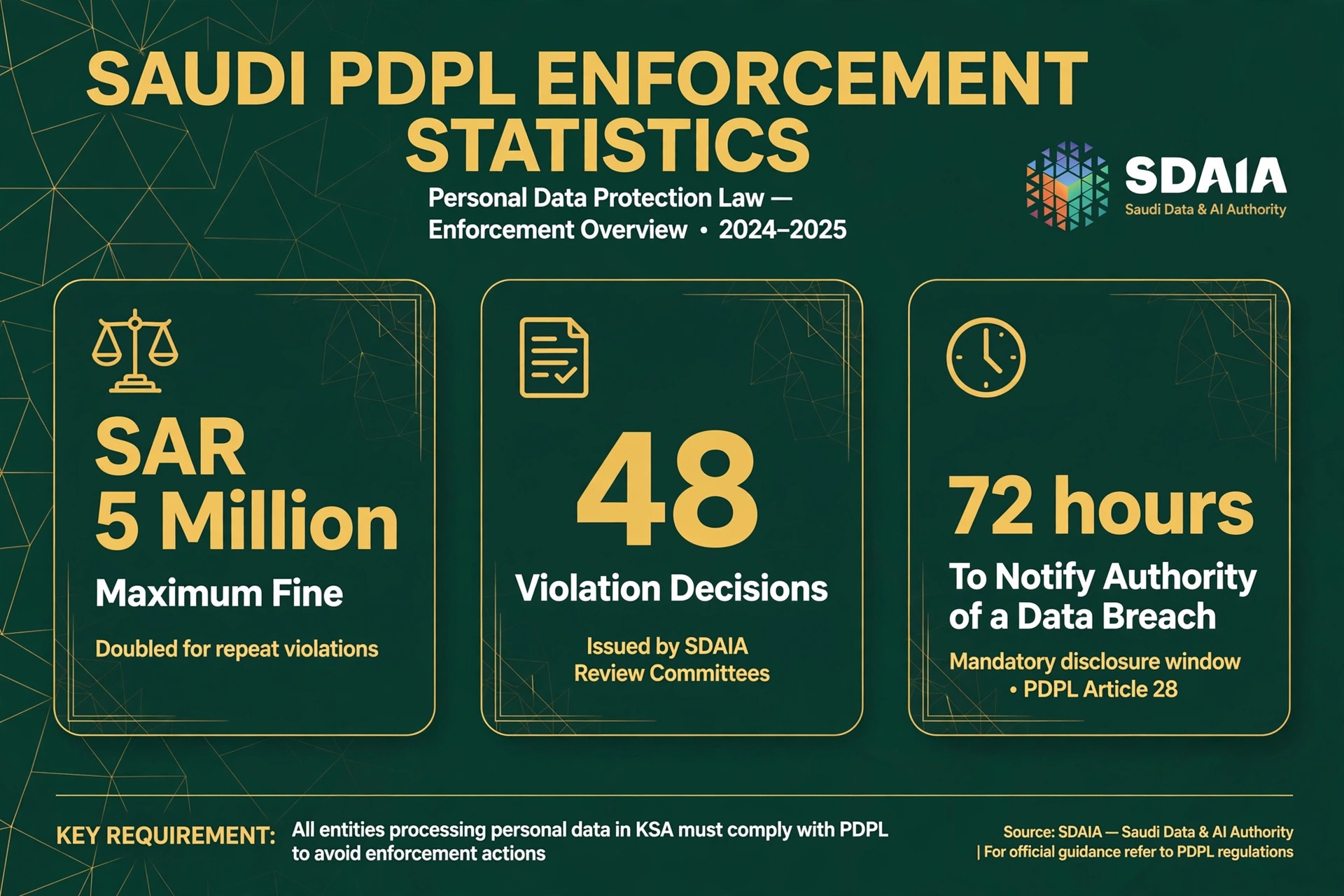
Enforcement sits with the Saudi Data and AI Authority (SDAIA). The law took full effect in 2023–2024, and enforcement has been accelerating: in January 2026, SDAIA reported that its review committees had issued 48 decisions confirming violations during the previous year.
Penalties are serious. The law provides for fines of up to SAR 5 million, which can be doubled for repeat violations, plus a requirement to notify the authority and affected individuals within 72 hours of a data breach becoming known. Fees change. Check the official website before you pay — and likewise, check the official SDAIA portal before you rely on any figure in this article.
What a visa office actually collects
Most agency owners underestimate how much personal data passes through their office. A typical client file for one application includes identity documents, contact details, family data, financial traces, photographs, and case history.
Under PDPL, the concept of “personal data” covers anything that can identify an individual, and it protects the data of everyone in that file — including the client’s family members, whose consent you usually never collected.
Consent and purpose at intake: the PDPL routine for a visa agency in Saudi Arabia
PDPL generally requires consent to process personal data, and the consent must be informed — the client must know what you are collecting, why, and who will see it.
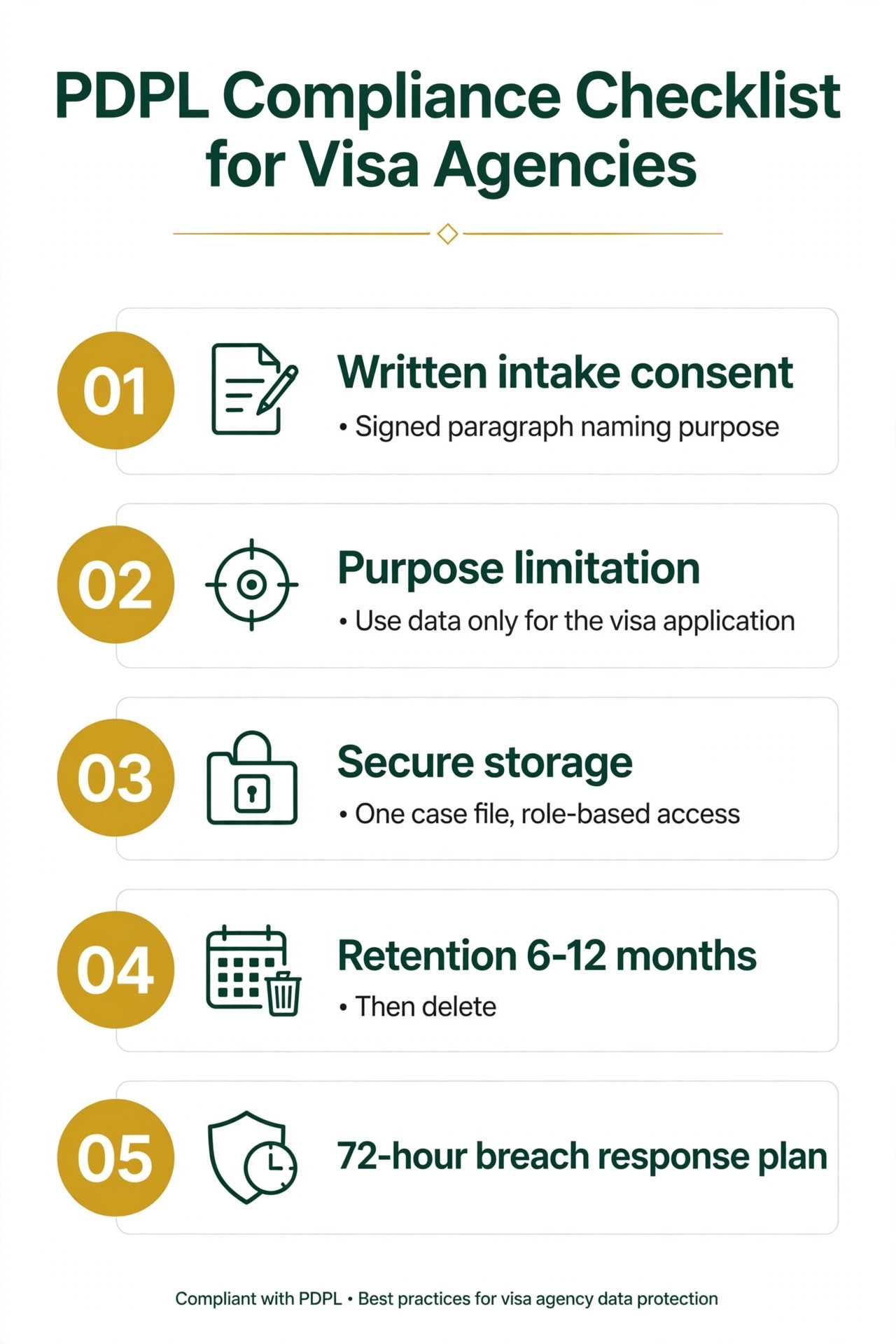
Add a one-paragraph consent line to your intake form (paper or digital), above the signature, in English and Arabic. Name the purpose, state the retention window, and give the client a way to ask for deletion.
WhatsApp, email and shared drives: safer habits for a Saudi visa agency
The SDAIA enforcement report specifically mentioned unlawful disclosure and weak technical measures — and the weakest link in most visa offices is the phone.
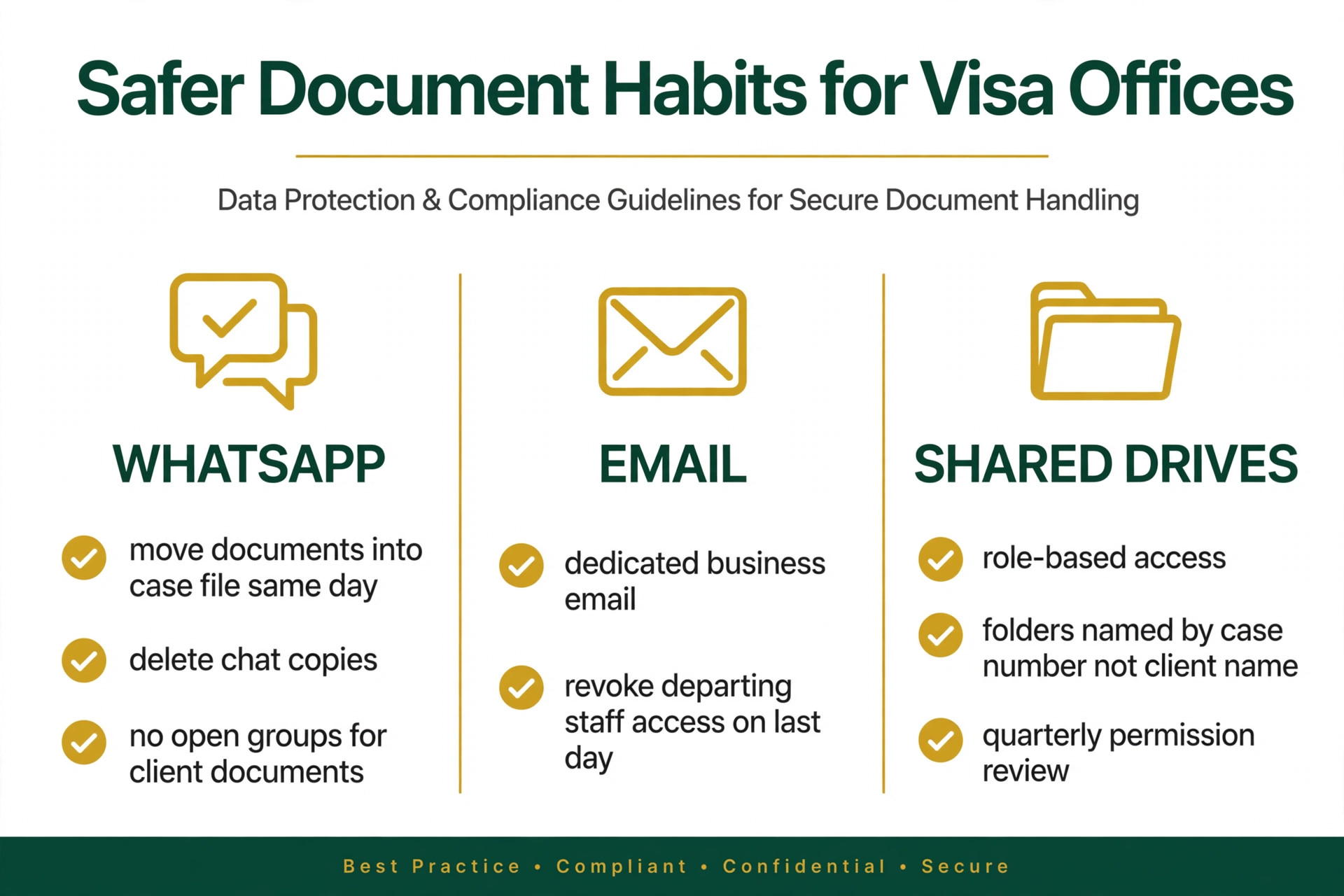
WhatsApp: Treat it as a transmission channel, not an archive. Move documents into your case file the same day, delete chat copies, avoid open groups.
Email: Use a dedicated business email for client files. Make sure departing staff lose access on their last day.
Shared drives: Restrict access by role. Name folders by case number. Review sharing permissions quarterly.
Retention and deletion after the case closes
PDPL does not allow keeping personal data longer than necessary for its purpose. Define a retention period (6–12 months is common), include it in intake consent, run quarterly clean-ups, and ensure deletion is complete.
Breach response in 72 hours
A breach includes a lost phone with client scans, documents emailed to the wrong address, or a shared link forwarded outside the office. PDPL requires notification within 72 hours. Keep a one-page response plan: Contain, Assess, Notify, Record.
Keeping one case file per client instead of scattered copies
Every habit above gets easier when each client has exactly one case file instead of fragments across phones, emails, drives and sticky notes.
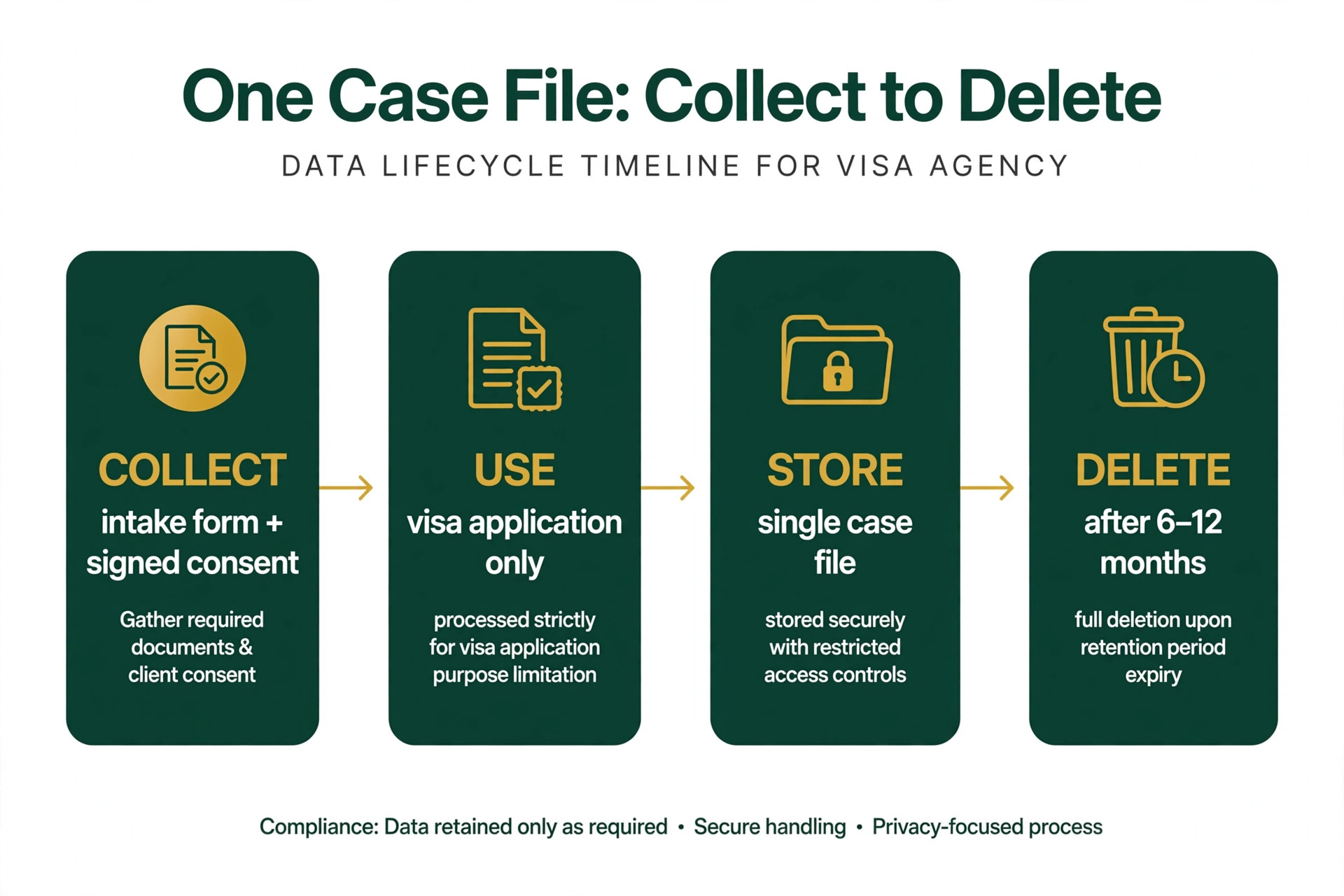
For many small agencies, the practical version is a print-ready or digital PDF case file per client. That is what the Visaora Agency Suite produces: per-client case files that agencies can white-label with their own logo.
Disclaimer: Visaora is software and does not provide legal advice. Requirements depend on your nationality and situation. Confirm with the official authority (sdaia.gov.sa) or a licensed adviser.
CTA: Request a free sample case file with your agency’s branding through the form on the Visaora Agency Suite page. Visaora is software, not legal advice. Always check the official website.
Does Saudi PDPL apply to my small visa office, or only to big companies?
It applies to data controllers of any size. If your office decides what client data to collect and how to use it, you are a data controller, and the law’s obligations — consent, purpose limitation, security measures, breach notification — apply to you.
What is the maximum PDPL fine in Saudi Arabia as of 2026?
Fines can reach up to SAR 5 million and may be doubled for repeat violations, according to legal analysis of the law. SDAIA reported 48 violation decisions in January 2026. Figures can change — check sdaia.gov.sa for the current text of the law.
Do I need written consent from every visa client?
PDPL generally requires consent for processing personal data, and consent should be informed and documented. A signed intake paragraph naming the purpose, the parties documents are shared with and the retention period is the practical way to do it. This is not legal advice — confirm the approach with a licensed adviser.
Can I keep sending client passport copies on WhatsApp?
WhatsApp is widely used by Saudi visa offices, but treat it as a transmission channel, not storage. Move documents into the case file the same day, delete chat copies, avoid open groups for client documents and secure the work phone. SDAIA’s enforcement has targeted weak technical and organisational measures.
How long can I keep a client’s file after the case closes?
Keep personal data no longer than necessary for its purpose. Many small agencies set a written retention period of 6–12 months after closure to support re-applications, and delete afterwards. Whatever you choose, document it, tell clients at intake and apply it consistently.
What counts as a data breach under PDPL?
Not only hacking: a lost phone with client scans, documents sent to the wrong email address, or a shared link forwarded outside the office can all be breaches. The law requires notification within 72 hours of becoming aware of a breach. Keep a one-page response plan ready.
Do I need a lawyer to become PDPL-compliant?
For a small office, the practical first steps — written intake consent, a defined retention period, access controls on files, staff phone hygiene and a breach plan — can be implemented without one. Because penalties are significant, having a licensed adviser review your consent wording and retention policy is a sensible investment. This article is not legal advice.
✈️ Planning Your Trip?
We may earn a commission — at no extra cost to you. Learn more