Dummy Ticket for Visa Application 2026: Safe or Risky? The Honest Answer
Updated: 11 October 2026 · 12 min read
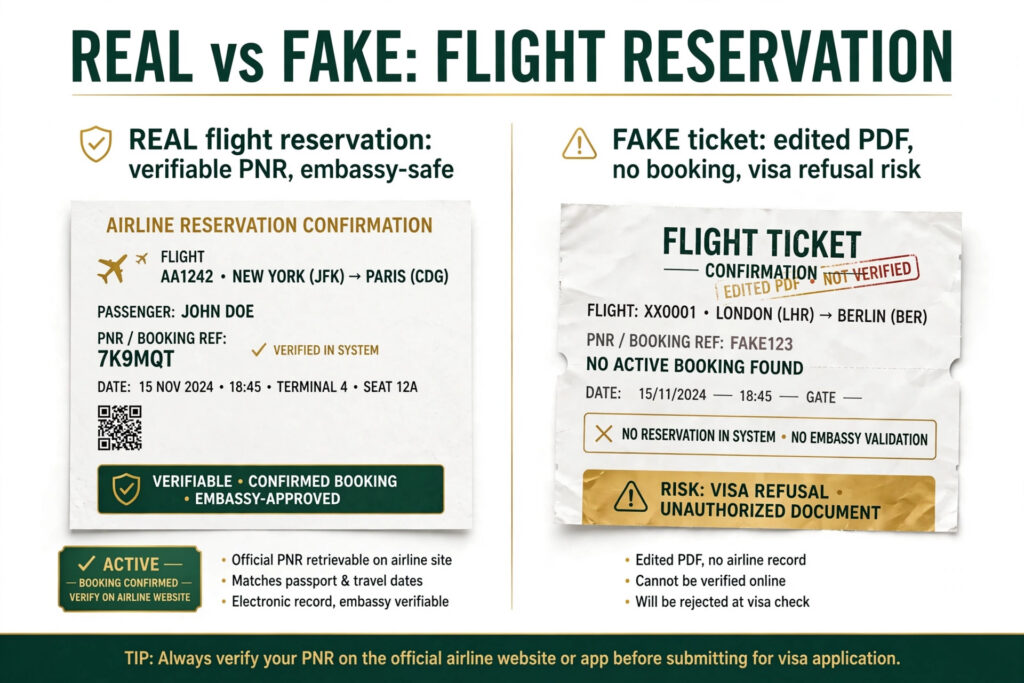
A dummy ticket for visa application purposes is safe when it is a genuine flight reservation — a real booking reference (PNR) in an airline’s system that an officer can look up and find. It becomes dangerous the moment it is a manufactured PDF with nothing behind it: a false document, and false documents lead to refusals and bans.
Pair your flight reservation with a day-by-day itinerary
Consulates read your flight hold alongside your travel plan: entry and exit dates, cities and where you stay. Build an embassy-friendly itinerary that matches your reservation dates in a few minutes. It is free, with no signup.
Few phrases in the visa world cause as much quiet panic as dummy ticket for visa application. Agents whisper it like a loophole, forums argue about it in circles, and applicants end up genuinely unsure whether they are following standard practice or committing fraud.
Both things get called “dummy tickets,” which is exactly the problem. One is a normal, above-board document that consulates themselves request. The other is a forgery that can end your travel plans for years. This guide separates the two — and shows the safe ways to evidence your flights.
- What “dummy ticket” actually means
- Why consulates ask for a reservation, not a paid ticket
- How PNR verification works in practice
- The fake version — and what it can cost you
- Three safe ways to evidence your flights
- The five-minute check before you submit
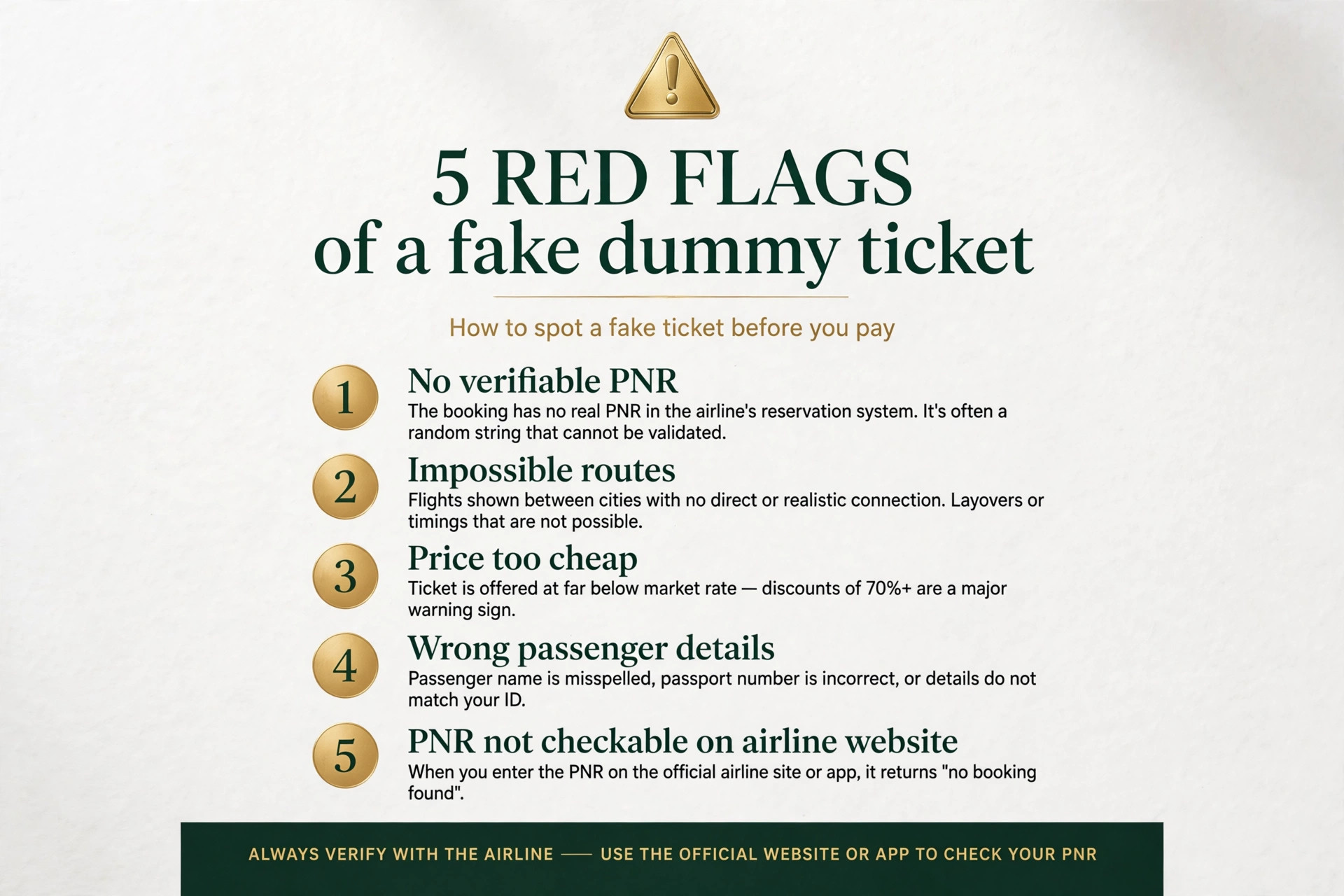
- Red flags when someone offers you a “ticket”
- FAQs: dummy ticket for visa application
- “Dummy ticket” covers two different documents: a genuine, verifiable flight reservation (safe, widely accepted) and an invented PDF with no booking behind it (fraud).
- The test is the PNR: if the booking reference pulls up your reservation on the airline’s website, the document is real. If it returns nothing, it is worthless — and dangerous.
- Consulates ask for a reservation or itinerary, not a paid ticket, precisely so applicants do not lose money on a refusal.
- A fabricated ticket can trigger refusal, a misrepresentation record, and multi-year bans.
What “dummy ticket” actually means
Strip away the slang and the concept is mundane. A dummy ticket is an unpaid flight reservation: a seat temporarily held in your name inside an airline’s booking system, created to show a consulate your intended travel dates and route. You have not bought the flight and cannot check in with it. It was never meant to get you on a plane — it exists to document an intention.
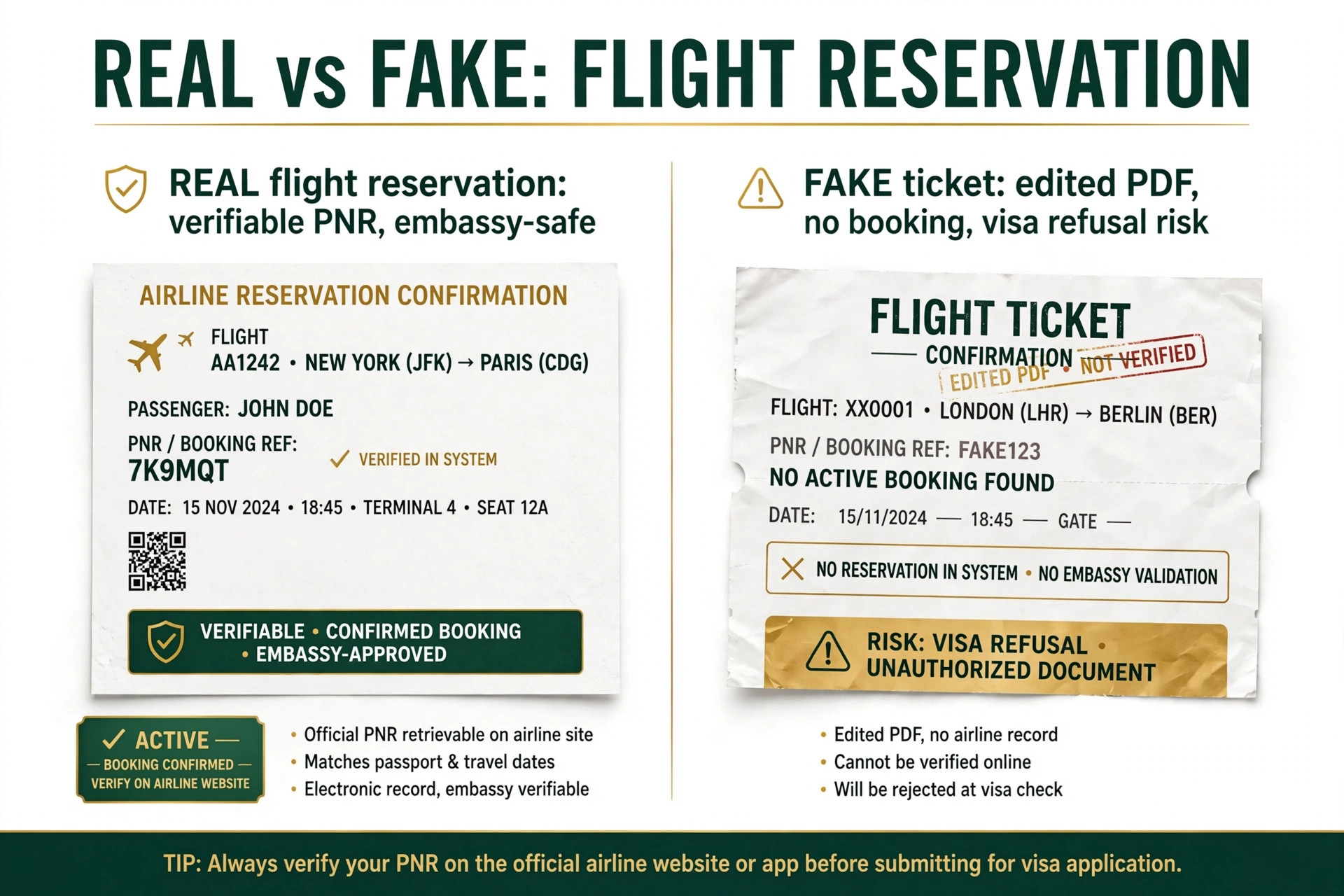
A genuine reservation always carries the same fingerprints. Your name appears exactly as printed in your passport. The flight numbers and times are real services that actually operate. And there is a six-character booking reference — the PNR, short for Passenger Name Record — the system’s own proof that the booking was created and stored.
Airlines hold seats directly; agencies and reservation services create them for applicants every day. The hold lasts a limited window — commonly one to three days — then lapses on its own if nobody pays.
Why consulates ask for a reservation, not a paid ticket
Applicants often assume the flight document is a test of wealth or commitment. It is neither. An officer reads it as evidence about your plan: your entry and exit dates, your route, and whether they line up with the rest of the file — hotels, insurance, leave letter, cover letter. A reservation that matches quietly strengthens the application. One that contradicts the hotels by three days quietly undermines it.
Official checklists word the requirement accordingly. The harmonised Schengen document lists ask for proof of means of transport as a round-trip flight reservation — not a purchased ticket. The reasoning is protective: decisions take weeks, applications get refused, and a non-refundable fare bought in hope becomes money burned. UK guidance makes the same point from the other direction, advising applicants not to book travel until the decision arrives. Submitting a reservation is not gaming anything; it is following the instructions as written.
The practical takeaway: if your checklist says “flight reservation” or “itinerary,” a genuine hold booking is not a compromise. It is precisely the document being requested. Preparing a Schengen application? Our Schengen visa tools and checklists can help you keep every date consistent.
How PNR verification works in practice
Everything in this topic turns on one mechanism. When a reservation is created — by an airline, an agency, or a reservation service — the booking is stored in a reservation system and assigned its PNR. That record holds the passenger names, flights, dates, and booking status. It is not a picture of a booking. It is the booking.
Retrieving it takes less than a minute. The airline’s “manage booking” page asks for two things — the PNR and the passenger’s surname — and the live record appears: your name, your flights, your dates. A visa officer doing a spot check performs exactly this lookup.
That is why the invented version fails so completely. A fabricated PDF may carry a plausible-looking code, but codes are cheap to type and impossible to fake inside the system itself. When the lookup returns “booking not found,” the officer sees a document that misrepresents reality. Holds also expire: a reservation that lapsed two days before your submission is, at checking time, indistinguishable from one that never existed. Timing is part of authenticity.
The fake version — and what it can cost you
The fake dummy ticket is typically born in one of three places: a free online “ticket generator,” an editing session over somebody else’s real itinerary, or a vendor selling polished PDFs at suspiciously low prices. It looks convincing on a phone screen. Underneath, there is no reservation, no record, nothing — and the reference code leads nowhere.
The consequences are out of all proportion to the few dollars saved:
- Refusal of the current application. An unverifiable booking is among the simplest discrepancies to confirm, and it poisons confidence in every other document you submitted.
- A misrepresentation finding on your record. Refusal reasons get recorded, a fraud-related finding colours future applications, and some countries share refusal information with partner governments.
- Bans measured in years. Several jurisdictions impose multi-year entry bans for false documents, reaching beyond tourism to family visits, business travel, and transit.
- Legal exposure in serious cases. Presenting a forged document to a government authority can carry penalties beyond immigration consequences.
None of this applies to genuine reservations — only to documents that were manufactured instead of booked.
| Test | Genuine reservation | Fake PDF |
|---|---|---|
| PNR lookup on airline site | Booking appears, in your name | “Booking not found” |
| What it costs | Small service fee, no airfare | Cheap or free — until it isn’t |
| Officer’s reading of it | The document the checklist requested | Misrepresentation |
| Worst case | Hold expires; you rebook it | Refusal, fraud record, multi-year ban |
One weak document can sink a strong application.
The Visaora Intelligence Suite reviews your complete file before you submit — documents, dates and consistency — and flags the issues that actually trigger refusals.
Check My Approval Chances →Three safe ways to evidence your flights
1. A verifiable hold reservation from a reputable source
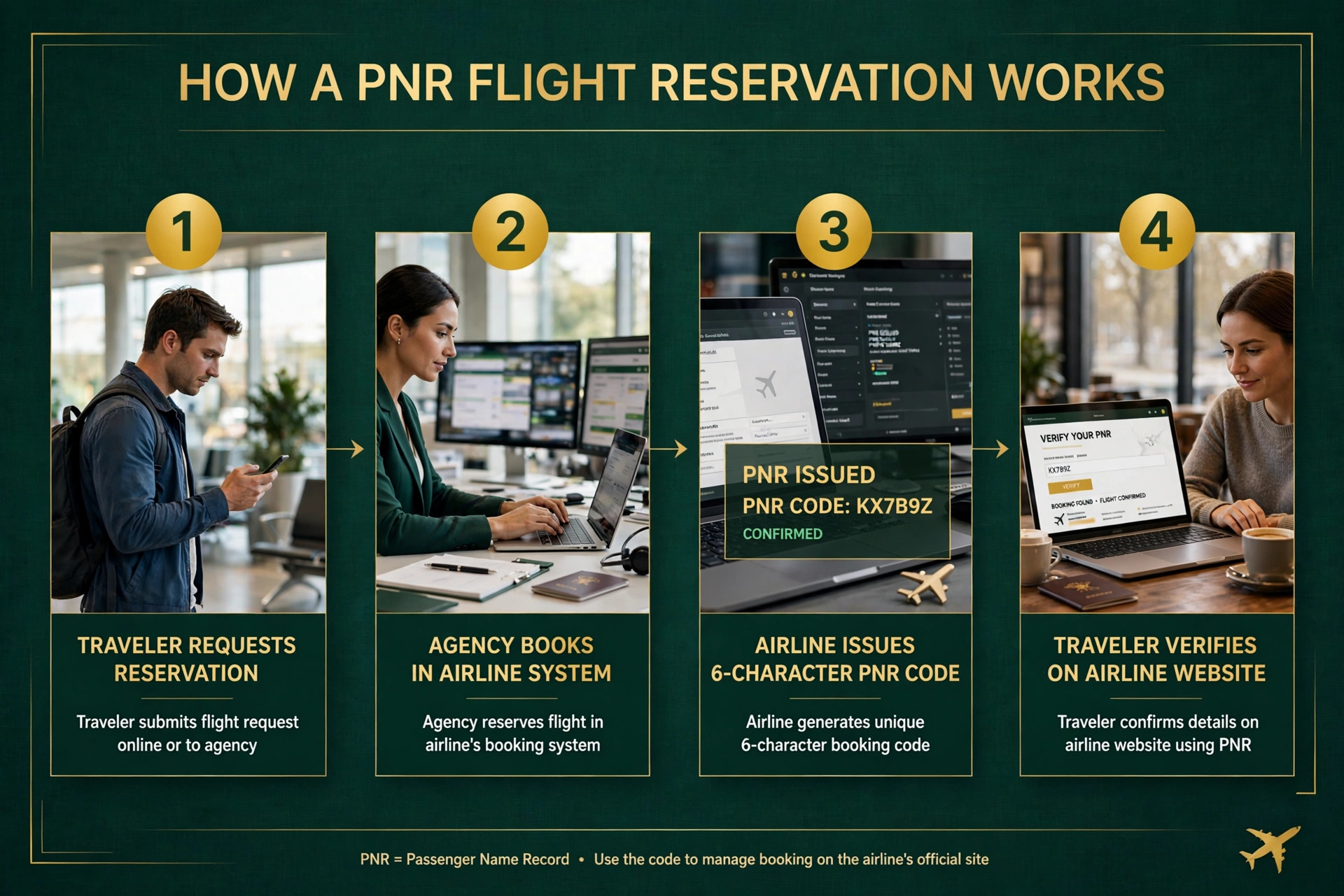
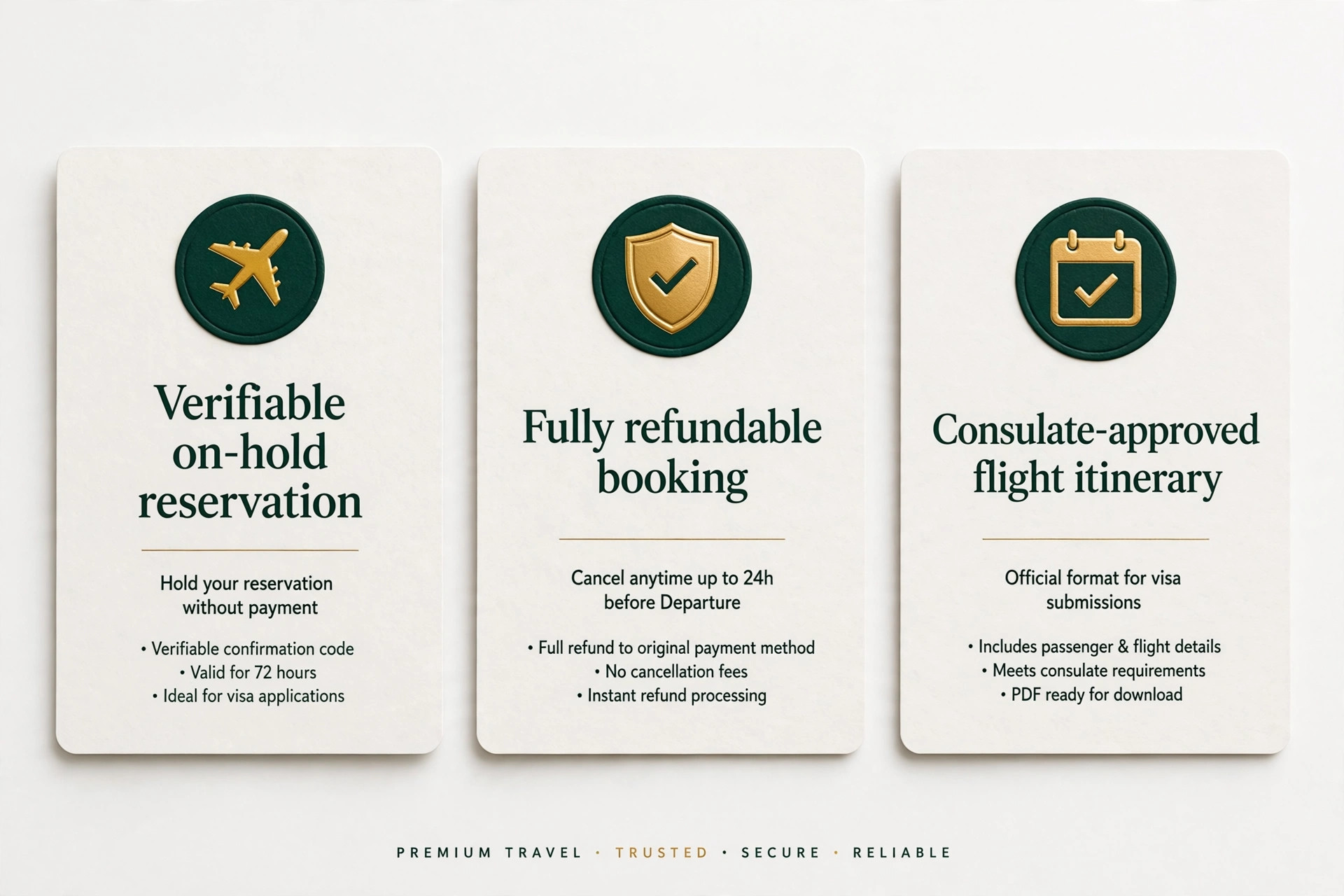
This is the route most applicants take. An established agency or reservation service creates a real hold in the airline’s system under your name and issues the itinerary showing the live PNR. You pay a modest service fee rather than a fare. The non-negotiable step is yours: look the PNR up on the airline’s website before using the document. A provider whose bookings verify has earned your trust; one who discourages checking has told you everything.
2. The airline’s own hold or fare-lock option
A number of airlines will hold a fare for a day or a few days, free or for a small charge, directly in their own system — the most straightforwardly verifiable evidence available, because the airline itself created the record. The trade-off is the short window: arrange the hold to cover your appointment or submission date, not the week before. Hold periods and fees differ by carrier and route.
3. A fully refundable paid ticket
For straightforward applications this is more than you need, but some files benefit from maximum-strength evidence: a previous refusal, a complex itinerary, thin margins elsewhere. A fully refundable round-trip ticket is a paid, ticketed booking no one can question, and the fare comes back if plans change. Read the fare rules word by word — “flexible” does not always mean a full refund.
The five-minute check before you submit
Whatever route you chose, run this sequence on the day your file goes in — it takes minutes and eliminates the entire category of risk:
- Look the PNR up yourself. Airline website, manage-booking page, reference plus surname. Your reservation must appear, live, with your name on it.
- Compare the name character by character against your passport.
- Cross-check every date — flights against hotels, insurance, approved leave, and your cover letter. Consistency is what the officer is scanning for.
- Confirm the hold is still alive on submission day — an expired hold verifies exactly like a fake one.
- File a screenshot of the successful lookup with your own records — proof, if a question ever arises, that the booking was real when it mattered.
If step one fails, stop. Do not submit and do not let an agent talk you past it — replace the document through one of the safe routes above and check again.
Red flags when someone offers you a “ticket”
The market includes honest operators and PDF merchants. Walk away from any seller who cannot name the airline before taking payment, who delivers a reference you are told “not to check yet,” or whose price is a fraction of everyone else’s with a same-day discount attached. Be equally wary of routes the airline does not fly, non-existent departure times, or your name spelled differently from your passport. It matters. A legitimate provider expects verification and builds their service around bookings that survive it.
Ready to submit a file with no weak links?
Run your application through the Visaora Intelligence Suite first — a structured review of documents, dates and refusal risks, so the first person to find a problem is you.
Check My Approval Chances →Quick answers: dummy ticket + itinerary
Do I need a travel itinerary as well as a dummy ticket?
Many Schengen checklists ask for evidence of your travel plans and accommodation as well as a flight reservation, but requirements differ by consulate. Check your consulate or visa centre checklist. If you add an itinerary, make sure its dates, cities and hotels match your flight reservation exactly. You can use the free travel itinerary generator for this.
Is a free online "dummy ticket generator" safe to use?
Not if it only produces a PDF. A document with no live booking reference (PNR) in the airline's system is fabricated, however real it looks. Use a genuine hold reservation, the airline's own fare-hold option, or a refundable ticket, and confirm the PNR on the airline's manage-booking page before you submit.
FAQs: dummy ticket for visa application
Is using a dummy ticket for a visa application legal?
Yes, when the document is a genuine reservation held in the airline’s system — holding seats without immediate payment is ordinary travel-industry practice, and consulates request reservations for this purpose. It is illegal when the “ticket” is fabricated: a document claiming a booking exists when none does is a false document.
Do Schengen embassies accept dummy tickets?
Yes — official Schengen checklists ask for a flight reservation as proof of means of transport, not a purchased ticket. A reservation with a live, verifiable PNR meets that requirement. Consulates word it this way so applicants are not forced to risk a non-refundable fare before a decision exists.
How can I check whether my dummy ticket is genuine?
Go to the airline’s official website, open the manage-booking page, and enter the six-character PNR together with your surname. A genuine reservation appears with your name, flights and dates. If the site reports no booking exists, the document is not a reservation at all — do not submit it; replace it through a reputable provider.
What happens if I submit a fake dummy ticket?
Expect refusal once the booking fails verification — and consequences that outlast it. A fabricated document is treated as misrepresentation: it can be recorded against you, affect future applications, and in several countries trigger a multi-year ban. The small saving is never worth a fraud finding attached to your name.
How long does a dummy reservation remain valid?
Most hold bookings stay live for roughly 24 to 72 hours, though some airlines and services offer longer windows. What matters is that the reservation is active when your application is submitted and assessed — so create it close to your submission date and re-check it on the day.
Should I just buy a real ticket before my visa is decided?
Usually not, and official guidance backs you up: UK authorities explicitly advise against booking travel before a decision, and Schengen checklists ask only for a reservation. A non-refundable fare bought early is money lost if the visa is refused or delayed. The exception is a fully refundable ticket, which some applicants with complex cases choose as stronger evidence.
Can I use a dummy ticket for UK, US and Canada applications?
For the UK, travel should not be booked before a decision; a genuine reservation may support your stated plans, but nothing fabricated, ever. The US and Canada do not require flight bookings as application evidence at all. Everywhere, the rule is identical: a real reservation is acceptable, an invented one is fraud.
What is the difference between a dummy ticket and a refundable booking?
A dummy ticket is an unpaid hold: a real PNR, a small service fee, and an expiry measured in days. A refundable booking is a paid, ticketed reservation that stays in place until you cancel it and the fare is returned. The refundable ticket is the stronger evidence; the hold is the cheaper, more flexible one.
Official sources
The positions described in this guide come from official document requirements, including:
- Schengen visa requirements checklist (German diplomatic mission; European Commission harmonised list) — round-trip flight reservation listed as the required proof of means of transport.
- European Commission list of supporting documents (hosted by Portugal’s Ministry of Foreign Affairs) — requires the round-trip airline reservation with passenger registration number and itinerary.
Always confirm the current checklist for your specific consulate, as requirements are updated periodically.
Disclaimer: General information based on published official checklists as of October 2026 — not legal advice, and no substitute for your consulate’s checklist. Cases involving a previous refusal or complex history deserve advice from a qualified immigration professional.
✈️ Planning Your Trip?
We may earn a commission — at no extra cost to you. Learn more