Schengen Visa Bank Balance Requirements 2026: How Much Money Do You Really Need?
“How much bank balance do I need for a Schengen visa?” It is the single most asked money question in visa forums — and the answers floating around online range from confident to completely invented. This guide gives you the honest version: what the Schengen visa bank balance requirements for 2026 actually are, the daily rough guides consulates and travelers use, what your statements must show, the red flags that get files refused, and a step-by-step checklist to make your funds section the strongest part of your application.
- There is no fixed legal minimum bank balance for a Schengen visa — the “€X,XXX required” posts you see online are myths.
- Officers check means of subsistence: can your funds realistically cover this trip?
- Rough guides used by travelers: €50–100 per day, with higher commonly cited figures for France (~€120/day) and Spain (~€118/day).
- Submit 3–6 months of bank statements showing stable, regular income.
- Sudden large deposits before applying are one of the biggest red flags.
- Weak funds are a classic refusal ground — our Schengen visa rejection reasons guide shows how often money issues sink applications.
The Truth: There Is No Fixed Minimum Bank Balance
Search “Schengen visa bank balance requirements 2026” and you will find confident-sounding answers: “You need €3,000.” “You need 5 lakh rupees.” “You need at least €100 per day, guaranteed.” Almost all of these are invented. The EU Visa Code does not set any fixed euro amount that every applicant must hold. What it requires is that you possess sufficient means of subsistence for the duration of your intended stay and your return home — a judgment call, made by the visa officer, against your trip.
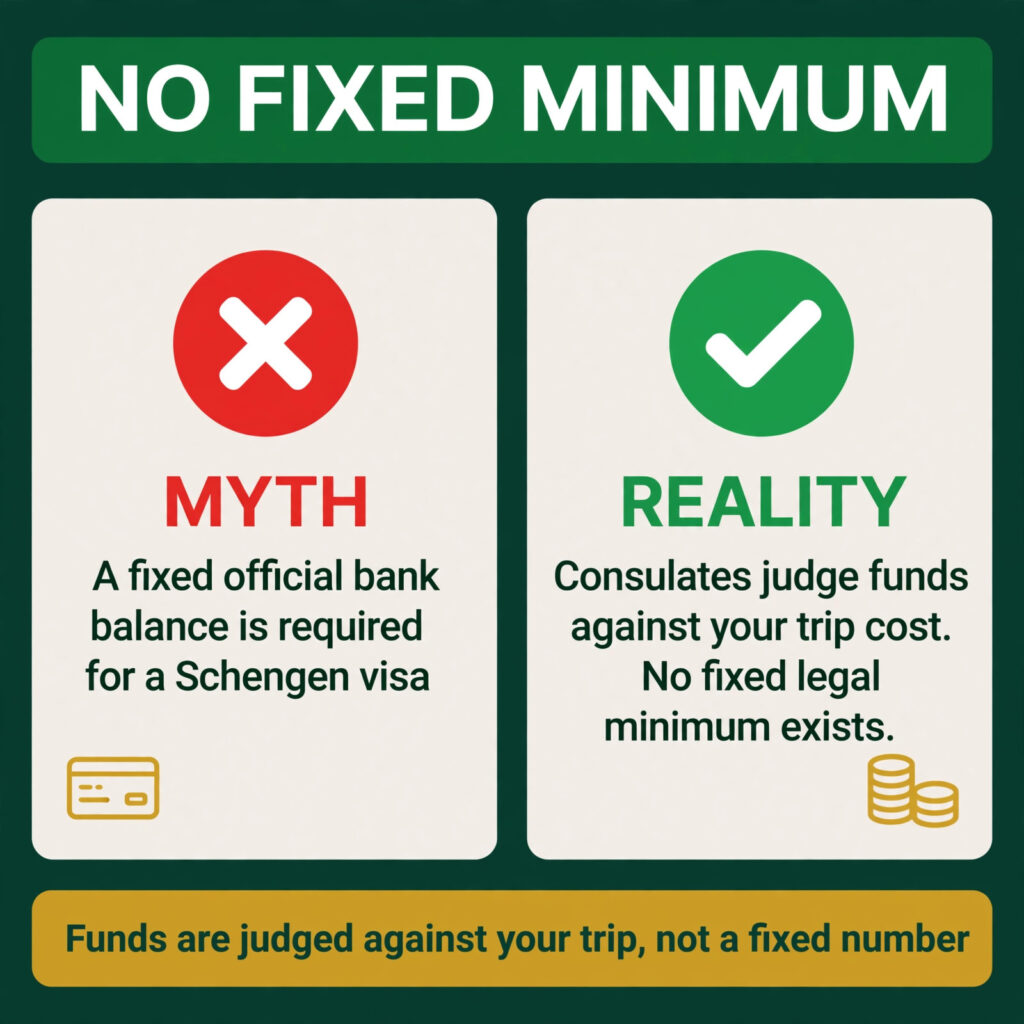
❌ The Myth
“Every applicant must show a fixed minimum — €3,000 / 5 lakh / €100 per day — or the visa is automatically refused.”
✅ The Reality
No EU-wide fixed amount exists. Officers judge whether your funds cover your trip. A modest, stable balance can be fine for a short trip; a large, unexplained one can still be refused.
This is actually good news. It means a modest but stable balance can be perfectly fine for a short, well-planned trip, while a large balance can still raise eyebrows if it appeared out of nowhere last week. The officer is not measuring your balance against a secret cutoff — they are studying the story your money tells. Does your income look real and regular? Do your spending patterns look like a genuine person living a genuine life? Does the balance make sense next to the trip you are proposing?
Think of it this way: a 7-day trip to Portugal with a €700 prepaid hotel booking and a steady monthly salary looks very different from a 30-day multi-country tour on a balance that jumped from near-zero to a large sum two weeks before the appointment. Same applicant, same bank — completely different verdicts. The number is only half the picture; the pattern is the other half.
Schengen Visa Bank Balance Requirements 2026: Daily Subsistence Guides
So if there is no official minimum, what number should you aim for? Travelers and advisors use rough daily guides to sanity-check their funds. These are commonly cited figures, not official law — treat them as planning tools, not guarantees:
🧮 Quick Trip-Cost Sanity Check
10-day trip × €80/day = €800 spending money
+ prepaid flights & hotels (say €900)
= ~€1,700 comfort zone for a 10-day trip
If your balance after prepaid bookings sits well above that and your income is steady, you are in sensible territory.
One more thing these guides do not tell you: officers also weigh your ties and context. A salaried professional with five years at one company, a family at home, and a two-week holiday is a low-risk profile even with a moderate balance. An applicant with no verifiable income and a large unexplained balance is high-risk even with more money. Funds are one chapter of the file, not the whole book — our Schengen Visa 2026 complete guide walks through how all the chapters fit together.
What Your Bank Statements Must Show
Consulates typically ask for the last 3–6 months of bank statements. Some ask for three months, some for six — prepare six and you are covered either way. These statements are the officer’s window into your financial life, and they are looking for four things:
- Regular income credits. Monthly salary credits with your employer’s name on them are the gold standard. They prove you earn what you claim to earn.
- Stability over time. A balance that rises and falls naturally with normal spending looks honest. A flat, untouched balance or wild swings invite questions.
- Spending that matches your life. Groceries, rent, fuel, utilities — ordinary transactions make your account look like it belongs to a real person, because it does.
- Enough left over for the trip. After your normal expenses, the balance should comfortably absorb the trip cost you are proposing.
Practical details that matter: get the statements stamped or officially generated by your bank — many consulates distrust home-printed screenshots. Make sure the account is in your name. If your salary lands in one account and you save in another, submit both and briefly explain the setup. And never submit statements with gaps — missing months look like you are hiding something, even when you are not.
5 Bank Statement Red Flags That Get Applications Refused
Officers see thousands of statements. They know exactly which patterns signal borrowed or manufactured funds. Avoid these five:
If any of these apply to you, the fix is rarely “add more money.” It is usually “wait, build a cleaner history, and apply when your statements tell an honest story.” A refusal for insufficient means of subsistence also makes your next application harder, so timing matters.
Proof of Funds for Freelancers and Self-Employed Applicants
No salary slips? No problem — but your paperwork burden is heavier. Without an employer’s letter and regular salary credits, you have to construct the income story your statements alone cannot tell:
- Tax returns. For Pakistani applicants, your FBR income tax returns are powerful evidence — they are government-verified proof of declared income. File them, keep them, submit them.
- Invoices and contracts. Client invoices, Upwork/Fiverr earning statements, and ongoing contracts show where the money comes from.
- Business bank statements. If clients pay into a business account, submit those statements too and explain the flow into your personal account.
- A short cover note. One paragraph explaining “I am a freelance designer; income arrives per project, averaging X per month; see attached invoices and tax returns” helps the officer connect the dots.
Freelancers get refused on funds more often than salaried applicants, not because they earn less, but because their income looks irregular on a statement. Your job is to make the irregular look documented and legitimate. Every invoice, every tax filing, every contract is a brick in that wall.
Your 5-Step Proof-of-Funds Checklist
Run through this before you book your appointment:
- Pull 6 months of statements. Official, stamped or bank-generated, in your name, with no missing months.
- Confirm regular income credits. Salary, client payments, or business transfers should appear in a recognizable rhythm.
- Check the balance against your trip. Use the daily guides above: trip days × daily figure + prepaid costs = your comfort zone.
- Attach tax returns. FBR returns for Pakistanis; equivalent filings elsewhere. They corroborate everything the statements suggest.
- Freeze the funny business. No last-minute lump sums, no borrowed top-ups, no transfers you cannot explain in one sentence.
Do this honestly and your funds section becomes the quiet, boring part of your file — which is exactly what you want. Visa officers approve boring. They refuse interesting.
Real-Life Scenario: Two Statements, Two Verdicts
Two applicants, both planning a 12-day France–Italy trip, both with balances around €4,000 at the appointment.
Applicant A showed six months of steady salary credits, rent and grocery spending, and a balance that had grown gradually from €2,800 to €4,000. His prepaid hotel bookings were attached. Approved in 14 days.
Applicant B showed a balance that had sat near €300 for five months, then jumped to €4,000 three weeks before the appointment via a single transfer from a cousin, with no explanation. Refused for insufficient justification of means — the officer assumed the money was borrowed for show. The balance was identical. The pattern was the verdict.
Common Mistakes to Avoid
- Believing a magic number. Chasing “€3,000” or “5 lakh” online myths instead of matching your funds to your actual trip.
- The last-minute top-up. The single most common self-inflicted wound in Schengen applications.
- Submitting only one account. If salary and savings live in different accounts, submit both — a partial picture invites doubts.
- Hiding a gap month. Skipping an ugly month looks worse than showing it with a brief explanation.
- Forgetting the sponsor’s paper trail. A parent’s sponsorship letter without the parent’s income proof is just a claim, not evidence.
- Draining the account after the appointment. Border officers can occasionally ask for proof of means on arrival — and a clean history protects future applications.
Pro Tips for Bulletproof Funds
Schengen Visa Bank Balance Requirements 2026: FAQs
Is there a fixed minimum bank balance for a Schengen visa in 2026?
No. The EU Visa Code sets no fixed euro amount. Consulates assess whether your funds are sufficient for your specific trip — its length, cost, and your circumstances. Daily figures you see online (€50–100/day and similar) are rough guides used by travelers, not official legal minimums.
How many months of bank statements do I need for a Schengen visa?
Most consulates ask for the last 3–6 months. Prepare six months to be safe: the statements must be continuous with no gaps, in your name, and ideally stamped or officially generated by your bank rather than home-printed.
Can a large last-minute deposit help my Schengen visa application?
No — it usually hurts. A sudden large deposit shortly before applying is one of the most common red flags; officers often treat it as borrowed funds placed there for show. Build a stable balance over months instead of topping up at the last minute.
What counts as proof of funds besides bank statements?
Salary slips, employment letters, tax returns (FBR returns for Pakistanis), fixed deposit certificates, and for freelancers, client invoices and contracts. Statements are the core, but supporting documents corroborate the story they tell.
Can I be refused a Schengen visa just for low bank balance?
Yes. Insufficient means of subsistence is a standard refusal ground. It is not only about the total — an unstable pattern, unexplained deposits, or funds that do not match your claimed income can each trigger a refusal even with a decent balance.
Do I need more funds for a longer Schengen trip?
Logically, yes — officers scale their expectations with trip length and cost. A 30-day itinerary needs convincingly more available funds than a 5-day city break. Use the daily rough guides (€50–100/day) multiplied by your trip days as a planning baseline.
Can someone else’s bank statement support my application?
Generally the funds should be yours, but a sponsor (such as a parent or spouse) can support you with their statements plus a signed sponsorship letter and proof of relationship. The sponsor’s own income pattern will then be judged the same way yours would be.
Should I keep extra money in my account after the visa is issued?
It is wise not to drain the account the day after your appointment. Border officers can occasionally ask for proof of means on arrival, and a healthy balance also protects you if you reapply later — your history stays clean and consistent.
Conclusion: The Pattern Beats the Number
There is no magic balance that guarantees a Schengen visa — and no fixed cutoff that dooms you. What officers reward is a believable financial story: regular income, natural spending, a balance that fits the trip, and not a single unexplained surprise. Build that story over 3–6 honest months, and your funds section stops being a risk and starts being an asset.
Want a professional read on your own statements before you file? Run them through the Visaora Intelligence Suite — it reviews your bank-statement pattern the way a visa officer would and tells you exactly what to fix. For the full application picture, continue with our Schengen Visa 2026 complete guide.
✈️ Planning Your Trip?
We may earn a commission — at no extra cost to you. Learn more
Pingback: Easiest Schengen Visa Country 2026: France vs Spain vs Italy vs Greece Compared - Visaora
Pingback: Schengen Student Visa Requirements 2026: Documents, Funds Proof & Complete Guide - Visaora