Best Travel Insurance for Schengen Visa 2026: €30,000 Rule, Compared & Explained
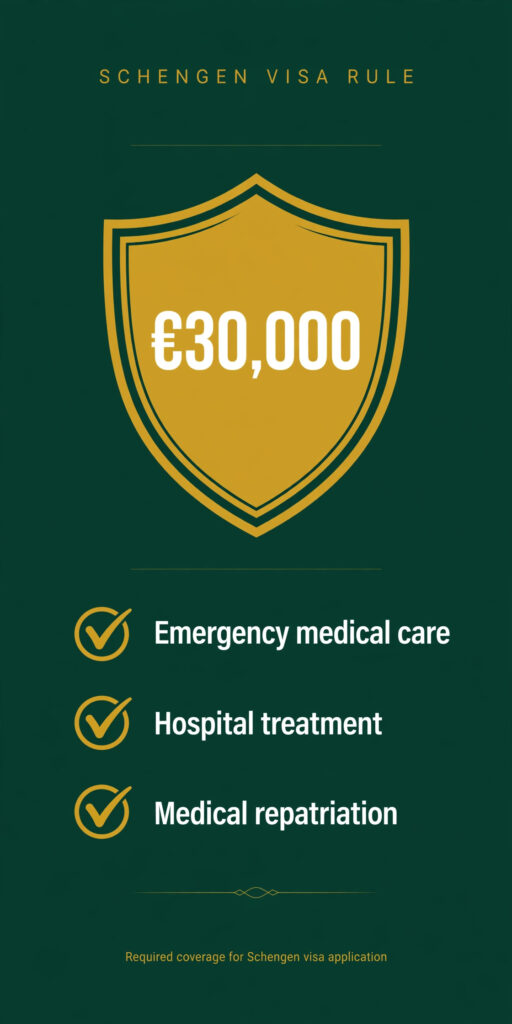
Quick Answer: The best travel insurance for Schengen visa 2026 is any policy that meets the EU’s mandatory €30,000 minimum medical coverage, valid across all 29 Schengen states for your entire trip, covering emergency medical care, hospital treatment, and repatriation. Any insurer’s plan can be the right one — the best policy for you depends on your trip length, budget, and whether you want extras like trip cancellation cover. What matters is that the certificate shows the required cover.
✅ Key Takeaways
- Schengen visa travel insurance is mandatory — your application is incomplete without it.
- The legal minimum is €30,000 in medical coverage under the EU Visa Code.
- Your policy must be valid in all 29 Schengen states for your entire stay.
- It must cover emergency medical care, hospital treatment, and repatriation (including in case of death).
- Zero deductible is strongly recommended — some consulates reject policies with a deductible.
- Most reputable providers refund the premium if your visa is refused — confirm before buying.
📑 In This Guide
Why Travel Insurance Is Mandatory for a Schengen Visa in 2026
Unlike a tourist trip to a visa-free destination, a Schengen visa application has a legally required document checklist — and travel medical insurance sits right on it, next to your passport, photos, and bank statements. This is not a recommendation or a nice-to-have. Under EU Regulation (EC) No 810/2009 (the Schengen Visa Code), every short-stay visa applicant must prove they hold adequate travel medical insurance before a consulate will even consider the file.
The logic is simple: European states do not want visitors arriving without a way to pay for emergency care. A single hospital stay abroad can cost thousands of euros, and consulates want proof — on paper, attached to your application — that an insurer will cover it. That is why the insurance certificate is examined as closely as your bank statements. If the certificate is missing, vague, or below the minimum coverage, your application can be refused on documentation grounds alone. Our guide to Schengen visa rejection reasons shows how often weak or incomplete documents sink otherwise solid applications.
The good news: compliant insurance is cheap and fast to buy. Most single-trip policies for a one- or two-week holiday cost less than a dinner out, can be purchased online in minutes, and generate an instant certificate you print and attach to your file. The rest of this guide shows you exactly what the certificate must say — and which providers issue one the consulate will accept without questions.
The €30,000 Rule Explained
The single number every applicant must memorize is €30,000. The Visa Code sets this as the minimum medical coverage your policy must provide. No Schengen consulate may demand more than this as a minimum, and none may accept less — it is the same threshold in Paris, Berlin, Rome, and every other consulate worldwide.
💰 The €30,000 Rule at a Glance
The four numbers every Schengen visa applicant must know.
Minimum medical cover
The legal minimum under the EU Visa Code. No consulate may accept less.
Schengen states covered
Your policy must be valid across the entire Schengen Area, not one country.
Of your trip dates
Cover must run from departure to return. One uncovered day can mean refusal.
Deductible recommended
Choose zero deductible. Some consulates reject certificates showing an excess.
What does “€30,000 of coverage” actually mean in practice? It means the insurer guarantees payment of at least €30,000 toward the medical costs listed in the next section. Policies in other currencies are fine — a $50,000 USD policy comfortably exceeds the threshold, and consulates accept non-euro policies as long as the equivalent value is clear on the certificate. What matters is the number on the certificate, because that is what the visa officer reads.
Two subtleties catch applicants out. First, the €30,000 is a minimum, not a recommendation. If you are older, have a medical condition, or are visiting for a long stay, a higher limit (many providers offer up to €2 million) buys real peace of mind for a small extra premium. Second, the coverage must apply per trip for the entire duration of your stay — a policy that covers only part of your dates will be rejected. Annual multi-trip policies are acceptable, but you must still produce a document showing cover for the specific trip dates in your application.
What Your Schengen Travel Insurance Must Cover
The Visa Code does not just set an amount — it lists exactly what the insurance must pay for. When you compare the best travel insurance for Schengen visa 2026 options, check each policy against this four-point list:
✅ What Your Policy Must Cover
Check every policy against this four-point list from the EU Visa Code.
Emergency medical treatment
Urgent care for sudden illness or injury during your trip.
Emergency hospital treatment
Inpatient stays, surgery and related hospital costs.
Repatriation
Transport home for medical reasons, including in case of death.
Schengen-wide validity
All 29 member states for your entire stay.
- Emergency medical treatment — urgent care for sudden illness or injury during your trip.
- Emergency hospital treatment — inpatient hospital stays, surgery, and related costs.
- Repatriation for medical reasons — transport back to your home country if medically necessary, including repatriation in case of death.
- Validity across the entire Schengen area — all 29 member states, not just the country that issued your visa. (For limited-territorial-validity visas, cover for the states on the visa sticker is sufficient, but standard applications should simply cover the whole zone.)
Your certificate should state these points explicitly. The best Schengen-focused providers print a dedicated “Schengen visa certificate” that lists the €30,000 limit, the covered countries, and the travel dates on one page — which is precisely what visa officers want to see. A generic travel policy that buries these details across ten pages of terms invites extra scrutiny and delays.
One more requirement worth knowing: the insurance should in principle be taken out in your country of residence (Visa Code, Article 15). If that is genuinely not possible, you may buy it in another country — but buying locally where available is the smoothest path.
How to Compare Schengen Travel Insurance Policies
There is no official EU “approved insurer” list — any insurer’s certificate is accepted if it clearly shows the required cover. What matters is not the brand on the certificate but what the certificate says. Compare policies point by point against this checklist:
| What to compare | Why it matters |
|---|---|
| Medical cover ≥ €30,000 | The legal minimum. The number must be printed on the certificate, not just the brochure. |
| Zero deductible | The Visa Code does not ban deductibles, but strict consulates reject certificates showing one. |
| Schengen-wide validity | Must state “Schengen Area” or “all Schengen states” — not a single country. |
| Dates match your trip | Cover must run from departure day to return day. Even one gap can mean refusal. |
| Repatriation included | Required explicitly by the Visa Code, including repatriation in case of death. |
| Visa-ready certificate | A clean one-page certificate: your name, cover amount, dates, area, insurer details. |
| Refund if visa refused | Many providers refund the premium before the policy start date — confirm the terms in writing. |
| Exclusions | Adventure activities or pre-existing conditions may be excluded. Check before you rely on it. |
How to choose the right plan for your trip
For a standard one-to-three-week holiday, a single-trip Schengen-focused plan is the simplest path — look for one that issues a pre-formatted visa certificate listing the €30,000 limit, covered countries and travel dates on a single page. For trips longer than a month, or if you travel frequently, compare an annual multi-trip plan against buying per-trip cover. If your itinerary includes adventure activities, confirm the policy does not exclude them. For the full application picture beyond insurance, see our Schengen Visa 2026 complete guide.
A note for Muslim travelers: Takaful alternatives
If you prefer Sharia-compliant cover, look for a Takaful plan — the Islamic alternative to conventional insurance. The consulate judges the certificate, not the product type: make sure the Takaful certificate explicitly states at least €30,000 in medical cover, repatriation cover, and validity across all Schengen states for your full trip dates. Anything less clearly documented than a conventional certificate will be treated the same way at the document check.
You can also verify the current official application guidance on the European Commission’s page about applying for a Schengen visa.
🛡️ Is Your Whole Application as Solid as Your Insurance?
Insurance is one document of many. RiskScan™ checks your refusal risk across documents, funds, travel history, and purpose of travel in 60 seconds — before the consulate does. From $12.
How to Buy Schengen Travel Insurance: 5-Step Checklist
Follow these steps in order and your certificate will pass the document check the first time:
📋 5-Step Buying Checklist
Follow in order and your certificate passes the document check the first time.
Confirm ≥ €30,000 cover
Read the certificate, not the marketing page. The number must be printed.
Choose zero deductible
Removes rejection risk at strict consulates entirely.
Match dates exactly
Cover from departure day to return day. No gaps.
Check Schengen-wide validity
Certificate should say “Schengen Area” or “all Schengen states”.
Print the certificate
Full name matching passport, cover amount, dates, area, insurer details.
- Confirm at least €30,000 in medical cover. Read the certificate, not the marketing page. The number must be printed clearly.
- Choose zero deductible. The Visa Code does not explicitly ban deductibles, but consulates in Germany, France, and the Netherlands are known to reject certificates that include one. Zero deductible removes the risk entirely.
- Match the dates to your trip exactly. Cover must run from your departure date through your return date. Even one uncovered day is grounds for refusal.
- Check validity across all Schengen states. The certificate should say “Schengen Area” or “all Schengen states” — not just one country.
- Download and print the certificate. It must show your full name (matching your passport), the coverage amount, the validity dates and area, and the insurer’s details. Bring a printed copy to your appointment; some centers still ask for paper.
Timing tip: buy your insurance as soon as your travel dates are fixed — you need the certificate before your visa appointment, and buying early also activates any trip-cancellation cover from day one.
4 Mistakes That Get Schengen Insurance Certificates Rejected
⚠️ 4 Mistakes That Get Insurance Certificates Rejected
Avoid these four and your insurance becomes a non-issue.
Cover below €30,000
A €20,000 or $25,000 policy fails the legal minimum. The officer will not round up.
Hidden deductible
“€100 excess” on the certificate is a red flag at strict consulates.
Wrong travel dates
Insurance June 1–10 for a June 1–15 trip leaves five uncovered days.
Not valid everywhere
A France-only policy fails when your itinerary includes Italy and Spain.
- Coverage below €30,000. A €20,000 or $25,000 policy fails the legal minimum — the officer will not round up or convert generously.
- A deductible hidden in the fine print. “€100 excess” or “deductible applies” on the certificate is a red flag at strict consulates. Always select the zero-deductible option where offered.
- Wrong travel dates. Insurance from June 1–10 for a June 1–15 trip leaves five uncovered days. Triple-check the dates against your flight reservations.
- Not valid in every state. A policy covering only France will not satisfy an application routed through the French consulate if your itinerary includes Italy and Spain. “Schengen-wide” is the safe wording.
Avoid these four and your insurance becomes a non-issue — one less thing for the visa officer to question.
What If Your Schengen Visa Is Refused? Getting a Refund
This is the question every careful buyer asks: “What if I pay for insurance and the visa doesn’t come through?” The answer is reassuring. Many reputable providers refund the full premium if your Schengen visa is refused, provided the policy period has not started and you submit the official refusal letter — typically within 10–14 days of the decision. Several Schengen-focused providers advertise this refund openly.
Not every provider offers it, so check the refund terms before you pay — it should be stated in the policy wording or FAQ. Keep your refusal letter safe regardless: if your application is denied, our rejection reasons guide walks through the seven most common refusal grounds and how to fix each one before reapplying.
📋 Refused Before? Don’t Guess What Went Wrong
RecoveryScan™ analyzes refusal patterns and builds your reapplication strategy — which documents to fix, when to reapply, and whether to appeal instead. From $12.
Best Travel Insurance for Schengen Visa 2026: FAQs
Is travel insurance mandatory for a Schengen visa in 2026?
Yes. Under the EU Visa Code, travel medical insurance is a required document for every Schengen short-stay visa application. Your file is incomplete without an insurance certificate showing at least €30,000 in medical coverage, and consulates can refuse applications that lack it.
How much travel insurance do I need for a Schengen visa?
You need a minimum of €30,000 in emergency medical coverage. The policy must also cover emergency hospital treatment and repatriation for medical reasons, including in case of death, and be valid across all 29 Schengen states for your entire stay.
Can I use my regular health insurance instead of buying travel insurance?
Only if your domestic health plan explicitly covers emergency medical costs of at least €30,000 across the Schengen area and you can document it on a certificate the consulate accepts. Most domestic plans do not, which is why nearly all applicants buy a dedicated Schengen-compliant travel policy.
Does Schengen travel insurance need to cover all 29 Schengen countries?
Yes, for a standard application the policy must be valid throughout the Schengen area — all 29 member states — not just the country that issued your visa. The certificate should state “Schengen Area” or “all Schengen states” explicitly to avoid questions at the document check.
Do I get a refund on travel insurance if my Schengen visa is refused?
Many reputable providers refund the full premium if your visa is refused, as long as the policy period has not started and you submit the official refusal letter, usually within 10–14 days. Always confirm the refund terms in the policy wording before you buy.
Should my Schengen travel insurance have zero deductible?
Zero deductible is strongly recommended. The Visa Code does not explicitly forbid deductibles, but consulates in countries like Germany, France, and the Netherlands are known to reject certificates showing a deductible or excess. Choosing zero deductible removes this risk completely.
When should I buy travel insurance for my Schengen visa application?
Buy it as soon as your travel dates are fixed, because you need the certificate before your visa appointment. Buying early also activates trip-cancellation cover from day one, protecting prepaid flights and hotels if your plans change before departure.
Can someone else buy Schengen travel insurance on my behalf?
Yes. A family member or travel agent can purchase the policy for you, as long as the certificate is issued in your name — exactly matching your passport — and meets all Schengen requirements. Double-check the name spelling before submitting your application file.
The Bottom Line: Buy the Certificate, Not the Marketing
Schengen travel insurance is one of the cheapest and simplest parts of your visa file — but only if the certificate says the right things. Memorize the €30,000 minimum, insist on zero deductible, cover every single travel day across all 29 states, and print a clean one-page certificate in your exact passport name. Get those four things right and insurance becomes the easiest “yes” in your application.
Ready to build the rest of your file? Start with our Schengen Visa 2026 complete guide, or read the 7 most common rejection reasons so you know exactly what the officer is looking for.
✈️ Planning Your Trip?
We may earn a commission — at no extra cost to you. Learn more