Schengen Visa for Freelancers from Pakistan 2026: Requirements, Proof of Income & Approval Tips
QUICK ANSWER
Yes — a Schengen visa for freelancers from Pakistan is absolutely possible in 2026. There is no rule against self-employment; the consulate simply wants the same three things it wants from every applicant: believable proof of income, enough funds for the trip, and convincing ties to Pakistan. Your application succeeds or fails on documentation, not on your job title — this guide shows you exactly which documents replace the salary slips and employer letters you do not have.
KEY TAKEAWAYS
- Freelancers are fully eligible — you substitute the employer letter with tax, bank and client documents.
- Pakistan-specific must-haves: NTN certificate plus FBR tax-return acknowledgements for the last 2 fiscal years, and 6-month bank statements signed and stamped by your bank.
- Show income as a pattern, not a number: six months of regular client payments beats one big unexplained balance.
- Strong ties to Pakistan (family, property, ongoing clients, a return ticket) answer the officer’s biggest question: will you come back?
- The 2026 Schengen visa fee is €90. Apply 6–8 weeks before travel, and never buy a non-refundable ticket before the visa is in your passport.
IN THIS GUIDE
- Can a Freelancer from Pakistan Actually Get a Schengen Visa?
- What the Visa Officer Is Really Asking
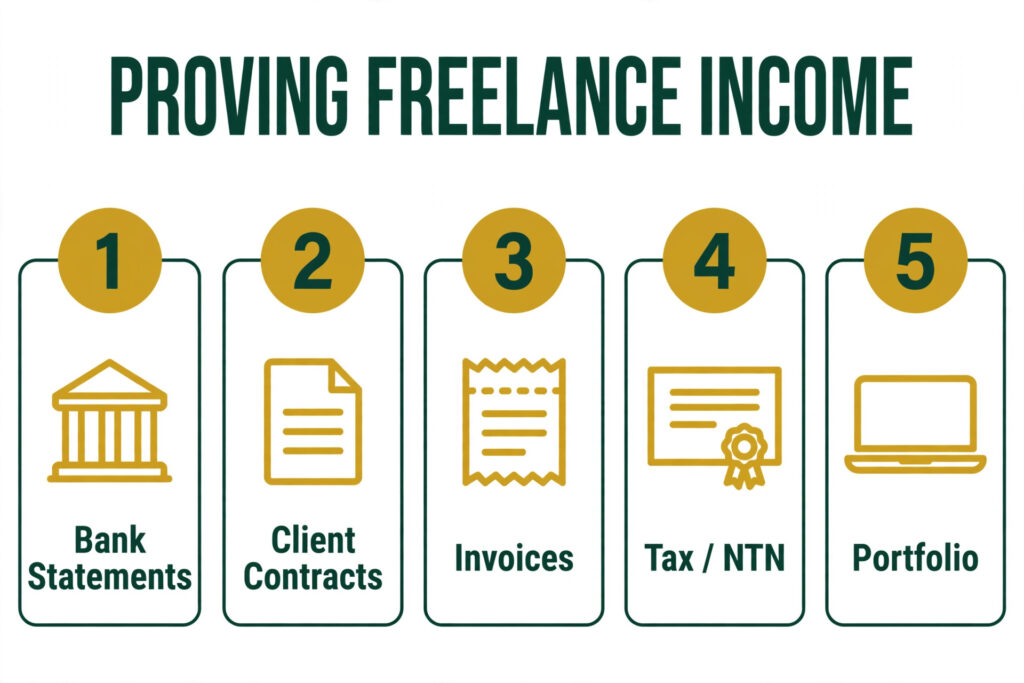
- Proving Freelance Income: The 5 Pillars
- Freelancer vs Employee: The Document Checklist
- NTN and FBR Tax Returns: Your Secret Weapon
- Proving Strong Ties to Pakistan
- Invitation Letter vs Self-Sponsored Travel
- Refusal Reasons That Hit Freelancers Hardest
- Timeline, Fees and Where to Apply
- 7 Approval Tips That Actually Move the Needle
- Frequently Asked Questions
If you earn on Upwork, Fiverr or directly from remote clients and dream of seeing Paris, Rome or Barcelona, you have probably heard the same discouraging line: “freelancers almost never get approved.” Here is the truth — it is harder than it is for a salaried applicant, but only because the paperwork is less obvious, not because the door is closed. A Schengen visa for freelancers from Pakistan follows the exact same Visa Code as everyone else’s application. The consulate does not reject you for being a freelancer; it rejects files where income looks unverifiable or the applicant’s return looks doubtful. Both problems are fixable with the right documents.
This guide walks you through the complete 2026 process: which documents replace salary slips, how to present irregular freelance income so it looks stable, the Pakistan-specific papers (NTN, FBR returns, NADRA FRC) that most guides forget, and the approval tips that experienced applicants swear by. For the general Schengen process — fees, the 90/180 rule and EES entry checks — see our Schengen Visa 2026 complete guide.
Can a Freelancer from Pakistan Actually Get a Schengen Visa?
Short answer: yes, every single week. The EU’s official Schengen visa rules describe a short-stay (Type C) visa for visits up to 90 days in any 180-day period. Nowhere in the Visa Code does it say the applicant must be salaried. What the rules do require is in the EU’s official entry conditions: a valid travel document, justification for the purpose of your stay, and proof of sufficient financial means.
For a salaried person, “proof of sufficient means” is easy: salary slips plus an employer letter. For you, it means assembling the same confidence from different pieces: bank statements showing regular client income, contracts proving the work is real and ongoing, and tax records proving the income is declared. Think of your file as telling a story — “I earn well, my work is legitimate, and my life is in Pakistan” — with every document as one sentence of that story.
The honest part: Pakistani applicants do face close scrutiny, and freelancers get an extra look because there is no employer to vouch for them. That is exactly why this guide exists. A well-prepared freelancer file beats a sloppy salaried file every time.
What the Visa Officer Is Really Asking
Forget the long checklist for a moment. When a visa officer opens your file, they are trying to answer three questions:
- Is this income real? Anyone can type numbers into a cover letter. The officer looks for third-party proof: money actually arriving in a bank, tax actually filed, clients who actually exist.
- Can this person afford the trip without trouble? Not just the flight and hotel — daily spending for the whole stay, with a comfortable buffer left over.
- Will this person come back to Pakistan? This is the big one. A freelancer with no boss, no leave letter and a laptop that works from anywhere can look “mobile” — which to an officer can read as a flight risk. Your ties to Pakistan must be louder than your ability to work remotely.
Every document you submit should answer at least one of these three questions. If a paper answers none of them, leave it out — a thick file of irrelevant documents does not impress anyone.
Proving Freelance Income: The 5 Pillars
Here is the core of your application. Build all five pillars and the “unverifiable income” objection collapses:
💼 The 5 Pillars of Freelance Income Proof
Build all five and the “unverifiable income” objection collapses.
Bank statements
6 months, signed and stamped by your bank. Regular client income beats one big deposit.
Client contracts
Current agreements prove income is real and give you reasons to return.
Invoices & receipts
Match invoices to bank deposits so income becomes a traceable fact.
NTN & FBR returns
Tax records are government-verified proof of your earnings.
Professional presence
Upwork/Fiverr profile, portfolio, LinkedIn — proof you are who you say.
1. Six-month bank statements (signed and stamped)
This is your most important document. Schengen checklists used in Pakistan ask for bank statements showing movements over the last six months, duly signed and stamped by the bank. The officer reads them like a story: regular incoming transfers from clients or platforms (Upwork, Payoneer, Wise), normal spending, a healthy closing balance. Consistency beats size — steady monthly income of $800 looks far stronger than a single mysterious deposit of $10,000 two weeks before your appointment. Never borrow money to inflate your balance; a sudden unexplained lump sum is one of the fastest routes to a refusal.
2. Client contracts and ongoing work agreements
Two or three current contracts do double duty: they prove your income is real and that you have reasons to return (work waiting for you). Include the client name, scope, payment terms and duration. Retainer agreements are gold — they show future income, not just past income. If you work through Upwork or Fiverr, export your contract history and earnings certificates from the platform.
3. Invoices and payment receipts
Match your invoices to the deposits in your bank statements. When an officer can trace “Invoice #47 → $1,200 → bank credit on March 3,” your income stops being a claim and becomes a fact. Twelve months of invoices in a neat folder is ideal; six months is the minimum.
4. NTN certificate and FBR tax returns
For Pakistani applicants this is close to mandatory: the National Tax Number certificate plus FBR acknowledgements of tax returns for the last 2 fiscal years. Filed tax returns are the single strongest third-party validation of your income — the government itself has verified your earnings. (More on this in its own section below.)
5. Portfolio and professional presence
Your Upwork/Fiverr profile with reviews, your LinkedIn, your portfolio website, a GitHub or Behance page — these corroborate that you are who your contracts say you are. Print a one-page summary with links and key stats (years active, completed projects, rating). It takes five minutes and removes the “is this person really a freelancer?” doubt.
Freelancer vs Employee: The Document Checklist
It helps to see the two files side by side. Notice that almost every salaried document has a freelance equivalent — you are not missing papers, you are translating them:
| Purpose | Salaried applicant shows | Freelancer shows |
|---|---|---|
| Income proof | 3 months’ salary slips | 6 months’ bank statements + invoices matched to deposits |
| Work legitimacy | Employment contract + employer letter | Client contracts + platform earnings history (Upwork/Fiverr) |
| Tax compliance | Tax deduction certificate | NTN certificate + FBR returns (last 2 fiscal years) |
| Permission to travel | Leave approval letter | Self-written cover letter + proof of ongoing client work |
| Ties to home | Job to return to | Active contracts, property, family, business registration |
💡 The freelancer translation rule: every salaried document has a freelance equivalent. Salary slips become bank statements, the employer letter becomes client contracts plus your cover letter, the tax deduction slip becomes your NTN and FBR returns. You are translating documents, not inventing them.
One document deserves special attention because salaried applicants never think about it: the cover letter. Without an employer letter, your cover letter carries extra weight. Write it yourself, one page, in plain English: who you are, what you do, who your clients are, how much you earn on average, why you are travelling, your exact dates and itinerary, and — most importantly — why you will return (ongoing contracts, family, property). Sign and date it. Officers read these.
NTN and FBR Tax Returns: Your Secret Weapon
If you take one Pakistan-specific tip from this guide, take this one: get your NTN and file your FBR returns before you apply. Schengen document checklists used in Pakistan explicitly ask self-employed applicants for the National Tax Number certificate and FBR acknowledgements for the last two fiscal years. Many freelancers skip this because “Fiverr already deducts tax” or “I’ll file later.” That is a mistake.
Here is why it matters so much: a tax return is the only income document in your file that comes from the government. Bank statements can be questioned, contracts can be doubted — but an FBR acknowledgement says the state of Pakistan has accepted your declared income. For a freelancer with no employer, that third-party validation is priceless. If you have not filed before, file now; even one filed year plus your NTN is far better than nothing, and you can explain in your cover letter that you are newly compliant.
Practical notes: keep your NTN certificate copy crisp and legible, print the FBR acknowledgement emails/slips for both years, and make sure the income figures on your returns roughly match the story your bank statements tell. Wild mismatches between declared income and bank credits invite questions.
VISAORA INTELLIGENCE SUITE
Will your freelance file survive a visa officer’s review?
Get a scored RiskScan of your documents, income proof and ties before you file — fix weak spots in minutes, not after a refusal.
Check My Score →Proving Strong Ties to Pakistan
Remember the officer’s third question — will you come back? A freelancer’s laptop works from a café in Berlin as easily as from Lahore, so you must make your roots visible. Stack as many of these as you honestly can:
🏠 Strong Ties to Pakistan — Stack Them
A freelancer’s laptop works anywhere, so make your roots visible. Use every tie you honestly have.
Family ties
NADRA FRC showing spouse, children or parents in Pakistan.
Property
Ownership papers for a house, flat or plot — even a small one.
Active contracts
Deliverables due after your return date say “I’m coming back”.
Return booking
A confirmed return reservation. Never a one-way ticket.
Business registration
Sole-proprietor or company certificate anchors your livelihood.
Travel history
Old visas and stamps prove you travel and return.
- Family ties: NADRA Family Registration Certificate (FRC) showing spouse, children or parents in Pakistan. Family remaining behind during your trip is one of the strongest ties there is.
- Property: ownership documents for a house, flat or plot — even a small one. Property is hard to walk away from, and officers know it.
- Ongoing client work: active contracts with deliverables due after your return date. Nothing says “I’m coming back” like work waiting for you.
- Return flight reservation: a confirmed return booking (not a one-way ticket, never a one-way ticket).
- Business registration: if you are registered as a sole proprietor or have a company, include the registration certificate — it anchors your livelihood to Pakistan.
- Previous travel history: old passports with visas and entry stamps (UAE, Malaysia, Thailand, Turkey — anywhere) prove you travel and return. If this is your first trip abroad, say so honestly and lean harder on the other ties.
A common freelancer mistake is thinking “I have no property and I’m unmarried, so I have no ties.” You still have clients, a tax record, a bank history and a return ticket. Present what you have confidently rather than apologizing for what you lack.
Invitation Letter vs Self-Sponsored Travel
Freelancers often wonder whether they need someone in Europe to invite them. You do not — self-sponsored travel is completely normal and often cleaner for a freelancer file. Here is how to choose:
Go self-sponsored if: you are travelling for tourism, your bank balance comfortably covers the trip, and your itinerary is your own. Book refundable hotels for the full stay, prepare a day-by-day itinerary, and let your finances speak. This keeps your file simple and consistent — no third party to explain.
Use an invitation if: you are genuinely visiting someone (friend, relative, business contact) or attending a specific event. The invitation should state the relationship, the address where you will stay, the dates, and ideally be accompanied by the host’s ID/residence proof. A vague invitation from a stranger you met online hurts more than it helps — officers see through it instantly.
Either way, the golden rule is consistency: your stated purpose, your bookings, your insurance dates and your cover letter must all tell the same story. Mixed signals — “tourism” on the form but a business invitation in the file — are a classic trigger for deeper scrutiny.
Refusal Reasons That Hit Freelancers Hardest
Most freelancer refusals come down to four predictable problems. The good news: each one has a concrete fix:
⚠️ 4 Refusal Reasons That Hit Freelancers Hardest
Most freelancer refusals come from these four problems — each has a concrete fix.
Weak income proof
Fix: the full 5-pillar package, invoices matched to deposits.
Weak ties to Pakistan
Fix: FRC, property, post-return deliverables, return ticket.
Unclear travel purpose
Fix: day-by-day itinerary matching your bookings.
Suspicious balance
Fix: build the balance gradually over 3–4 months.
- Weak income proof. Statements submitted without contracts or invoices, or income that appears from nowhere. Fix: the full 5-pillar package from section 3, with invoices matched to deposits.
- No strong ties to Pakistan. The officer is not convinced you will return. Fix: FRC, property papers, post-return client deliverables, return ticket — stack them.
- Unclear purpose of travel. A one-line “tourism” with no itinerary. Fix: a day-by-day plan with cities, hotels and transport that matches your bookings.
- Low or suspicious balance. Funds that barely cover the trip, or a big deposit with no explanation. Fix: build the balance over 3–4 months before applying; as a rough rule of thumb, travel guides suggest showing around €50–€70 per day of travel in accessible funds, on top of pre-paid flights and hotels.
If you have been refused before, read our detailed breakdown of the 7 real Schengen rejection reasons and how to fix each one — it covers appeal vs reapply strategy, which matters a lot for freelancers tempted to rush a second application.
Timeline, Fees and Where to Apply
Fees: the Schengen visa fee in 2026 is €90 for adults, paid at your appointment. On top of that, the visa application centre (usually VFS Global in Pakistan) charges its own service fee, which varies by destination country and changes over time — check the exact amount on the VFS Global Schengen information page for Pakistan for your destination before you go. Budget also for travel insurance (mandatory, minimum €30,000 medical coverage valid across all Schengen states).
Where to apply: you apply through the embassy or consulate of your main destination — the country where you will spend the most days. In Pakistan, most Schengen countries outsource appointment booking, document collection and biometrics to VFS Global, with centres in Karachi, Islamabad and Lahore; the embassy itself makes the decision. Book your slot on the VFS page for your destination country as early as possible — appointment availability is often the real bottleneck.
Timing: the Visa Code allows consulates up to 15 calendar days to decide, but from Pakistan the practical experience reported by applicants is often 2–4 weeks, longer in summer peak season. Apply 6–8 weeks before your travel date — you can apply up to 6 months ahead, and early application is the cheapest insurance against delays. Use the waiting time to keep your bank statements clean and consistent.
7 Approval Tips That Actually Move the Needle
- Start the paper trail 4 months early. Open a dedicated folder (physical or digital) and begin collecting: every invoice, every contract, monthly bank statements. A file built over months looks nothing like a file assembled in a weekend.
- Keep one clean salary-style account. If possible, route client income through a single bank account and avoid mixing it with family transfers or business expenses. One clear income stream is easy for an officer to read.
- Explain irregular months in the cover letter. Freelance income dips — a quiet Ramadan or a gap between projects is normal. One honest sentence (“February was slow between two contracts; March recovered to $X”) beats silence, which invites suspicion.
- Do not quit or pause clients before applying. Active, ongoing work is a tie to Pakistan. If anything, line up deliverables due after your return date and mention them.
- Buy refundable everything. Flight reservations (not tickets), refundable hotels, and insurance with the right dates. Never sink non-refundable money into a trip before the visa decision.
- Photocopy like a professional. Every original gets a clear copy, pages in the order of the consulate’s checklist, with a one-page index on top. Officers process dozens of files a day — make yours the easy one.
- Never submit a document you cannot explain. If the officer calls or asks at the counter about any paper in your file, you should be able to explain it in one sentence. If you cannot, it does not belong in the file.
VISAORA INTELLIGENCE SUITE
One weak document can sink a strong application.
Run your complete freelance file through the Suite’s RiskScan before your VFS appointment — income proof, ties and itinerary scored like an officer would score them.
Check My Score →A Realistic Example: What a Strong Freelancer File Looks Like
Illustrative example — a Lahore-based web developer
She earns around $1,500 a month through Upwork with two long-term retainer clients. Her file contains: six months of bank statements showing regular payouts, invoices matched to each deposit, her NTN certificate plus two years of FBR return acknowledgements, the two retainer contracts (with deliverables due after her return date), her NADRA FRC, a return flight reservation, refundable hotel bookings for a 12-day Italy itinerary, and a €30,000 Schengen insurance certificate. Her one-page cover letter ties it together: who she is, what she earns, why she is travelling, and why she is coming back.
Illustrative example only — it shows the shape of a complete file, not a promise of any outcome.
Frequently Asked Questions
Can a freelancer from Pakistan get a Schengen visa without a regular job?
Yes. The Schengen Visa Code does not require salaried employment — it requires proof of income, sufficient funds and ties to your home country. Freelancers prove these with 6-month bank statements, client contracts, invoices, an NTN certificate and FBR tax returns instead of salary slips and an employer letter. Many Pakistani freelancers are approved every year with well-documented files.
How much bank balance do I need for a Schengen visa as a freelancer from Pakistan?
There is no official fixed amount, but travel guides suggest roughly €50–€70 per day in accessible funds, on top of pre-paid flights and hotels — about €750–€1,050 for a 15-day trip. More important than the total is the pattern: regular client income over six months matters far more than one large unexplained deposit.
Do I need an NTN and tax returns for a Schengen visa from Pakistan?
Schengen checklists used in Pakistan ask self-employed applicants for the National Tax Number certificate and FBR tax-return acknowledgements for the last 2 fiscal years. While exact enforcement varies by consulate, filed returns are the strongest third-party proof of freelance income you can submit. If you have never filed, get your NTN and file as soon as possible before applying.
What if my freelance income is irregular from month to month?
Irregular income is normal for freelancers and won’t sink your application if you address it honestly. Show the full six months so the officer sees the average, not just the dips, and add one line in your cover letter explaining quiet periods. Retainer contracts and ongoing client agreements also reassure the officer that future income is stable.
Is an invitation letter better than self-sponsored travel for freelancers?
Not necessarily. Self-sponsored tourism is completely normal and often keeps a freelancer’s file simpler. Use an invitation only if you are genuinely visiting someone or attending a specific event — it should state the relationship, address and dates, with the host’s ID or residence proof. A vague invitation from a stranger hurts more than it helps.
Can I use my Upwork or Fiverr earnings as proof of income?
Yes — platform earnings are excellent proof because they come from a third party. Export your Upwork or Fiverr contract history and earnings certificates, and make sure the payouts match the credits in your bank statements. Add your public profile (reviews, completed projects, rating) as a one-page summary so the officer can verify you are an established freelancer.
How long does Schengen visa processing take from Pakistan?
The Visa Code allows up to 15 calendar days for a decision, but applicants from Pakistan commonly report 2–4 weeks, with longer waits in the summer peak season. Appointment availability at VFS Global centres in Karachi, Islamabad and Lahore is often the real bottleneck, so book your slot early and apply 6–8 weeks before your intended travel date.
What are the most common refusal reasons for Pakistani freelancers?
The four biggest are weak or unverifiable income proof, insufficient ties to Pakistan, an unclear travel purpose, and a low or suspicious bank balance. Each has a fix: full income documentation with matched invoices, stacked ties (family, property, active clients, return ticket), a detailed day-by-day itinerary, and a balance built gradually over months.
✈️ Planning Your Trip?
We may earn a commission — at no extra cost to you. Learn more