Australia 190 Invitation Rounds 2026: Latest Results, Cut-Offs & Predictions
Updated: 21 October 2026 · 11 min read
Australia 190 invitation rounds in 2026 are run separately by each state and territory — there is no single national 190 round. Each state sets its own schedule, occupation lists and cut-off scores: the points needed vary by state, occupation and round, so check your target state’s site. Tasmania does not rank by SkillSelect points: it uses its own priority-attribute ROI score (Gold 1,000, Green 250+, Orange below 250). The ACT ranks by Canberra Matrix score. Check your target state’s program page for the next round date; rounds typically run monthly to quarterly.
If you are waiting on an Australia 190 invitation round in 2026, here is the single most important thing to understand: unlike the 189 visa, the 190 has no national invitation round. Your invitation comes from a state or territory government — New South Wales, Victoria, Queensland, South Australia, Western Australia, Tasmania, the ACT or the Northern Territory — and each one runs its own program, on its own timetable, with its own occupation priorities and its own idea of what a competitive score looks like.
This guide explains how 190 rounds actually work in 2026, what the latest invitation activity looks like state by state, what cut-off scores occupations are really seeing, and how to position yourself for the next round. No myths, no recycled 2023 data — just the mechanics as they operate now.
- How 190 invitation rounds actually work
- State-by-state: 2026 round activity
- Cut-off scores by occupation: what it really takes
- 190 vs 189 rounds: why they differ
- Predicting the next round: 5 signals
- How to improve your invitation chances
- 7 mistakes that waste your EOI
- 190 timeline: EOI to invitation
- FAQs: Australia 190 rounds 2026
- There is no single national 190 round — each of the 8 states/territories runs its own invitation program.
- The points needed for a 190 invitation vary by state, occupation and round; check your target state’s site. State nomination adds 5 points to your SkillSelect score.
- Tasmania ranks ROIs by its own priority-attribute score (Gold 1,000, Green 250+, Orange below 250), not SkillSelect points; the lowest 190 score invited on 15 October 2026 was 319. The ACT ranks candidates by Canberra Matrix score, which is also separate from SkillSelect points.
- Rounds run monthly to quarterly depending on the state; most publish results or program updates after each round.
- Your EOI must select the 190 visa and your target state(s) — an 189-only EOI will never receive a 190 invitation.
How 190 invitation rounds actually work
The 190 is a state-nominated visa. That single fact explains everything about its invitation rounds. The process has four stages, and the state government — not the Department of Home Affairs — controls the critical one:
- You submit an Expression of Interest (EOI) in SkillSelect, selecting the 190 visa subclass and nominating one or more states. Your EOI shows your points total, occupation, and claims.
- The state reviews EOIs against its own criteria — occupation lists, minimum points, work experience, English level, and sometimes factors like ACT’s Canberra Matrix score or Tasmania’s priority-attribute ROI score.
- The state issues a nomination invitation to selected EOIs during its invitation round. This is the “190 invitation round” everyone talks about — it is the state’s round, not a national one.
- You apply for the visa within the state’s deadline (usually 60 days), and Home Affairs assesses the visa application itself.
The state nomination adds 5 points to your total — so an 80-point EOI becomes 85 for 190 purposes. States also apply their own filters on top of points: a high score alone does not guarantee selection if your occupation is not a state priority, if you cannot evidence your claims, or if you have no genuine commitment to living in that state.
Each program uses its own ranking. Published SkillSelect point bands are not shown because they vary by occupation and round.
Always check your occupation against your target state’s current published data before relying on any score.
State-by-state: 2026 round activity
Each state publishes its program differently — some announce round dates in advance, others invite continuously and publish summaries afterwards. Here is how the eight programs operate in 2026:
| State / Territory | Round pattern | Selection basis | Note |
|---|---|---|---|
| New South Wales | Periodic invitation rounds | Points + occupation priority | Largest program; most competitive scores |
| Victoria | Rolling invitations | ROI selection + points | Registration of Interest required first |
| Queensland | Periodic rounds | Points + occupation lists | Separate streams (graduates, offshore, onshore) |
| South Australia | Rolling / periodic | Points + state occupation list | Strong regional pathways |
| Western Australia | Scheduled invitation rounds | Points + occupation priority | Publishes round results with cut-offs |
| Tasmania | Regular ROI invitation rounds | Own ROI score from priority attributes (Gold 1,000 · Green 250+ · Orange below 250) | Ranks by ROI score, not SkillSelect points; publishes round results |
| ACT (Canberra) | Canberra Matrix rounds | Matrix score ranking | Matrix points ≠ SkillSelect points |
| Northern Territory | Rolling | Commitment + occupation need | Smallest program; genuine NT commitment key |
Program structures summarised from state migration program pages (2026). Round timing and occupation lists change — always verify against your target state’s current program page before relying on this table.
New South Wales and Victoria: the heavyweights
NSW runs the largest 190 program and the most competitive. Invitation rounds are periodic, selection is heavily points-driven within priority occupations, and the points needed vary by occupation and round, so check the NSW site for current information. Victoria uses a Registration of Interest (ROI) system — you register, the state selects ROIs it wants, and only then invites you to apply for nomination. A strong ROI (compelling employment prospects, high points) matters as much as the raw score.
Tasmania, ACT and NT: the accessible doors
The smaller jurisdictions rank candidates differently. Tasmania’s ROI system gives each registration a priority-attribute score, not a SkillSelect points total: a Gold attribute is worth 1,000, Green attributes are worth 250 or more, and Orange attributes are worth less than 250. Local employment, study and residence drive that score. The ACT’s Canberra Matrix scores you on Canberra-specific factors (residence, employment, study, family ties) separately from SkillSelect points. The NT prioritises genuine commitment to living in the Territory. If your points are modest, these three deserve your attention before the big states.
Tasmania round, 15 October 2026
Migration Tasmania invited ROIs to apply for nomination on 15 October 2026:
- Subclass 190: 45 invitations (12 Gold, 33 Green); lowest ROI score invited 319
- Subclass 491: 32 invitations (1 Gold, 31 further invitations); lowest ROI score invited 88
- ROIs on hand after the round: 878 for the 190, with 944 nomination places available; 612 for the 491, with 682 places available
- Rolling three-month average of the lowest score invited: 427 (190) and 81 (491)
These are Tasmanian ROI scores, not SkillSelect points. Because Thursday 22 October 2026 is Hobart Show Day, the next invitation round takes place on Friday 23 October 2026. Source: Migration Tasmania, Processing Times and Invitations Issued (checked 21 October 2026).
ACT round, 12 October 2026: the latest official results
The ACT ran its first Canberra Matrix invitation round of the 2026–27 program in the week starting 12 October 2026, for Subclass 190 only. It issued 261 invitations to apply for ACT nomination, and no 491 invitations:
- Doctorate Streamlined Pathway: 54 invitations (190)
- Canberra residents, Small Business Owners: 18 invitations (190), minimum Matrix score 120
- Canberra residents, Critical Skill Occupations: 126 invitations (190)
- Overseas applicants, Critical Skill Occupations: 63 invitations (190)
The ACT says it invites the highest-ranked Matrix in each occupation, and the cut-off depends on the monthly allocation, the date and time of Matrix submission, the occupation cap and demand. A minimum ranking score is an indication only, not a guarantee. These are Canberra Matrix scores, not SkillSelect points. The tentative next rounds are in the weeks starting 25 January 2027, 22 March 2027 and 24 May 2027, and the dates can change. The 2026–27 ACT allocation has not been announced yet. Source: ACT Government, Canberra Matrix invitation round (checked October 2026).
Where your 190 invitation actually comes from.
Apply to multiple states where eligible — your EOI can nominate more than one.
The 190 Points Test Explained
Every factor below adds to one total. Think of the table as your Australia 190 visa points calculator: add each category that applies to you, then add the 5 nomination points at the end.
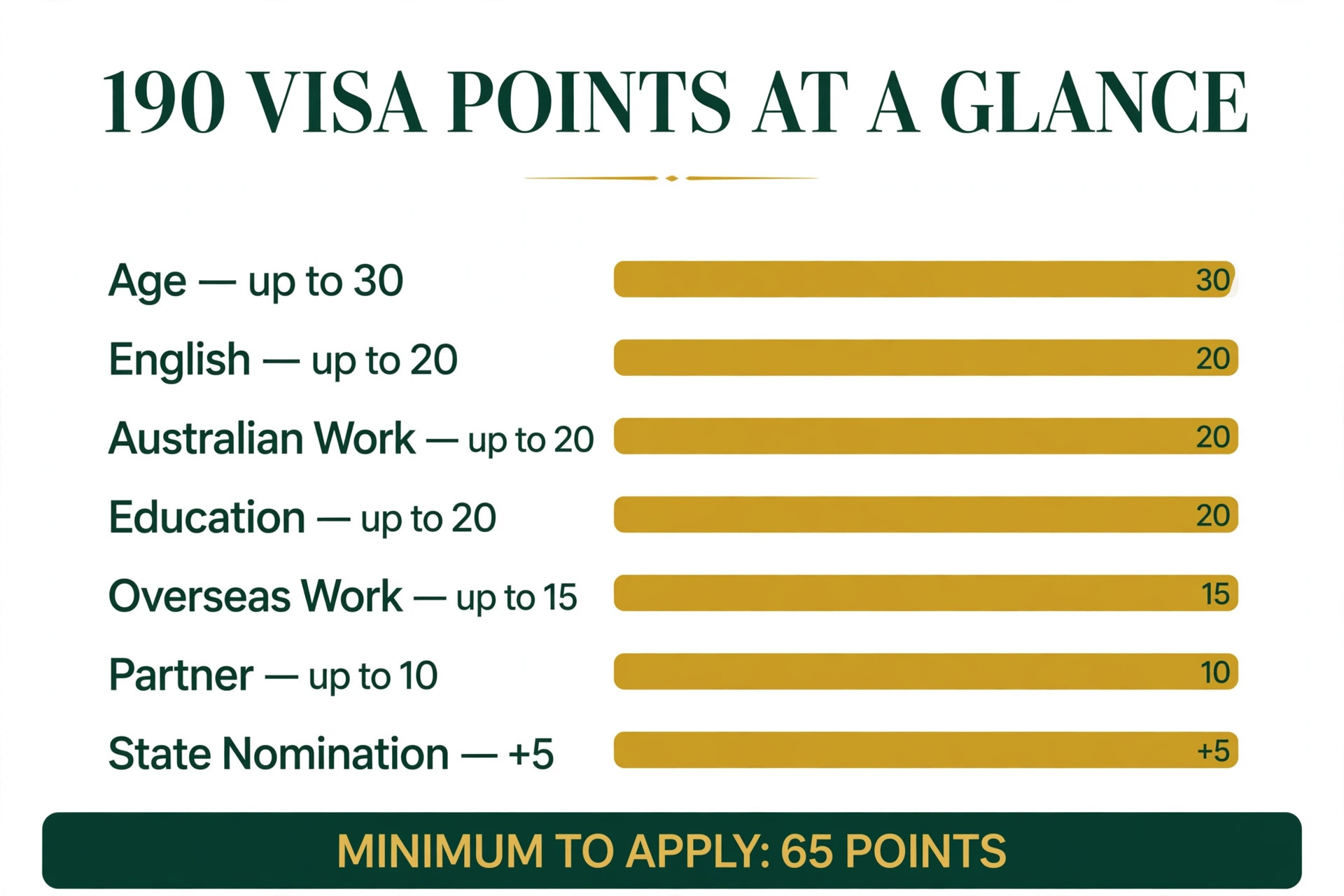
Age (up to 30 points)
| Age at invitation | Points |
|---|---|
| 18 to 24 years | 25 |
| 25 to 32 years | 30 |
| 33 to 39 years | 25 |
| 40 to 44 years | 15 |
Age is assessed at the time you are invited, and you must be under 45. The 25–32 band is the sweet spot at 30 points, which is why many applicants treat their early thirties as the ideal window.
English language (up to 20 points)
| English level | Points |
|---|---|
| Competent English (e.g. IELTS 6 in each band) | 0 |
| Proficient English (e.g. IELTS 7 in each band) | 10 |
| Superior English (e.g. IELTS 8 in each band) | 20 |
English is the single biggest lever for most applicants. Moving from Competent to Superior is worth 20 points — more than a whole extra qualification. Equivalent scores apply for PTE Academic, TOEFL iBT, OET, Cambridge C1 Advanced and other Home Affairs-approved tests. If you are close to a higher band, retaking the test is often the fastest way to lift your score.
Skilled work experience
| Experience | Points |
|---|---|
| Overseas: 3 to 5 years | 5 |
| Overseas: 5 to 8 years | 10 |
| Overseas: 8 years or more | 15 |
| In Australia: 1 to 3 years | 5 |
| In Australia: 3 to 5 years | 10 |
| In Australia: 5 to 8 years | 15 |
| In Australia: 8 years or more | 20 |
Only skilled employment in your nominated occupation (or a closely related one) counts, and it must be supported by evidence your assessing authority accepts. Australian experience is weighted more heavily than overseas experience, which is one reason onshore applicants often score higher.
Education and other boosters
| Factor | Points |
|---|---|
| Doctorate (recognised standard) | 20 |
| Bachelor or Master degree | 15 |
| Diploma or trade qualification | 10 |
| Specialist education: Australian STEM or ICT research Master or PhD | 10 |
| Australian study requirement (two academic years) | 5 |
| Regional study (studied and lived in designated regional Australia) | 5 |
| Professional Year completed in the last four years | 5 |
| Community language (NAATI credentialed, paraprofessional or above) | 5 |
Partner points (up to 10 points)
| Partner situation | Points |
|---|---|
| Single, or partner is an Australian citizen or permanent resident | 10 |
| Partner has a suitable skills assessment, Competent English, and is under 45 | 10 |
| Partner has Competent English only | 5 |
Many couples miss these points. If your partner can get a skills assessment in an occupation on the relevant list, plus Competent English, that is 10 points — often the difference between waiting and being invited.
State nomination: +5 points
State or territory nomination for the 190 visa adds 5 points to your total. This is why the headline number is always the total including nomination: a candidate with 60 base points becomes 65 once nominated. For comparison, nomination or family sponsorship for the 491 visa adds 15 points.
Worked Example: Calculate Your Own Score
Take Priya, a 30-year-old software developer with a Bachelor degree, five years of skilled overseas work experience, and Proficient English. Her base score:
- Age 25–32: 30 points
- Bachelor degree: 15 points
- Overseas skilled work (5 years): 10 points
- Proficient English: 10 points
- Base total: 65 points
- Plus state nomination: +5 points
- Final 190 score: 70 points
At 70, Priya is eligible but not competitive for IT, where invitation scores vary by state and round. One move changes that: lifting her English from Proficient to Superior adds 10 points, taking her to 80 and making her far more competitive. That single test result is worth more than years of extra waiting.
Now take Daniel, a 34-year-old electrician with a trade qualification, eight years of overseas experience, and Competent English. His score: age 25 + trade 10 + overseas work 15 + English 0 = 50 base points, plus 5 for nomination = 55. He is not yet eligible. But if his partner gains Competent English (5 points) and he completes a NAATI community language credential (5 points), he reaches 65 and becomes eligible to lodge an EOI; whether 65 is enough depends on the state and round.
To see where your own total lands, run your profile through the free Australia PR points estimator.
Cut-off scores by occupation: what it really takes
“What is the 190 cut-off?” is the wrong question — there is no single cut-off. The right question is: what did my occupation need in my target state last round? Cut-offs move with each round based on how many invitations the state issues and how many EOIs compete. That said, 2026 patterns are clear:
- High-demand professional occupations (software engineers, ICT roles, accountants): the points needed vary by state and round; check your target state’s site.
- Healthcare occupations (registered nurses, medical practitioners): the points needed vary by state and round; check the state site.
- Trades (electricians, carpenters, chefs): vary widely with state demand and local licensing; check the state site.
- Tasmania and the ACT: Tasmania ranks by its own ROI score (lowest 190 score invited on 15 October 2026: 319); the ACT ranks by Canberra Matrix score. Neither is a SkillSelect points cut-off.
The honest way to read any published cut-off: it is last round’s minimum invited score for that occupation in that state. It tells you the floor of what worked, not a guarantee of what will work next round. If last round’s floor for your occupation was 90 and you sit on 85, you need more points or a different state — not hope.
Priya, a software engineer on 85 points (including nomination), targets NSW — where recent invitation scores for her occupation have been higher than hers. She waits three rounds with nothing. Her colleague targets South Australia at the same 85 points, where her occupation is a state priority and her score is within reach — invited in the next round. Same points, same occupation, different state strategy, different outcome. The state you choose is a decision, not a default.
190 vs 189 rounds: why they differ
The 189 (Skilled Independent) runs national SkillSelect rounds controlled by Home Affairs — one queue, one cut-off per round, published afterwards. The 190 is eight separate state queues. This creates three practical differences:
- Timing: 189 rounds follow a federal schedule; 190 rounds follow eight state schedules that do not synchronise.
- Transparency: 189 publishes round cut-offs nationally; 190 transparency varies — WA publishes detailed round results, while some states publish little beyond program updates.
- Strategy: 189 rewards pure points; 190 rewards points plus state fit — occupation priority, local ties, and genuine commitment to the state.
Many applicants run both in parallel: an EOI can select 189 and one or more 190 states simultaneously. There is no penalty for multi-selecting — and for most applicants, the 190 is where the realistic chance lives, because the extra 5 points and state prioritisation open doors that 189’s national queue keeps shut.
Predicting the next round: 5 signals
Nobody can tell you the exact date of the next round — but five signals tell you when to be ready:
- State program updates. States announce program years, occupation list changes and round schedules on their migration pages. Check monthly.
- Previous round cadence. A state that invited monthly for six months will likely continue monthly — until it announces otherwise.
- Occupation list movements. Your occupation appearing on (or disappearing from) a state list is a stronger signal than any calendar.
- Quota announcements. Federal planning levels set how many 190 places exist nationally; state allocations follow. Bigger allocation years mean more frequent rounds.
- Your EOI’s birthday. EOIs expire after two years. An EOI about to expire during a quiet period should be refreshed — never let it lapse mid-wait.
How to improve your invitation chances
- Add points where they are cheapest. Superior English (20 points) is the single highest-value upgrade for most applicants — cheaper and faster than another degree.
- Target the right states. Apply everywhere your occupation is listed and you meet the criteria. Three state EOIs beat one.
- Evidence every claim. States verify employment claims; unverifiable experience is worse than unclaimed experience.
- Show genuine commitment. For smaller states, a researched settlement plan and evidence of ties outweigh five extra points.
- Keep your EOI current. Update it the day anything changes — new English score, new experience milestone, new qualification. Stale EOIs get skipped.
For points maths and estimators, see the Visaora Australia visa tools page — including the 189/190 points estimator.
7 mistakes that waste your EOI
- Selecting 189 only. An 189-only EOI can never receive a 190 invitation. Select every visa subclass you are eligible for.
- Targeting one state by default. Sydney is not a strategy. Check all eight programs against your occupation.
- Claiming unverifiable experience. States audit. If you cannot evidence it, do not claim it.
- Letting the EOI go stale. Update scores, experience and personal details immediately — outdated EOIs are skipped.
- Ignoring ROI/matrix steps. Victoria and Tasmania need an ROI; the ACT needs a Canberra Matrix. An EOI alone is not enough there.
- Chasing last round’s cut-off. Floors move. Build a buffer above the last published minimum, not parity with it.
- Missing the nomination deadline. State invitations expire (often 60 days). Calendar it the day it arrives.
190 timeline: EOI to invitation
Typical total time: 8–18 months from EOI to visa grant, highly variable by state and occupation.
FAQs: Australia 190 invitation rounds 2026
When is the next 190 invitation round?
There is no single national 190 round — each state and territory runs its own program on its own schedule. Check your target state’s migration program page for announced round dates; rounds typically run monthly to quarterly. States like WA publish round results, while others invite on a rolling basis.
What is a good points score for the 190 visa?
It depends on the state and occupation. The points needed vary by state, occupation and round, so check your target state’s site. Tasmania does not rank by SkillSelect points: it uses its own priority-attribute ROI score (Gold 1,000, Green 250+, Orange below 250), and the lowest 190 score invited on 15 October 2026 was 319. The ACT ranks by Canberra Matrix score instead of SkillSelect points.
How is the 190 different from the 189?
The 189 is a national SkillSelect round run by Home Affairs with one queue and published cut-offs. The 190 is eight separate state-run programs — each state sets its own occupation lists, schedules and selection criteria, and adds 5 nomination points to your score. The 190 also requires you to live in the nominating state for at least two years.
Can I apply for 190 in multiple states?
Yes. Your SkillSelect EOI can nominate multiple states for the 190, and you can also select the 189 simultaneously. There is no penalty for multi-selecting — it is standard strategy. Just make sure you meet each state’s individual criteria.
Do I need a job offer for the 190?
Generally no — most states do not require a job offer for the 190. Selection is based on points, occupation demand and state-specific criteria. Some states and streams give extra weight to local employment, but it is an advantage, not a requirement, in most programs.
How long does a 190 invitation take?
The wait varies enormously — from weeks for high-demand occupations in smaller states to a year or more for competitive occupations in NSW and Victoria. The full journey from EOI to visa grant typically runs 8–18 months. Keep your EOI updated throughout; stale EOIs get skipped.
What is the Canberra Matrix?
The Canberra Matrix is the ACT’s points system for ranking 190 (and 491) candidates, separate from SkillSelect points. It scores Canberra-specific factors like local residence, employment, study and family ties. You must meet the minimum matrix score for your occupation’s demand level to be considered in an ACT round.
Does the 190 require living in the nominating state?
Yes. The 190 carries a two-year commitment to live and work in the nominating state or territory. States take this seriously — particularly smaller ones — and evidence of genuine commitment strengthens your nomination application.
The bottom line
The 190 is not one race — it is eight, and the winners are the applicants who treat it that way. Pick your states deliberately, build a points buffer above last round’s floor, evidence everything, and keep your EOI alive. The invitation goes to the prepared, not just the high-scoring.
For points calculators and more, browse the Visaora Australia visa tools page — 100+ tools.
✈️ Planning Your Trip?
We may earn a commission — at no extra cost to you. Learn more