Australia Student Visa Processing Time 2026 (Subclass 500)
By Visaora Editorial Team · Updated November 2026 · 12 min read
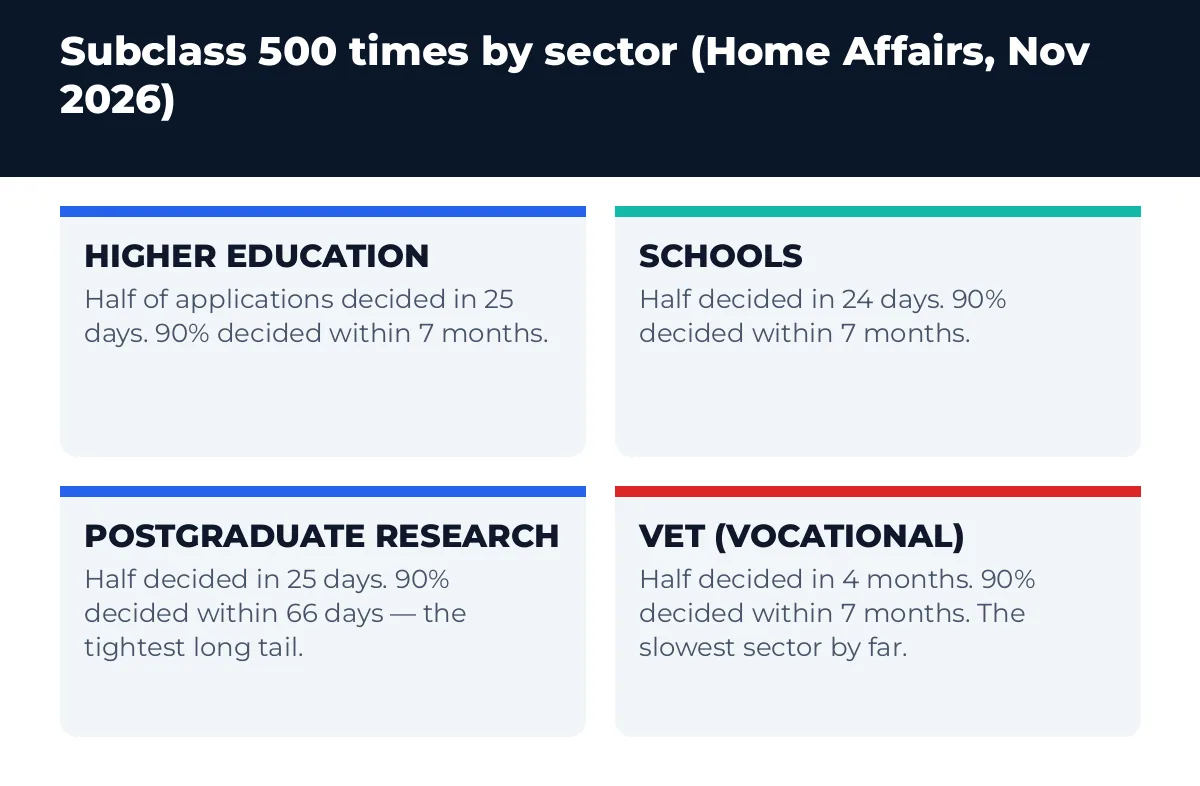
Quick Answer: Australia student visa processing time depends on your education sector. In the Department of Home Affairs guide updated in November 2026, half of Higher Education applications were decided in 25 days, but half of vocational (VET) applications took 4 months — and 90% of cases in most sectors were decided within 7 months. Lodge early and plan around the 90% figure, not the median.
Key takeaways
- Home Affairs publishes processing times by sector, as percentiles: the time within which 50% and 90% of recently decided applications were finalised.
- Higher Education and Postgraduate Research are the fastest large sectors: half decided in 25 days.
- VET is the slowest: half decided in 4 months, 90% within 7 months.
- Offshore applications lodged on or after 14 November 2025 are processed in the priority order set by Ministerial Direction 115.
- There is no paid priority service for student visas. A complete, decision-ready file is the only speed lever an applicant holds.
Two students can lodge on the same morning and hear back a season apart. That is not a glitch in Australia’s system; it is the system working exactly as published. The Department of Home Affairs measures student visa (subclass 500) waiting times by education sector, and the spread between a university applicant and a vocational college applicant is now the widest it has ever been. This guide reads the current official figures properly — what the percentiles mean, which sector you are actually in, and how to plan a course start around a wait you cannot shorten by paying. Before you lodge, work through our Australia Genuine Student requirement guide, because the files that stall longest are usually the ones with a weak story, not a slow queue.
Contents
- How long does an Australian student visa take in 2026?
- What are the processing times by sector?
- How does Home Affairs measure these times?
- What is Ministerial Direction 115, and why does it change your wait?
- How do you lodge a decision-ready application?
- Why is your student visa taking longer than the median?
- Example scenario: two students, one intake, two timelines
- Common mistakes when planning around the wait
- Frequently asked questions
- Sources
How long does an Australian student visa take in 2026?
For a typical university student, plan on weeks; for a vocational student, plan on months. Home Affairs’ November 2026 figures put the Higher Education median at 25 days, while the vocational education and training (VET) median is 4 months. The long tail matters more than either median: in most sectors, one application in ten is still undecided at 7 months. Which end of that spread you land on depends on your sector, your provider, and how complete your file is on the day you lodge.
One structural change sits underneath all of these numbers. Student applications lodged from outside Australia on or after 14 November 2025 are no longer simply taken in order; they are prioritised under Ministerial Direction 115, explained below. And a boundary worth knowing before you plan an onshore application: since October 2026, most temporary visa holders already in Australia can no longer apply for a student visa from inside the country at all, so the offshore queue is the only queue for most new students.
Immigration agency? Qualify UAE leads free with Visaora Agency Leads → https://visaora.io/visaora-agency-leads/
What are the processing times by sector?
Home Affairs publishes one line per education sector. “50%” is the time within which half of recently decided applications were finalised; “90%” is the time within which nine out of ten were finalised. The sector on your application is set by your course and provider, not by choice.
| Student visa sector | 50% decided within | 90% decided within |
|---|---|---|
| Independent ELICOS (English courses) | 11 days | 49 days |
| Schools | 24 days | 7 months |
| Higher Education (universities) | 25 days | 7 months |
| Postgraduate Research | 25 days | 66 days |
| Vocational Education and Training (VET) | 4 months | 7 months |
Last checked: November 2026 – Sources: Department of Home Affairs, visa processing times guide (Student visa, subclass 500, by sector; updated November 2026).
Read the Postgraduate Research line twice, because it teaches the right lesson. Its median matches Higher Education at 25 days, but its 90% mark is 66 days rather than 7 months — a far tighter tail. Medians tell you about the typical file; the 90% column tells you about risk. When you choose dates for flights, housing and course deferral deadlines, the 90% column is the one to plan against. The ELICOS line shows the opposite shape: very fast for most, because short English courses draw simpler files — but even there, one in ten runs to 49 days.
How does Home Affairs measure these times?
Backwards. The guide is built from applications that have already been decided, so it describes the recent past rather than promising anything about your file. Home Affairs says so plainly: the guide gives an indication of how long an application may take, based on how long recently decided applications took, and it does not promise a decision inside the timeframe. The department updates the figures every month, so a sector can drift between the day you research and the day you lodge.
The tool also knows nothing about your individual case. It cannot see your file, your provider’s risk profile, or the request for information sitting unanswered in your inbox. That is why the same published median can honestly coexist with your classmate’s 12-day grant and your own four-month wait: the distribution is wide, and your position in it is set by your sector, your priority level, and the state of your documents.
What is Ministerial Direction 115, and why does it change your wait?
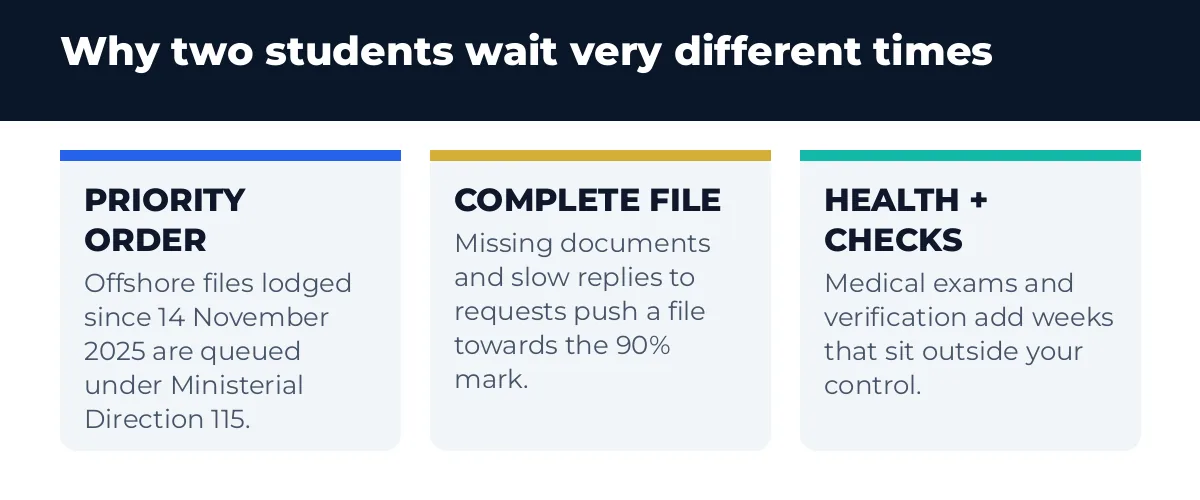
Ministerial Direction 115 is the processing order the Minister has set for offshore student visa applications lodged on or after 14 November 2025 (it replaced Direction 111 for new lodgements). Instead of one line, applications are sorted into priority levels, and higher-priority files are assessed ahead of lower-priority ones. In practice, your priority is shaped by your education sector and your provider’s standing — which is why two offshore applications lodged the same week can be decided months apart, with both outcomes entirely normal.
Onshore student applications are generally assessed in order of lodgement instead. The practical takeaway is not to game the direction — you cannot choose your priority level — but to understand that the published sector times now blend files moving at deliberately different speeds. If your sector and provider sit in a lower priority band, the median is optimistic for you, and the honest plan is the 90% figure plus a deferral conversation with your provider held early, not in a panic the week before orientation. Students weighing Australia against other destinations can compare the savings evidence expected with our proof of funds comparison for student visas, since financial evidence is one of the things assessors test hardest while your file waits.
How do you lodge a decision-ready application?
You cannot buy speed, but you can refuse to donate delay. Home Affairs’ own advice to applicants is to check twice and submit once — the department’s list of what slows a file is short and entirely practical. Work through it in this order:
- Confirm your enrolment first. You need your Confirmation of Enrolment (CoE) from your provider before the visa application exists. No CoE, no lodgement.
- Build the evidence before you lodge, not after. Genuine Student responses, financial evidence and English results should be written, gathered and checked while you wait for the CoE — not started the day it arrives.
- Lodge online through ImmiAccount and pay the correct charge. Home Affairs cannot process an application paid at the wrong charge; the file waits while that is sorted out.
- Attach every document at lodgement. Uploading the full set on day one is the single biggest difference between files decided in the fast half and files that stall waiting for requests.
- Do health examinations promptly. If a medical is required, book it as soon as you are asked. Clinic queues in peak season add weeks that appear in nobody’s published table.
- Answer every request for information fast and in full. A partial reply invites a second request. Two requests can quietly double your wait.
Why is your student visa taking longer than the median?
Home Affairs’ student visa page names the usual causes: the form was not filled in correctly, documents the department needs were not included or more information is required, or the department needs time to verify your information. Around those sit the structural causes: a health examination queue, peak intake volumes (applications surge before the February and July intakes), and a lower priority level under the ministerial direction. None of these is fixed by emailing the department, and none is a verdict on your application — long waits end in grants every day.
There is one more cause applicants rarely consider: the grant cannot rescue a missed course start. If your wait eats your intake, the decision you eventually receive may be for a course you can no longer begin on time, and deferral becomes a conversation between you and your provider. Protect yourself early: know your provider’s deferral deadline, and open that conversation while there is still slack in it. If the answer is ultimately a refusal rather than a grant, timing rules decide what review options exist — a different topic from this one, and a reason to keep every document you submitted.
Example scenario: two students, one intake, two timelines
Example — the students below are invented; the figures are the current Home Affairs ones. Mariam and Daniel both lodge offshore in early March for courses starting in late July. Mariam holds a CoE for a master’s degree at a university: Higher Education sector, median 25 days. Her complete file is decided in five weeks, and she books flights in May with months to spare. Daniel holds a CoE for a VET diploma: median 4 months, 90% mark 7 months. His file is still being assessed in June, and by early July he is discussing a deferral to the next intake with his college — not because anything went wrong, but because he planned his life around the 25-day figure he had seen quoted for “Australian student visas” generally. The sector column was the whole story, and it was published before either of them lodged.
Common mistakes when planning around the wait
- Planning on the median. Half of all applicants wait longer than the median by definition. Plan travel and housing on the 90% figure.
- Quoting the wrong sector’s time. A university median says nothing about a VET file. Find your own sector’s row first.
- Lodging weeks before the course starts. Home Affairs advises lodging well in advance of your start date. Peak intakes punish late files twice.
- Uploading documents in instalments. Every missing document is a future request for information, and every request adds a round trip measured in weeks.
- Paying anyone who promises priority. There is no paid fast track for subclass 500. Priority is set by ministerial direction, not by invoice.
- Letting the deferral deadline pass silently. Providers work with students who warn them early. Silence until orientation week is the worst negotiating position.
Frequently asked questions
How long does a subclass 500 visa take for higher education students?
In the Home Affairs guide updated in November 2026, half of Higher Education sector applications were decided within 25 days, and 90% within 7 months. Those figures describe recently decided applications, not a promise about yours. A complete file lodged early for a mainstream intake usually lands in the faster half; document requests and health checks push files towards the long tail.
Why do VET student visas take so much longer?
Because the sector’s queue is genuinely slower, not because individual officers are slower. Half of vocational education and training applications were decided within 4 months in the November 2026 guide, against 25 days for higher education. Sector volumes, provider profiles and the priority order in Ministerial Direction 115 all feed the gap. VET applicants should lodge a full season before their course starts.
Is there a priority or express service for Australian student visas?
No. There is no fee you can pay Home Affairs to decide a student visa faster, and agents cannot sell you one either. Processing order is set by the department under its ministerial directions. The only speed available to you is a decision-ready file: correct form, correct charge, and every document attached on the day you lodge.
When should I lodge my student visa before my course starts?
As soon as your Confirmation of Enrolment is issued and your evidence is complete — months before the course, not weeks. Home Affairs advises allowing plenty of time because applications take longer in peak periods. Planning against the 90% figure for your sector, rather than the median, is the safest way to choose a lodgement date.
What does “50% processed in 25 days” actually mean?
It means that among recently decided Higher Education applications, half were finalised within 25 days of lodgement — and half took longer. The companion figure, 90% within 7 months, means one in ten took longer than 7 months. Neither number is a minimum or maximum for your application; together they describe the shape of the queue you are joining.
Can I check the progress of my own student visa application?
Yes, through your ImmiAccount, which shows your application’s status and any requests the department has sent you. The published processing times guide cannot tell you anything about your specific file — it only reports how long recently decided applications took. If a request for information appears in your account, answering it quickly is the fastest legitimate way to keep your file moving.
Sources
- Department of Home Affairs — Global visa processing times and the visa processing times guide
- Department of Home Affairs — Student visa (subclass 500)
- Department of Home Affairs — Student visa processing priorities
Sorting the paperwork for your application? Start with our free Australia PR Document Checklist if permanent residence is the long-term goal, or estimate your skilled points with the Australia 189/190 Points Estimator — and if your plans change to visiting first, our subclass 600 visitor visa guide covers that route.
Visaora provides software tools and general information, not legal advice. Rules change; always confirm with the official authority.
✈️ Planning Your Trip?
We may earn a commission — at no extra cost to you. Learn more