Schengen Visa from Bahrain 2026: Residents’ Guide to Documents, Appointments and Timing
Quick answer: If you live in Bahrain, apply to the Schengen country that is your main destination, through the route that country uses in Manama: Germany and the countries it represents go through the VFS Global centre, Spain through BLS, and others through their own embassy route. Book first, then follow that office’s checklist.
Last checked against official sources on 27 October 2026
By Visaora Editorial Team · Updated October 2026 · 17 min read
You live in Manama, Muharraq or Riffa, and the plan is Europe. The first decision is not which flight to book. It is which country’s office should receive your application, because in Bahrain the answer changes where you go, which form you fill in and which checklist you follow. Submit to the wrong country and the file can be refused before anyone looks at your documents.
This guide works through that decision first, then the submission routes in Manama, the documents Bahrain residents are asked for, the fees, and the timing. Every rule is tied to an official source checked on 27 October 2026. One habit matters throughout: a Schengen stay is capped at 90 days in any 180-day period, so plan the days before you plan the route. Our free Schengen 90/180 day counter does that counting for you.
Key takeaways
- Apply to your main destination: the country where you spend the most days, or the country that is the main purpose of the trip.
- In Manama, Germany and eight countries it represents use the VFS Global centre; Spain uses the BLS centre in Seef; France starts on France-Visas.
- Your passport, Bahrain residence permit, work proof, bank statements, bookings and insurance must all tell the same story.
- The standard fee is €90 for adults and €45 for children aged 6 to 12; centres add a service fee on top.
- Apply up to six months ahead and no later than 15 days before travel; decisions normally take 15 days, sometimes up to 45.
On this page
- Which Schengen country should you apply to?
- Where do you submit your application in Bahrain?
- What documents do Bahrain residents need?
- How much does it cost?
- When should you apply, and how long does it take?
- How do families and dependants apply?
- Example scenario: five nights in Amsterdam, four in Berlin
- What are the most common mistakes to avoid?
- What happens if your application is refused?
- Frequently asked questions
- Official sources
Readers in neighbouring Gulf states apply under the same Visa Code but through different offices; our guides to a Schengen visa from Saudi Arabia, a Schengen visa from Qatar and a Schengen visa from Kuwait show how the routes compare. The office that decides your file is the one for Bahrain, your country of residence.
Which Schengen country should you apply to?
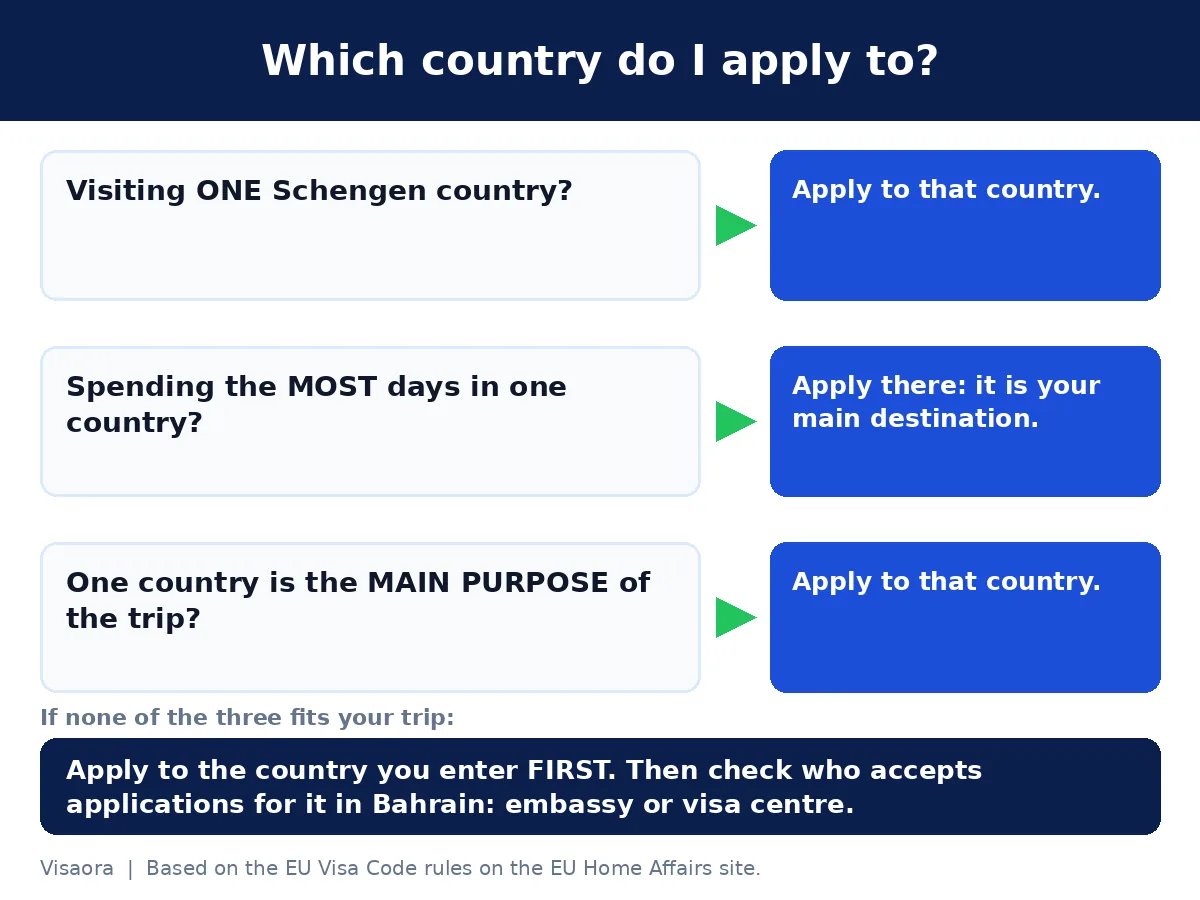
Apply to the country that is your main destination. The EU’s guidance is short: lodge the application at the consulate of the country you intend to visit — and if the trip covers several, at the consulate of the one where you will spend the longest time.
The main destination comes first
Count your days country by country. Six days in Italy and three in France makes Italy the main destination, even if your flight lands in Paris. Purpose can outweigh days: a four-day trade fair in Munich with two days in Vienna still points to Germany, because the fair is why the trip exists. Spain’s centre publishes the same order embassies use: main destination, main purpose, longest stay, first entry.
First entry is the fallback, not a shortcut
Only when no main destination can be identified — equal days, no single purpose — do you apply to the country you enter first. You cannot use a cheap flight into one country to choose its embassy when your days clearly sit elsewhere; Dutch guidance warns that an application lodged with the wrong country will be rejected.
Where do you submit your application in Bahrain?
Almost every Schengen application from Bahrain is submitted in Manama, but not at the same counter. Which centre or embassy takes your file depends on the destination country, so confirm the route before you book anything.
Embassy or visa application centre?
An embassy or consulate decides your application. A visa application centre only accepts it: staff check the file for completeness, collect the fees, take your fingerprints, forward everything to the embassy and return your passport at the end. No centre can approve your visa or speed up a decision, whatever an agent promises.
The German route: VFS Global in the Diplomatic Area
The German embassy in Manama runs a visa application centre operated by VFS Global, on the 18th floor of the Diplomatic Commercial Tower. Every applicant for Germany submits there, and the same centre takes applications for the countries Germany represents in Bahrain: Belgium, the Netherlands, Luxembourg, Norway, Finland, Sweden, Iceland and Slovenia. The Netherlands’ own official site confirms it from the other side: Bahrain residents applying for a Dutch visa use the same German VFS centre. For Germany itself, the embassy recommends completing the VIDEX online form before the appointment.
Spain: BLS International in Seef, decided in Kuwait
Spain’s applications are accepted by BLS International at Al-Aali Mall in Seef, by appointment, with fingerprints taken at submission for applicants aged 12 and over. One quirk surprises many residents: Spain has no embassy in Bahrain, so the file is decided by the Embassy of Spain in Kuwait. You submit and collect in Manama, but the decision is made in Kuwait — another reason to apply early.
France and the remaining countries
France starts online: the application is created on the official France-Visas portal, which sets out the documents and fee for your case, and the file is then submitted at the VFS centre for France in Manama. For any other country, start from its embassy page for Bahrain and follow the route it names; if it has no mission in Manama, the page will say who represents it, the way the Netherlands points to Germany.
Booking steps, in order
- Settle your main destination using the three questions above.
- Open that country’s official page for Bahrain and confirm who accepts applications: embassy, VFS or BLS.
- Book the appointment on the centre or embassy website — yourself, not through an agent.
- Download that office’s checklist and work through it in order.
- Re-check the checklist and the fee the week before your appointment.
Appointment slots are the scarce resource in every Gulf capital. If your dates are fixed and slots look thin, our explainer on Schengen appointment shortages and legitimate options covers what actually helps — and which paid shortcuts to avoid.
What documents do Bahrain residents need?
Your destination’s checklist governs your file, and checklists differ in detail between embassies. These are the categories that appear across the official Bahrain checklists, and what each group is really proving:
| Category | What it proves | Watch out for |
|---|---|---|
| Passport and Bahrain residence | Who you are, and that you legally live in Bahrain | Passport validity, blank pages, permit running past the trip |
| Work or business proof | Your job in Bahrain, and that you are expected back | Letter dates and salary that must match your statements |
| Bank statements | That you can pay for the trip yourself | Unexplained large deposits and gaps in the record |
| Travel insurance | Medical cover of at least €30,000 in all Schengen states | A card without the policy, cover that ends before you return |
| Itinerary and stay proof | Where you will be, night by night | Dates that differ from the application form |
Passport and Bahrain residence
The EU guidance asks for a passport expiring at least three months after you leave the Schengen area; the German checklist for Bahrain adds the standard conditions: issued within the last ten years, at least two blank visa pages, and a copy of your Bahrain residence permit, valid at least until the end of the requested visa or journey. Bring your CPR card as well: it ties your residence to your file. France’s Bahrain checklist has gone further, asking for the permit and re-entry visa to be valid at least six months, with the CPR in original and copy. A permit close to expiry is a problem to solve before you book, not at the counter. Residence and work status in Bahrain sit with the LMRA; our guide to Bahrain LMRA registered worker permit fees explains that side of living in the kingdom.
Work or business proof
Employed residents are usually asked for an employer letter stating the role, salary and approved leave, signed by someone who can confirm it. Business owners show their commercial registration and company documents instead. The letter and the statements are read together: the salary it names should be visible landing in the account, month after month. If you changed jobs recently, say so in a short cover note.
Bank statements
Checklists usually ask for recent personal bank statements — three to six months is the common range — in the format the office names. What the officer is testing is a pattern, not a single balance: regular income and enough left to fund the trip. A large deposit landing the week before submission, unexplained, does more damage than a modest but steady balance. If a deposit has an ordinary explanation, such as a bonus, add a one-line note and the matching paper.
Travel insurance
Insurance is a fixed rule, not a formality. The German embassy in Manama sets it out in full: minimum medical cover of €30,000, valid in all Schengen states and for the validity of the visa, with Schengen or Europe named as the destination on the policy. Two details catch people out: an insurance card alone is not accepted — it must come with the policy itself — and hand-written policies are refused. The embassy generally accepts policies issued in Bahrain. Buy for the full trip dates and keep the certificate with the file.
Itinerary and stay proof
Show where you will sleep each night: hotel or accommodation bookings in your name, or an invitation letter from a host with their address and contact details. For the journey itself, a flight reservation is normally what is asked for; most embassies do not require a paid ticket before the decision. Visaora’s free document checklist generator turns these categories into a personal list — use it to prepare, then measure the result against your embassy’s own checklist.
How much does it cost?
The visa fee is set by the EU Visa Code and is the same whichever Schengen country you apply to. What changes by route is the service fee the centre adds.
| Applicant | Standard visa fee | Notes |
|---|---|---|
| Adults | €90 | Set by the EU Visa Code |
| Children aged 6 to 12 | €45 | Half the adult fee |
| Children under 6 | No fee | One of the categories the fee is waived for |
| Visa centre service fee | Varies | Charged by VFS or BLS on top of the visa fee; check the current figure on the centre’s website |
Last checked: October 2026 – Sources: EU Migration and Home Affairs; German Embassy Manama
Fees are collected by the centre when you submit; Spain’s centre, for example, takes cash or card and issues a receipt, which you also need when you collect your passport. Centres collect in Bahraini dinars at the rate they apply on the day, so treat any dinar figure from an older page or forum as out of date until the centre’s own site confirms it. For a wider comparison of what Gulf residents pay across the region, see our breakdown of UAE, Qatar and Bahrain visa costs.
When should you apply, and how long does it take?
The Visa Code gives you a wide window, and the mistake is to use the wrong end of it. Applications can be lodged up to six months before the trip and no later than 15 calendar days before it.
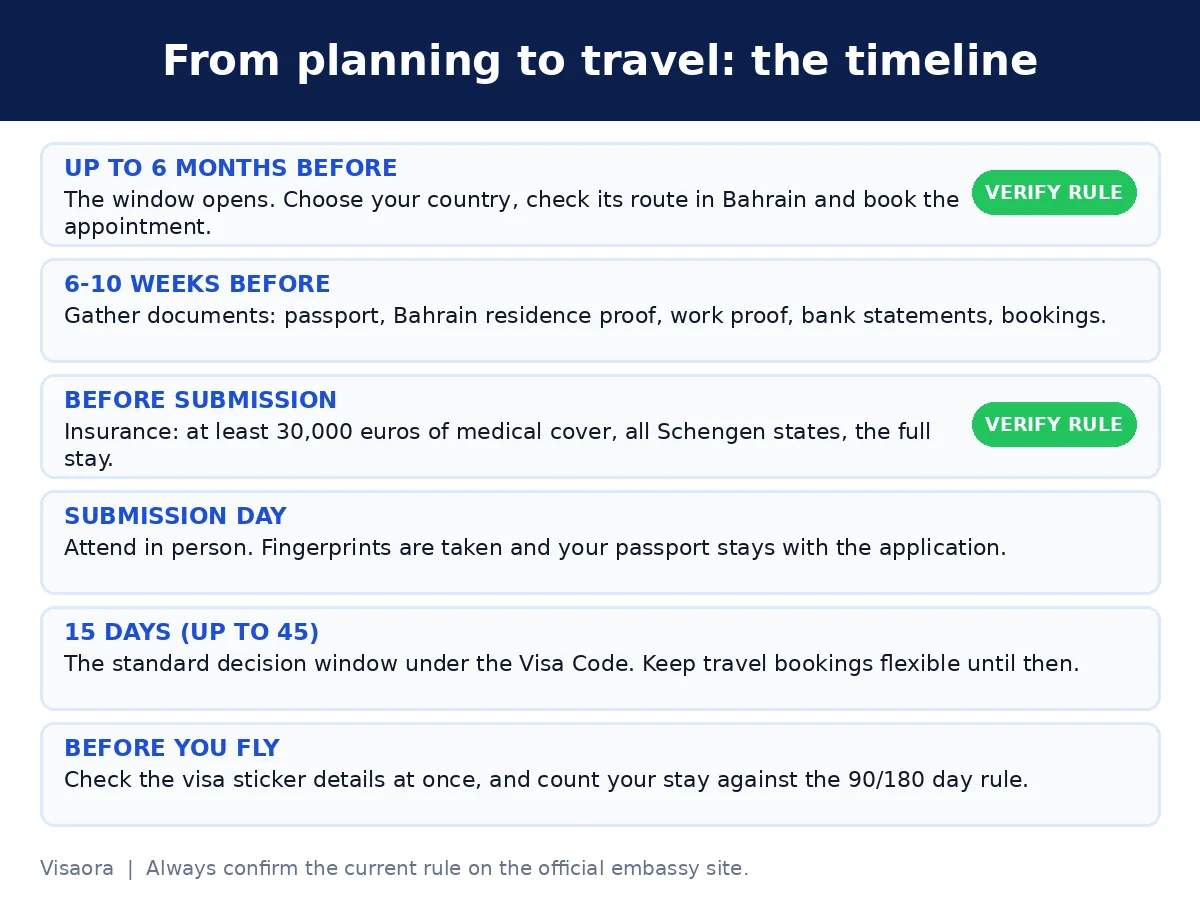
The decision itself normally takes 15 calendar days, and can stretch to up to 45 days where a file needs a closer look; the German embassy repeats the same range for Bahrain. Add appointment waiting time in front of that, and the honest planning figure for a peak-season trip is six to ten weeks. Summer, Eid and the December holidays fill Manama’s slots first; book as soon as the six-month window opens and keep hotels refundable until the decision lands.
The 15-day latest point is a legal minimum, not a plan. An application lodged at the edge leaves no room for a missing document or a slow file — and your passport stays with the application until the decision, so other travel in those weeks is off the table too.
How do families and dependants apply?
Every traveller needs their own application and their own appointment, children included. Parents or legal guardians sign for minors; on the German route, the form for a child under 16 is signed by both parents. Spain’s centre takes fingerprints from applicants aged 12 and over; younger children are generally exempt from fingerprinting.
A dependant who does not work — a spouse keeping house, a student son or daughter — applies on the strength of the sponsor’s file: the sponsor’s employment letter, statements and residence documents, plus proof of the relationship. Keep the sponsor’s documents identical across every family member’s file; officers notice when the same salary letter shows two figures in two envelopes. If your fingerprints were taken by a Schengen mission within the past 59 months, the German page notes you may not need to attend in person — but the office confirms it case by case.
Example scenario: five nights in Amsterdam, four in Berlin
Example scenario — fictional, for illustration only. Ahmed works as an engineer in Manama and holds a Bahrain residence permit on his CPR. His trip is five nights in Amsterdam and four in Berlin, flying into Amsterdam first. The Netherlands is his main destination twice over: most days, and first entry. Because the Netherlands is represented by Germany in Bahrain, Ahmed books his appointment at the VFS Global centre for Germany in the Diplomatic Area — not at a Dutch office, and not at BLS. Eight weeks before travel he gathers his passport, CPR and residence permit copies, his employer letter, recent bank statements, hotel bookings for both cities and a travel policy naming Schengen with €30,000 of medical cover. He checks his earlier trips on the 90/180 counter so the new nine days sit safely inside the limit. Nothing in this example promises an outcome; it shows the routing decision and the matching paperwork that official checklists reward.
What are the most common mistakes to avoid?
- Applying to the first-entry country. When a main destination exists, first entry is the wrong office.
- Booking at the wrong centre. The centre follows the destination: BLS is for Spain, the VFS German centre is for Germany and the countries it represents.
- An insurance card without the policy. Manama’s German route refuses cards on their own and hand-written policies; carry the full policy showing €30,000 cover.
- A residence permit that expires mid-trip. Renew first; the permit must outlast the journey, and some checklists ask for months more.
- Paying for an appointment. Appointments are booked free on the official site; anyone selling one is selling a risk.
- Dates that disagree. Form, flights, hotels and insurance must describe the same trip, night by night.
- Non-refundable bookings before the decision. Your passport is with the embassy and the answer can take 45 days.
- Working from another country’s checklist. A Dubai or Doha checklist is not a Manama one; use your destination’s Bahrain page.
Plan the trip with free Visaora tools
Visaora offers 100+ free tools for visa planning. Count your stay against the 90/180 day rule, and build your document list before you book the appointment.
One last habit: lay the finished file next to the checklist and tick each item in pen. Files rarely fail on one big thing; they stall on one small thing.
What happens if your application is refused?
A refusal arrives with reasons, in writing. Read them before you react: the EU guidance confirms every refused applicant is told why the application was rejected and how to submit an appeal. The exact route depends on the country that decided. Spain’s centre notes that a refusal can be appealed to the embassy. Germany changed its route in 2025: the informal remonstration procedure was abolished worldwide from 1 July 2025, so for a German refusal the options are judicial review or a fresh application — and the embassy itself notes a new application can be submitted at any time.
Whichever route you take, the work is the same: answer the stated reason with evidence, not argument. If the letter doubts your funds, a longer, steadier statement history says more than a complaint. If it doubts your purpose or your return to Bahrain, strengthen the itinerary, bookings and residence proof. Reapplying with the same file and a new date rarely changes the answer.
Frequently asked questions
Where do I submit a Schengen application in Bahrain?
It depends on your destination. For Germany and the countries the German embassy represents in Bahrain — Belgium, the Netherlands, Luxembourg, Norway, Finland, Sweden, Iceland and Slovenia — you submit at the VFS Global centre in Manama. Spain uses the BLS centre in Seef. Other countries use their own embassy route. The embassy always decides; the centre only collects your file.
Can I apply with a short residence permit validity left?
Only with care. The German checklist for Bahrain asks for a valid Bahrain residence permit that runs at least until the end of the requested visa or journey, and France’s Bahrain checklist has asked for residence and re-entry validity of at least six months. If your CPR or permit expires soon, renew it first, and check your destination’s current checklist before booking.
Do I need to book an appointment?
Yes. Every submission route in Manama works by appointment: the VFS centre for Germany and the countries it represents, the BLS centre for Spain, and embassies that take applications directly. Book on the centre or embassy website, not through an agent, and book before you pay for travel. Slots go quickly before summer and Eid, so start early.
What bank statements are usually asked for?
Most checklists ask for your recent personal bank statements, commonly covering the last three to six months, showing salary credits and a balance that covers the trip. Print them in the format your checklist names, and explain any large one-off deposit with a short note or payslip. The exact period differs by embassy, so treat the destination’s current checklist as the rule.
Is a hotel booking enough as accommodation proof?
For a tourist trip, yes, in most cases: confirmed hotel or accommodation bookings covering every night of your stay, with your name and the dates matching your application. If you stay with friends or family, checklists usually ask for an invitation letter from your host instead, with their address and contact details. Keep bookings refundable until the decision arrives.
Can I travel before the decision?
No. Your passport stays with the application until the embassy decides, and you collect it only when the decision is ready. A decision normally takes 15 calendar days and can take up to 45, so plan around the wait rather than around your hoped-for date. Do not book non-refundable flights or hotels until the visa is in your hand.
Official sources
- EU Migration and Home Affairs — Applying for a Schengen visa
- German Embassy Manama — Schengen Visa / Short Stay Visa
- NetherlandsWorldwide — Applying for a Schengen visa for the Netherlands in Bahrain
- BLS International — Spain Visa Application Centre, Bahrain (FAQs)
- France-Visas — the official visa portal for France
Visaora provides software tools and general information, not legal advice. Rules change; always confirm with the official authority.
Start free: count your days with the Schengen 90/180 day counter and build your file with the document checklist generator, then confirm every item against your embassy’s checklist.
✈️ Planning Your Trip?
We may earn a commission — at no extra cost to you. Learn more