H-1B Lottery 2026: How It Works Under the New Wage-Weighted System (FY2027 Guide)
Every spring, hundreds of thousands of skilled professionals watch one government announcement the way sports fans watch a draft. The H-1B lottery 2026 — the selection for US fiscal year 2027 — was the most consequential one in years, because the rules of the game changed completely. The old system was pure luck: every candidate got one identical ticket. The new one is weighted by salary, which means the paycheck your employer offers now directly shapes your odds. This guide walks you through exactly how it works: the timeline, the new wage-weighted math, the cap, the costs, and what to do next — whether you were selected, passed over, or are planning for the next round.
Quick Answer
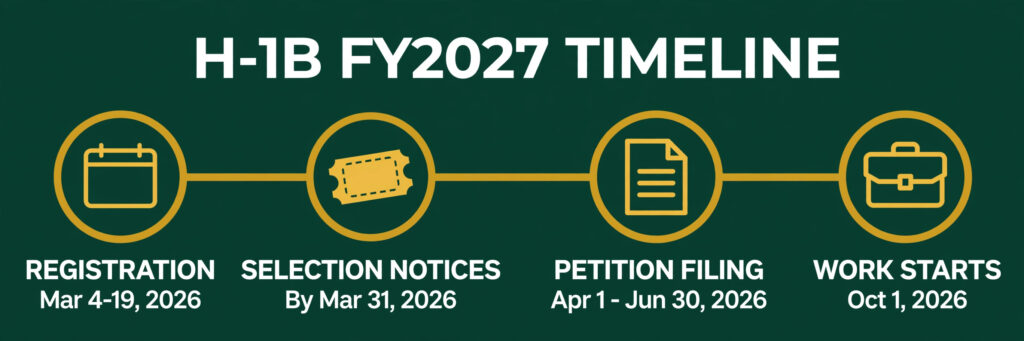
The H-1B lottery 2026 (for fiscal year 2027) worked like this: US employers registered each candidate electronically with USCIS between March 4–19, 2026 and paid a $215 fee per registration. USCIS then ran a weighted selection — instead of a pure random draw — giving each candidate 1 to 4 entries based on the Department of Labor wage level tied to the offered salary. Selection notices went out by March 31, 2026, employers filed full petitions between April 1 and June 30, 2026, and approved workers started on October 1, 2026. The annual cap is 85,000: 65,000 regular plus 20,000 for US master’s degree holders.
- The FY2027 registration window ran March 4–19, 2026, with a $215 fee per candidate, paid by the employer.
- Selection is no longer purely random: the offered wage level determines 1–4 entries per candidate in the pool.
- The annual cap is 85,000 — 65,000 in the regular pool plus 20,000 reserved for US advanced-degree holders.
- Selection notices went out by March 31, 2026; petitions were filed April 1–June 30, 2026; work began October 1, 2026.
- A $100,000 proclamation fee made headlines, but a court vacated its implementing guidance in June 2026 — its status is legally unsettled.
In This Guide
- What Is the H-1B Lottery, Exactly?
- How the H-1B Lottery 2026 Worked: The Full Timeline
- The Big Change: Wage-Weighted Selection Explained
- The H-1B Cap Explained: 65,000 + 20,000
- H-1B Lottery 2026 Costs: What Employers Paid
- Who Does What: Employer and Employee Checklist
- After the Draw: Selected vs. Not Selected
- What’s Next: Looking Toward FY2028
- Real-Life Scenario: The Salary That Changed the Odds
- Common Mistakes to Avoid
- Pro Tips for the Next Cap Season
- Frequently Asked Questions
What Is the H-1B Lottery, Exactly?
The H-1B lets US companies hire foreign professionals for “specialty occupations” — roles that normally require a bachelor’s degree or higher in a specific field. Think software engineers, data scientists, doctors, architects, and financial analysts. Congress caps new H-1B visas at 85,000 per fiscal year, and demand has outstripped that number for well over a decade. So USCIS runs an electronic selection process to decide which candidates employers may petition for.
Two things trip people up right away. First, you cannot enter yourself. There is no self-application route — a US employer (or their attorney) must register you. If a company wants to hire you, they put your name in; you cannot buy your own ticket. Second, the lottery is only the doorway, not the visa. Being selected simply gives your employer permission to file the full petition. The real scrutiny — degrees, job duties, wages, company legitimacy — comes afterward.
There is also a parallel track with no lottery at all. Universities, nonprofit research organizations, and government research institutions are cap-exempt: they can sponsor H-1B workers year-round without touching the 85,000 limit. If you work in academia or research, this is often the simplest path.
How the H-1B Lottery 2026 Worked: The Full Timeline
The FY2027 season followed a tight, predictable calendar. Here is each stage, in order:
New for FY2027, employers had to submit wage data up front: the occupation’s Standard Occupational Classification (SOC) code, the area of intended employment, and the highest Department of Labor (OEWS) wage level the offered salary met or exceeded. In previous years this appeared only later, in the full petition. Now it drives the selection itself.
The Big Change: How the 2026 Wage-Weighted System Works
For years, the H-1B lottery was a pure random draw — a junior hire at an entry-level salary had exactly the same odds as a senior architect earning four times as much. A Department of Homeland Security final rule, effective February 27, 2026, replaced that with a weighted selection process for the FY2027 season, and it is the single biggest change to the program in recent memory.
The mechanics are straightforward. The Department of Labor divides prevailing wages into four levels (I through IV) for each occupation and location. USCIS enters each unique candidate into the selection pool multiple times based on the wage level the employer declared at registration:
Three guardrails matter. First, each person still counts only once toward the cap — the extra entries only change the probability of being picked, not how many visas one person can take. Second, selection is beneficiary-centric: if several employers register the same person, USCIS uses the lowest wage level submitted across those registrations, so gaming the system with multiple entries backfires. Third, the wage level declared at registration gets checked against the actual petition — if the real salary drops below the declared tier, expect requests for evidence or a denial. The honest rule: declare the level you can actually defend.
| Feature | Old Random Lottery (before FY2027) | New Wage-Weighted System (FY2027+) |
|---|---|---|
| How candidates were picked | Pure random draw — one entry per person | Weighted draw — 1 to 4 entries based on wage level |
| Who had the edge | Nobody — every candidate had equal odds | Higher-paid roles (Level III and IV) have meaningfully better odds |
| Wage info at registration | Not required — only basic details | Required: SOC code, work location, and OEWS wage level |
| Multiple employers, one candidate | Abused in the past with duplicate registrations | Beneficiary-centric: one selection per person, lowest wage level applies |
| Rule effective date | — | February 27, 2026 |
The H-1B Cap Explained: 65,000 + 20,000
The 85,000 figure everyone quotes is actually two separate pools. The regular cap holds 65,000 visas open to any qualifying candidate. The advanced degree exemption — often called the master’s cap — reserves 20,000 more for people who earned a master’s degree or higher from a US university.
If you hold a qualifying US advanced degree, you effectively get two chances: you are considered in the regular pool first, and if not selected there, you are considered again in the master’s pool. The same wage-level weighting applies within each pool, so a master’s degree plus a strong salary is the best combination in the system. A foreign master’s degree, by the way, does not qualify — it must be from a US institution.
For the full official breakdown of caps and exemptions, see USCIS’s H-1B Cap Season page.
H-1B Lottery 2026 Costs: What Employers Paid
The lottery stage itself is cheap by design — USCIS wants the entry barrier low so employers register broadly. For FY2027, the registration fee was $215 per candidate, paid electronically and non-refundable. Crucially, the employer pays it; the worker cannot register or pay on their own behalf.
The real money shows up after selection. The full Form I-129 petition carries government filing fees that run into the thousands of dollars depending on employer size, plus legal fees — most employers use an immigration attorney, and the new wage-level rules made that advice more valuable, not less. Employers also pay the Department of Labor nothing for the LCA itself, but preparing a compliant one takes real work.
Who Does What: Employer and Employee Checklist
One of the most common misunderstandings is who is responsible for what. The short version: the employer does almost everything; the employee’s job is to provide accurate documents fast and not disappear.
- Registration: employer creates the USCIS account, enters your details and wage level, pays $215 — you provide passport, degree info, and accurate personal details.
- Selection: employer monitors the USCIS account for the selection notice — you wait, and keep your phone on for the employer’s call.
- Petition: employer gets the certified LCA, files Form I-129 with evidence, pays fees — you supply degree certificates, evaluations, CV, and prior visa documents.
- Visa / status: employer supports with the approval notice and employment letter — you attend the consular interview abroad or change status inside the US.
After the Draw: Selected vs. Not Selected
If you were selected: congratulations are premature but warranted. Your employer files the LCA and Form I-129 inside the filing window. USCIS reviews the specialty-occupation claim, the employer-employee relationship, and wage compliance. If approved while you are abroad, you apply for the H-1B visa stamp at a US consulate; if you are already in the US (say, on F-1 OPT), you typically change status without leaving. One practical tip for students: a timely filed cap-subject petition can trigger “cap-gap” protection that extends F-1 status until October 1 — ask your school’s international office about it.
If you were not selected: nothing is filed, nothing is appealed — there is no waitlist and no second chance within the same season. USCIS confirmed no additional selection round for FY2027. That stings, but it is not the end of the road. Realistic next moves include a cap-exempt job at a university or nonprofit research organization (no lottery, year-round filing), extending F-1 OPT or STEM OPT if eligible, or another visa category entirely — O-1 for extraordinary ability, L-1 for intracompany transfers, or TN for Canadian and Mexican professionals in listed occupations. If you are weighing US options more broadly, our USA visa tools hub is a good starting point — and if another country is on the table, the Canada visa tools hub covers a system with very different rules.
What’s Next: Looking Toward FY2028
The FY2027 season is complete — registrations closed, selections made, petitions filed, and the first workers under the new system started on October 1, 2026. The next cap season, for fiscal year 2028, is expected to open in March 2027, though USCIS announces exact dates each year on its H-1B Electronic Registration Process page. If you are planning ahead, the smart moves are the same ones that mattered this year: line up a genuine employer sponsor early, get foreign credentials evaluated, and understand which wage level your offered salary will land in — because under the new rules, that number is no longer just a compliance detail. It is your odds.
Real-Life Scenario: The Salary That Changed the Odds
Consider a data analyst in Karachi with two US offers in early 2026. Offer A paid at DOL wage Level I for the role and location — one entry in the selection pool. Offer B, from a larger employer, paid at Level III — three entries. Both employers were legitimate, both roles were genuine specialty occupations.
She chose Offer B, partly for the salary and partly for the odds. Her registration carried three entries instead of one — and she was selected in the FY2027 draw. Correlation is not proof (a single draw is still random at heart), but the math is honest: under the weighted system, three entries are simply three chances. The lesson for the next season is practical, not cynical — when comparing offers, ask the employer which wage level your salary maps to, and factor the answer into your decision.
Common Mistakes to Avoid
Pro Tips for the Next Cap Season
Frequently Asked Questions
What happens if I win the H-1B lottery?
Winning means your employer can file an H-1B petition for you — it is an invitation to apply, not a visa. Your employer first gets a certified Labor Condition Application from the Department of Labor, then files Form I-129 with USCIS inside the filing window. Only after USCIS approves that petition can you start work or get your visa stamped.
How do I check my H-1B lottery status?
Your employer (or their attorney) checks the status in their USCIS online account, where each registration shows as Selected, Submitted, Not Selected, or Denied. USCIS also sends email notifications when statuses change, but the online account is the official record — ask your employer to confirm directly rather than waiting on email.
What’s the deadline for filing the H-1B petition after selection?
For FY2027, selected employers had a filing window of at least 90 days starting April 1, 2026 — in practice April 1 through June 30, 2026. The exact deadline appears on your selection notice. Missing it means losing the selection entirely, so employers should start preparing the petition the moment selection is confirmed.
What documents do I need for the H-1B petition?
The core package is Form I-129 plus a certified Labor Condition Application, proof of your degree (with a foreign credential evaluation if applicable), your passport, evidence of your current immigration status, the selection notice, and a detailed job description matching the registered position. Employers typically add company financials and an offer letter.
Will there be a second H-1B lottery for FY 2027?
No. USCIS confirmed that the FY2027 cap was reached and that it would not run an additional selection round. Non-selected registrations were marked Not Selected with no appeal or waitlist. If you missed out, the realistic paths are a cap-exempt employer, another visa category, or the next cap season.
What happens if I’m not selected in the H-1B lottery?
Nothing is filed and you lose nothing beyond the registration fee — you simply try again next year. In the meantime, many candidates bridge the gap with F-1 OPT or STEM OPT, a cap-exempt H-1B job at a university or nonprofit research organization, or an alternative visa category such as O-1, L-1, or TN if they qualify.
How does the new wage-weighted H-1B selection work?
Instead of one random entry per person, USCIS enters each candidate into the selection pool based on the Department of Labor wage level tied to the offered salary: Level I gets 1 entry, Level II gets 2, Level III gets 3, Level IV gets 4. Higher-paid roles get more chances, but every candidate counts once toward the cap.
How much does it cost to register for the H-1B lottery?
USCIS charged a $215 registration fee per beneficiary for the FY2027 season, paid electronically and non-refundable even if you are not selected. The employer pays it — employees cannot register themselves. Full petition fees after selection are separate and significantly higher, and employers should budget for those plus legal costs.
Conclusion: The New Game Rewards Higher Pay — Play It Honestly
The wage-weighted H-1B lottery changed the strategy for everyone: salary is no longer just a compliance number, it is your odds. The winning playbook for FY2028 is simple — line up a genuine sponsor early, know which wage level your offer maps to, keep your credentials evaluated, and declare only the level you can defend in the petition.
Want a clear-eyed read on your own case before the next season opens? Run your profile through the Visaora Intelligence Suite — it scores your strengths, flags your red flags, and shows exactly what to strengthen while there is still time. And if you are weighing US options broadly, our USA visa tools hub is the place to start.
Last updated: October 2026. Immigration rules change — always confirm current requirements on uscis.gov before making plans.
✈️ Planning Your Trip?
We may earn a commission — at no extra cost to you. Learn more