Yes — as an expat resident of the UAE, Qatar, Kuwait, Oman or Bahrain, you can perform Umrah in 2026. Saudi Arabia’s Ministry of Hajj and Umrah confirmed that GCC residents may use an Umrah visa via Nusuk, a transit (stopover) visa with Saudia or flynas, or a tourist visa — but every pilgrim, citizen or resident, must book an Umrah permit on the Nusuk app before entering the Haram.
Last reviewed: 18 October 2026
This guide compares the three routes, explains the Nusuk permit everyone must complete, and lists the season dates and document checklists for each route. It is written for expats in Dubai, Doha, Kuwait City, Muscat and Manama in plain English. Visaora is software and does not provide legal advice. Requirements depend on your nationality and situation. Confirm with the official authority or a licensed adviser. Weighing the tourist eVisa? Estimate your total first with the free Saudi eVisa cost calculator.
Quick Answer: GCC residents (expats in the UAE, Qatar, Kuwait, Oman and Bahrain) can perform Umrah in 2026 through three routes: a one-year multiple-entry Saudi tourist eVisa, a free 96-hour Saudia/flynas stopover visa, or a dedicated Umrah visa via Nusuk or a licensed agent. Whichever route you take, every pilgrim — citizen or resident — must book a Nusuk Umrah permit before entering the Haram, and must avoid the Hajj-period suspension (roughly mid-April to end of May 2026).
Key Takeaways
- Three routes for GCC residents: tourist eVisa (repeat trips), stopover visa (layover Umrah on Saudia/flynas), dedicated Umrah visa (first-timers, Ramadan).
- A Nusuk permit is mandatory for everyone — visa-free entry is not permission to perform Umrah.
- Stopover visa: 96 hours, issued free during airline booking, single entry, no extensions, Umrah yes but not Hajj.
- Umrah pauses around every Hajj — in 2026 roughly mid-April to end of May. Never book non-refundable travel across the suspension.
- Carry meningococcal (ACWY) vaccination proof; a Rawdah visit in Madinah needs a separate Nusuk permit.
In This Guide
Who can go: GCC citizens vs residents
The rules turn on citizenship, not where you live. GCC citizens — passport holders of the UAE, Saudi Arabia, Kuwait, Qatar, Oman and Bahrain — can perform Umrah at any time of the year, entering Saudi Arabia through all land, air and sea ports without a visa (Ministry of Hajj and Umrah announcement, reported by Gulf News, 27 June 2025).
In the same announcement, the Ministry said GCC residents can perform Umrah on Umrah visas via nusuk.sa, transit visas with Saudia and flynas, and tourist visas through the Ministry of Foreign Affairs’ portal, ksavisa.sa (Gulf News, 27 June 2025). Everyone needs a Nusuk permit for Umrah and for Rawdah prayer in Madinah — visa-free entry and permission to perform Umrah are two different things.
Route 1: Saudi tourist eVisa
The tourist eVisa is the most flexible route if you plan more than one trip — a one-year, multiple-entry visa that also permits Umrah outside the Hajj season. It suits expats whose residence permit has good remaining validity (travel guides advise three months or more at application). Note eligibility depends partly on nationality — many nationalities qualify directly, and some qualify through a valid US, UK or Schengen visa. If your profile is complicated, run the Saudi eVisa rejection predictor before you pay.
You apply online through the official portal (ksavisa.sa); approval often arrives within hours or a few days. The visa is generally valid one year with multiple entries and up to 90 days of total stay. At checkout the portal shows an itemised total — visa fee plus mandatory medical insurance and charges. Fees change. Check the official website before you pay — the official eVisa portal (ksavisa.sa) is the only authoritative figure.
The tourist visa permits Umrah outside the Hajj season; it does not permit Hajj. You still book each Umrah slot on Nusuk separately.
Example: Fatima, an Indian executive on a UAE residence visa, wants two Umrah trips plus a Riyadh weekend. She applies for the tourist eVisa once, estimates the total with the Visaora calculator, and books both Umrah slots on Nusuk. One visa covers all three trips.
Route 2: transit visa with Saudia or flynas
Flying somewhere with a long connection through Saudi Arabia? Turn the layover into a four-day Umrah. This suits GCC residents connecting through Jeddah, Riyadh or Dammam on Saudia or flynas — the only two carriers whose booking flow generates this visa.
Saudi Arabia’s Ministry of Foreign Affairs launched the stopover visa in early 2023: up to 96 hours (four days) in the Kingdom, valid for 90 days from the date of issue, single entry and non-extendable. The visa is issued free of charge during booking; travellers pay a small processing fee plus mandatory medical insurance. It is generated automatically when you choose a flight with a Saudi stopover on the Saudia or flynas website (reported by The Economic Times and Business Standard, November 2025). GCC residents are eligible even though they are not GCC citizens; travellers on other airlines need a standard paid transit visa instead.
The stopover visa explicitly allows Umrah — but not Hajj. You must register on Nusuk and book your Umrah appointment before travelling, even for a short layover.
Watch out: under-12-hour layovers where you stay airside with a confirmed onward ticket need no visa at all. The stopover visa matters when you leave the airport — and 96 hours goes fast, so have your Nusuk slot booked in advance, not improvised at the terminal.
Example: Ahmed, a Pakistani engineer in Doha, books a Saudia flight to London with a three-day Jeddah stopover. He selects the stopover visa during booking, receives it by email within minutes, and books his Umrah slot on Nusuk for the middle day. Four days, one layover, no package agent.
Route 3: Umrah visa and Nusuk packages
The dedicated Umrah visa is the traditional single-entry route, arranged through the Nusuk platform or a licensed Umrah agent. It suits residents whose nationality is not eVisa-eligible, first-time pilgrims who want a guided package, and anyone travelling during Ramadan when packages handle the crowded logistics.
Umrah visas are issued for the season — typically single-entry with up to 90 days of stay. On Nusuk, hotel booking inside the platform is part of the process; through an agent, the package bundles visa, hotel and transport. Official fees on the Nusuk platform are fixed, with the final cost depending on insurance, service charges and whether you book through an agent — confirm current charges on the Nusuk Umrah portal before paying.
Watch out: book only through Nusuk or a licensed operator, and pay only against a written receipt listing what is included. Some nationalities can only apply through authorised agents in their home country — never through unofficial middlemen.
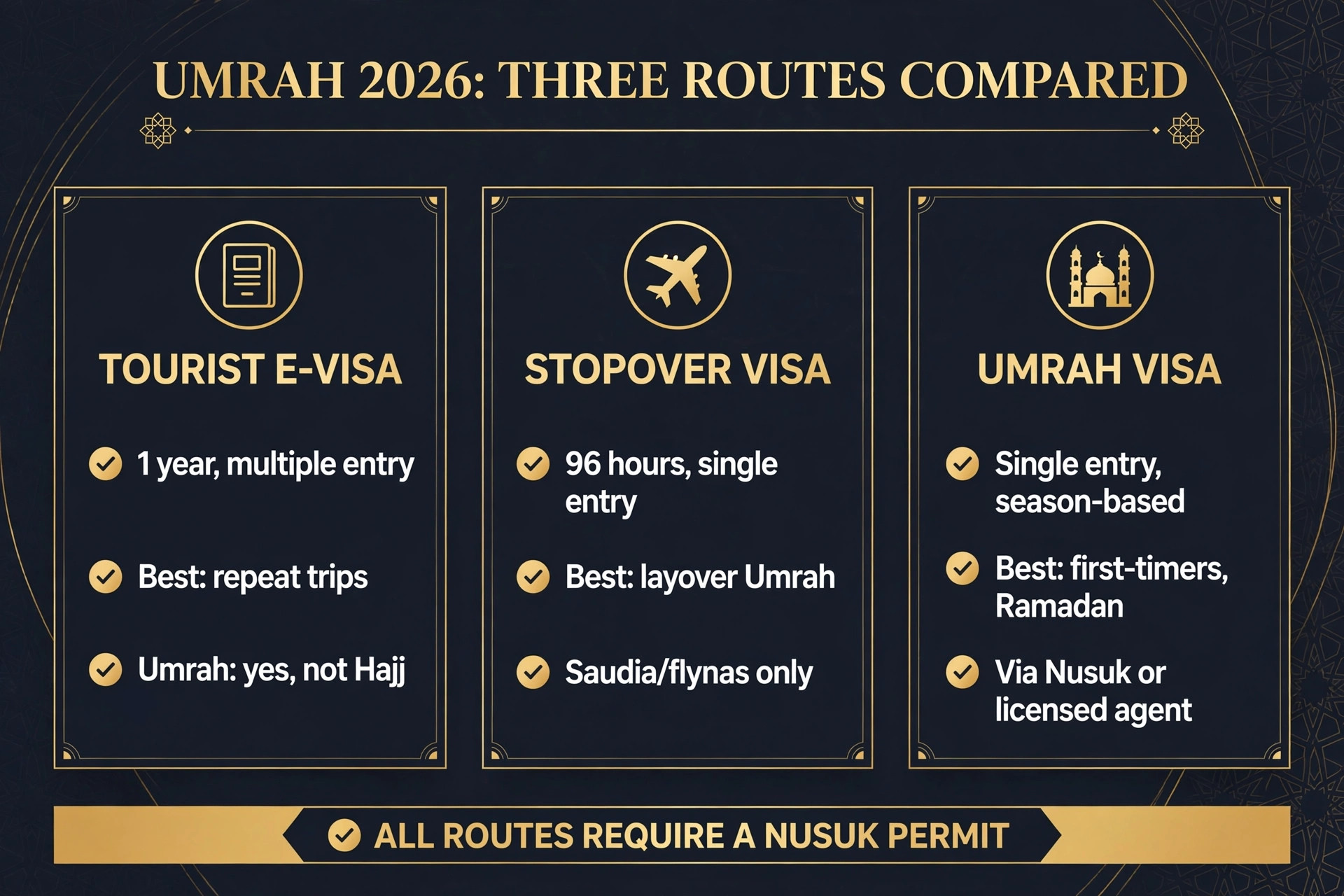
The three routes, side by side
| Tourist eVisa | Stopover (transit) visa | Umrah visa | |
|---|---|---|---|
| Issued by | MOFA portal (ksavisa.sa) | Saudia / flynas booking flow | Nusuk or licensed agent |
| Best for | Repeat trips, mixed travel | One Umrah inside a layover | First-timers, Ramadan, packages |
| Validity | ~1 year, multiple entry | 96 hours, single entry, use within 90 days | Single entry, season-based, up to 90 days |
| Umrah | Yes, outside Hajj season | Yes, explicitly — not Hajj | Yes — its purpose |
| Cost | Visa fee + mandatory insurance at checkout; fees change, check the official portal | Visa free; small processing + mandatory insurance | Government fee + insurance + services via Nusuk/agent |
| Nusuk permit | Required | Required, before travel | Required |
| Not allowed | Hajj | Hajj, extensions | Hajj-season travel |
The Nusuk permit step (everyone)
Whichever route you take, no one enters the Haram for Umrah without a Nusuk permit. The Ministry’s electronic services require it of all Muslim visitors regardless of visa type — including GCC citizens who entered without any visa at all.
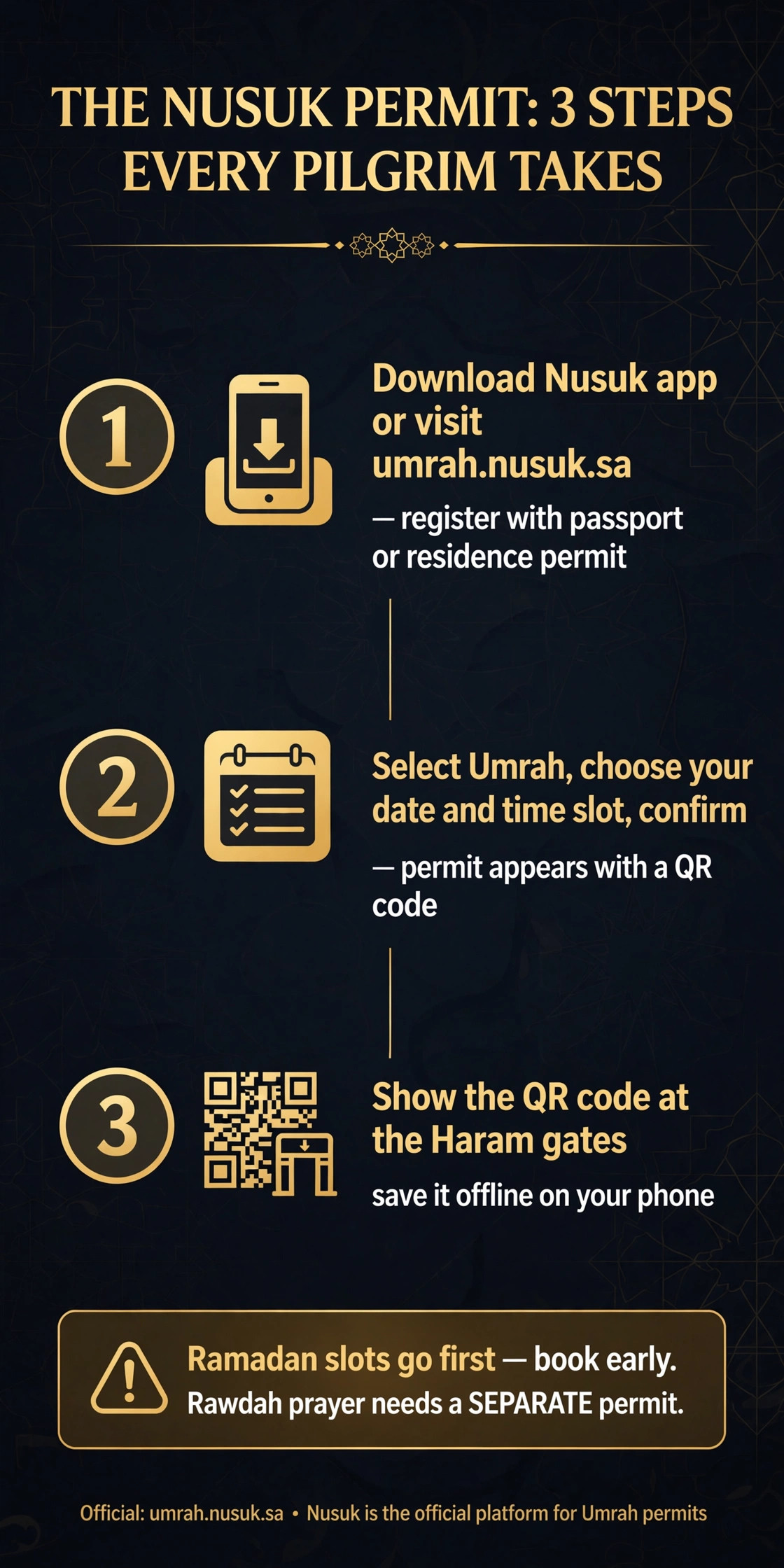
- Download the Nusuk app (iOS/Android) or use umrah.nusuk.sa and register with your passport or residence-permit details. The identity details in Nusuk must match the document you travel on.
- Select “Umrah”, choose your date and time slot, and confirm. The permit appears with a QR code.
- Show the QR code at the Haram gates. A Rawdah visit in Madinah needs a separate Nusuk permit — book it too if Madinah is in your plan.
Practical notes: Ramadan slots go first — book early. Each traveller needs their own permit, and minors under 18 travel linked to a parent or guardian’s application. Save your QR code offline on your phone; airport Wi-Fi and roaming are the two most common points of failure at the Haram gates.
Season dates and Hajj-period suspension
Umrah has a published season calendar, and Saudi Arabia pauses it around every Hajj. Never book flights or hotels that overlap the suspension.
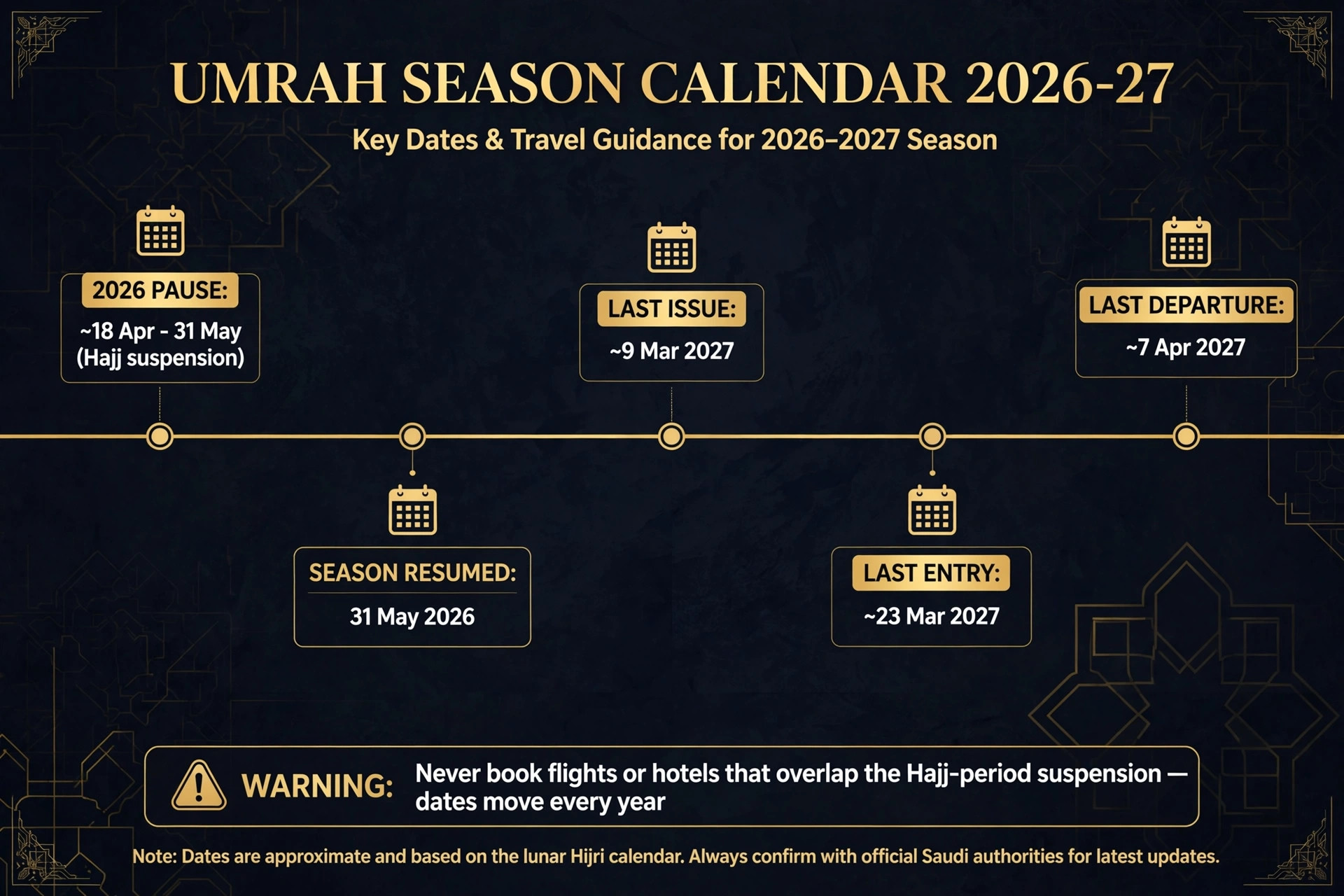
- Before Hajj: for the 2025–26 season, the first of Shawwal was the last date for issuing Umrah visas, the 15th of Shawwal the last entry date, and the first of Dhul Qi’dah the last departure date (Gulf News, 27 June 2025). In 2026, travel guides report Umrah permits were paused from around 18 April to 31 May (Khaleej Times, reported 2026) — expect a similar multi-week pause before Hajj 2027.
- After Hajj: travel guides report Umrah visas resumed on 31 May 2026, with the season’s last issue date around 9 March 2027, entry by 23 March 2027 and departure by 7 April 2027 (Wego, updated September 2026).
- Bottom line: these dates move every year and the travel-guide dates are reported, not ministerial text. Confirm the live calendar on umrah.nusuk.sa before booking anything non-refundable. Browse the full set of Gulf visa tools if you are planning wider regional travel.
Vaccinations and documents
Health: Saudi health authorities typically require proof of meningococcal (ACWY) vaccination for Umrah pilgrims; seasonal flu vaccination is widely recommended and sometimes checked. The list is updated before each season — check the Saudi Ministry of Health guidance and the UAE Ministry of Foreign Affairs travel page for Saudi Arabia before you travel.
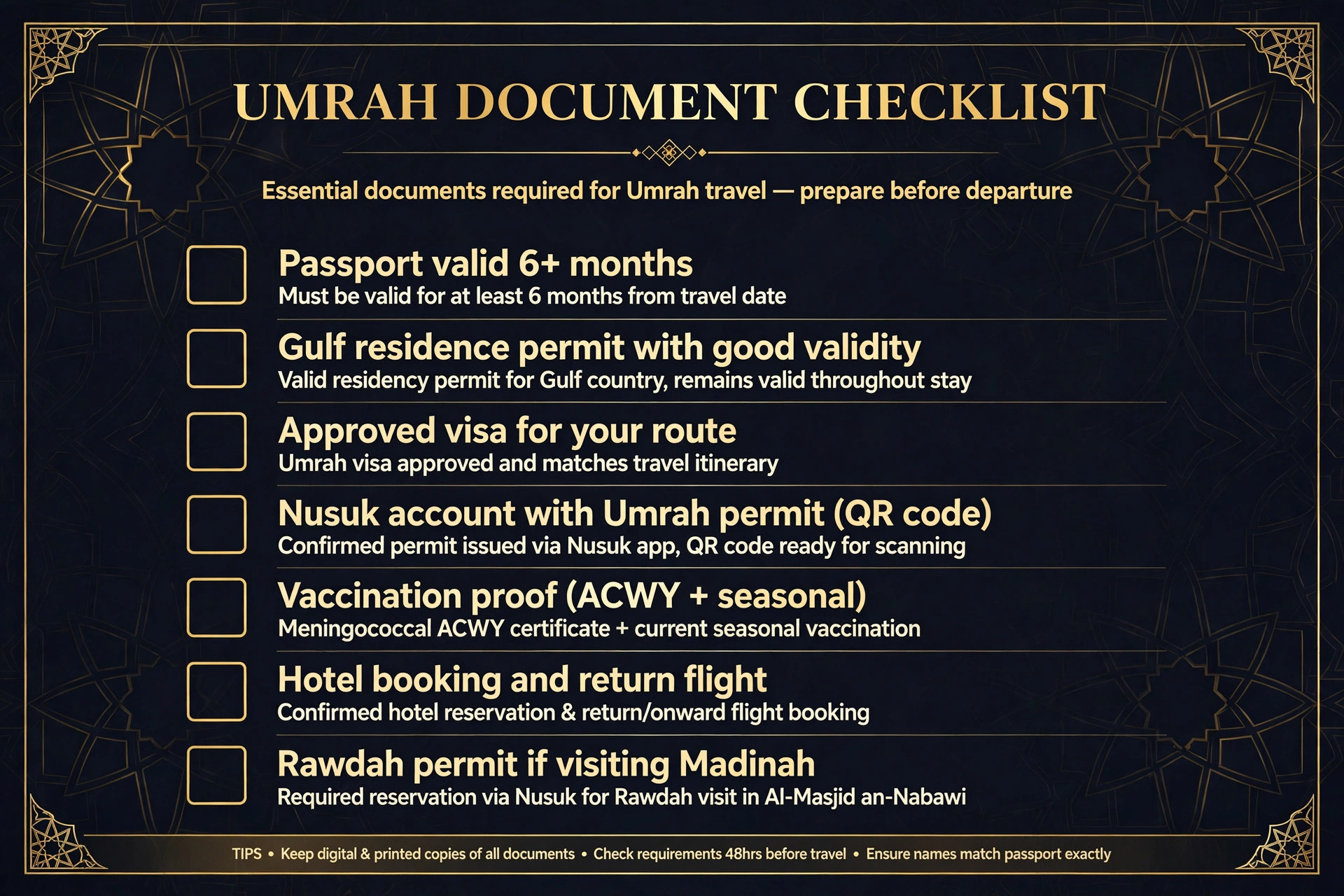
Document checklist (all routes):
- Passport valid at least six months beyond your entry date
- Your Gulf residence permit, valid with good remaining validity
- The visa for your chosen route, approved before travel
- Nusuk account with your Umrah permit (and Rawdah permit, if visiting Madinah)
- Vaccination proof (ACWY and any seasonal requirements)
- Hotel booking and return flight
- Women aged 18 and above may apply and travel independently, without a mahram; minors under 18 travel with a parent or guardian (reported rules, 2026 — confirm current guidance on Nusuk)
FAQ — Umrah visa for GCC residents 2026
Do GCC residents need a visa for Umrah in 2026?
Yes, if you are an expat resident rather than a GCC citizen. Citizens of the six Gulf states enter Saudi Arabia visa-free for Umrah, but residents need one of three visas: a tourist eVisa, a Saudia/flynas stopover visa, or a dedicated Umrah visa. Every pilgrim — citizen or resident — also needs a Nusuk Umrah permit.
Can I perform Umrah on a Saudi tourist visa?
Yes, outside the Hajj season. The tourist eVisa explicitly permits Umrah, though not Hajj. It is a one-year multiple-entry visa, which suits expats planning repeated trips. You still need a Nusuk Umrah permit for each visit, and you must avoid the Hajj-period suspension each year.
Is the Saudia/flynas stopover visa really free?
The visa itself is issued free of charge during the airline booking flow. Travellers pay a small processing fee plus mandatory medical insurance at booking. It allows a single entry of up to 96 hours, must be used within 90 days of issue, and cannot be extended. It permits Umrah but not Hajj.
Do I still need a Nusuk permit as a visa-free GCC citizen?
Yes. Visa-free entry and permission to perform Umrah are different things. The Ministry of Hajj and Umrah requires every Muslim visitor — Saudi citizens, GCC citizens and visa holders alike — to hold a Nusuk permit for Umrah and a separate permit for Rawdah prayer in Madinah.
When does Umrah pause for Hajj each year?
Saudi Arabia suspends Umrah visas and permits for several weeks before each Hajj. In 2026 the pause ran roughly from mid-April to the end of May. For the 2026–27 season, travel guides report the last Umrah visa issue date around 9 March 2027. Always confirm the live season calendar on umrah.nusuk.sa before booking.
What vaccinations do I need for Umrah from the Gulf?
Saudi health authorities typically require meningococcal (ACWY) vaccination proof for Umrah pilgrims, and seasonal flu vaccination is recommended. Requirements can change before each season, so check the Saudi Ministry of Health guidance and the UAE MOFA travel updates page for Saudi Arabia before you travel.
Can a woman travel for Umrah without a mahram in 2026?
Yes. Women aged 18 and above can apply for the Umrah visa and travel independently, without a male guardian, under Saudi Arabia's current framework. Minors under 18 must travel with a parent or legal guardian, with the child's details linked to the adult's application.
Disclaimer: Visaora is software and does not provide legal advice. Requirements depend on your nationality and situation. Confirm with the official authority (haj.gov.sa) or a licensed adviser.
Sources
- Gulf News, “Saudi Arabia: GCC citizens and residents can now perform Umrah anytime,” 27 June 2025 — Ministry of Hajj and Umrah announcement; three visa routes for GCC residents; Nusuk permit required for all: gulfnews.com
- Nusuk Umrah platform (official): umrah.nusuk.sa
- Ministry of Hajj and Umrah — Umrah (official): haj.gov.sa/en/umrah
- UAE Ministry of Foreign Affairs — travel updates for Saudi Arabia: mofa.gov.ae
- The Economic Times, “Saudi Arabia launches free stopover visa,” 2025 — 96-hour stopover visa via Saudia/flynas; Nusuk booking required: economictimes.indiatimes.com
- Business Standard, “Saudi’s free 96-hour stopover visa lets Indians perform Umrah in transit,” 13 November 2025 — GCC residents eligible; single entry; Umrah permitted, not Hajj: business-standard.com
- Wego travel blog, “Umrah Visa 2026,” updated September 2026 — 1448 season dates, GCC resident rules (travel guide; confirm on official portals): blog.wego.com
Related reading: Saudi eVisa Cost Calculator · Saudi eVisa Rejection Predictor · Gulf Visa Tools
CTA: Planning the tourist-eVisa route? Estimate your total — visa fee, insurance and group size — with the free Saudi eVisa cost calculator before you apply. Agencies: turn this into a client-ready case file with Visaora Agency Leads.
Visaora is software, not legal advice. Always check the official website.
✈️ Planning Your Trip?
We may earn a commission — at no extra cost to you. Learn more