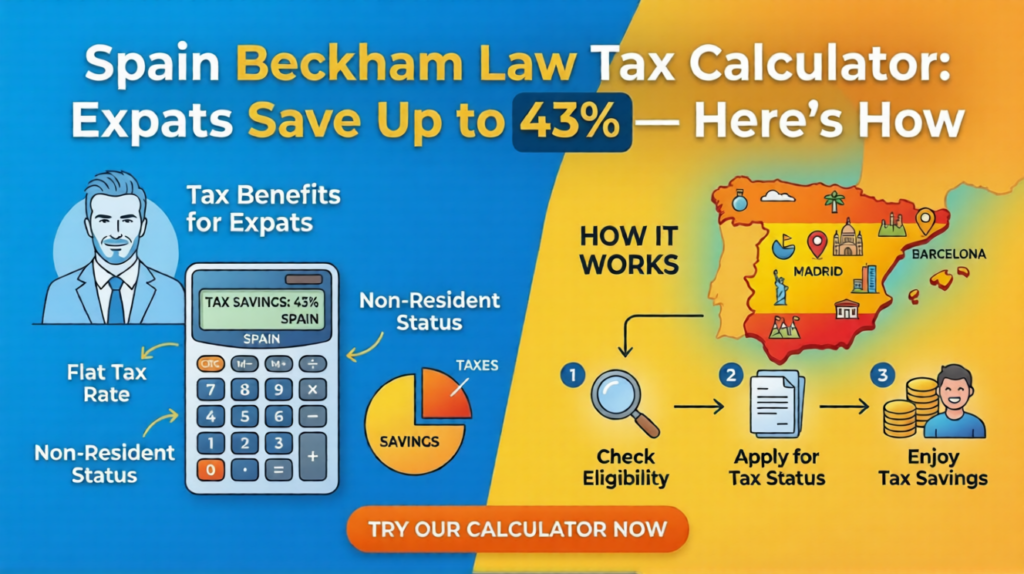
Spain Beckham Law Tax Calculator: Expats Save Up to 43% — Here’s How
If you’ve recently moved to Spain for work, there’s a legal tax regime that could cap your income tax at just 24% — regardless of how much you earn. This is the complete guide to Spain’s famous “Beckham Law,” who qualifies, and exactly how much you can save.
Maximum income tax rate under the Beckham Law — vs. up to 47% under the standard Spanish scale
What Is the Beckham Law, and Why Is It Called That?
The “Beckham Law” is a popular nickname for a Spanish tax regime officially known as the Special Tax Regime for Impatriates (Régimen Especial de Tributación para Trabajadores Desplazados a Territorio Español), introduced under Royal Decree 687/2005 and embedded in Article 93 of Spain’s Personal Income Tax Act.
Its nickname comes from England footballer David Beckham, who moved to Real Madrid in 2003. When the regime was formalized in 2004–2005, it became widely associated with his arrival — and the enormous tax benefit he and other high-earning foreign athletes and executives could claim. The name stuck, even though the law today applies to a far broader group of professionals, digital nomads, remote workers, and startup entrepreneurs.
The core idea is elegant: Spain wants to attract skilled international talent. To do so, it allows qualifying newcomers to be taxed as non-residents on their Spanish-source income for the first six tax years — even while physically living in Spain. This matters enormously, because non-residents pay a flat 24% rate on the first €600,000 of income, while residents face a progressive scale that reaches 47% (and even 54% in some regions like Catalonia).
2003 — Beckham Joins Real Madrid
David Beckham’s high-profile transfer catalyzes Spanish lawmakers to formalize an existing concept: a special tax status for foreign professionals relocating to Spain for work.
2005 — Law Is Enacted
Royal Decree 687/2005 formally establishes the Special Impatriate Regime. The press immediately dubs it the “Ley Beckham.” It applies mainly to executives, athletes, and high earners above a salary threshold.
2015 — Reform Restricts Access
A government reform raised the minimum annual salary requirement and excluded certain professional athletes, triggering criticism that the law had become too restrictive to compete with rival expat tax regimes across Europe.
2023 — Startup Law Expands It Again
Spain’s landmark Startup Act (Ley de Startups) broadens the Beckham Law to digital nomads, remote workers employed by foreign companies, and startup founders — opening the door to a new generation of mobile professionals.
How the Tax Saving Actually Works
Understanding the mechanics is the key to appreciating just how significant this regime can be. Here’s a direct comparison of what you’d pay under each system.
Under Spain’s standard progressive personal income tax (IRPF), a resident pays tax on their worldwide income. The marginal rate climbs steeply: 19% on the first €12,450; 24% up to €20,200; 30% up to €35,200; 37% up to €60,000; 45% up to €300,000; and 47% on income above that. Regional governments add their own slice on top, so in practice the combined rate can reach 54% in high-tax regions like Catalonia.
Under the Beckham Law, qualifying impatriates are taxed at a flat 24% on Spanish-source income up to €600,000, and just 47% on any amount above that threshold — with no progressive ratchet in between. Critically, foreign-source income (dividends, rentals, investments held abroad) is typically taxed separately and often more lightly, or not at all.
Standard Resident Tax
- 📈 Progressive scale: 19% → 47%
- 🌍 Worldwide income taxed
- 📍 Regional rates add up to 7%
- 📉 No ceiling on effective rate
- 💸 Wealth tax obligations apply
Beckham Law Regime
- 📊 Flat 24% on first €600,000
- 🇪🇸 Only Spanish-source income taxed
- 🏝️ Foreign income largely excluded
- 📅 Valid for 6 full tax years
- ✅ No Spanish wealth tax exposure
The practical impact is dramatic. A professional earning €150,000 per year pays roughly €60,000–€65,000 in income tax under the standard regime. Under the Beckham Law, that same person owes approximately €36,000 — a saving of more than €25,000 annually. Over six years, that accumulates to over €150,000 in total tax relief.
Eligibility Requirements: Do You Qualify?
The Beckham Law is not available to everyone who moves to Spain. There are clear conditions, and meeting all of them is essential. Below are the core requirements as updated following the 2023 Startup Act amendments.
No Prior Spanish Residency
You must not have been a tax resident in Spain in the 5 years immediately preceding your move. Occasional short visits do not count, but any prior tax residency disqualifies you.
Move Because of Work
Your relocation to Spain must be triggered by a work contract, employer transfer, or — post-2023 — a decision to work remotely or found a startup. A “lifestyle” move alone is not sufficient.
Work Primarily in Spain
At least 85% of your work activities (by income) must be carried out in Spanish territory, or — for remote workers — the nature of your work must be genuinely location-independent and performed from Spain.
Apply Within 6 Months
You must submit Form 149 to Spain’s tax authority (Agencia Tributaria) within 6 months of registering with Spanish Social Security. Missed deadlines forfeit the regime entirely — no exceptions.
No Spanish-Owned Shares >25%
If you work for a Spanish company and own more than 25% of its shares, you may be disqualified. This prevents the regime from being used as a personal tax vehicle by Spanish business owners who “relocate” themselves.
Prior Spanish Tax Residency
Any tax residency in Spain during the 5-year window before your arrival disqualifies you completely. Even a partial tax year as a Spanish resident counts. Returning expats must be particularly careful here.
Want to Know Exactly How Much You’d Save?
We’ve built a free Beckham Law Tax Simulator that calculates your personal tax saving in under 60 seconds. Enter your income, region, and foreign assets — and see your exact numbers side by side.
Beckham Law Tax & Opt-In Simulator
Enter your income, region, and foreign earnings. The simulator instantly shows your standard Spanish tax vs. Beckham Law tax — and your total saving over the full 6-year regime. Free to use, no sign-up required.
Annual Tax Burden by Income Level
Comparison of total tax paid at various income levels — standard IRPF vs. Beckham Law flat rate (Madrid-based taxpayer).
The gap widens dramatically as income rises. At €60,000 per year, the saving is modest — around €6,000. But at €200,000 per year, the difference swells to over €38,000 annually. For senior executives, founders, or high-earning professionals, the Beckham Law is among the most powerful legal tax instruments available in any European country.
Even after the six-year window expires, many expats have built sufficient roots, investments, and local tax-planning strategies to offset the eventual transition. For the right person, the Beckham Law is not just a temporary benefit — it’s the foundation of a long-term financial strategy in Spain.
How to Apply for the Beckham Law Regime
The application process is administrative rather than complex, but it demands precision. A single missed deadline or incomplete document can void your eligibility permanently.
Obtain Your NIE Number
Before anything else, you need a Número de Identidad de Extranjero (NIE) — Spain’s foreigner ID number. Apply at a Spanish consulate before you move, or at a National Police station shortly after arrival.
Week 1Register with Social Security
Your employer or you (if self-employed) must register with Spain’s Seguridad Social. The 6-month countdown for your Beckham Law application begins from your first Social Security registration date.
Week 1–2Submit Form 149 (Modelo 149)
File Modelo 149 with Spain’s tax authority within 6 months. Include your employment contract, passport copy, NIE certificate, and proof of prior non-residency. Missing this window means permanently losing access.
Within 6 monthsReceive Your Resolution
The Agencia Tributaria acknowledges your application within a few weeks. Once approved, you receive a formal resolution. Keep it safe — your employer needs it to apply the correct withholding rate to your payslips.
1–3 monthsFile Annual Returns (Modelo 151)
Instead of Modelo 100, Beckham Law participants file using Modelo 151 — a simplified non-resident form. The filing deadline is June 30 of the year following the tax year.
Annual — June 30Plan Your Transition Strategy
The regime lasts 6 tax years. In year 5, begin planning your post-Beckham strategy: stay as a standard resident, explore other EU countries, or restructure income sources. Early planning makes all the difference.
Year 5 onwardBeckham Law: Advantages and Limitations
Like any tax regime, the Beckham Law has genuine strengths and real limitations. Understanding both helps you make an informed decision — and avoid surprises after you’ve already moved.
✅ Advantages
- → Flat 24% rate on income up to €600,000 — dramatically lower than progressive resident rates
- → Foreign-source income (overseas dividends, rents, capital gains) largely excluded from Spanish taxation
- → No Spanish wealth tax exposure — significant for high-net-worth individuals with foreign assets
- → Simplified annual tax return using Modelo 151 rather than the complex Modelo 100
- → Six full tax years of benefit — substantial for planning purposes
- → No geographic restriction within Spain (though savings vary by region)
- → Extended in 2023 to digital nomads and startup founders, greatly widening access
❌ Limitations
- → Cannot deduct personal allowances, family deductions, or mortgage relief normally available to residents
- → Treaty benefits may be limited — some double-tax treaties offer less favorable non-resident treatment
- → Income above €600,000 is still taxed at 47%, the same as the top resident rate
- → Does not cover Social Security contributions — you still pay these at standard rates
- → The strict 6-month application window is unforgiving — no late application exception exists
- → Prior Spanish residency within the 5-year window disqualifies you completely
- → Regime ends at year 6 — requires proactive planning to avoid a sudden tax rate jump
Frequently Asked Questions
Ready to Make Your Move to Spain?
The Beckham Law could save you tens of thousands of euros annually — but only if you apply within 6 months of arriving. Don’t leave money on the table.
Calculate Your Personal Saving →